


How to Match SEO Content to the Real Buyer Journey: The Buyer Journey Search Framework (BJSF)
As part of our SEO Company in India hub, this Buyer Journey Search Framework helps B2B brands map content across Awareness, Evaluation and Decision stages, connect pages with strategic internal links, and measure real buyer movement beyond traffic and rankings.
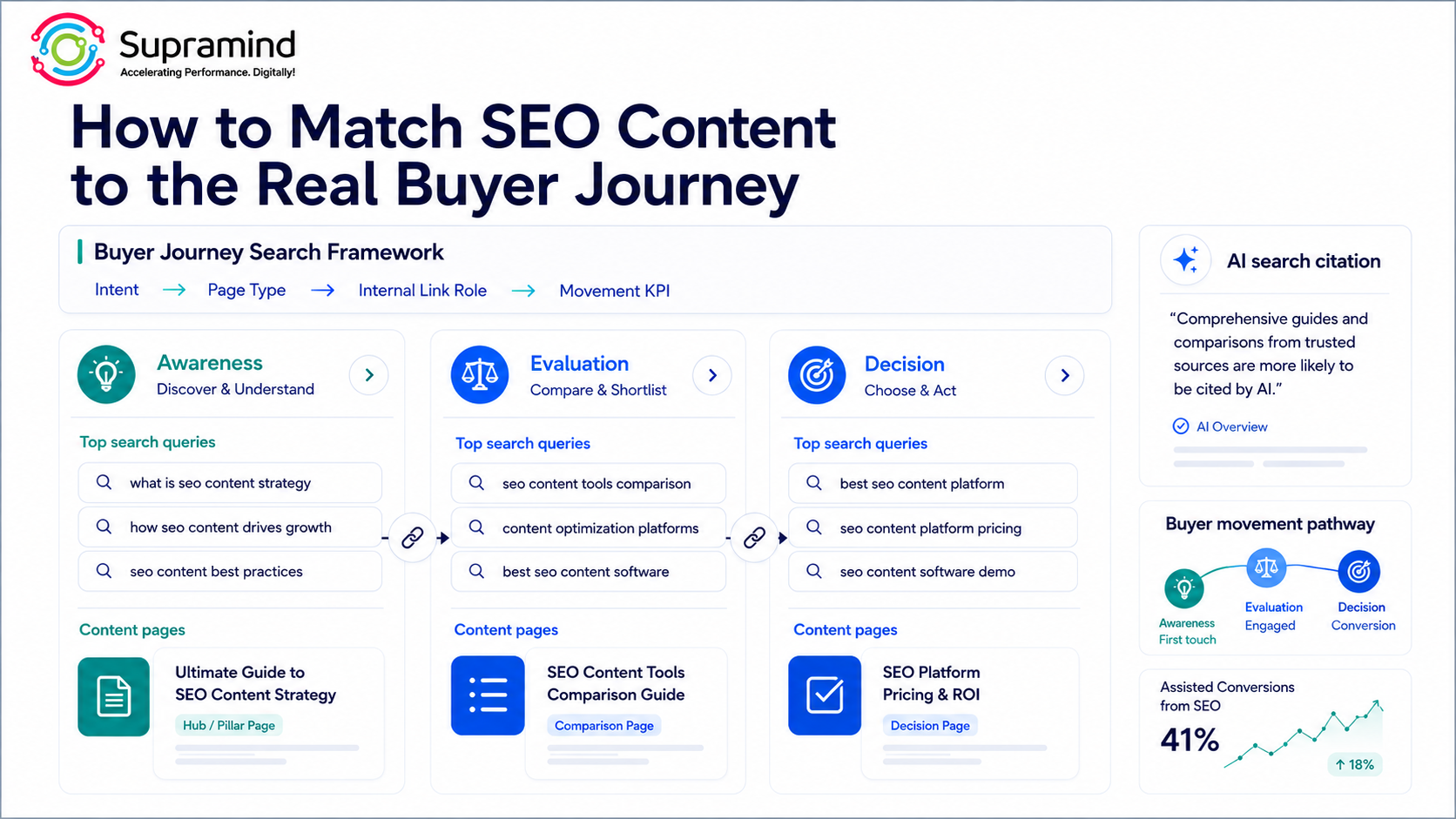
TL;DR: The Buyer Journey Search Framework in One Box
Use the Buyer Journey Search Framework (BJSF) to map every SEO page to one of three stages: Awareness, Evaluation, or Decision. For each page, define four things: search intent, page type, internal link role, and movement KPI. The goal is not more funnel content. The goal is measurable buyer movement from research to comparison to proof-backed action.
Map the searcher task before choosing the content format.
Use internal links to move buyers, not only to pass crawl equity.
Judge pages by stage-fit KPIs, not only rankings or sessions.
Build citation-worthy pages for AI search and proof-led buying committees.
Why Is TOFU/MOFU/BOFU Not Enough in 2026?
The old funnel assumes buyers move in a straight line. B2B buyers do not. A late-stage account can still search a basic definition because a new CFO, security lead, legal reviewer, procurement stakeholder, or implementation owner has entered the buying process.
The biggest mistake is assuming “informational = top funnel” and “commercial = bottom funnel.” In high-consideration SEO journeys, the same account can move forward, loop backward, compare options, validate proof, and re-read fundamentals before making a decision.
| Finding | Why it matters |
|---|---|
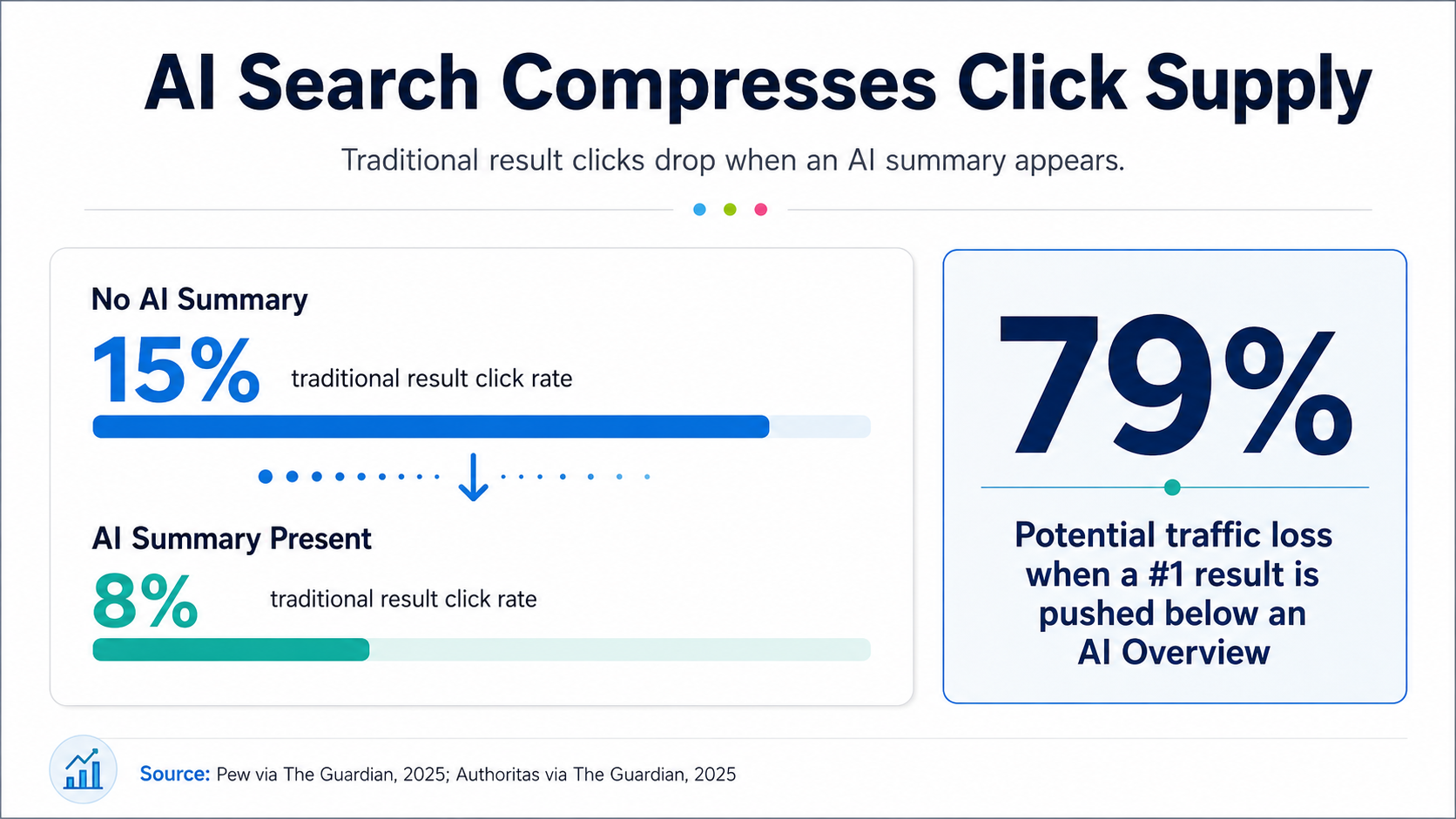
| Users clicked traditional Google results only 8% of the time when an AI summary appeared, versus 15% without one. | Awareness traffic is no longer guaranteed, even when you rank. |
| A page previously ranking first could lose about 79% of traffic when pushed below an AI Overview. | Ranking is not the same as visibility. |
| High-consideration query research achieved 96% precision in identifying complex research behavior. | Commercial buyers still search broadly and educationally. |
BJSF treats the buyer journey as a movement system, not a funnel. The framework asks: what is this page helping the buyer do next?
What Is the Buyer Journey Search Framework?
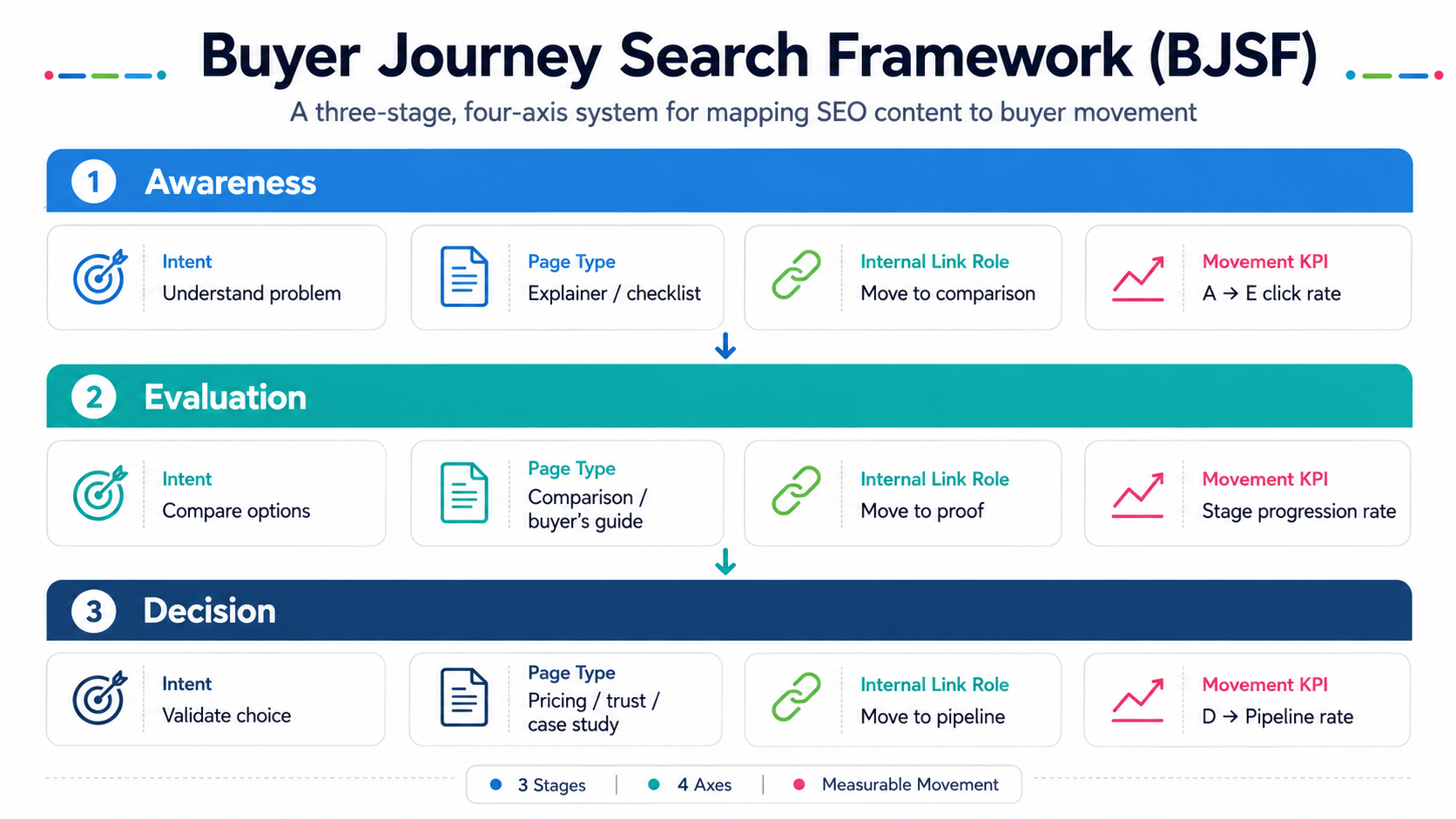
The Buyer Journey Search Framework (BJSF) is a three-stage, four-axis system for B2B SEO planning. It maps each page to Awareness, Evaluation, or Decision, then assigns the page an intent role, page type, internal link role, and movement KPI.
| BJSF axis | What it decides |
|---|---|
| Intent | What question, risk, comparison, or proof does the searcher need? |
| Page type | What format should satisfy the query? |
| Internal link role | Where should the page move the buyer next? |
| Movement KPI | How will you measure progression? |
BJSF is not TOFU/MOFU/BOFU with new names. It is more operational. TOFU/MOFU/BOFU helps categorize content. BJSF tells you what the page should do next.
The 3-Stage Intent Map
The easiest way to use BJSF is to classify the query by the job the buyer is trying to complete. The modifier helps, but the task matters more. A pricing query usually means validation. A comparison query usually means evaluation. A definition query usually means awareness, unless it is a buying committee re-entry signal.
| Stage | Query signals | Example queries | Best page type | What it should do |
|---|---|---|---|---|
| Awareness | “what is,” “why,” “how to,” “checklist,” “basics” | what is vendor risk management; why SOC 2 matters; cybersecurity due diligence basics | Explainer, glossary-guide, checklist, hub article | Answer and frame the problem |
| Evaluation | “best,” “vs,” “alternatives,” “comparison,” “template,” “ROI” | vendor risk management software comparison; SOC 2 vs ISO 27001; best GRC software for SaaS | Comparison page, alternatives page, buyer’s guide, template/tool | Compare and de-risk options |
| Decision | “pricing,” “demo,” “security,” “case study,” “implementation,” “compliance” | [brand] pricing; [brand] demo; [brand] security; [brand] case study | Pricing page, demo page, trust page, case study, ROI calculator | Validate and convert |
Decision content can be shorter, but it cannot be thin. A 700-word pricing page may still need links to SOC 2 details, implementation docs, ROI proof, procurement FAQs and case studies.
Buyer Journey Stage Finder
Use this tool after the intent map to classify search queries into Awareness, Evaluation or Decision, then assign the right page type and movement KPI.
The BJSF Decision Matrix
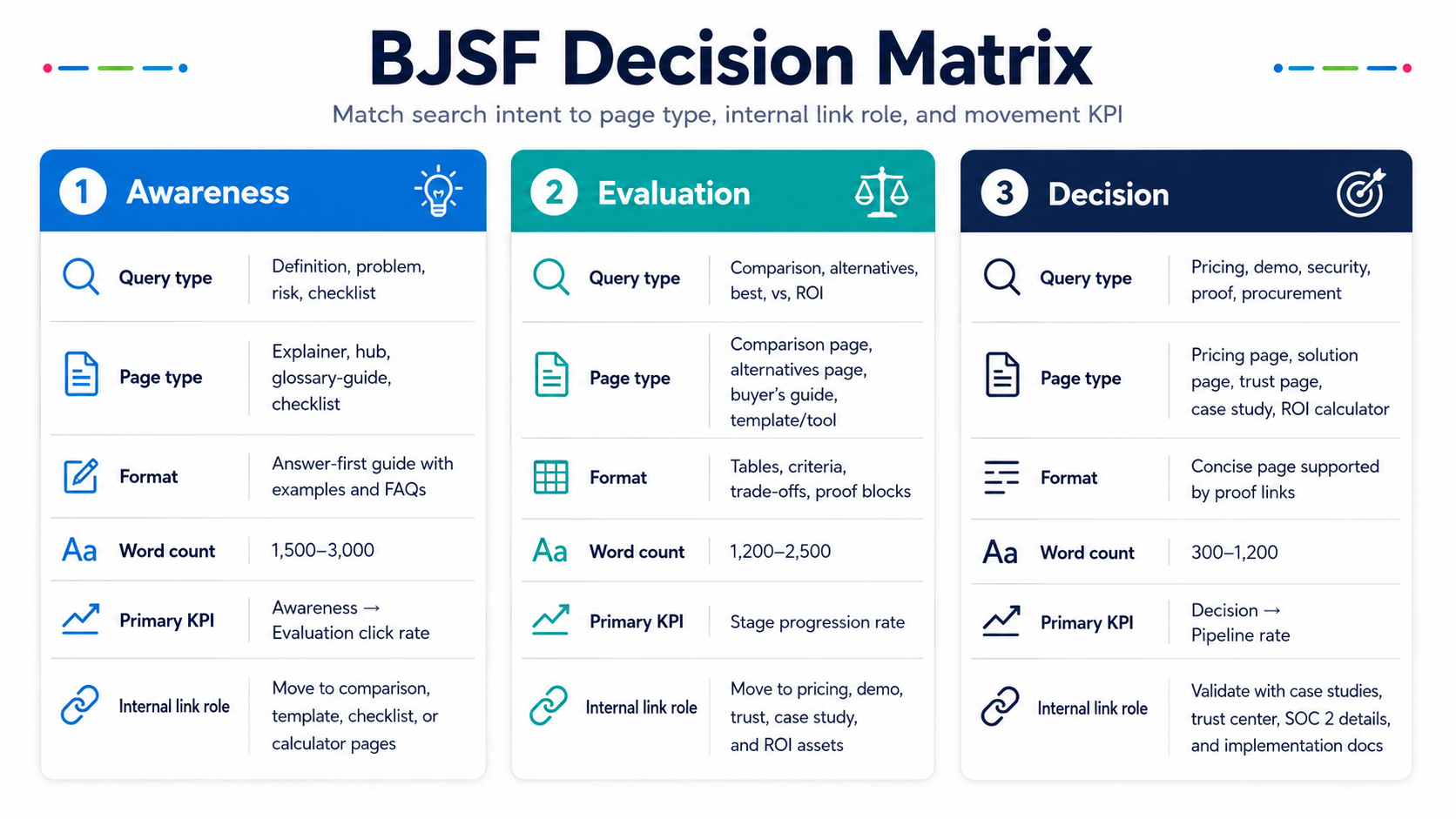
The matrix is the working model. Awareness pages should not be judged only by conversions. Evaluation pages should not be treated like blog posts. Decision pages should not rely only on a demo CTA.
| Stage | Query type | Page type | Format | Word count range | Primary KPI | Internal link role |
|---|---|---|---|---|---|---|
| Awareness | Definition, problem, risk, checklist | Explainer, hub, glossary-guide, checklist | Answer-first guide with examples and FAQs | 1,500-3,000 | Awareness to Evaluation click rate | Move readers to comparison, template, checklist, or calculator pages |
| Evaluation | Comparison, alternatives, best, vs, ROI | Comparison page, alternatives page, buyer’s guide, template/tool | Tables, criteria, trade-offs, proof blocks | 1,200-2,500 | Stage progression rate | Move buyers to pricing, demo, trust, case study, and ROI assets |
| Decision | Pricing, demo, security, proof, procurement | Pricing page, solution page, trust page, case study, ROI calculator | Concise page supported by proof links | 300-1,200 | Decision to Pipeline rate | Validate with case studies, trust center, SOC 2 details, implementation docs |
Internal Linking Architecture That Moves Buyers
Most internal linking advice focuses on crawl equity. BJSF focuses on buyer movement. The anchor should tell the reader why the next page is useful in their decision process, not just insert a keyword into nearby text.
Awareness links
Help the reader progress with anchors such as “compare options,” “use the checklist,” “see the buyer’s guide,” or “calculate ROI.”
Evaluation links
Reduce risk with anchors such as “review security overview,” “see implementation timeline,” “read customer story,” or “compare pricing.”
Decision links
Support the buying committee with trust pages, policy pages, technical documentation, case studies, integration pages and procurement support.
BJSF Internal Linking Journey Map
Use this tool to trace internal links from awareness assets to comparison pages, proof pages, pricing pages, demo pages and trust assets.
Measurement: Rankings Are Not Enough
Rankings are a visibility metric. They do not prove buyer movement. In AI search, a page can lose clicks even when it still contributes to answer visibility, brand familiarity, or buying committee validation. The measurement question changes from “did we rank?” to “did the buyer move?”
| Metric | What it measures |
|---|---|
| Stage entry share | Where organic users enter the journey |
| Next-page click rate | Whether a page sends users to the next stage |
| Stage progression rate | Movement from Awareness to Evaluation or Evaluation to Decision |
| Assisted conversion share | Content influence beyond last click |
| Deep-scroll completion | Whether the page was consumed |
| Qualified CTA CTR | Whether users click the right stage-fit CTA |
| Return-to-research rate | Whether late-stage buyers loop backward |
| Session quality score | Composite quality using engagement, movement, key events and account match |
Journey Velocity Formula
Journey Velocity Calculator
Use this calculator to separate organic traffic growth from real buyer progression. If traffic rises but Journey Velocity falls, your content is attracting readers without advancing buyers.
BJSF Content Journey Diagnostic
The diagnostic step turns symptoms into actions. Instead of asking whether a page is “good,” ask which movement problem it creates: weak progression, weak proof, weak internal routing, poor AI visibility, or low-quality conversion intent.
BJSF Content Journey Diagnostic
Use this tool in place of a static checklist to identify journey leaks and prioritize fixes by stage.
Worked Example: Vendor Risk / GRC
For the query “what is vendor risk management,” use an awareness guide. It should define the category, explain risk types, show why it matters, and link to a vendor risk checklist, software comparison page and security questionnaire template. KPI: Awareness to Evaluation click rate.
For “vendor risk management software comparison,” use an evaluation page. Include comparison tables, buying criteria, use cases, implementation considerations and proof blocks. Link to pricing, demo, case study, security overview and ROI calculator. KPI: Stage progression rate.
For “[brand] security” or “[brand] pricing,” use a decision page. Keep the page focused, but support it with links to SOC 2 details, trust center, implementation docs, customer stories and integration pages. KPI: Decision to Pipeline rate.
BJSF does not treat backward movement as failure. In B2B, a buyer returning from pricing to methodology may mean the committee is still validating the decision.
Research Gaps Worth Owning
Public sources still do not answer several useful questions. These gaps are opportunities for B2B brands, SEO teams and agencies to publish original data that AI search systems and human buyers can cite.
| Research gap | Why it is an opportunity |
|---|---|
| How often do B2B buyers loop backward by stage? | Quantified account-level journey data is scarce. |
| What are stage-specific organic conversion benchmarks? | Most public benchmarks mix channels and intent types. |
| Which internal links increase assisted pipeline? | Internal linking studies focus on rankings, not revenue movement. |
| Which page types win AI citations? | Current AI visibility studies rarely segment by B2B page type. |
| Which elements drive citation: tables, schema, stats, or frameworks? | AI citation optimization still lacks strong public evidence. |
If you can publish data on these, you can own the category.
BJSF Content Journey Scorecard
Use the scorecard to check whether a content library is built for movement. A page can rank, earn traffic and still fail the journey if it does not move the reader to the next decision step.
BJSF Content Journey Scorecard
Score each priority page against intent clarity, page type fit, internal link movement, proof strength and measurement readiness.
Final Summary
The Buyer Journey Search Framework gives SEO teams a practical way to stop treating content as isolated URLs. It connects search intent, page type, internal links and measurement into one movement system.
For an SEO Company in India, the framework is useful because it shows clients why more traffic is not always the answer. The stronger goal is building a journey where awareness pages create evaluation movement, evaluation pages reduce risk, and decision pages help qualified buyers act with confidence.
FAQ
What is the Buyer Journey Search Framework?
The Buyer Journey Search Framework is a B2B SEO system that maps each page to Awareness, Evaluation or Decision. It assigns every page an intent role, page type, internal link role and movement KPI.
How is BJSF different from TOFU/MOFU/BOFU?
TOFU/MOFU/BOFU categorizes content. BJSF operationalizes it. It connects search intent, page format, internal links and measurement so teams can track buyer movement instead of only content coverage.
How do I map search intent to buyer journey stage?
Map by task, not just keyword modifier. Awareness searches define problems. Evaluation searches compare options. Decision searches validate pricing, proof, security, procurement and implementation details.
What is Journey Velocity in SEO?
Journey Velocity measures how quickly organic in-market accounts move from Awareness to Evaluation, Evaluation to Decision, and Decision to Pipeline. It separates traffic growth from real buyer progression.
Do internal links move buyers through the journey?
Yes, when they are built as journey paths. Awareness pages should link to comparison and template assets. Evaluation pages should link to pricing, trust, proof and demo assets. Decision pages should link to validation content.
How does AI search change buyer journey SEO?
AI search reduces click supply and separates ranking from citation. Content now needs answer-first summaries, tables, sourced statistics, clear frameworks and structured proof to be both clickable and citable.
Sources
- Buyer Journey Search Framework Research Report, 2026 - Attached research report.
- Pew via The Guardian, 2025 - AI summaries causing “devastating” drop in online news audiences, study finds.
- Authoritas via The Guardian, 2025 - AI summaries causing “devastating” drop in online news audiences, study finds.
- High-Consideration Queries Study, 2024 - High-consideration query research.
- B2B Account Scoring Study, 2022 - B2B advertising and account scoring research.
- Google AI Overviews Audit, 2026 - AI Overview activation and citation study.
- AI Search Source Overlap Study, 2026 - Google Search, AI Overview and Gemini source-overlap study.
- Log in to post comments


 INDIA
INDIA