


A Simple System for Refreshing Old Content That Has Lost Traffic
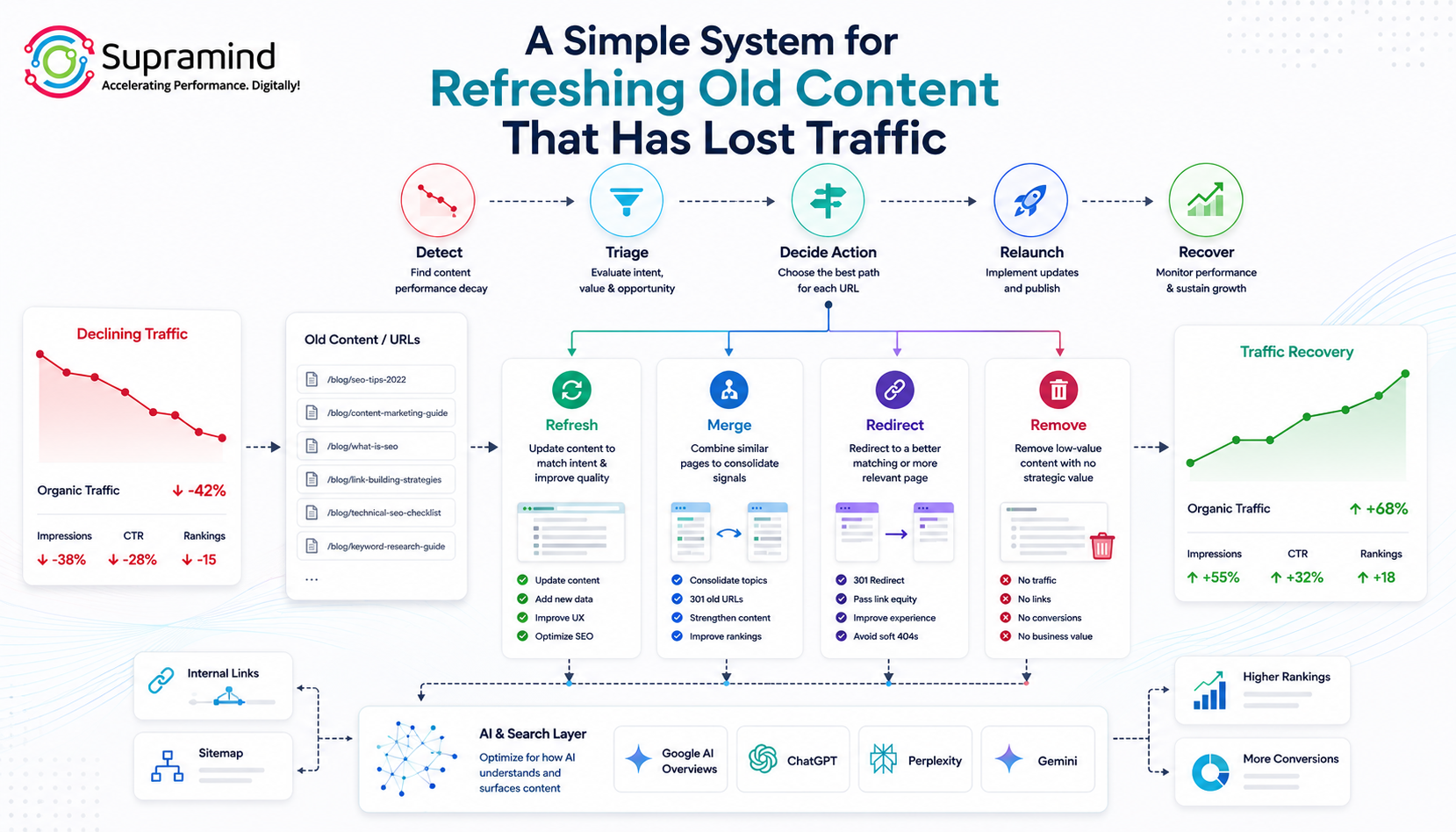
As part of our SEO Agency in India hub, this framework explains how to refresh old content that has lost traffic by finding decaying URLs, choosing whether to refresh, merge, redirect or remove them, and relaunching priority pages for SEO recovery.
TL;DR: Content Decay in One Box
Content decay is the gradual loss of organic traffic, rankings, impressions, CTR or conversions from an existing page because the page no longer matches current search intent, SERP expectations, freshness needs or trust signals.
HubSpot reported that even if it stopped publishing new posts for one month, it would still retain 76% of blog traffic and 92% of leads, showing that old content carries major SEO value when maintained properly.
The Content Renewal Framework gives every declining URL one of four outcomes:
Refresh
The page still has demand, rankings, links or business value, but the content is outdated.
Merge
Two or more pages target the same intent and are cannibalising each other.
Redirect
The page is no longer useful, but has links or a close replacement page.
Remove
The page has no demand, links, traffic, conversions or strategic value.
Why Old Content Loses Traffic
Most websites do not lose organic traffic overnight. They lose it URL by URL.
What decay looks like
- One blog drops from 1,000 clicks to 650.
- A guide that ranked in position 3 slips to position 9.
- A comparison page stops appearing in AI Overviews.
- A resource page still exists, but screenshots, statistics, pricing, examples and internal links are outdated.
Why it happens
- Search intent changes and competitors update their pages.
- Google starts rewarding fresher or more complete results.
- Backlinks and internal links weaken over time.
- SERP features shift and AI systems prefer clearer, more structured answers.
- Multiple URLs on the same site compete for the same query.
At Supramind Digital, old content is not treated as a forgotten publishing archive. It is treated as an SEO asset that needs renewal, consolidation or retirement.
The Content Renewal Framework
The Content Renewal Framework is a diagnostic and decision system for finding old content that has lost traffic and deciding whether to refresh, merge, redirect or remove it.
It is built for SMB and mid-market websites where content libraries often grow for years without structured maintenance. The goal is not to update the date. The goal is to recover useful rankings, improve trust, strengthen internal links and make the page more extractable for Google, ChatGPT, Perplexity, Gemini and Google AI Overviews.
1. Detect
Use GSC, GA4, rank trackers, backlink tools and crawl data to find URLs with measurable decline.
2. Triage
Score each page by traffic loss, ranking loss, SERP feature loss, conversion decline, backlink loss, CTR decline and age.
3. Act
Assign the URL to one outcome: refresh, merge, rewrite, redirect or remove.
1. The Decay Detection Layer
Start with data. Do not refresh content because it feels old. Use Google Search Console, GA4, Ahrefs, Semrush, Screaming Frog, Sitebulb or your rank tracker to identify URLs showing measurable decline.
Content Decay Scoring Matrix
| Signal | Threshold | Tool | Weight |
|---|---|---|---|
| Organic traffic drop | More than 30% YoY | GSC, GA4 | High |
| Average position drop | More than 5 positions | GSC | High |
| CTR decline | More than 20% vs category average | GSC | Medium |
| Backlink loss | More than 10% referring domains lost | Ahrefs, Semrush | Medium |
| Content age | More than 18 months untouched | CMS, Screaming Frog | Low |
| SERP feature loss | Lost featured snippet, PAA, local pack or AI visibility | SERP tracker | High |
| Internal link loss | Fewer internal links than before | Screaming Frog, Sitebulb | Medium |
| Conversion decline | Leads, enquiries or assisted conversions down | GA4, CRM | High |
| Query mismatch | Page now ranks for irrelevant or weaker-intent queries | GSC | Medium |
Supramind Content Decay Score Formula
Content Decay Score Formula
Score each factor from 0 to 1, then use this weighted formula to prioritise the pages that deserve attention first. Total weight equals 100 points.
| Factor | Score |
|---|---|
| Traffic drop: 45% | 1 |
| Ranking drop: 6 positions | 1 |
| SERP feature lost | 1 |
| Conversion decline: minor | 0.5 |
| Backlink loss: low | 0 |
| CTR decline: 25% | 1 |
| Content age: 24 months | 1 |
Decay Score: (1 x 25) + (1 x 20) + (1 x 15) + (0.5 x 15) + (0 x 10) + (1 x 10) + (1 x 5) = 82.5 / 100.
2. The Triage Decision Tree
After scoring, every URL should pass through a decision tree. Do not rewrite first. Decide first.
Is the topic still searched?
Check GSC, keyword tools, SERP demand and business relevance.
Does the URL have links or a close replacement?
If yes, redirect. If no, remove or 410.
Is there a stronger competing URL on your site?
Check cannibalisation, links, query overlap and internal link signals.
Redirect or remove
Protect useful authority, but do not keep URLs with no demand, traffic, links or strategic value.
Merge + 301
Combine similar pages into the strongest URL when multiple pages serve the same intent.
Is intent still aligned?
Compare the current SERP, AI answers, page type, format and buyer problem.
Refresh or rewrite
Refresh if the intent is still right. Rewrite if the topic still matters but the old angle is wrong.
3. Action Playbook 1: Refresh
When to Use Refresh
Use a refresh when the page still has search demand, existing rankings, organic impressions, backlinks or internal links, business relevance, correct search intent and outdated content, data, examples or UX.
Refresh Execution Checklist
- Compare the page against the current top 5 SERP competitors.
- Update outdated statistics, examples, screenshots, prices and tool references.
- Rewrite the introduction to answer the query faster.
- Add missing sections based on SERP and People Also Ask gaps.
- Improve internal links to relevant Supramind hubs.
- Add expert commentary, author review or first-hand experience.
- Update FAQ, schema, image alt text and dateModified.
- Relaunch with internal links and GSC re-indexing.
Light: 2-4 hours
Medium: 4-8 hours
Heavy: 8-14 hours
HubSpot reported up to a 106% increase in organic views after historical optimisation.
Goinflow reported an 87% increase in organic clicks and 57% increase in impressions for one refreshed EarthKind article over a two-month pre/post comparison. Another refreshed article saw a 268% increase in clicks and 176% increase in impressions.
Common Mistakes
- Updating the publish date without improving the content.
- Adding word count instead of improving intent match.
- Ignoring internal links.
- Keeping old screenshots, old data and outdated examples.
- Refreshing multiple cannibalising URLs instead of merging them.
4. Action Playbook 2: Merge
When to Use Merge
Use a merge when two or more URLs target the same intent and compete with each other. Typical signs include overlapping query sets, weak positions across both URLs, split internal links and users not needing both pages separately.
Merge Execution Checklist
- Pick the strongest destination URL based on links, traffic, rankings and relevance.
- Extract the best sections from weaker URLs.
- Build one stronger, more complete page.
- Remove duplicated or thin sections.
- 301 redirect weaker URLs to the main page.
- Update all internal links to point to the final URL.
- Update sitemap and canonical tags.
- Track rankings for merged queries for 30, 60 and 90 days.
Two similar blogs: 4-6 hours
Three to five overlapping blogs: 8-14 hours
Large cluster consolidation: 15-30+ hours
Reduced cannibalisation and stronger authority concentration.
Merging does not have one universal benchmark because results depend on authority consolidation and intent fit. The main benefit is not just traffic recovery. It is reducing cannibalisation and making one URL clearly stronger.
Common Mistakes
- Merging pages with different intent.
- Redirecting to a loosely related page.
- Forgetting to update internal links.
- Removing useful sections that helped long-tail rankings.
- Using a 302 instead of a 301 for permanent consolidation.
5. Action Playbook 3: Rewrite
When to Use Rewrite
Use a rewrite when the topic still has demand, but the old angle no longer matches the SERP. This is common when the SERP changes from definitions to comparisons, blog posts to templates or tools, or informational intent to commercial intent.
Rewrite Execution Checklist
- Re-map the primary and secondary intent.
- Analyse the top-ranking competitors.
- Identify what Google and AI systems are extracting.
- Rebuild the outline from scratch.
- Preserve useful sections and remove outdated logic.
- Add original frameworks, examples, tables and decision tools.
- Rework the CTA and internal links.
- Update technical freshness signals only after the rewrite is live.
Blog rewrite: 6-10 hours
Guide rewrite: 10-20 hours
Commercial resource rewrite: 15-30 hours
Powered by Search documented a 9x organic traffic increase for a refreshed ClickFunnels article.
SeriesX Marketing reported close to a 200% organic traffic increase across refreshed ReportGarden articles, plus a 13% average position improvement and 50% impression increase.
Sources: Powered by Search and SeriesX Marketing
Common Mistakes
- Keeping the old structure when the SERP has changed.
- Writing for the old keyword instead of current intent.
- Removing historical authority by changing the URL unnecessarily.
- Not adding a stronger commercial path.
- Forgetting AI-search extractability: definitions, tables, FAQs and structured answers.
6. Action Playbook 4: Redirect or Remove
When to Redirect
- The topic no longer deserves a standalone URL.
- The page has backlinks.
- There is a closely relevant replacement page.
- The content is outdated but the authority is still valuable.
- The page duplicates a better URL.
When to Remove
- There is no search demand.
- There are no backlinks.
- The page has no traffic or conversions.
- There is no relevant replacement.
- The page is thin, outdated or misleading.
Redirect / Remove Checklist
- Check organic traffic, impressions and assisted conversions.
- Check backlinks and referring domains.
- Check whether the topic still has search demand.
- Find the closest relevant replacement page.
- Use 301 redirect if a clear replacement exists.
- Use 410 or remove if the page has no value and no replacement.
- Update internal links.
- Remove deleted URLs from XML sitemap.
Single redirect: 15-30 minutes
Small cleanup batch: 2-4 hours
Large archive pruning: 10-30+ hours
Cleaner crawl paths, stronger internal link concentration and reduced index bloat.
Common Mistakes
- Redirecting every deleted blog to the homepage.
- Removing URLs that still rank for long-tail queries.
- Deleting pages with useful backlinks.
- Removing pages that should have been refreshed.
- Forgetting to update internal links and sitemap entries.
7. Relaunch Protocol
A content refresh is not complete when the content is edited. The relaunch matters because search systems, internal links and users need consistent signals after the update.
Post-Update Checklist
| Step | Action |
|---|---|
| 1 | Update visible Last updated date only if the page was materially changed. |
| 2 | Update dateModified in Article schema. |
| 3 | Update sitemap lastmod only for significant updates. |
| 4 | Request re-indexing in Google Search Console. |
| 5 | Add internal links from 3-5 relevant high-authority pages. |
| 6 | Update links from related blogs and hub pages. |
| 7 | Refresh screenshots, image filenames and alt text where required. |
| 8 | Re-share through LinkedIn, newsletter or sales enablement if useful. |
| 9 | Track rankings, clicks, CTR and conversions after 30, 60 and 90 days. |
Google Freshness Signals to Handle Correctly
Google says it has query deserves freshness systems for queries where users expect recent information. Google also says it does not rely on one date signal and looks at multiple factors to estimate when a page was published or significantly updated.
| Signal | Correct Use |
|---|---|
| Visible date | Show published or last updated date clearly. |
| dateModified | Update only after meaningful content changes. |
| Sitemap lastmod | Use only for significant page updates. |
| Article schema | Keep dates consistent with visible dates. |
| Canonical | Keep the main refreshed URL canonicalised. |
| Redirects | Use 301 for merged or replaced content. |
| FAQ schema | Mark up only FAQs visible on the page. |
| Breadcrumb schema | Keep visible breadcrumbs and schema aligned. |
Sources: Google Search Central ranking systems guide, Google Search Central publication dates guide and Google Search Central sitemap guide
8. Global Statistical Data Block
The strongest case for content renewal is not just that old posts decay. It is that refreshed URLs already have history, links, query data and search engine familiarity that new URLs do not have on day one.
Blog posts generally peak in traffic around months 9 to 12, making the one-year mark a practical refresh-review window.
NP DigitalThe average last-update age for ranking URLs across 17,000+ SERPs.
Siege MediaCommercial best software queries decay the fastest, averaging only 143 days since the last update.
Siege MediaAverage increase in monthly organic search views after historical optimisation, plus double the leads.
HubSpotOf high-growth sites focus on updating content, while many declining sites focus only on new content.
NP DigitalThe average blog post takes just under 3.5 hours to create, a useful benchmark against light refreshes.
Orbit MediaOf links to sampled websites had rotted over nine years, showing how link decay weakens old content.
AhrefsA statistically significant sessions decline caused by removing useful elements during a refresh.
SearchPilot9. Refresh Frequency Benchmarks by Content Type
Refresh frequency should depend on query class, not a fixed editorial habit. Commercial and fast-changing SERPs need more frequent review than stable evergreen explainers.
| Content Type | Review Frequency | Likely Refresh Frequency | Reason |
|---|---|---|---|
| News content | Continuous | As facts change | Google uses freshness systems for time-sensitive queries. |
| Best/listicle pages | Every 3-6 months | Every 3-6 months | Product, pricing and competitor data change fast. |
| SaaS comparison pages | Every 3-6 months | Every 6 months | Commercial SERPs change quickly. |
| Tutorials/how-to guides | Every 6-12 months | Every 12-24 months | Processes and screenshots age gradually. |
| Evergreen explainers | Every 12 months | Every 18-30 months | Stable topics decay slower. |
| Regulatory/compliance content | Every 3-6 months | As laws or standards change | Accuracy and trust risk are high. |
| Service-supporting blogs | Every 6 months | Every 6-12 months | These support commercial pages. |
| Resource pages | Every 6-12 months | Based on usage and SERP change | Often depend on links, templates and examples. |
Siege Media's 2025 SERP study supports this difference: best software averaged 143 days since last update, while how to averaged 864 days and what is averaged 750 days.
10. Cost and Effort: Refresh vs New Content
Refreshing is not always cheaper. But it often has a stronger SEO base because the URL may already have indexation history, backlinks, internal links, ranking data, query data, existing impressions, user engagement signals and topical relevance inside the site.
| Work Type | Typical Effort | SEO Starting Point | Best Use |
|---|---|---|---|
| Light refresh | 2-4 hours | Existing rankings and data | Updating data, links, FAQs, screenshots. |
| Medium refresh | 4-8 hours | Existing rankings but weak intent fit | Adding sections and improving structure. |
| Heavy refresh | 8-14 hours | Strong URL but outdated page | Rebuilding a guide or resource. |
| Full rewrite | 10-30 hours | Existing URL authority | New SERP angle, same topic. |
| New blog post | 3.5+ hours average | Starts from zero | New topic opportunity. |
| New strategic guide | 10-30+ hours | Starts from zero | New category, service or hub expansion. |
Orbit Media's 2025 blogger survey found the average blog post takes just under 3.5 hours to create. Orbit also notes that some updates can take more time than the original post when the goal is to make the page the best result on the topic.
Sources: Orbit Media blogging statistics and Orbit Media update old blog posts
11. AI Search and GEO Layer
Content renewal now needs to serve both search engines and answer engines. A refreshed page is more likely to perform in ChatGPT, Perplexity, Gemini and Google AI Overviews when it includes clear definitions, named frameworks, decision trees, tables, step-by-step processes, cited statistics, expert commentary, updated dates, FAQs, schema, short answer blocks and examples by industry or use case.
Content refresh is important because old blogs lose rankings.
Content refresh is the process of improving an existing URL that has lost organic traffic, rankings, impressions or conversions. The correct action is not always rewriting. A declining page should be classified into one of four outcomes: refresh, merge, redirect or remove.
The second version is more useful for AI extraction because it gives a definition, process and decision logic in one block.
12. The 90-Day Content Renewal Calendar
- Weeks 1-2
Data and Scoring
Pull data from GSC, GA4, Ahrefs and your CMS. Score pages using the Content Decay Matrix to prioritise the workload.
Output: Priority List - Weeks 3-4
Diagnosis and Assignment
Check SERPs, search intent and cannibalisation. Assign every URL an action: refresh, merge, rewrite, redirect or remove.
Output: Renewal Roadmap - Weeks 5-10
Execution Sprints
Refresh high-priority pages first. Merge cannibalising pages and update redirects. Rewrite high-value pages where intent has shifted.
Output: Updated Content Batches - Weeks 11-12
Relaunch and Measurement
Update schema, sitemaps and internal links. Request GSC indexing. Prepare the 30-day early movement report.
Output: Relaunch Complete
30/60/90 Measurement Plan
| Checkpoint | What to Measure |
|---|---|
| 30 days | Indexing, impressions, early ranking movement and crawl status. |
| 60 days | Clicks, average position, CTR and SERP feature recovery. |
| 90 days | Leads, conversions, assisted revenue and full traffic recovery. |
Final Summary
Refreshing old content is not a cosmetic publishing task. It is a decision system. The strongest renewal programmes detect decay with data, prioritise URLs with a weighted score, choose the correct action before editing, relaunch with clean technical signals and measure performance over 30, 60 and 90 days.
The biggest mistake is treating every declining URL as a rewrite candidate. Some pages need a light refresh. Some need consolidation. Some should be redirected. Some should be removed. The win comes from making the right call for each URL.
13. FAQ
How often should I refresh old content?
Refresh frequency depends on the content type. Commercial pages, listicles and comparison content should usually be reviewed every 3-6 months. Tutorials can be reviewed every 6-12 months. Evergreen explainers may only need a major refresh every 18-30 months unless search intent or facts change earlier.
What is the difference between refresh and rewrite?
A refresh improves an existing page while keeping the same core intent. It may involve updating data, examples, links, FAQs, schema and formatting. A rewrite is needed when the topic still matters but the old angle no longer matches the SERP or user intent.
Does updating the publish date help SEO?
Updating the date alone is not a real SEO refresh. Google recommends using visible dates and structured dates accurately. The date should be changed only when the page has been materially updated.
When should I delete old content?
Delete or 410 old content when it has no search demand, no backlinks, no traffic, no conversions, no internal-link value and no strategic relevance. If the page has backlinks or a close replacement, use a 301 redirect instead.
When should I merge content?
Merge content when two or more pages target the same search intent and split rankings, links or internal authority. Choose the strongest URL, combine the best content, redirect weaker URLs and update internal links.
How do I measure content refresh ROI?
Measure organic clicks, impressions, average position, CTR, conversions, assisted revenue and internal-link improvements before and after the refresh. Use 30, 60 and 90-day checkpoints instead of judging performance immediately after publishing.
Can refreshing content hurt rankings?
Yes. Refreshes can hurt rankings if you remove useful sections, change URLs unnecessarily, fake freshness, weaken title CTR, merge pages with different intent or delete pages that still attract long-tail traffic.
Is content refresh useful for AI search visibility?
Yes. Refreshing content with clear definitions, decision trees, tables, FAQs, cited statistics and schema can make the page easier for ChatGPT, Perplexity, Gemini and Google AI Overviews to understand and extract.
Need help turning declining content into a structured SEO recovery plan?
Supramind Digital helps brands audit content decay, rebuild priority URLs, consolidate cannibalising content and improve SEO performance across search and AI discovery surfaces.
Sources
- HubSpot: Historical blog optimisation study
- Goinflow: Content refresh case examples
- Powered by Search: ClickFunnels content marketing strategy case study
- SeriesX Marketing: ReportGarden client success story
- Google Search Central: Ranking systems guide
- Google Search Central: Publication dates guide
- Google Search Central: Sitemap guide
- Siege Media: Content refresh research
- Orbit Media: Blogging statistics
- Orbit Media: How to update old blog posts
- Log in to post comments


 INDIA
INDIA