


How to Turn Trust Signals Into Ranking Assets on Service Pages
As part of our SEO Company in India hub, this Trust & Credibility SEO Framework helps you turn service-page trust signals into ranking assets. Use it to audit credibility gaps, add proof assets, strengthen business and expert signals, and build internal links that support rankings, AI-search citations, and qualified enquiries.
Only 37.9% of URLs cited in Google AI Overviews also appeared within the first 10 SERP blocks in Ahrefs’ March 2026 analysis. That means ranking on page one is no longer the full visibility game. Service pages now need to be visible, verifiable, structured and easy to cite.
The Trust & Credibility SEO Framework is a service-page optimisation system that turns proof assets, business identity, expert accountability and internal trust links into ranking and citation assets. The outcome is stronger organic visibility, better AI-search eligibility and lower buyer hesitation.
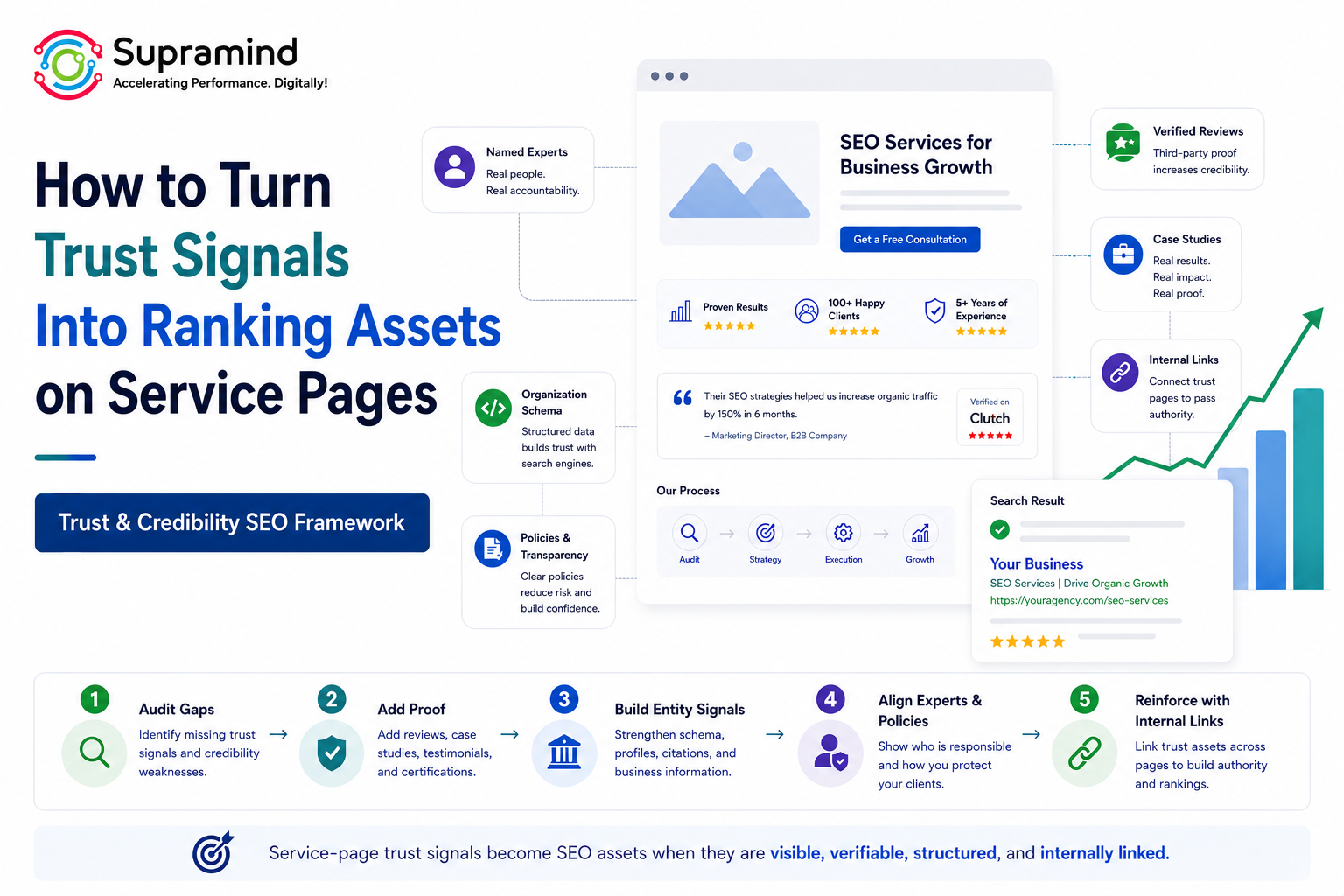
Trust & Credibility SEO Framework: The Core Idea
Trust is not decoration. It is a ranking-support system. A service page that only says “we are experts” asks the user and search systems to believe a claim. A service page that shows the expert, links the proof, explains the process, clarifies the business entity and connects supporting pages makes that claim easier to verify.
Service-page trust signals work best when they reduce buyer doubt and improve machine-readable clarity at the same time. Reviews, case studies, author profiles, policy links, schema, contact details and internal links should reinforce one consistent entity.
Trust is a ranking-support system, not a design accessory.
Service pages need proof, entity clarity and accountability.
Generic badges are weaker than verifiable business evidence.
Internal links should connect claims to About, policy and proof pages.
AI search visibility depends on clarity, credibility and citation-ready evidence.
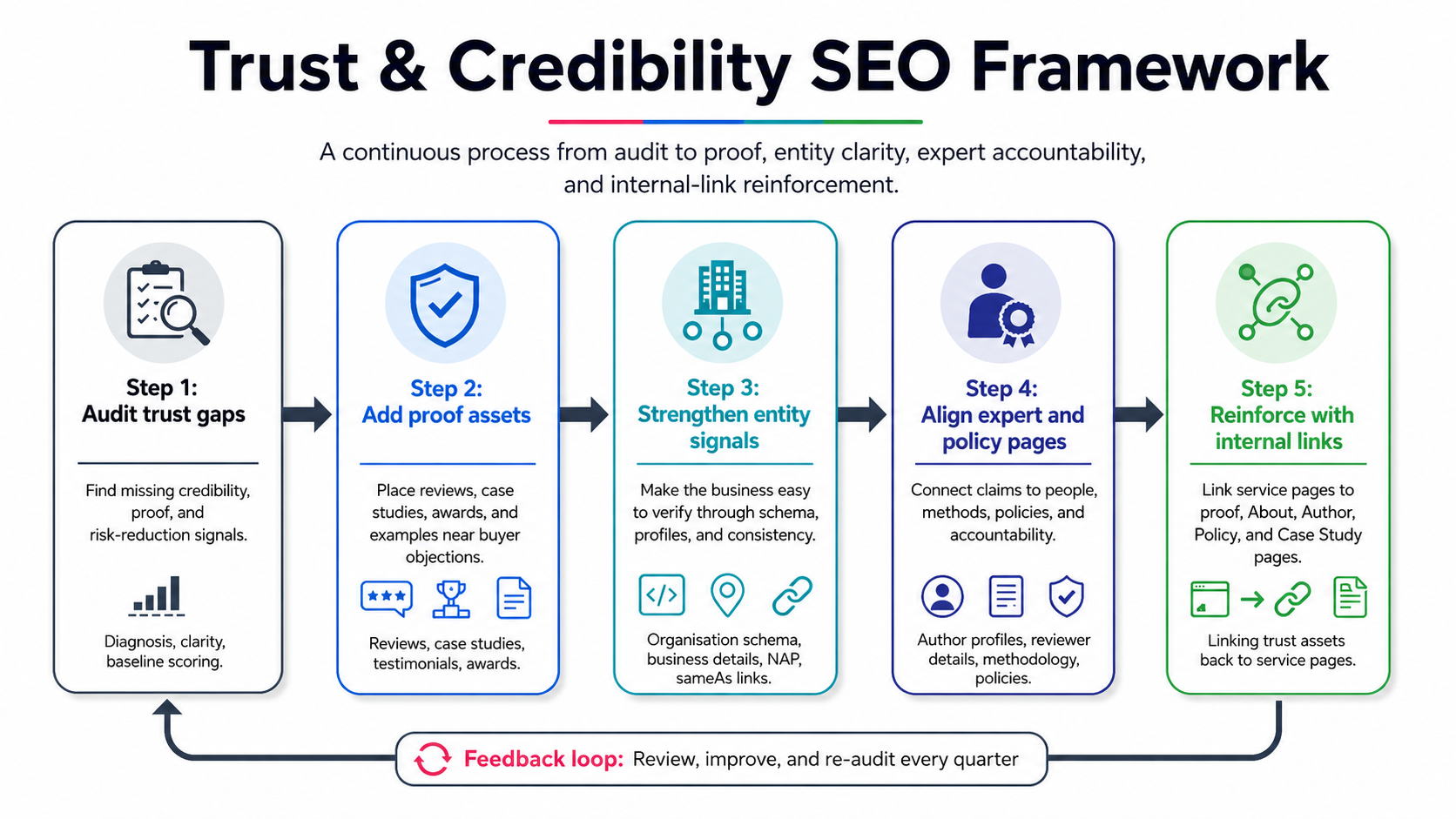
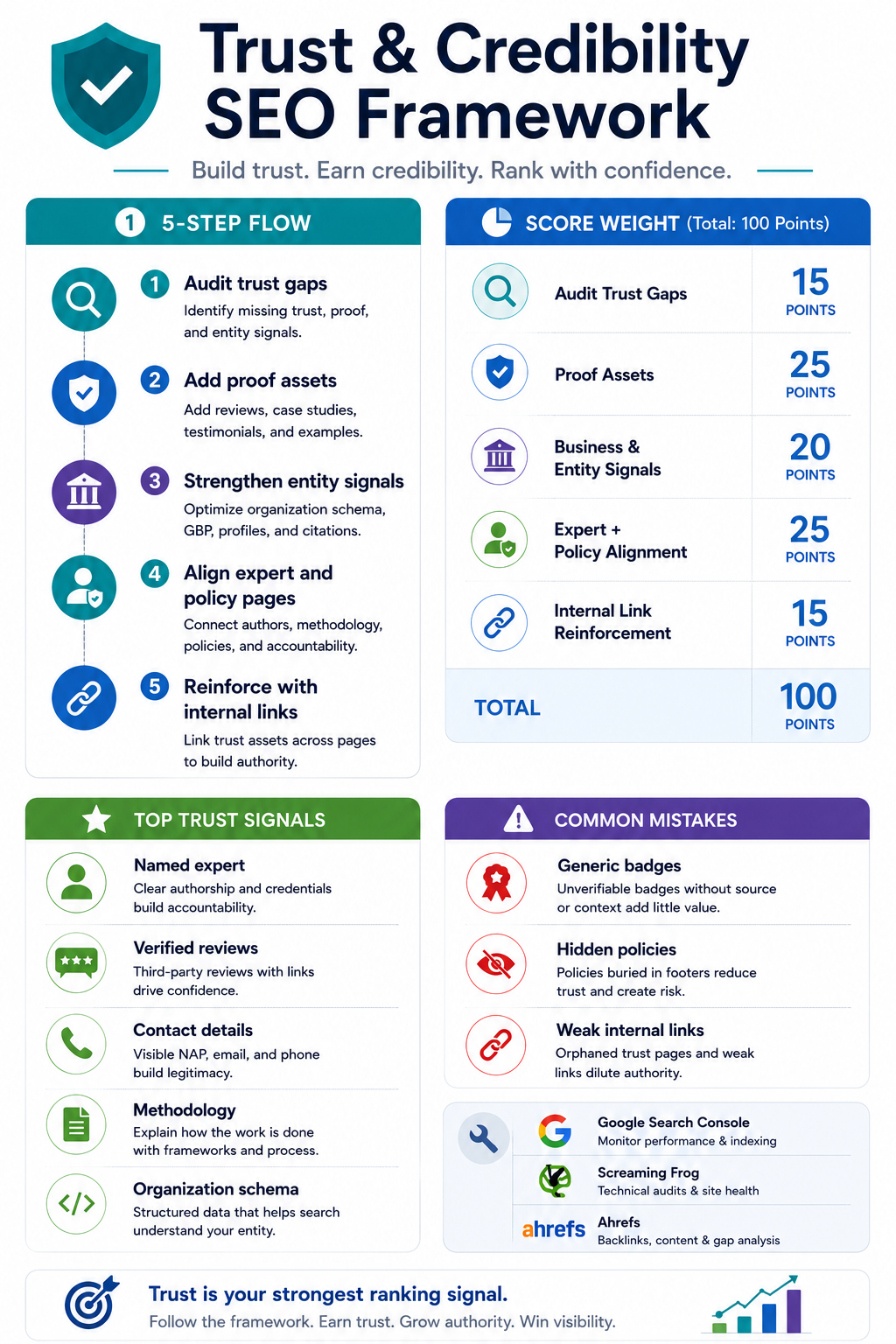
Audit trust gaps
Find missing credibility proof, entity clarity and risk-reduction signals.
Add proof assets
Place reviews, case studies, awards and examples near buyer objections.
Strengthen entity signals
Make the business easy to verify through schema, profiles and consistency.
Align experts and policies
Connect claims to people, methods, policies and accountability.
Reinforce with internal links
Route authority between service, proof, About, author and policy pages.
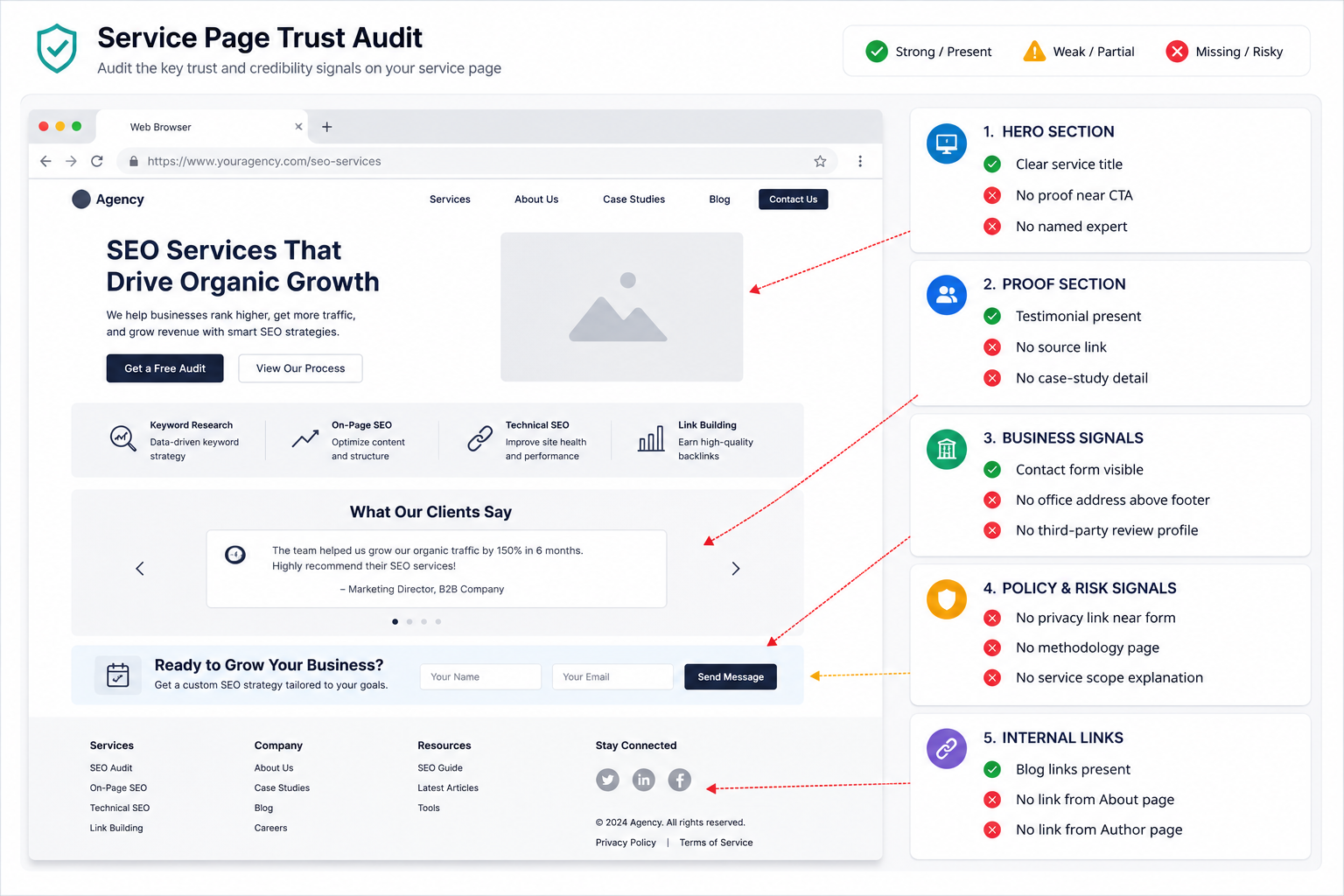
Step-by-Step Service Page Trust Audit
A trust-gap audit is a page-level review that checks whether users and search systems can verify who owns the page, why the business is credible and whether the service claims are supported. It is different from a standard SEO audit because it focuses on buyer-verification friction, not just rankings, titles, crawl errors or keyword placement.
What the data says
Google recommends using organisation details such as name, address, telephone, logo and sameAs links to help clarify and disambiguate a business. For service pages, this means trust has to be visible in the content and consistent across the site, structured data and public profiles.
Audit checklist
- Can users identify the business name, location and contact method quickly?
- Does the hero area include proof, not only a slogan?
- Are claims backed by reviews, case studies, credentials or public profiles?
- Is the responsible expert, founder, strategist or team visible?
- Are About, Contact, Privacy, Terms and policy pages one click away?
- Does the page explain process, scope and limitations clearly?
What I’d do next
- Run the URL through Screaming Frog and export internal links to identify orphaned trust pages.
- Use Google Search Console URL Inspection to confirm the page is crawlable and indexable.
- Create a spreadsheet with four columns: missing proof, missing entity signal, missing expert signal and missing policy link.
So what
A service page can look polished and still feel risky. If a buyer cannot see who is responsible, where the company exists, how the service is delivered and where the proof comes from, the page creates friction. In competitive SEO markets, that friction can reduce enquiry quality and weaken the page’s eligibility for citation-led discovery.
Common mistake
Auditing rankings but not buyer-verification friction.
Common mistake
Hiding trust pages only in a legal footer.
Common mistake
Using long copy as a substitute for verifiable proof.
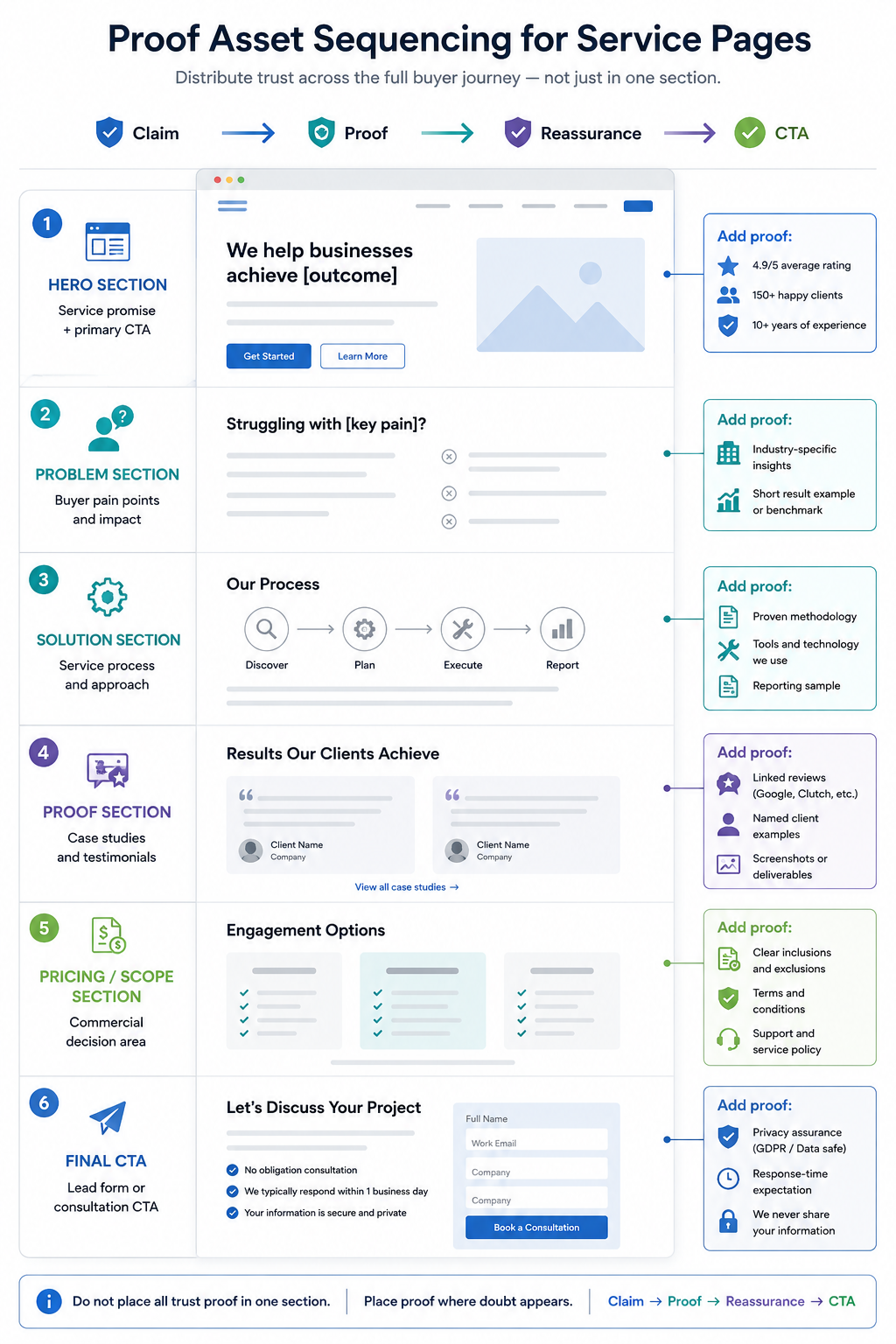
Proof Asset Sequencing: Place Evidence Where Doubt Appears
Proof assets are visible evidence blocks that make service claims verifiable. These include reviews, case studies, certifications, client examples, press mentions, screenshots, process evidence and reporting samples. The key is sequencing: do not place all trust proof in one testimonial section and expect it to support every claim on the page.
What the data says
Trust is earned through relevance, responsiveness and clarity of action. For service pages, that means a generic badge is weaker than proof that answers the exact objection the buyer has at that point in the journey.
| Page section | Buyer doubt | Best proof to add | Why it works |
|---|---|---|---|
| Hero section | Can this company deliver? | Rating, client count, years of experience, named expert | Reduces first-scroll hesitation before the main CTA. |
| Problem section | Do they understand my market? | Industry-specific insights, short benchmark or pain-point example | Turns generic service copy into relevant analysis. |
| Solution section | How will the work actually be done? | Methodology, tools, reporting sample, workflow | Makes the service process easier to evaluate. |
| Proof section | Where are the real outcomes? | Case studies, named testimonials, screenshots, third-party reviews | Links claims to verifiable business evidence. |
| Pricing or scope section | What am I committing to? | Inclusions, exclusions, terms, support commitments | Reduces risk near commercial decision points. |
| Final CTA | Is my data safe? | Privacy reassurance, response-time expectation, no-spam promise | Makes the enquiry action feel safer. |
What I’d do next
- Add a proof strip below the hero with years in business, review source and one concrete service outcome.
- Place one testimonial or case-study excerpt beside the main enquiry CTA.
- Link every review badge, award and press mention to a verifiable source.
- Use Looker Studio or reporting screenshots to turn service outcomes into reusable proof visuals.
Business and Entity Signals: Make the Brand Easy to Verify
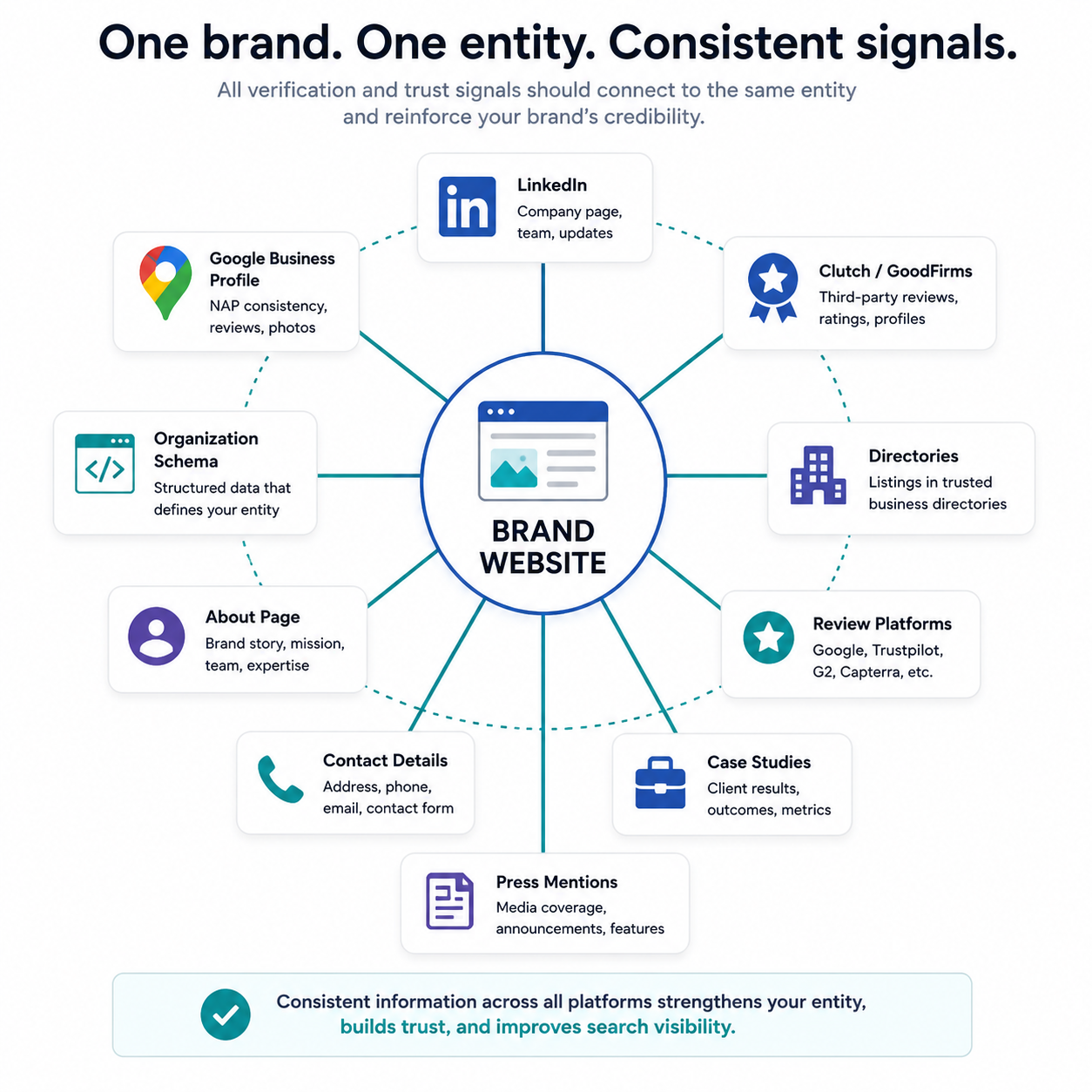
Business and entity signals are structured and visible details that help Google, AI systems and users verify the organisation behind a service page. Entity clarity matters because modern search does not evaluate a page in isolation. It connects the website, schema, public profiles, review platforms, business listings, author identities and brand mentions into a wider credibility graph.
What the data says
Organization structured data can help search systems understand administrative details and disambiguate an organisation in Search results. The visible page and the structured data should support the same facts: company name, URL, logo, location, profiles, contact points and public identity.
Entity signal checklist
- Company name is consistent across the website, schema, footer and public profiles.
- Address and phone details match public listings and contact pages.
- The page connects to LinkedIn, Google Business Profile, Clutch or GoodFirms where relevant.
- Organization or LocalBusiness schema is deployed on suitable pages.
- Legal or registration identifiers are available where appropriate.
- The About page explains the company, mission, team and credibility clearly.
Implementation sequence
- Add Organization schema on the homepage or About page.
- Add sameAs references to credible social, review and directory profiles.
- Check NAP consistency across the website, Google Business Profile and third-party listings.
- Validate schema and compare it against visible page content before publishing.
So what
Entity ambiguity creates unnecessary ranking and conversion drag. If the website says one thing, the schema says another, and the public profiles are outdated, search systems and buyers have to work harder to trust the business. For service pages, consistency is a credibility multiplier.
Expert and Policy Alignment: Connect Claims to Accountability
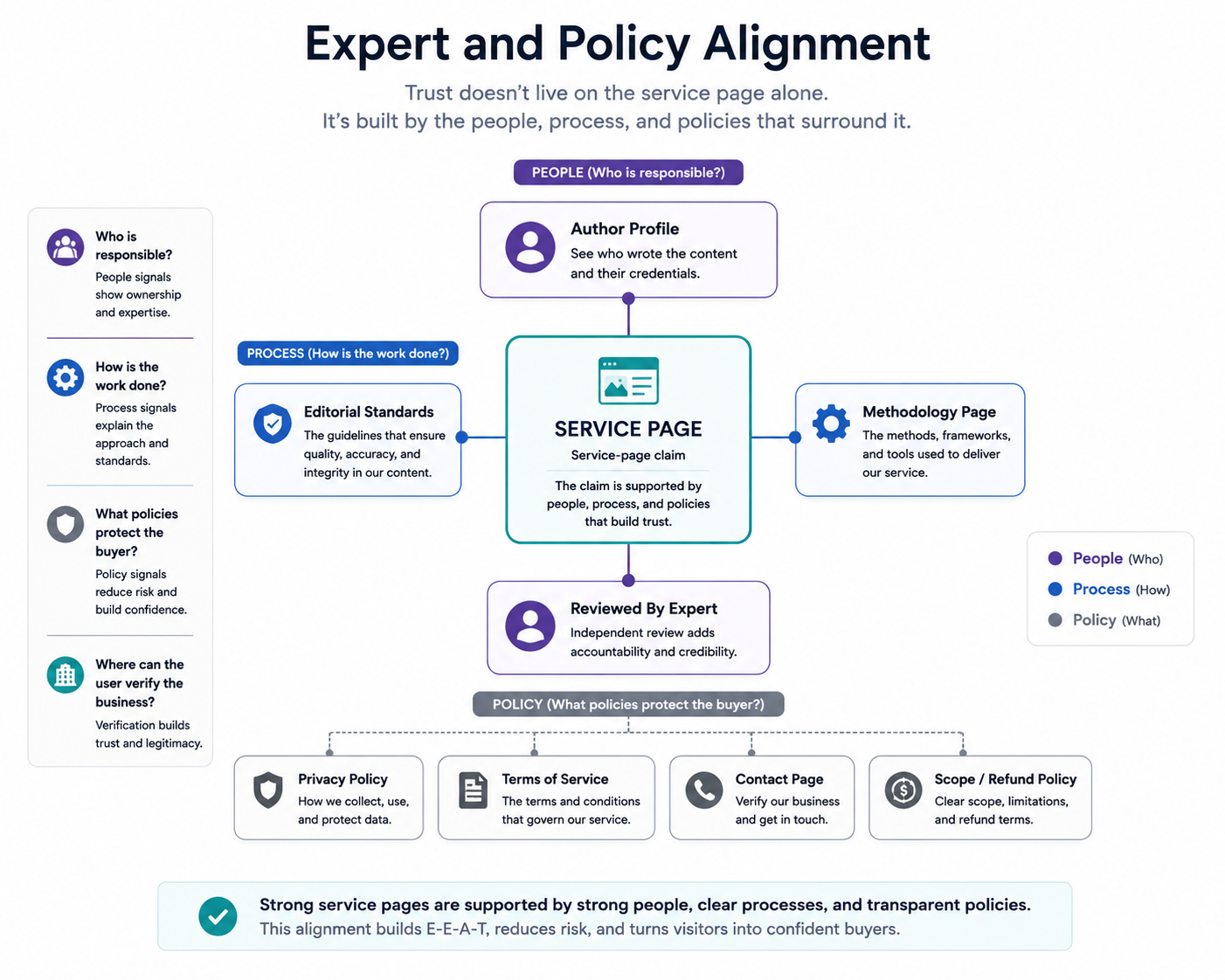
Trust does not live on the service page alone. It is built by the people, processes and policies that surround it. Expert and policy alignment links service claims to the people responsible for the work, the standards used to deliver it and the policies that protect the buyer.
People
Show who is responsible. Add a named author, strategist, reviewer or founder with role, experience, social proof and relevant published work.
Process
Explain how the work is done. Link to methodology pages, editorial standards, reporting samples and service delivery frameworks.
Policy
Clarify what protects the buyer. Make Privacy, Terms, Contact, Refund, Scope and support policies easy to find where risk appears.
What I’d do next
- Add a “Strategy led by” or “Reviewed by” block with a real person page.
- Create short methodology pages for audits, link building, reporting and content review.
- Link policy pages contextually where risk, commitment, pricing or data collection is mentioned.
- Add a visible reviewed date where the content has commercial, technical, medical, financial or legal sensitivity.
Trust Cluster Internal Linking Model
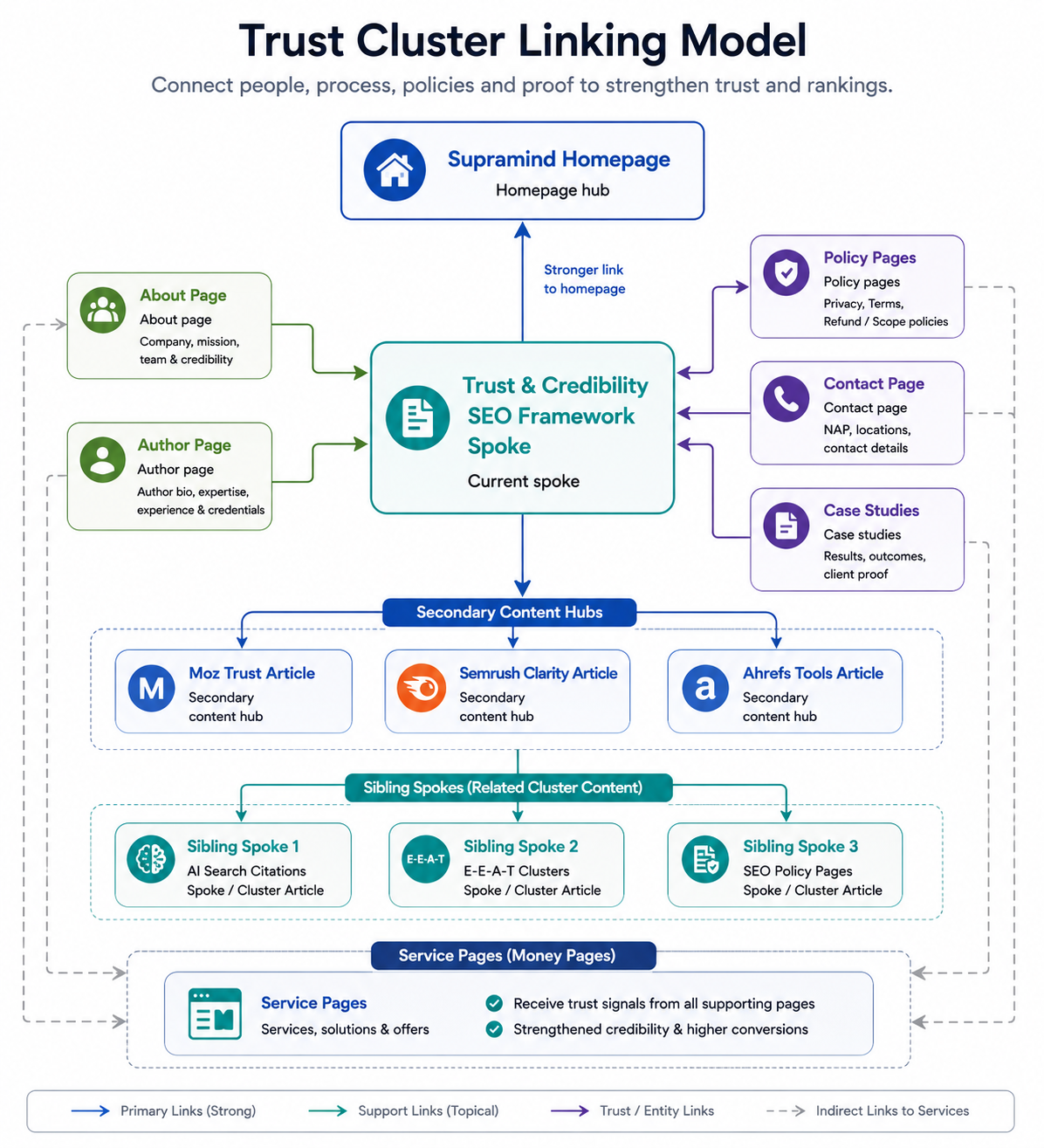
Internal-link reinforcement is the deliberate routing of relevance and trust from About, author, policy, case-study and insight pages into the main commercial service URL. It helps search systems connect service claims to supporting evidence and helps cautious buyers verify the business before submitting a lead form.
| Node type | Purpose | Internal-link role |
|---|---|---|
| Homepage | Primary brand and entity hub. | Links to the framework, service hubs and key trust pages. |
| About page | Company mission, team, experience and credibility. | Links back to service pages and proof assets. |
| Author or expert page | Expertise, credentials and published work. | Connects expert authority to service topics. |
| Policy pages | Privacy, terms, refunds, scope and service commitments. | Supports high-risk conversion areas. |
| Case studies | Results, outcomes and client proof. | Links directly to relevant service pages. |
| Supporting blogs | Topical depth and search demand capture. | Builds relevance toward the money page without overusing exact-match anchors. |
What I’d do next
- Map one hub, three supporting blogs, three trust pages and two proof assets for each service URL.
- Use Screaming Frog to identify orphan pages and shallow internal-link paths.
- Add links where the reader naturally needs evidence, not in repetitive footer blocks.
- Use varied anchors across branded, topical, partial-match and proof-led phrases.
Trust / Authority Signal Inventory Table
Not every trust signal has the same weight. Some are quick wins, while others need stronger governance. Use this inventory to prioritise trust additions by impact, implementation effort and importance for YMYL or high-risk service pages.
| Signal | Where to place | Impact | Effort | YMYL critical? | Schema hook |
|---|---|---|---|---|---|
| Named expert or strategist | Hero or first proof block | High | Low | Yes | Person |
| Verified review links | Near CTA | High | Low | Yes | Review |
| Case-study excerpt | Mid-page proof block | High | Medium | No | Article |
| Office address and phone | Header utility and footer | High | Low | Yes | LocalBusiness |
| Organization sameAs links | Footer or About page | High | Low | Yes | Organization |
| Legal business name | About or footer | Medium | Low | Yes | Organization |
| Author social-graph references | Author profile | Medium | Medium | Yes | Person |
| Editorial standards page | Footer and author page | High | Medium | Yes | Article |
| Methodology disclosure | Service process section | High | Medium | Yes | HowTo |
| Pricing or scope clarity | Offer section | High | Medium | No | Service |
| Policy page links | Footer and risk sections | Medium | Low | Yes | Organization |
| Last reviewed date | Top or bottom meta | Medium | Low | Yes | Article |
Trust & Credibility Score Worksheet
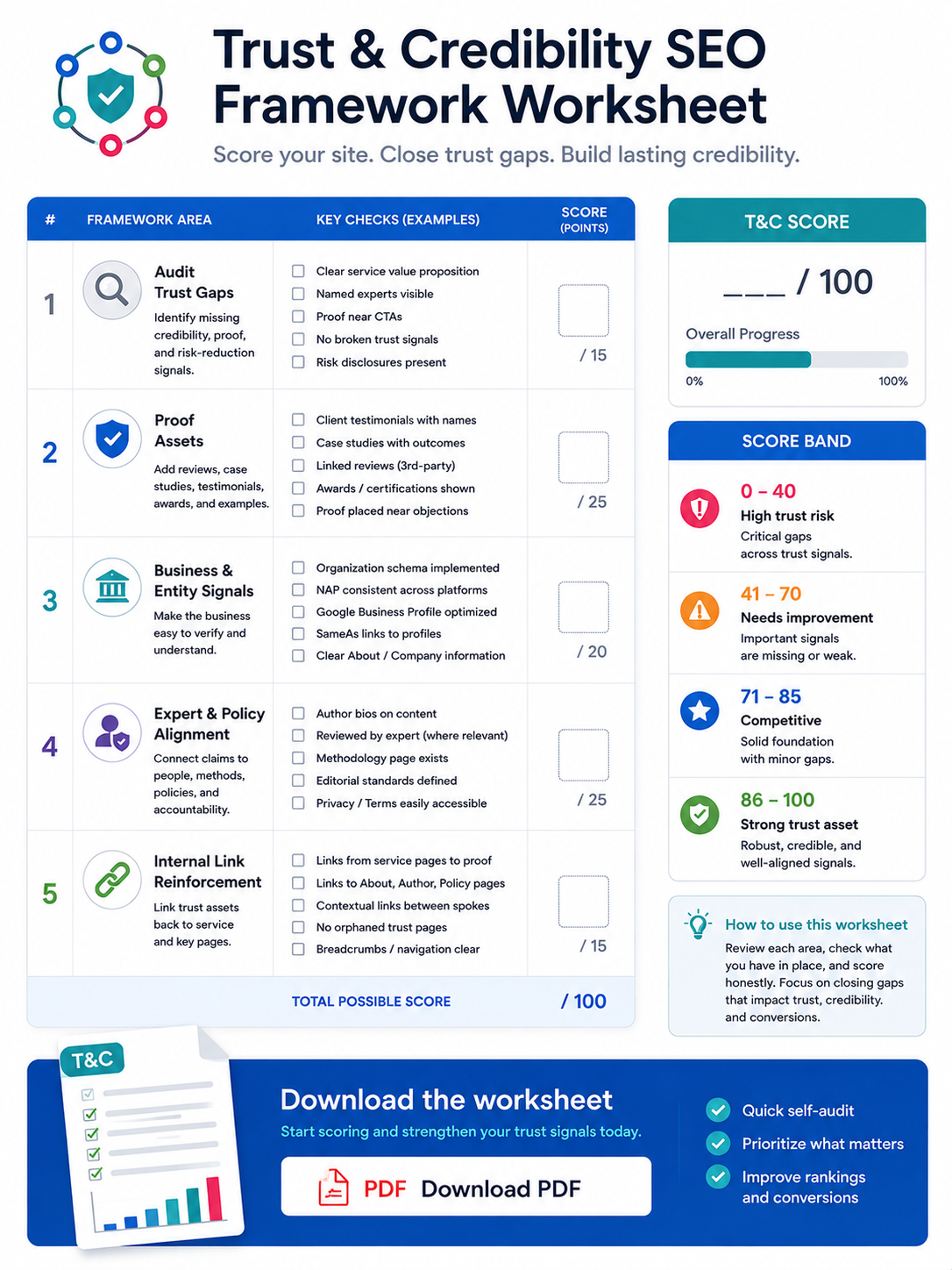
The T&C Score is a 100-point page-audit score. Proof and governance carry the highest weight because they affect both human confidence and machine-readable credibility. Use the worksheet to score each active service page, then prioritise the gaps that influence trust, conversion and search visibility.
Audit trust gaps
Clear service value proposition, named experts, proof near CTAs, risk disclosures and baseline clarity.
Proof assets
Client testimonials, case studies, linked reviews, awards and proof placed near objections.
Business and entity signals
Organization schema, NAP consistency, Google Business Profile, sameAs links and clear company information.
Expert and policy alignment
Author bios, expert review, methodology pages, editorial standards, Privacy and Terms accessibility.
Internal link reinforcement
Links from service pages to proof, About, Author and Policy pages with no orphaned trust assets.
0–40: High trust risk
Critical gaps across credibility, proof and governance signals.
41–70: Needs improvement
Important signals exist, but they are missing, weak or poorly placed.
71–85: Competitive
Solid foundation with minor gaps that can still affect conversion.
86–100: Strong trust asset
Robust, credible and well-aligned trust signals across the service journey.
Download the worksheet PDF and score one priority service page before scaling the framework across the rest of your service architecture.
Schema and Technical Implementation
Use schema to clarify visible facts, not to make invisible claims. The cleanest implementation is the one where structured data, page content, public profiles, internal links and business information all tell the same story.
Schema types to consider
- Organization: company name, URL, logo, location and sameAs profile references.
- Person: author, reviewer, strategist or expert connected to the organisation.
- Article: editorial content with honest dates, author and publisher details.
- Service: real services described visibly on the page, with accurate area served and provider details.
Technical checks before publishing
- Validate syntax in Schema.org Validator.
- Test rich-result eligibility and parsing in Google Rich Results Test.
- Inspect the URL in Google Search Console after publishing.
- Confirm rendered HTML includes the author block, business details and key proof assets.
- Match schema facts to visible copy and avoid exaggerated claims.
Industry-Specific Variations
The same framework applies across industries, but the trust threshold changes. Medical, financial and legal pages need stronger accountability and policy visibility than low-risk informational pages. SaaS and B2B pages need proof of implementation quality, security and integration experience.
| Industry | Trust requirement | What to prioritise |
|---|---|---|
| Medical | Highest expert-verification standard. | Named reviewers, clinical credentials, reviewed dates, limitations and patient-support links. |
| Financial | Transparent risk and accountability signals. | Fee clarity, risk disclaimers, regulatory context, complaints policy and methodology links. |
| SaaS | Operational proof and buyer reassurance. | Customer logos with context, security documentation, support expectations and integration clarity. |
| E-commerce | Commercial reassurance before purchase. | Refund logic, merchant examples, conversion evidence, payment safety, delivery and support details. |
| B2B tech | Technical credibility and evidence depth. | Expert authorship, technical explainers, partner mentions, customer stories and comparison content. |
Common advice is wrong when it says “add trust badges” as a universal fix. The right signal depends on the risk. Medical trust depends on accountable clinical review. Financial trust depends on disclosure and regulation. SaaS trust depends on security and implementation clarity.
Measurement Framework: Track Trust Like an SEO Asset
Trust work should not be treated as a one-time content refresh. Measure it across leading, mid and lagging indicators. Leading indicators show whether trust assets are being discovered. Mid indicators show whether service-page visibility is improving. Lagging indicators show whether the work produces qualified pipeline.
| KPI | Tier | Tool | Report setup |
|---|---|---|---|
| Review velocity | Leading | Google Business Profile / Clutch | Monthly new reviews and average recency. |
| Branded search trend | Leading | Google Search Console | Query filter with brand regex. |
| Schema health | Leading | Rich Results Test / GSC | Error-free structured-data pages. |
| Brand mention frequency | Leading | Ahrefs Alerts / Brand24 | New monthly web mentions. |
| Service-page CTR | Mid | Google Search Console | Page filter plus commercial query set. |
| Average position for branded-service queries | Mid | Semrush / Ahrefs | Keyword group tracking. |
| Trust-page assisted sessions | Mid | GA4 | Path exploration to enquiry event. |
| Qualified organic leads | Lagging | GA4 + CRM | Lead source and quality tagging. |
| Organic pipeline value | Lagging | CRM | Landing-page cluster attribution. |
| Revenue from organic service pages | Lagging | CRM / Looker Studio | Closed-won attribution by URL cluster. |
Final Summary: Trust Signals Become Assets When They Are Connected
Service-page trust is not built by adding a few badges, testimonials or claims. It is built when every important claim can be traced to proof, every proof asset can be verified, every expert signal connects to a real person, every policy reduces risk and every supporting page reinforces the same business entity.
Audit gaps first
Before adding new content, identify what a cautious buyer cannot verify today.
Add proof near objections
Match evidence to doubt: reviews near CTAs, methodology near process claims and policies near risk areas.
Clarify the entity
Align website content, public profiles, schema, contact details and business listings.
Connect people, process and policy
Make authorship, expert review, delivery standards and customer protection visible.
Reinforce with internal links
Build a trust cluster so service pages receive credibility from About, Author, Policy, Case Study and supporting blog pages.
The result is a service page that is more credible for buyers, clearer for search systems and better prepared for AI-led discovery. That is how trust signals become ranking assets.
FAQs
What is a trust signal in SEO?
A trust signal in SEO is a visible or machine-readable cue that helps users and search systems verify a page, author or business. Examples include expert authors, reviews, contact details, policy links, structured data and third-party mentions.
How do trust signals help service pages rank?
Trust signals help service pages rank by improving credibility, entity clarity and user confidence. They do not replace content quality, but they make commercial claims easier to verify and connect to supporting evidence.
What trust signals matter most for service pages?
The most important service-page trust signals are proof assets, visible contact details, expert accountability, entity consistency, clear policies and internal links from supporting pages. These signals work best when placed near buyer objections.
Are trust badges good for SEO?
Trust badges are useful only when they answer a real buyer concern. Generic badges can distract from stronger evidence such as reviews, policies, credentials, case studies, methodology pages and verified third-party profiles.
Should every service page have schema?
Every important service page should use schema only when the markup matches visible content. Misleading or hidden structured data can create trust and eligibility problems, so schema should clarify real facts rather than exaggerate claims.
What is the role of E-E-A-T in service-page SEO?
E-E-A-T helps evaluate whether a page feels experienced, expert, authoritative and trustworthy. On service pages, the most practical expression of E-E-A-T is proof, expert ownership, transparent policies and third-party validation.
How often should trust assets be updated?
Trust assets should be reviewed at least quarterly for active service pages. Update reviews, case studies, team details, schema, policy links and contact information whenever business facts change.
How do internal links support trust?
Internal links support trust by connecting commercial claims to supporting proof pages. A service page becomes more credible when About, Author, Policy, Case Study and Blog pages all reinforce the same entity and service narrative.
Can trust signals improve AI-search visibility?
Trust signals can improve AI-search readiness by making a page easier to understand, verify and cite. AI Overview research shows that ranking for the direct query is not the only path to citation visibility.
How should an SEO company in India show credibility?
An SEO company in India should show credibility through clear service scope, public proof, named experts, transparent reporting methods, local and global client evidence and verifiable third-party profiles. Ranking claims alone are not enough.
Need an ethical SEO partner to turn service-page trust into measurable organic growth?
Supramind Digital helps brands strengthen service-page trust signals, technical SEO, internal linking, proof assets and AI-search readiness so visibility and conversions grow together.
Sources
- Log in to post comments


 INDIA
INDIA