


Travel SEO Forensic Auditor: Traffic Drop Diagnostic Tool
Have you experienced a sudden or severe drop in organic travel traffic or bookings? Check the symptoms below to instantly diagnose whether you've been hit by an algorithmic penalty, a manual action, or a technical SEO leak.
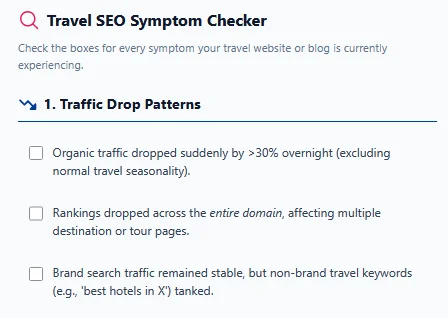
Travel SEO Symptom Checker
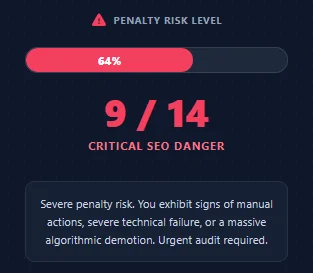
Penalty Risk Level
Symptoms Detected
Diagnosis Status
Awaiting InputPriority Action Area
Check the boxes on the left to identify the root cause of your traffic drop.
"This diagnostic tool is a critical component of Supramind’s master framework for protecting and recovering SEO for Travel Websites."
Why Travel Websites Are Highly Vulnerable to Traffic Drops
Losing organic traffic is one of the most stressful events a travel brand can face. When your leads, bookings, and revenue dry up overnight, guessing the cause leads to wasted time and lost seasonal opportunities.
Travel websites—such as OTAs, tour operators, and destination blogs—are particularly susceptible to Google Core Updates because travel is fundamentally a YMYL (Your Money or Your Life) sector. Users invest significant money, time, and safety into trips based on your content. If Google's algorithm detects thin content, a lack of first-hand travel experience, or technical indexing bloat (common with large faceted navigation on booking sites), it will demote the entire domain.
A Travel SEO Forensic Audit cuts through the noise. It systematically strips away variables to find the exact root cause of your traffic decline—whether it’s a technical failure you induced (like a broken multi-region setup), an algorithmic downgrade, or a manual penalty.
How to Use the Forensic Diagnostic Tool
Gather Your Analytics Data
Before you start clicking boxes, open Google Analytics (GA4) and Google Search Console (GSC). Look at the exact date your traffic began to drop. Did it fall off a cliff on a specific Tuesday, or has it been bleeding out slowly over three months? Cross-reference this date with major Google Algorithm Update announcements, and be sure to explicitly rule out normal travel seasonality.
Input Your Symptoms
Go through the 14-point diagnostic checklist above. Be brutal and honest. If you recently did a booking engine migration, tick the box. If you know you rely heavily on aggregated API content for hotel listings, tick the box. The tool needs accurate symptoms to diagnose the illness.
Analyze the Penalty Risk Level
The dynamic panel on the right will categorize your risk. If it flags a "Technical / Minor Leak," you likely just have broken links or a bad canonical tag in your travel directories. If it turns red for "Algorithmic Impact," you've been caught in a broad Google Core Update and need a massive travel content strategy pivot.
Algorithmic Downgrades vs. Manual Actions in Travel
It is vital to understand the difference between the two main types of Google penalties that hit travel sites:
- Manual Actions: A human reviewer at Google looked at your site and applied a penalty because you violated Google's Spam Policies (e.g., buying link placements from other travel bloggers, cloaking destination pages). You will receive a direct notification in Google Search Console. To recover, you must fix the issue and submit a "Reconsideration Request."
- Algorithmic Downgrades: The algorithm simply decided your site is no longer the best travel resource for the user. There is no notification in GSC. Recovering from an algorithmic hit requires a holistic overhaul of your site's quality, architecture, and E-E-A-T (adding real travel expertise). You often will not see traffic return until Google runs its next major core update months later.
What Does a Travel SEO Forensic Audit Cover?
| Penalty Type | Symptoms & Forensic Solutions |
|---|---|
| Technical Failures | Often caused by botched migrations, broken hreflang tags (common on multi-language booking sites), or rogue "noindex" tags. We audit server logs, robots.txt, and canonical chains to plug the leak. |
| Algorithmic Updates | Traffic drops perfectly aligned with Google Core Updates. Solutions require overhauling thin destination content, improving travel E-E-A-T, and pruning programmatic index bloat. |
| Manual Actions | A human reviewer penalized your site for spam, unnatural travel links, or deceptive redirects. Requires toxic link disavows, cleanup, and a formal reconsideration request. |
| Keyword Cannibalization | No penalty exists, but your own pages (e.g., multiple "Dubai Itineraries") are fighting each other in the SERPs, causing erratic rankings. Fixed via content merging and 301 redirects. |
More Free SEO Tools
Once you recover from a penalty, you need the right tools to build authority. Use Supramind's other free resources:
- Travel SEO AI Content Audit Checklist
- Travel SEO Opportunity Calculator
- Travel SEO E-E-A-T Checklist & Rating Tool
- Travel SEO AI Snippet Builder
Related Travel SEO Teardowns & Case Study
See how market leaders deploy Answer-First Formatting and LLM Candy in our teardown library:
Airbnb SEO Strategy Breakdown
Marketplace growth engine & Trust UX teardown.
Skyscanner SEO Strategy Analysis
Index Efficiency Leak + Revenue Math exploration.
Expedia SEO Teardown
A Profit & Loss SEO Teardown of Expedia's massive platform.
Booking.com SEO Optimization
Strategy to Win More Organic Bookings globally.
Emirates Aviation SEO Breakdown
Aviation-focused SEO and premium content positioning.
Etihad Airways SEO Teardown
Aviation SEO playbook and authority engineering techniques.
GetYourGuide SEO Teardown
Tours & tickets organic booking scaling strategy.
Travel SEO Traffic Growth Case Study
Discover how we utilized advanced SEO architecture to drive 2333% Traffic Growth for a major travel client.
Travel SEO Forensic Audits FAQs
What is a Travel SEO Forensic Audit?
A travel SEO forensic audit is a deep-dive investigation into a travel website or blog that has experienced a sudden or severe drop in organic traffic and bookings. It aims to diagnose whether the drop was caused by a technical failure, an algorithmic core update, or a manual penalty from Google.
How do I know if my travel site was hit by a Google Core Update?
If your traffic drops significantly across the entire domain precisely when Google announces a broad Core Update or Helpful Content Update, and there are no technical errors reported in Google Search Console, it is highly likely you suffered an algorithmic demotion due to content quality or lack of E-E-A-T signals.
How long does it take to recover from an SEO penalty?
Technical issues (like broken canonicals on booking pages) can often be resolved and see recovery within weeks. Manual actions require submitting a reconsideration request and can take a month or more. Algorithmic penalties typically require a total overhaul of content quality and may take several months—often waiting until the next core update—to fully recover.
- Log in to post comments


 INDIA
INDIA