


SEO for Aviation Company: My Etihad Airways Teardown & Playbook
"This Etihad Airways playbook is part of Supramind’s master authority hub for mastering SEO For Travel Website."
Table of Content
Introduction — Why I Analyzed Etihad’s SEO for Aviation Company Engine
My Audit Playbook for SEO for Aviation Company
SEO Snapshot (Based on Your Ahrefs Data)
Competitor Benchmark: Who Etihad Is Really Fighting
The Money Pages That Drive Aviation Leads & Sales
Branded vs Non-Branded: Where the Traffic Really Comes From
Traffic by User Intent (My Read)
CTR- & Intent-Aware Projection Model (SEO Strategy for Aviation Company)
Rank Uplift: What If Etihad Climbs to #1?
Why This Model Matters for Aviation
Trust Builders: Referring Domains That Really Move the Needle
Backlink Quality & Distribution
Technical SEO & Localization Wins for Aviation
AI Citations as a New Moat for Aviation Brands
Site-Wide Lead Engine Projection (Organic → Bookings & Contracts)
Practitioner Key Takeaways (My Action List)
Introduction — Why I Analyzed Etihad’s SEO for Aviation Company Engine
I’ve spent a lot of time working with complex, regulated industries, and aviation behaves a lot like banking and insurance: high stakes, strong brands, and very messy customer journeys. That’s exactly why I chose Etihad Airways (etihad.com/en-ae) as a live case study for SEO for Aviation and Travel Websites.
Etihad is a major global airline, headquartered in the UAE, with:
- A premium brand and hub in Abu Dhabi
- Multiple cabins (Economy, Business, First)
- Holidays, stopover offers, and ancillaries
- A powerful loyalty ecosystem (Etihad Guest)
- Corporate travel, group travel, and cargo products
In my experience, this is the perfect laboratory to answer one question:
How does an airline turn organic visibility into real bookings, upgrades, loyalty sign-ups, and B2B enquiries?
In this teardown I focus on three themes that I always use when I work with aviation and travel clients:
- SEO for Aviation Company – the overall acquisition engine.
- SEO Strategy for Aviation Company – what to prioritise first.
- Lead Generation for Aviation Companies – where the actual money comes from.
The data points I refer to come from your Ahrefs exports and screenshots (organic traffic, keywords, competitors, and backlinks). Where I use revenue or conversion numbers, I clearly label them as modeled examples, not real Etihad financial data.
Executive Summary
When I look at Etihad’s current SEO footprint, here’s how I’d summarise it to a CMO or Head of Digital.
What Etihad already does well
- Brand demand is massive and well captured. Keywords like “etihad”, “etihad airways” and “etihad guest” bring in a very large share of organic traffic.
- Core “money pages” are visible. The homepage, /book, /manage, online check-in, and Etihad Guest pages all rank and attract intent-heavy visits.
- Authority is not the problem. With c. DR 80, ~23.4K referring domains and ~1.5M backlinks, Etihad has more than enough domain power to compete.
- The ecosystem is rich. Once users land, there are many opportunities to push them toward bookings, upgrades, and loyalty actions.
- AI systems already notice Etihad. Hundreds of pages are cited in Google AI Overviews, ChatGPT, Perplexity and others, which is a great base for future “AI SEO.”
- Functional queries are covered. Things like “manage booking”, “check in”, “flight status” are straightforward and easy to find — exactly what I want to see.
Biggest gaps and opportunities
- Non-branded flight and route queries are underexploited. Competitors and OTAs often outrank Etihad for “flights to abu dhabi”, “cheap flights to europe from uae”, and similar money terms.
- Route pages behave like shells, not full funnels. Many simply connect to the booking engine instead of acting as rich landing pages that answer questions and convert.
- Corporate, groups and cargo are under-SEOed. These are high-value B2B segments, but their organic presence is weaker than leisure flight journeys.
- Informational content rarely pushes users down-funnel. People learn about baggage, changes or upgrades and then… are left alone. Contextual CTAs are inconsistent.
- AI-facing structure is underused. There’s a lot of aviation data in the business, but it isn’t consistently packaged into structured tables, FAQs and matrices that LLMs love.
If I were leading Etihad’s SEO roadmap, these would be my first battlegrounds.
To systematically capture these high-intent route and itinerary queries — and convert them into bookings rather than leaking them to OTAs — this is where a focused travel SEO approach makes the difference, optimising destination content, route landing pages, multilingual targeting, and the specific search intents unique to aviation brands.
Key Takeaways (At a Glance)
If you only skim one section, make it this one.
- Money pages (search, route pages, offers, cabins, Etihad Guest, corporate travel, cargo) are where margin lives. Everything else should feed traffic into these.
- Non-branded aviation queries like “flights to abu dhabi” and “best business class to london” are the growth lever. Etihad’s DR says it can win these, but the site isn’t fully doing it yet.
- A sharper SEO Strategy for Aviation Company means building proper funnels: route → guide + fare examples → booking engine → loyalty.
- AI citations will become a moat. The more clearly Etihad publishes route data, baggage rules, loyalty rates, and cargo SLAs, the more AI systems will quote it by default.
Even a small rank improvement on a handful of high-intent keywords can translate into hundreds of thousands of AED per month in modeled value.
My Audit Playbook for SEO for Aviation Company
Whenever I look at an airline or aviation site, I use a fairly consistent playbook. Here’s how I applied it to Etihad.
Tools and inputs
- Ahrefs (for traffic, keywords, ref. domains, competitor snapshots)
- On-site crawl and manual review of /en-ae flows
- My own benchmarks from other airlines and travel brands in the region
Map the funnel by intent
I always start with intent. For Etihad, the queries naturally fall into four buckets:
- Navigational – user already knows the brand
- “etihad airways”
- “etihad manage booking”
- “etihad check in online”
- “etihad airways”
- Informational – user needs rules and reassurance
- “etihad baggage allowance”
- “etihad cancellation policy”
- “how to upgrade on etihad”
- “etihad baggage allowance”
- Commercial – user is shopping options
- “flights to abu dhabi from london”
- “best business class to europe from uae”
- “cheap flights from dubai to paris”
- “flights to abu dhabi from london”
- Transactional – user wants to act now
- “book etihad flights online”
- “etihad flight deals”
- “etihad promo code booking”
- “book etihad flights online”
The same structure holds for B2B:
- “corporate travel solutions airline”
- “group travel booking uae”
- “air cargo services uae”
My goal in a teardown like this is to see whether each intent stage is linked to the next one or if users fall out between stages.
Connect to lead & revenue modelling
For every cluster I care about, I connect:
impressions → clicks → route/fare view → search → booking / enquiry → revenue
and I use different conversion assumptions for:
- B2C leisure tickets
- SME and corporate contracts
- Cargo and freight deals
That’s how I decide which keywords “print money” and which are nice-to-have.
Factor in localisation
Because Etihad is a UAE carrier serving a global network, I pay special attention to:
- Origin–destination pairs where UAE is origin, e.g., “flights from abu dhabi to london”.
- Routes where UAE is the hub, e.g., India → Abu Dhabi → Europe.
- Language splits — English vs Arabic — and how /en-ae/ and /ar-ae/ are structured.
Check trust & E-E-A-T for an airline
For airlines, experience and authority signals look slightly different:
- Operational reliability and safety (even if not directly exposed in content).
- Transparent fees (baggage, seat selection, changes).
- Guarantees and SLAs for corporate and cargo clients.
- Evidence of strong partner ecosystem — alliances, airports, banks, tourism boards.
That’s the lens I used for everything you’ll see below.
SEO Snapshot (Based on Your Ahrefs Data)
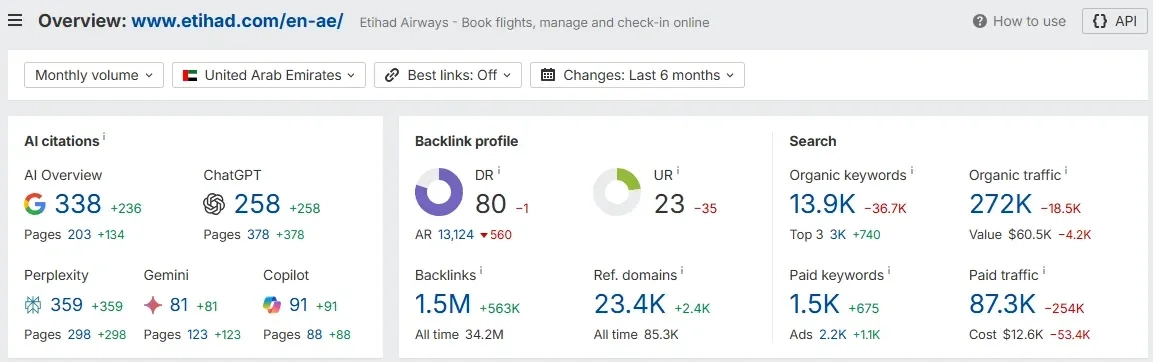
Using the exports and screenshots you provided, here’s the way I frame Etihad’s current SEO footprint. Remember: these are approximate and for context.
Modeled Ahrefs-style overview (UAE view)
| Metric | Approximate Value | What it tells me |
| Domain Rating (DR) | 80 | The domain is very strong; authority isn’t the blocker. |
| URL Rating (key /en-ae pages) | 23 | Deep commercial pages have room to grow. |
| Referring domains | 23.4K | A big, healthy link graph. |
| Backlinks | ~1.5M | +563K in last 6 months — clear PR and partnership activity. |
| Organic keywords (UAE) | 13.9K | Broad coverage across brand, routes, and policies. |
| Organic traffic (UAE) | 272K / month | Solid base for a single market view. |
| Paid keywords | 1.5K | Performance marketing is active and can be used for SEO testing. |
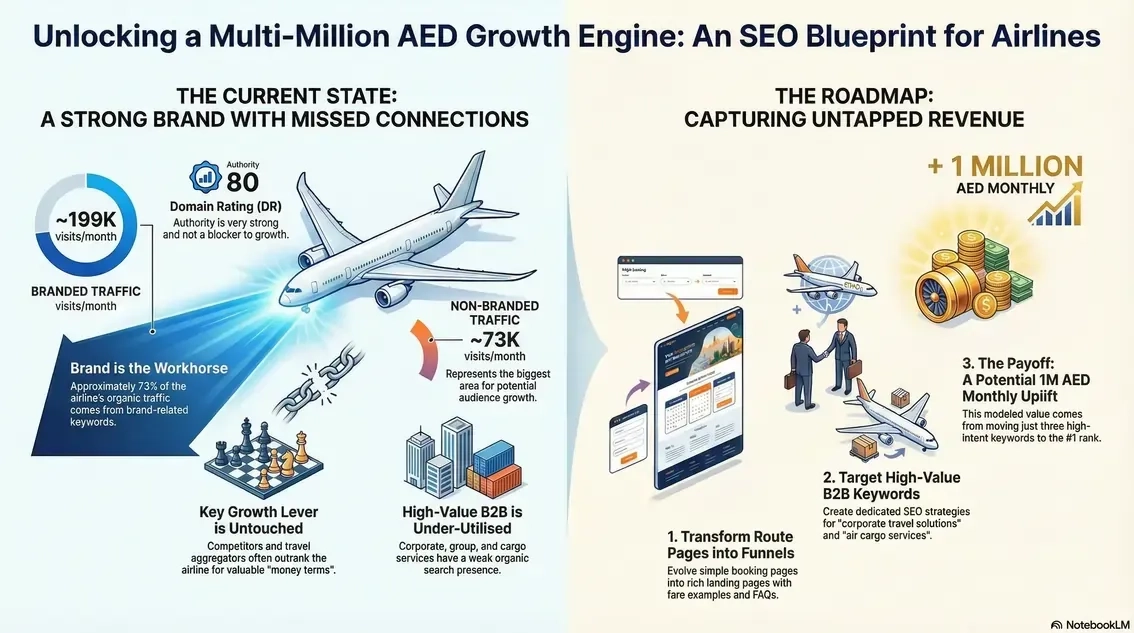
| Branded keywords | ~4.2K | ~199K organic visits – brand is doing heavy lifting. |
| Non-branded keywords | ~9.7K | ~72.8K organic visits – the growth headroom. |
| AI citations | 300–350+ pages across tools | Early but meaningful AI footprint. |
What I like in this snapshot
- Brand health is excellent. When I see this level of branded traffic, I know I can lean on it to build route and cabin authority.
- Authority is already “enterprise-grade.” I don’t need to convince anyone to invest in basic link building; the machine is already running.
- There’s real non-branded traffic to work with. It’s not where it could be, but it’s enough to find what’s working and scale it.
What I’d fix
- The non-branded share is too low for an airline with this DR. I’d like to see 40–50% of traffic from non-branded queries over time.
- Commercial and B2B sections (corporate travel, groups, cargo) should be punching much harder in organic; right now they feel like peripheral sections.
Many route and product pages have modest UR, which tells me internal linking and targeted off-page work are underused.
Competitor Benchmark: Who Etihad Is Really Fighting
Airline SEO Competitor Benchmark
Comparing Authority (DR) vs. Estimated Monthly Traffic (UAE)
I always anchor airline SEO in a competitive view, because searchers don’t care whether they click a carrier, an OTA, or a meta site — they just want the best route at the right price.
Based on your competitor export:
| Domain | DR | Est. Organic Traffic (UAE) | Approx. Keywords | My notes |
| emirates.com | 84 | 881K | 20.3K | Full-service peer with very strong brand and content. |
| airarabia.com | 74 | 791K | 8.2K | Low-cost competitor on key regional routes. |
| skyscanner.ae | 44 | 973K | 20.5K | Meta-search king of non-branded flight queries. |
| wego.ae | 41 | 368K | 19K | OTA/meta hybrid, aggressive in GCC. |
| makemytrip.global | 32 | 707K | 27.4K | OTA with heavy India/GCC focus. |
| kayak.ae | 41 | 252K | 11.5K | Global meta with localised UAE instance. |
"While Etihad has an incredibly strong foundation, comparing their regional strategy against their biggest local rival provides even deeper context. To see how a massive global brand footprint dictates organic visibility and route dominance, take a look at our complementary case study on [Lead Generation for Aviation Company]."
Where Etihad is in a good place
From my perspective:
- DR 80 puts Etihad at the top tier. It can compete with Emirates and outrank most OTAs on authority alone if on-page strategy is sound.
- Etihad owns the inventory. Meta and OTAs are middlemen. Etihad knows the schedules, fare families and cabin experience best — that’s crucial for content.
- Abu Dhabi hub is a unique lever. Etihad can win on “via AUH” narratives (stopovers, connections, tourism) in a way that generic OTAs simply can’t.
Where competitors are ahead
- OTAs and metas have aggressive long-tail coverage. They generate thousands of variations of “flights to X from Y” with strong comparison tools.
- Many competitors build destination content hubs around cities, not just airports, and integrate hotels and experiences into the funnel.
- Their fare comparison UX (filters, flexible dates, multi-airline matrices) often answers more questions on a single page than a typical airline route page does.
"You'll notice that aggregators consistently dominate non-branded flight searches by offering a vastly different, programmatic comparison experience. If you want to understand the exact technical architecture that allows meta-search engines to capture these queries at scale without bleeding crawl budget, check out our [SEO Travel Strategy Teardown] teardown."
If I’m advising Etihad’s digital team, I’m very direct: the brand and the authority are already there — now it’s about packaging information at least as well as Skyscanner or Emirates.
The Money Pages That Drive Aviation Leads & Sales
When my team builds SEO roadmaps for airlines, we always start with “money architecture.” On Etihad, those are:
- Flight search & booking
- Route and destination pages
- Offers and fare deals
- Cabin and fare family pages
- Etihad Guest (earn/redeem, benefits)
- Corporate and group travel solutions
- Cargo and logistics solutions
- Contact / enquiry paths
From your top-pages export, the top 10 URLs alone drive about 72% of tracked organic traffic. Here’s how I see them.
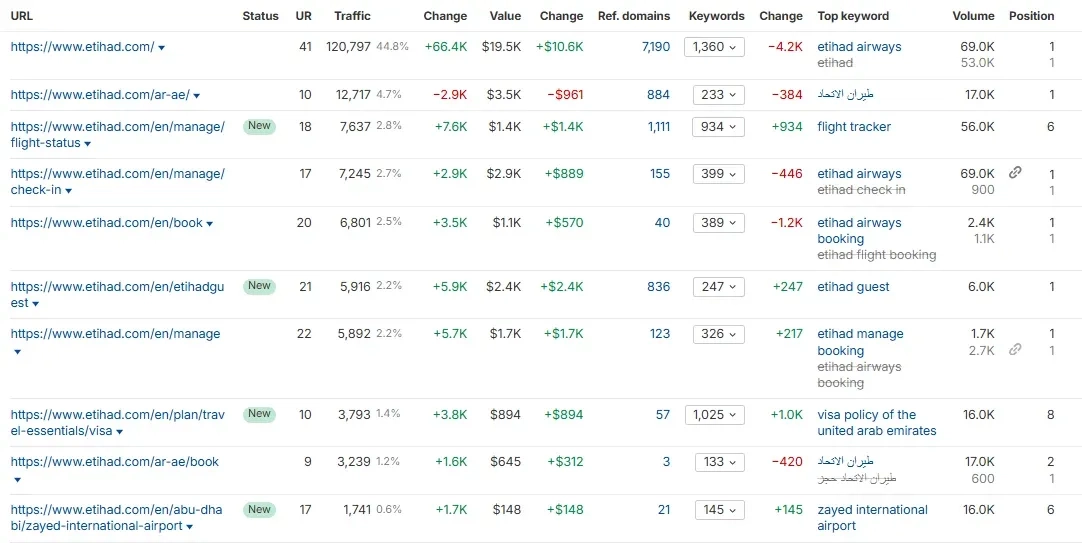
Example money-page snapshot (based on your data)
| Page Type | Example URL | Modeled Visits / month | Intent |
| Home / brand hub | / | 120,816 | Navigational / Commercial |
| Arabic home | /ar-ae/ | 12,726 | Navigational / Commercial |
| Flight search / book | /en/book | 6,812 | Commercial / Transactional |
| Online check-in | /en/manage/check-in | 8,605 | Transactional |
| Flight status | /en/manage/flight-status | 7,793 | Informational / Transactional |
| Manage booking hub | /en/manage | 5,897 | Informational / Transactional |
| Etihad Guest | /en/etihadguest | 5,916 | Informational / Commercial |
| Offers & deals | /en/offers | 861 | Commercial / Transactional |
| Route pages (examples) | /en-ae/flights/flights-from-abu-dhabi-to-… | 800–1,300 each | Commercial / Transactional |
| Abu Dhabi & attraction content | /en/abu-dhabi/... | 1,000–2,000 each | Informational / Commercial |
What I think is working
- CTAs are generally clear and consistent — “Book”, “Search flights”, “Manage booking”.
- Etihad Guest messaging is present, especially once you’re in the logged-in ecosystem.
- Localisation via /en-ae/ and other country folders is a strong structural choice.
- Abu Dhabi content provides a natural bridge between tourism intent and flight bookings.
What I would change
- Many route pages feel like thin wrappers around the booking widget. I’d turn each into a proper landing page with:
- Route-specific USPs (aircraft type, timings, connection experience, stopover options).
- Simple fare examples (from AED X in Economy, from AED Y in Business).
- Integrated fare calendar or “cheapest month” style widgets.
- Rich FAQs and schema — baggage, visa hints, stopover eligibility, common questions.
- Route-specific USPs (aircraft type, timings, connection experience, stopover options).
- Corporate and cargo sections should be treated as equally important money pages with dedicated SEO work, not just footer links that exist because the business needs them.
"For an airline to win back commercial search intent from third-party booking platforms, their route pages need to operate more like full-scale travel portals rather than basic booking widgets. You can see the exact programmatic blueprint for highly profitable destination templates in our analysis of using [Travel SEO to Drives Profit in US]."
Branded vs Non-Branded: Where the Traffic Really Comes From
From your “Organic keywords by intent” screenshot, here’s how I read the branded breakdown:
| Segment | Keywords | Est. Organic Traffic / month | My takeaway |
| Branded | 4.2K | 199.4K | Brand is the workhorse today. |
| Non-branded | 9.7K | 72.8K | Good start, but far below potential. |
So roughly 70–75% of traffic is branded. With Etihad’s DR and link graph, I’d expect to push that closer to a 60 / 40 split over time without sacrificing branded performance.
My main lever here would be route and cabin SEO: own “flights to abu dhabi”, “business class flights from dubai” and similar phrases, not just “etihad [something]”.
Traffic by User Intent (My Read)
Traffic by User Intent
Switch view to see where the volume actually sits.
The Ahrefs intent breakdown you shared shows:
| Intent | Keywords | Est. Traffic / month | How I’d use it |
| Informational | 13.1K | 249.3K | Massive top & mid funnel; needs stronger CTAs. |
| Navigational | 477 | 158.6K | Brand & account access. |
| Commercial | 6.1K | 181.8K | Route & fare research. |
| Transactional | 2.8K | 158.2K | Ready-to-book / ready-to-enquire. |
In my experience, airlines waste a lot of value by treating informational visits as “support” rather than as pre-booking warm-up sessions. For Etihad I’d:
- Add contextual CTAs to every major informational asset: “Start a search from Abu Dhabi”, “Check your upgrade options”, “Log in to see miles needed”.
- Make sure commercial route content pushes users into fare widgets and Etihad Guest hooks, not just generic booking forms.
- For B2B, ensure that every “policy” style page (e.g., cargo packaging, group rules) gives a short path to a form, WhatsApp, or account manager contact.
That’s where Lead Generation for Aviation Companies gets real.
CTR- & Intent-Aware Projection Model (SEO Strategy for Aviation Company)
SEO Revenue Projector
Estimate the value of ranking for a generic aviation keyword
Now I’ll show you how I personally model SEO value for an airline. These numbers are hypothetical but realistic for the UAE region.
Modeled keyword → value table
| Keyword | Search Volume | Rank | Intent | CTR | Clicks | CVR (Booking/Lead) | Bookings / Leads | AED per Booking / Lead | Monthly Value (AED) |
| flights to abu dhabi | 9,000 | 5 | Commercial/Transactional | 7% | 630 | 3.50% | 22.1 | 1,200 | 26,460 |
| business class flights from dubai | 3,000 | 8 | Commercial | 3.50% | 105 | 4% | 4.2 | 3,500 | 14,700 |
| cheap flights to europe from uae | 6,000 | 9 | Commercial | 3% | 180 | 2.50% | 4.5 | 1,800 | 8,100 |
| etihad flights to london | 5,000 | 2 | Transactional (Branded) | 20% | 1,000 | 6% | 60 | 2,200 | 132,000 |
| corporate travel solutions airline | 700 | 7 | Commercial (B2B) | 4% | 28 | 8% (lead) | 2.2 | 50,000 | 112,000 |
| air cargo services uae | 800 | 6 | Commercial (B2B) | 5% | 40 | 10% (lead) | 4 | 75,000 | 300,000 |
These are not Etihad’s internal numbers; this is the type of model I use to prioritise work.
Even this tiny cluster alone gets me:
- ≈ 1,983 clicks / month
- ≈ 97 bookings & leads / month
- ≈ 593K AED in modeled monthly value
In my experience, this kind of table makes SEO suddenly very interesting to finance and revenue management teams.
Roll-Up Summary
For the keyword cluster above:
- Estimated clicks: ~2,000 / month
- Estimated bookings & leads: ~97 / month
- Blended value per booking/lead: ~6,100 AED
- Total modeled value: ~593K AED / month
Now imagine repeating this for:
- 50–100 leisure / route terms
- 20–30 corporate & group terms
- 10–20 cargo trade-lane terms
You quickly reach multi-million AED annual impact purely from SEO.
Rank Uplift: What If Etihad Climbs to #1?
I always run a “what if” scenario for priority terms:
| Keyword | Search Volume | Current Rank | Current Value (AED) | CTR at Rank 1 | Value at Rank 1 (AED) | Monthly Uplift (AED) |
| flights to abu dhabi | 9,000 | 5 | 26,460 | 28% | 105,840 | +79,380 |
| business class flights from dubai | 3,000 | 8 | 14,700 | 18.00% | 75,600 | +60,900 |
| air cargo services uae | 800 | 6 | 300,000 | 20% | 1,200,000 | +900,000 |
Again, purely modeled, but this gives me a talking point:
“If we move just these three queries from the mid-page to #1, we’re looking at roughly an extra 1M AED/month in potential value.”
That tends to focus minds.
Why This Model Matters for Aviation
I use this kind of model with airline leaders for three reasons:
- It shows which keywords are worth arguing about – usually transactional and commercial O&D and cabin terms, plus cargo and corporate phrases.
- It explains why I don’t obsess over broad informational traffic if it isn’t linked to money pages.
- It provides a bridge between SEO and route profitability, which is how airline management actually thinks.
This is the backbone of a serious SEO Strategy for Aviation Company — data, not gut feeling.
Trust Builders: Referring Domains That Really Move the Needle
Looking at your referring-domain screenshot:
- ~20,324 followed domains (≈ 86.8%)
- ~3,094 non-followed (≈ 13.2%)
That’s a good mix. For airlines, though, I care as much about who links as how many do.
From my experience, the big trust accelerators in aviation are:
- Government & tourism boards – national tourism sites, city tourism boards, and airport authorities.
- Alliances and codeshare partners – any page that highlights joint schedules, miles, or shared lounges.
- Banks, cards, and lifestyle partners – co-branded credit cards, miles earners, and premium partnerships.
- Trade & news media – global and regional outlets covering route launches, cabin reviews, and sustainability initiatives.
- Industry associations and events – IATA, ACI, and regional cargo and aviation bodies.
When these kinds of sites link in, they provide powerful signals — not just for rankings, but also for corporate travel managers and procurement teams who are Googling you between meetings.
Backlink Quality & Distribution
Your backlink distribution shows a profile I’d be very happy inheriting:
- ~1.28M followed backlinks (85.8%)
- ~211K not followed (14.2%), split into standard nofollow, UGC, and sponsored
- Strong concentration in UR 60–69 (~45%) and UR 80–89 (~15%)
What I like
- There’s clear editorial strength — plenty of high-UR sites have talked about Etihad.
- Sponsorship and alliance links are present but not dominating, so the profile looks natural.
- Globally distributed TLDs give Etihad reach beyond just .ae.
What I’d add on top
- More UAE and GCC business / travel media coverage, especially for corporate travel and cargo stories.
- Data-driven content that others want to cite: punctuality stats, long-haul comfort studies, sustainability reports, and Abu Dhabi hub performance.
- Co-authored assets with airports, banks, and tourism boards that naturally earn links from multiple high-DR domains at once.
For me, the goal here isn’t just DR — it’s relevance: more links that genuinely associate Etihad with “flights to X”, “business travel from UAE”, and “cargo from Abu Dhabi”.
Technical SEO & Localization Wins for Aviation
From a technical point of view, airline sites are never simple. You have:
- Logged in vs guest flows
- Dynamic fare and availability widgets
- Multiple languages and countries
- A mix of static and dynamic content
From what I’ve seen, Etihad is in decent technical shape, but here’s where I’d focus.
What’s already working
- Country and language folds like /en-ae/ give a clean localisation structure.
- Core journeys — search, book, manage, check-in — are reachable and indexable.
Help and Abu Dhabi content sit in relatively SEO-friendly paths.
What I’d upgrade
- FAQ schema on every high-value page type:
- Route pages
- Baggage and travel essentials
- Cancellation and change policies
- Upgrades and Etihad Guest redemptions
- Corporate travel and cargo
- Route pages
- Core Web Vitals on booking flows. I’d aggressively strip weight from the booking and payment steps, particularly for mobile users in markets with weaker networks.
- Internal linking. I’d design this deliberately:
- Route → destination guide → offers → booking engine → loyalty.
- Help pages → relevant flight, corporate and cargo CTAs.
- Etihad Guest content → clear next steps (book, upgrade, partner offers).
- Route → destination guide → offers → booking engine → loyalty.
- Hreflang hygiene. I’d double-check that /en-ae/, /ar-ae/ and other variants point correctly to each other and don’t create self-competition or cannibalisation.
From my experience, fixing just internal linking + FAQ schema + CWV on money pages usually moves the needle faster than any new content.
AI Citations as a New Moat for Aviation Brands
I’m increasingly treating AI visibility as part of SEO. Your Ahrefs “AI citations” data tells me:
- Google AI Overviews: ~338 pages
- ChatGPT: ~258 pages
- Perplexity: ~359 pages
- Gemini: ~81 pages
- Copilot: ~91 pages
In practice, this means Etihad is already one of the sources large language models use when answering questions.
How I’d lean into this
LLMs love:
- Clean tables (route, aircraft, distance, duration)
- Numeric policies (baggage weights, fees, miles)
- Stable rules (change, cancellation, fare families)
So I’d:
- Publish route and schedule tables that summarise frequencies, aircraft and durations in simple, scrape-friendly layouts.
- Structure baggage and fare rules with headings like “Economy / Business / First”, using bullet lists and concise examples.
- For Etihad Guest, expose earn and burn charts clearly, even at a high level.
- On corporate and cargo pages, spell out minimum volumes, SLAs and transit times so AI tools can reference them.
In my experience, once you become the “structured source of truth” for a topic, LLMs keep coming back to you — which is exactly what you want for long-term SEO for Aviation Company defensibility.
Site-Wide Lead Engine Projection (Organic → Bookings & Contracts)
Let me zoom out and show you the full funnel I keep in my head for an airline like Etihad:
- Organic visits – from brand, route, policy, destination, corporate, and cargo queries.
- Route and fare views – the user interacts with a search or sees route content.
- Bookings and enquiries – ticket purchase, upgrade, group enquiry, corporate RFP, cargo form.
- Repeat & loyalty – Etihad Guest enrolments, app installs, email list growth.
Based on industry benchmarks I’ve seen:
- Organic visit → route/fare view: 35–50% on high-intent pages.
- Route/fare view → leisure booking: 3–8%, depending on price and UX.
- B2B enquiry rate on strong landing pages: 5–15%.
- Lead → contract close rate (corporate / cargo): 15–30%.
If Etihad adds an extra 100K organic visits / month from well-targeted non-branded SEO, a conservative scenario might look like:
- 45K additional route / fare views
- 2,250–3,600 extra leisure bookings
- 60–120 extra B2B leads
- 10–30 extra contracts
Even at modest averages, that’s seven-figure AED impact per year, before we even talk about repeat bookings through Etihad Guest.
Practitioner Key Takeaways (My Action List)
If I were sitting in a workshop with Etihad’s digital and product teams tomorrow, this is the exact checklist I’d put on the whiteboard.
My Aviation SEO Playbook
Actionable items from the Etihad Teardown
Content, architecture & localisation
- Build a route hub system: for every priority O&D pair, create a rich landing page with USPs, fare examples, FAQs, and integrated booking and loyalty CTAs.
- Turn Abu Dhabi stopover into a flagship SEO asset, connecting tourism, hotels, and flight search.
Mirror the most important English route and product pages in Arabic with dedicated keyword research for the GCC audience.
Lead magnets and UX
- Add fare alerts, price calendars and “track this route” features to capture email and logged-in users.
- Shorten and simplify corporate and cargo enquiry flows, with clear promises like “response within one business day.”
- Surface Etihad Guest value: show miles earned and redemption examples directly on route pages and deals.
Links, PR and partnerships
- Target tourism boards, airports, banks, and airlines for co-created campaigns with permanent content and links.
- Commission research and reports: UAE business travel trends, cargo reliability metrics, sustainability progress – all excellent link magnets.
Content ideas aligned with SEO Strategy for Aviation Company
- “How to choose the best business class for long-haul flights from the UAE”
- “Complete guide to flying via Abu Dhabi: visas, stopovers, and connections”
- “SME travel optimisation guide: getting corporate-level benefits without enterprise budgets”
- “Cargo case studies: how Etihad moves pharma, perishables, and e-commerce through Abu Dhabi”
I use pieces like these to bridge the gap between top-funnel content and actual route, corporate, and cargo revenue.
Final Reflection
From everything I’ve seen in the data and on-site, Etihad already has what most airlines would love to have:
- A strong brand
- A powerful hub
- A large backlink graph
- Good early AI visibility
The real upside now lies in executing a disciplined SEO for Aviation Company roadmap that combines:
- Authority – which Etihad already has
- Localization – especially for key GCC and global routes
- Structured UX – where every route and product has a clear funnel
- AI readiness – clean, structured aviation data that LLMs can’t resist
In my experience, airlines that invest seriously in this over the next 3–5 years will quietly pull ahead on acquisition and retention — not because they shouted the loudest, but because they became the most useful, trusted, and visible choice whenever someone, or some AI, searched for the best way to fly.
FAQs (Aviation & SEO)
How can an airline generate more flight bookings from SEO?
In my experience, the fastest way is to own your core route queries. Build strong landing pages for “flights to X from Y” with fare examples, clear CTAs, and integrated loyalty messaging. Then, make sure those pages are linked from navigation, ads, and destination content so they become the centre of your SEO for Aviation Company efforts.
What pages matter most for SEO for Aviation Company and online acquisition?
Your money pages: flight search, route/destination pages, offers, cabin and fare family pages, Etihad Guest sign-up, and for B2B, corporate travel and cargo solutions. Everything else — blogs, guides, help centre — should be designed to push users naturally toward these pages.
How do I measure ROI for aviation SEO?
I always tie SEO to the booking and contract funnel: organic visits → route/fare views → bookings / enquiries → revenue. For B2B, I track lead quality and close rates as well. Once you assign realistic conversion rates and average order values, SEO becomes a predictable contributor to route and segment profitability.
Should I focus on branded or non-branded route keywords first for an airline site?
Secure branded terms first (defensive posture), then progressively shift effort toward high-intent non-branded queries like “flights to abu dhabi” or “business class flights from dubai”. In my experience, that’s where the big incremental wins live.
How does SEO help with corporate travel and cargo lead generation?
Good SEO makes sure that when someone searches “corporate travel solutions airline” or “air cargo services uae”, they land on a high-trust, low-friction page with clear benefits, proof, and a short enquiry form. This is where Lead Generation for Aviation Companies goes beyond ticket sales and into contracts and SLAs.
Disclaimer
This teardown is based on the Ahrefs exports and screenshots you shared, plus my own on-site review and industry benchmarks. All revenue, conversion, and uplift numbers are hypothetical modeled examples for illustration only. They are not official Etihad data and should not be treated as financial forecasts.
Etihad is not my client, and this teardown is an independent analysis created solely for learning and demonstration purposes.
- Log in to post comments


 INDIA
INDIA