


SEO Travel Strategy Teardown: Skyscanner USA’s Index Efficiency Leak + Revenue Math

"This Skyscanner teardown is part of Supramind’s central resource hub dedicated to comprehensive Travel SEO Services."
Table of Contents
- TL;DR (What Matters Commercially)
- How to Read This Teardown
- Introduction
- Executive Hook (Revenue Math First)
- The “Leak Locator” Diagnostic
- Revenue Model (Plain English, Assumption-Based)
- “CEO Math” Opportunity
- The Money Pages (What Actually Drives Conversions)
- Market Reality: Competitor Benchmark (USA SERPs)
- Demand Mix (USA): Branded vs Non-Branded + Intent
- Routing Efficiency (RE): Turning Research Mode into Revenue Mode
- Technical + Indexation Leak (Frame as Revenue Loss)
- AI Search Visibility as a Moat (ChatGPT / AI Overview / Gemini)
- Backlink Moat (Only What Matters for ROI)
- The P&L Model (CTR- & Intent-Aware Projection in USD)
- Top 15 Keyword Projection (USA): Click + Revenue Uplift if Moved to Top 3
- Practitioner Notes: Action Plan Roadmap (Prioritized by Profit)
- Final Summary
- Risks + How I De-Risk
- FAQs
- Disclaimer
TL;DR (what matters commercially)
- US organic traffic is slightly down (-3.2%) while US keywords keep expanding. That is the classic index-efficiency leak: surface area is growing faster than revenue-producing clicks.
- Paid traffic is down 28%. SEO now carries more acquisition responsibility; the plan must prioritize conversion, not publishing volume.
- AI presence is rising (mentions up) but citations are down (cited pages -2.9K). That creates a monetization risk: attention without click-throughs.
- If you fund only three workstreams: (1) conversion upgrades on money templates, (2) rank uplift for pages sitting 4–20, (3) index/template governance to prevent bloat.
How to read this teardown
- Start with the Scoreboard and Leak Locator to validate the problem.
- Then move to Money Templates and Routing Efficiency: that is where revenue is won or lost.
- Use Index Governance + AI-Citable design as compounding moats (stability + distribution).
- Finish with the Roadmap to translate insights into a funded operating plan.
Introduction
In my experience running growth reviews as a Travel SEO Agency, Skyscanner’s US SEO isn’t an “audit problem,” it’s an acquisition efficiency problem: you already have massive reach, but the next step is to make that reach convert into partner click-outs and bookings more predictably. A scalable Travel SEO Strategy at this level is not “publish more content”—it’s turning template reach into measurable click-outs while defending visibility as AI and SERP features compress clicks.
“You’re competing with Google itself.”
— Ahrefs (Travel SEO)
Executive Hook (Revenue math first)
“Travel SEO is about turning strangers into guests.”
— Backlinko (Travel SEO guide)

What the data says (USA snapshot)
| Metric (USA) | Value | Change | What it signals commercially |
| Authority Score | 79 | — | Strong trust = lower CAC over time via durable rankings |
| Organic traffic (est.) | 5.2M/mo | -3.20% | Demand capture efficiency slipped |
| Organic keywords (est.) | 2.4M | +8.8% | Surface area expanded faster than outcomes |
| Paid traffic (est.) | 270.2K/mo | -28% | Paid dependency reduced; SEO must carry more revenue |
| Paid keywords | 14.5K | -5.90% | Likely budget tightening / consolidation |
| Referring domains | 25K | — | Real moat metric (harder to copy than raw links) |
| Backlinks | 125.5M | — | Scale is huge; quality and external share matter |
| Branded vs non-branded | 31% / 69% | — | Non-brand is the market share lever |
| SERP presence mix | 91.9% Organic / 1.1% AI Overviews / 6.9% Other features | — | Clicks are being competed away by SERP packaging |
| AI visibility | 73/100 | — | New distribution channel is already meaningful |
| AI mentions | 130.5K | +4.4K | Presence rising |
| AI cited pages | 80.2K | -2.9K | Mentions up, citations down = monetization risk |
The "Leak Locator" Diagnostic Before fixing rankings, run this 3-point check to confirm the efficiency leak:
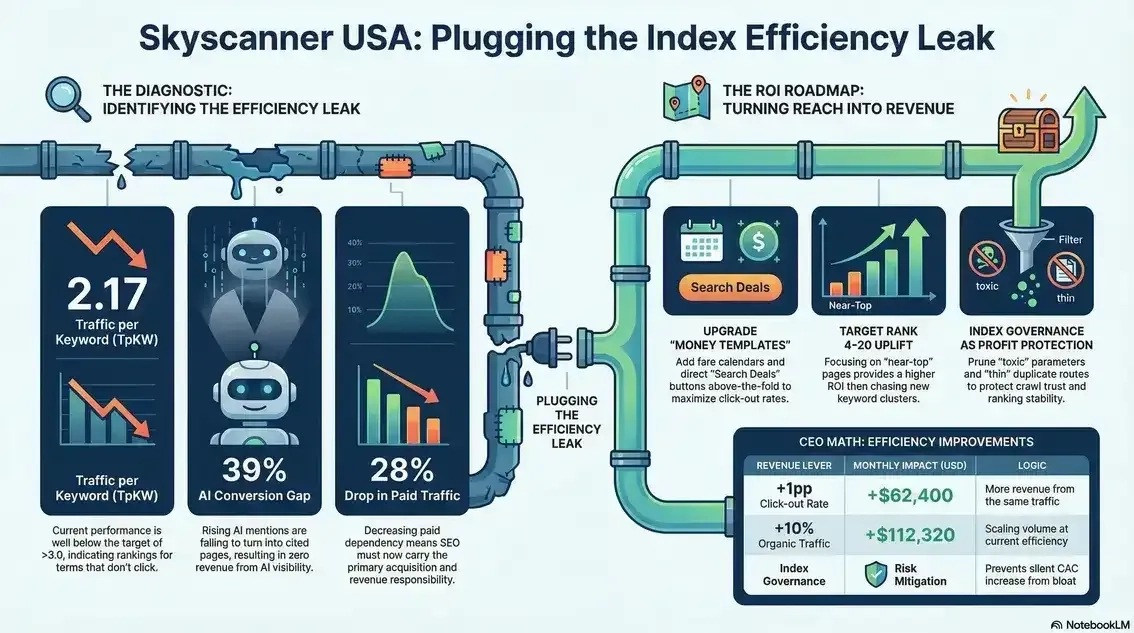
- Metric 1: Traffic per Keyword (TpKW). Current status: 2.17 (5.2M visits / 2.4M keywords). Goal: >3.0. A drop here means you are ranking for terms that don't click.
- Metric 2: AI Conversion Gap. You have 130.5K mentions but only 80.2K cited pages. Gap: 39% of your AI presence is unlinked mentions, which equals zero revenue.
- Metric 3: Paid/Organic Offset. Paid traffic is down 28%. SEO must now carry the revenue load.
Decision rules to keep the team focused:
- If TpKW < 2.5: pause new template expansion; prioritize pruning, consolidation, and quality upgrades.
- If AI citation rate < 70%: prioritize structured “AI-citable” blocks and schema on the highest-traffic templates.
- If paid keeps shrinking: do not fund low-intent content without an explicit routing path into money templates.
Revenue model (plain English, assumption-based)
Revenue Engine Modeler
Skyscanner monetizes SEO primarily through partner click-outs (users clicking to airlines/OTAs). I model value per click-out and click-out rate as ranges.
Assumptions (clearly labeled):
- Click-out rate from US organic sessions: 12% / 18% / 25% (Conservative / Base / Aggressive)
- Value per click-out: $0.75 / $1.20 / $1.80
- Estimated US organic sessions/mo (proxy): 5.2M
| Scenario | Click-outs/mo | Value/mo (USD) |
| Conservative | 624,000 | $468,000 |
| Base | 936,000 | $1,123,200 |
| Aggressive | 1,300,000 | $2,340,000 |
"CEO Math" Opportunity
| Lever | Why it matters | Base impact math (monthly) |
| +1pp click-out rate | More revenue from same traffic | 5.2M × 1% × $1.20 = $62,400/mo |
| +10% organic traffic | More volume at same efficiency | 520K sessions × 18% × $1.20 = $112,320/mo |
| Stop keyword growth turning into bloat | Protects crawl trust and ranking stability | Prevents silent CAC increase |
What I’d do next (ROI levers)
- Conversion upgrades on money templates (routes + hotel cities) before chasing more traffic.
- Rank uplift on near-top pages (positions 4–20) where CTR jumps.
- Template/index governance so scaling doesn’t dilute quality and rankings.
The Money Pages (what actually drives conversions)
Your AI “Cited Pages” list is the giveaway: AI is citing template pages like flight route templates, hotel city templates, and routes pages. That’s what matters commercially: templates scale.
Money Page Map (template → conversion path)
| Page type | Example URL pattern | Intent | Primary conversion action | Why it wins |
| Flights city→region | /flights/flights-from-city-to-region/.../cheap-flights-from-...-to-... | Transactional | Compare fares → click-out | Matches “cheap flights” intent at scale |
| Flights-to region | /flights/flights-to-region/.../cheap-flights-to-... | Comm/Trans | Compare + alert | Captures destination shoppers |
| Hotel city | /hotels/{country}/{city}-hotels/ci-... | Transactional | Compare hotels → click-out | High revenue density if UX is sharp |
| Routes | /routes/us/kr/united-states-to-south-korea.html | Commercial | Discover routes → click-out | Planning-stage feeder into bookings |
| Car rental hubs | /car-rental... | Commercial | Search → click-out | Strong unit economics if friction is low |
The Money Template Requirements Checklist To maximize the $1.20/click-out value, every "Money Template" must pass this audit:
1. Above-the-Fold (ATF) Utility:
- [ ] Fare Calendar: Immediate visualization of "Cheapest Month" or flexible dates.
- [ ] Direct Conversion Action: "Search Deals" or "View Flights" button visible without scrolling.
2. Decision Support Modules:
- [ ] Price Trend Graph: "Prices are currently High/Low" (Beats utility competitors).
- [ ] Booking Window: "Best time to book is 4 weeks out" (Beats airline direct sites).
3. Retention Layer:
- [ ] Price Alert Toggle: High-visibility toggle for email capture.
Prioritization Logic: Upgrade templates based on the "Revenue Density Score": (Traffic Volume × Transactional Intent % × Current Rank 4–10).
Market Reality: Competitor Benchmark (USA SERPs)
“The travel industry is a highly competitive niche.”
— Semrush (Travel SEO)

The SERP Win-Condition Playbook
| Competitor Type | Examples | Their Advantage | Skyscanner's Win Condition (Feature to Ship) |
| Airlines | United, AA | Loyalty & Brand | "Unbiased Comparison." Ship cross-airline price grids that airlines cannot show. |
| OTAs | Orbitz, Travelocity | Bundles/Deals | "Intent Routing." Ship faster "intent-to-template" speed (e.g., direct to "Cheapest Month" view). |
| Metasearch | Kayak, Momondo | SERP Packaging | "AI-Readiness." Structure data (price history, best time to fly) so AI must cite you. |
| Utilities | FlightAware | Deep Utility | "Decision Modules." Add "Best time to book" and "Price Trend" charts to route pages. |
"You can see in the data that direct airlines dominate on brand strength and customer loyalty, forcing aggregators like Skyscanner to compete purely on comparison utility. To see how a massive global brand footprint dictates organic visibility, take a look at how airlines map out [Airline Lead Generation]."
Competitor comparison (from your table)
| Domain | Category | Traffic proxy | SE keywords | What they win on | What Skyscanner can win on |
| united.com | Airline | 13M | 2.0M | Loyalty demand | “Best price across sellers” |
| aa.com | Airline | 19.2M | 2.4M | Brand strength | Faster comparisons + alerts |
| kayak.com | Metasearch | 8.8M | 5.1M | SERP packaging | Utility modules + AI routing |
| travelocity.com | OTA | 4.3M | 6.0M | Packaging/deals | Neutral + intent-to-template speed |
| flightaware.com | Utility | 7.9M | 3.7M | Product depth | Add “decision help” modules |
"While Skyscanner battles for routing supremacy as a metasearch engine, traditional OTAs rely heavily on packaging and direct deals to win the SERPs. To see how these bundle economics play out in organic search, compare this data to our programmatic blueprint for using [Travel SEO to Drives Profit in US]."
So what (business impact)
Google is effectively a marketplace: users are choosing between sellers of attention. Your advantage must be decision speed + trust + template depth.
What I’d do next (ROI levers)
Build a SERP playbook per archetype: “how we beat airlines/OTAs/utilities” with one decisive advantage each. Own “comparison intent” where direct brands struggle: cheapest month, flexible dates, multi-airline comparisons, price alerts.
Demand Mix (USA): Branded vs Non-branded + Intent

Branded vs Non-branded
| Demand type | Share | Business meaning |
| Branded | 31% | Efficient but capped by brand size |
| Non-branded | 69% | Scalable lever for market share |
Keywords by intent (USA)
Market Intent Distribution
Share of 2.4M tracked organic keywords in the USA
Keyword Share Visualization
| Intent | Share | Keywords | Traffic | Business meaning |
| Informational | 65% | 1.8M | 2.9M | Research mode; monetize via routing + alerts |
| Commercial | 19% | 523.4K | 761.5K | Shoppers comparing options |
| Transactional | 9.80% | 267.5K | 324.8K | Ready to book/click-out (highest $ density) |
| Navigational | 6.20% | 168K | 1.8M | Brand/platform seeking; defend SERP |
New KPI: Routing Efficiency (RE) Definition:
The percentage of sessions starting on an Informational page (e.g., "best time to visit Paris") that click through to a Commercial/Transactional Template (e.g., "Flights to Paris").
The Routing Optimization Protocol Transform "Research Mode" into "Revenue Mode" by embedding these specific modules:
| User Intent Layer | Current Status | Upgrade Module (The Fix) |
| Informational (65%) | Passive reading | Dynamic Widget: "Prices to [Destination] dropped 12% this week. See dates." |
| Commercial (19%) | Comparing | Price Alert Modal: "Track this route for <$500." Captures email for later monetization. |
| Transactional (9.8%) | Ready to book | Partner Handoff: Frictionless "Select -> Go to Site" button above the fold. |
Technical + Indexation “Leak” (frame as revenue loss)
Traffic down while keywords up is the classic “index efficiency” warning.
“If the copy of a web page isn’t indexed, that page is unlikely to rank.”
— Backlinko (Travel SEO guide)
The Index Governance Ledger (0-3 Scoring Protocol) Assign every URL pattern a score to determine its fate:
| Score | Status | Action | Target URL Pattern |
| 0 | Toxic | Noindex, Follow + Block Parameters | Parameter URLs with no unique inventory (e.g., ?sort=price&asc). |
| 1 | Thin | Canonical to Parent | Near-duplicate routes or "Hotels in [Tiny Village]" with <3 properties. |
| 2 | Standard | Index, Self-Canonical | Core City/Route pairs (e.g., "Flights to London"). |
| 3 | Money | Index + Priority Internal Links | High-Traffic Transactional Templates (e.g., "Cheap Flights NYC to LAX"). |
"Managing millions of dynamic sorting and filtering URLs without bleeding crawl budget is the ultimate technical hurdle for massive travel sites. We saw this exact same indexation challenge—and how to govern it effectively at scale—in our deep dive on building [Online Travel Agency SEO Strategy] architecture."
So what (business impact) :
Governance is not “technical SEO.” It’s profit protection.
What I’d do next :
Set publish thresholds: index only when a template has enough unique value to win and convert.
AI Search visibility as a moat (ChatGPT / AI Overview / Gemini)
“To beat AI, become more human.”
— Wesley van der Hoop via Backlinko
What the data says
| AI metric | Value | Trend | What it implies |
| AI visibility | 73/100 | Medium | Room to become category default |
| Mentions | 130.6K | +4.4K | Presence rising |
| Cited pages | 80.2K | -2.9K | Mentions not always turning into traffic |
Platform mix (from screenshots)
| Platform | Mentions | Cited pages (where shown) |
| ChatGPT | 35.3K | 41.4K |
| AI Mode | 44.0K | 35.8K |
| AI Overview | 22.7K | 13.3K |
| Gemini | 28.6K | 13.3K |
Prompt → Page cited → What user wanted → What Skyscanner should show next
The "AI-Citable By Design" Schema To turn mentions into citations, your templates must serve structured data LLMs can parse easily:
- Price History Block: <Table> with Low/Avg/High prices for the route.
- Rule Summary: Bulleted list of "Airlines flying this route" and "Flight duration."
- Booking Window Logic: Clear text stating "Book X weeks in advance for best price".
AI Landing Conversion Plan When a user clicks from ChatGPT (Intent: "Help me plan"), the landing page must immediately orient them.
- Requirement: Show a "Compare Now" module above the fold. Do not bury the flight search bar below text.
What I’d do next (ROI levers)
Make the top cited templates “AI-citable by design”: price trends, booking windows, airline rules summaries. Add a conversion path above the fold: Compare now + Set price alert.
Backlink moat (only what matters for ROI)
Macro
| Metric | Value | Meaning |
| Follow links | 123.87M | Strong authority transfer |
| Nofollow links | 1.74M | Small portion |
| Text links | 125.3M | Best for SEO strength |
Quality signal from ref-domain export
In the top ref-domain backlink volume, Skyscanner’s own network dominates.
| Ref domain set (export sample) | Backlinks in sample | Share |
| Skyscanner network domains | 64,857,693 | 99.94% |
| External domains | 42,056 | 0.06% |
So what (business impact)
The moat is not “125M backlinks.” The moat is that external authority competitors can’t copy easily. A network-heavy link profile can look huge, but it doesn’t always unlock new US clusters as efficiently as earned US authority links.
What I’d do next (90-day link plays)
| Play | Asset | Why it drives ROI |
| Data PR | US route “best time to book” + price trend reports | Earns high-authority links that lift money templates |
| Partnerships | airports, tourism boards, student travel hubs | Links + direct referral sessions |
| Reclaim | unlinked mentions + broken link recovery | Low-cost authority recovery |
| Seasonal newsroom | Spring break, Thanksgiving, summer routes | Links arrive when conversion intent spikes |
The P&L Model (CTR- & Intent-aware projection in USD)
“These new features reduce clicks on traditional blue links.”
— Backlinko (Travel SEO guide)
Model setup (assumptions)
CTR by rank (travel SERP conservative curve)
| Rank | CTR |
| 1 | 28% |
| 2 | 15% |
| 3 | 11% |
| 4 | 8% |
| 5 | 6% |
| 6 | 5% |
| 7 | 4% |
| 8 | 3% |
| 9 | 2.50% |
| 10 | 2% |
| 11–20 | 1.8% → 0.9% |
| 21–50 | 0.5% → 0.2% |
Primary conversion: partner click-out
Base assumptions: click-out rate 18%, value/click-out $1.20
Top 15 Keyword Projection (USA): Click + Revenue Uplift If Moved to Top 3
How this table was built (from the sheet you provided):
- Filtered to Position Type = Organic
- Kept keywords ranking positions 4–20
- Selected top 15 by US Search Volume
- Incremental uplift assumes movement to Rank #3 (CTR 11%)
- Incremental value/mo = (Search Volume × (0.11 − Current CTR proxy)) × 0.18 × $1.20
| Keyword | Current rank | US vol/mo | Intent | Current CTR (proxy) | Est. incremental clicks/mo | Est. incremental value/mo |
| google flights | 10 | 20,400,000 | Transactional | 2.00% | 1,836,000 | $396,576 |
| volaris | 8 | 673,000 | Comm/Nav | 3.00% | 53,840 | $11,629 |
| vuelos baratos | 10 | 368,000 | Comm/Info | 2.00% | 33,120 | $7,154 |
| cheap tickets | 7 | 246,000 | Comm/Nav | 4.00% | 17,220 | $3,720 |
| cheap hotels | 13 | 246,000 | Commercial | 1.60% | 23,124 | $4,995 |
| googleflights | 8 | 135,000 | Info/Trans | 3.00% | 10,800 | $2,333 |
| boletos de avion | 9 | 90,500 | Comm/Info | 2.50% | 7,692 | $1,662 |
| flights to denver | 8 | 74,000 | Commercial | 3.00% | 5,920 | $1,279 |
| boletos de avion baratos | 8 | 49,500 | Comm/Info | 3.00% | 3,960 | $855 |
| pasajes baratos | 10 | 49,500 | Comm/Info | 2.00% | 4,455 | $962 |
| flight ticket | 4 | 33,100 | Comm/Info | 8.00% | 993 | $214 |
| british airways flights | 5 | 33,100 | Info/Trans | 6.00% | 1,655 | $357 |
| cheap hotel | 7 | 27,100 | Commercial | 4.00% | 1,897 | $410 |
| book flights | 5 | 27,100 | Comm/Info | 6.00% | 1,355 | $293 |
| flights to denver colorado | 9 | 22,200 | Commercial | 2.50% | 1,887 | $408 |
Important note (planning discipline): “google flights” is a major outlier by volume. Keep it in the table because it’s in the dataset, but do not build the business case on a single head term. The CEO-grade plan is still the portfolio uplift across templates and clusters.
Rank-uplift scenarios (portfolio math, not one keyword lottery)
| Uplift scenario | Why it matters | Outcome |
| 4–10 → Top 3 | CTR jump is the biggest | Scales across template clusters |
| 11–20 → Top 3 | Often easiest wins | High ROI, lower effort |
Sensitivity (3 scenarios)
| Scenario | CTR compression | Click-out rate | Value/click-out | Business meaning |
| Conservative | 0.7x | 12% | $0.75 | Worst-case SERP click squeeze |
| Base | 1.0x | 18% | $1.20 | Reasonable planning assumption |
| Aggressive | 1.1x | 25% | $1.80 | Strong UX + strong partner economics |
Practitioner Notes: Action Plan Roadmap (Prioritized by Profit)
Keywords up, traffic down → fix efficiency first. Paid down → SEO must carry more revenue responsibility. AI citations exist at scale → monetize distribution you already earned.
14-Day Sprint Roadmap
Phase 1: Efficiency & Governance (Days 1–14)
- Day 1-3 (Governance): Audit URL parameters. Apply Noindex to "Score 0" patterns (sorting/filtering parameters).
- Day 4-7 (Template Conversion): Ship the "Price Alert" toggle and "Cheapest Month" view to the top 20 traffic templates.
- Day 8-14 (Intent Routing): Add the "Compare Now" widget to top 50 Informational blog posts.
Phase 2: Uplift & Expansion (Days 15–60)
- Week 3: Execute "Rank Uplift" on positions 4–10 using internal linking from the "Score 3" pages.
- Week 4: Roll out "AI-Citable" schema (Price Trends) to the top 1,000 Route pages.
A Travel SEO Agency should treat this as an operating plan: template conversion first, rank uplift second, and index governance as the compounding moat.
Final Summary
If you only fund 3 things (the Travel SEO Strategy that compounds bookings predictably)
- Template conversion upgrades (fastest measurable dollars).
- Rank uplift for near-top high-intent templates (CTR jump).
- Index/template governance (prevents scaling from turning into a tax).
Expected 6-month impact range (USD — modeled)
- Conservative: efficiency improvements only → meaningful incremental value, but muted by SERP compression.
- Base: conversion + selective ranking gains → strong compounding revenue effect.
- Aggressive: conversion + broad template wins + AI routing → outsized market share capture.
Risks + how I de-risk
| Risk | Business downside | De-risk action |
| Scaling creates bloat | Rankings volatility, higher CAC | Governance + publish thresholds |
| AI mentions don’t convert | Attention without revenue | Route citations to money templates |
| Overreliance on a few head terms | Fragile plan | Portfolio uplift across templates |
FAQs
Why are US keywords up (+8.8%) while traffic is down (-3.2%)?
Because footprint can grow via indexing while clicks don’t—CTR pressure, weak rank mix, or thin/duplicate pages. That’s an efficiency leak.
What matters more: 125.5M backlinks or 25K referring domains?
Referring domains. Backlink volume can be inflated by sitewide or network effects; unique domains are harder to copy and signal real authority.
Is AI Search worth investing in?
Yes. You already have scale (130.5K mentions, 80.2K cited pages). The ROI comes from making cited pages convert, not just getting cited.
Should we reduce informational content since informational is 64.8%?
No. Route informational pages into money templates, alerts, and comparisons. Information is only wasteful when it becomes a dead end.
What’s the single fastest win?
Template-level conversion upgrades on the highest-traffic and highest-citation pages.
Disclaimer
This teardown is based on third-party data only—primarily the SEMrush exports and AI Search screenshots provided (US traffic/keywords, authority, backlinks/referring domains, branded vs non-branded split, intent mix, competitor set, and AI visibility metrics), plus the US Organic Positions sheet (199 rows) used for the Top 15 keyword projection. We do not have GA4 access or any internal Skyscanner data (conversion rate, margins, attribution, or revenue). Skyscanner is not our client; this is an independent, external analysis. Where revenue is modeled, assumptions are clearly labeled with Conservative/Base/Aggressive sensitivity ranges. All projections are directional decision-support models, not guarantees.
- Log in to post comments


 INDIA
INDIA