


SEO For Travel Agency: GetYourGuide US SEO Teardown to Drive More Tour & Ticket Bookings
"This GetYourGuide teardown is part of Supramind’s specialized authority hub covering seo for tour operators and ticket booking platforms."
Table of Contents (TOC)
- Introduction — Why I Analyzed GetYourGuide’s SEO
- Executive Summary (US lens + Information Gain)
- Key Takeaways (At a Glance)
- My Audit Playbook for GetYourGuide SEO (US)
- SEO Snapshot (Ahrefs-Style View — US)
- Competitor Benchmark — US “Things To Do” SERP Reality
- The Money Pages That Drive Bookings
- CTR- & Intent-Aware Projection Model (Travel SEO Strategy)
- Trust Builders: Referring Domains That Move Rankings in Travel
- Backlink Quality & Distribution
- Technical SEO & Indexation Control for Marketplaces
- AI Citations / LLM Visibility as a New Moat for GetYourGuide SEO
- Site-Wide Booking Engine Projection (Organic → Booking)
- Practitioner Key Takeaways (Actionable Notes)
- Final Reflection
- FAQs (Travel & SEO)
- Disclaimer
GetYourGuide is already a monster in tours/activities search—and this teardown shows how it can turn US organic visibility into more bottom-funnel bookings for tours, attractions, tickets, museum passes, day trips, and city cards. In other words: a pragmatic SEO For Travel Agency playbook where the “win” isn’t traffic—it’s availability → time slot → checkout → booking.
This is a US-only lens (US queries, US search behavior, US conversion realities), while still acknowledging that US travelers book globally (Paris/Rome/Tokyo inventory matters because Americans search it).
Introduction — Why I Analyzed GetYourGuide’s SEO For Travel Agency Engine (US)
“Things to do” SERPs in the US are unusually brutal:
- Google’s Things to do modules and map experiences
- OTAs + marketplaces (Viator/Tripadvisor, Klook, etc.)
- Publishers (Lonely Planet / Rick Steves–style guides)
- City passes (Go City, CityPASS)
- Local operators with niche authority
- Review platforms + “best of” listicles
- Increasingly: AI answers that pre-filter choices
"Traditional OTAs are also aggressively bundling these exact tours and tickets with flight and hotel purchases to maximize their share of wallet. To see exactly how that broader bundle strategy plays out in the search results, take a look at our complete guide on dominating [Travel SEO USA]."
And yet, the same SERPs contain the largest commercial long tail in travel:
- Neighborhoods + landmarks (“Edge NYC tickets”, “Brooklyn Bridge tour”)
- Time-slot demand (“tickets tonight”, “last minute”, “same day”)
- Modifiers that correlate with conversion:
skip-the-line, free cancellation, wheelchair accessible, family-friendly, sunset, small group, VIP, refunds
Teardown focus (US):
- How GetYourGuide converts organic demand into bookings (city discovery → activity pages → checkout)
- How US behavior differs (mobile-first, weekend trips, same-day intent, “near me”, family planning)
- Three themes we’ll reuse throughout: SEO For Travel Agency, Travel SEO Strategy, GetYourGuide SEO
Executive Summary (US lens + Information Gain)
What GetYourGuide is doing well (US)
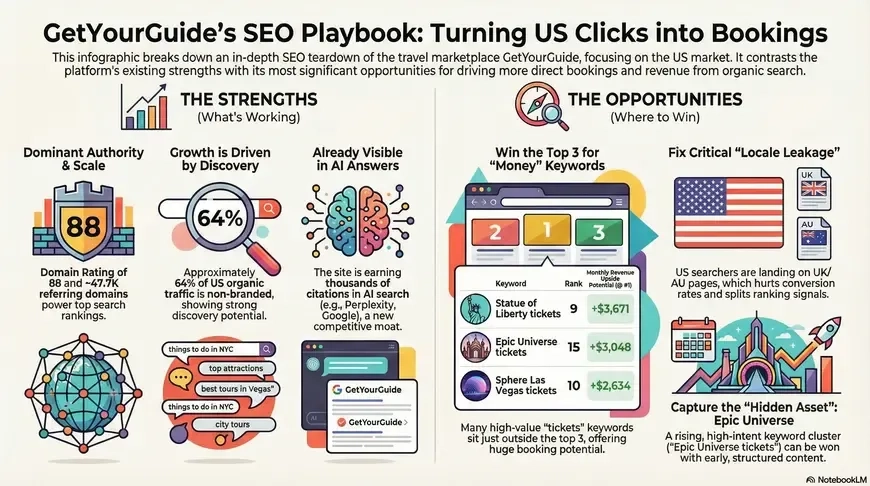
- Authority + scale: DR 88, ~47.7K referring domains, 28.5M backlinks—enough to compete in the most expensive “tickets” SERPs.
- Strong non-brand engine: US non-branded traffic is ~390.7K vs branded 218.7K (non-brand is the growth lever).
- Bottom-funnel keyword coverage exists: US “tickets” clusters like “Summit One Vanderbilt tickets”, “Statue of Liberty tickets”, “Sphere Las Vegas tickets” are already ranking (often page 1, not always top 3).
- AI discovery is real: AI citations are already showing up at scale (e.g., Perplexity ~2.8K vs ChatGPT ~1.7K citations).
Biggest opportunities (US)
- Win the top 3 where it prints money: Many high-volume US “tickets” terms sit around positions 6–15—a small rank uplift creates outsized booking lift.
- Fix “locale leakage” (hreflang / canonical alignment): US keywords are sometimes ranking to /en-gb/ or /en-au/ URLs (conversion + indexation drag).
- Indexation discipline for marketplace scale: Facets and near-duplicates can quietly cannibalize crawl budget and blur relevance.
- CTR is a growth channel: US SERPs are module-heavy; snippet + schema + “free cancellation / instant confirmation” messaging can materially change click share.
- AI citations moat: Turn city/attraction pages into “AI-quotable” sources (tables, itinerary blocks, comparison modules) and channel users to bookable inventory.
The four Information Gain questions — mini answers (and we’ll revisit)
- The Hidden Asset (keyword competitors missed):
Hypothesis with supporting signal: the emerging “Epic Universe tickets” cluster (US volume shows up high and growing) is a breakout opportunity where early structured pages can win before the SERP hardens. - The Technical Leak (index bloat / hreflang):
Strong signal from US keyword→URL mapping: multiple US keywords resolve to /en-gb/ or /en-au/ pages (example: “museum of illusions new york tickets” pointing to /en-gb/). That’s classic hreflang + canonical conflict territory. - The AI Footprint (Perplexity vs ChatGPT):
From the AI citations snapshot: Perplexity ~2.8K vs ChatGPT ~1.7K citations (US view). That gap is an actionable content-formatting and internal-linking opportunity. - The Revenue Math (direct booking vs portal lead):
Modeled, explained later: a direct booking can be ~2–4× more valuable than a “portal lead” (affiliate/referrer mediated booking) because you keep more margin (take rate) and own retention (account/app).
Key Takeaways (At a Glance)
- ✔ Money pages (city + attraction + “tickets” activity SKUs) capture the highest commercial intent.
- ✔ US growth is mostly non-branded discovery, not brand defense.
- ✔ A strong Travel SEO Strategy here is an architecture + indexation + CTR + conversion story.
- ✔ AI/LLM citations can become a moat for itinerary and “what to do” answers—if pages are built to be cited and to route users into bookable inventory.
My Audit Playbook for GetYourGuide SEO (US)
What I looked at (marketplace-specific)
- Snapshot metrics: authority, traffic, keyword counts, AI citations
- Top pages (US traffic estimates): what page types earn demand
- Top keywords (US): where rank uplift yields bookings
- Competitor benchmark: who wins which SERP layer (marketplaces vs publishers vs passes)
- Funnel mapping (US intent):
- Navigational: “getyourguide login”, “promo code”, “refund”
- Informational: “best things to do…”, “is GetYourGuide legit”
- Commercial: “statue of liberty tickets”, “sphere las vegas tickets”
- Transactional: “book … today”, “tickets tonight near me”
Marketplace trust (E-E-A-T) that actually converts
US travelers buy when pages reduce uncertainty:
- Reviews density + recency
- Clear inclusions/exclusions
- Meeting point clarity + map
- Accessibility
- “Free cancellation” and deadline windows
- Operator credibility + what to expect
SEO Snapshot (Ahrefs-Style View — US)
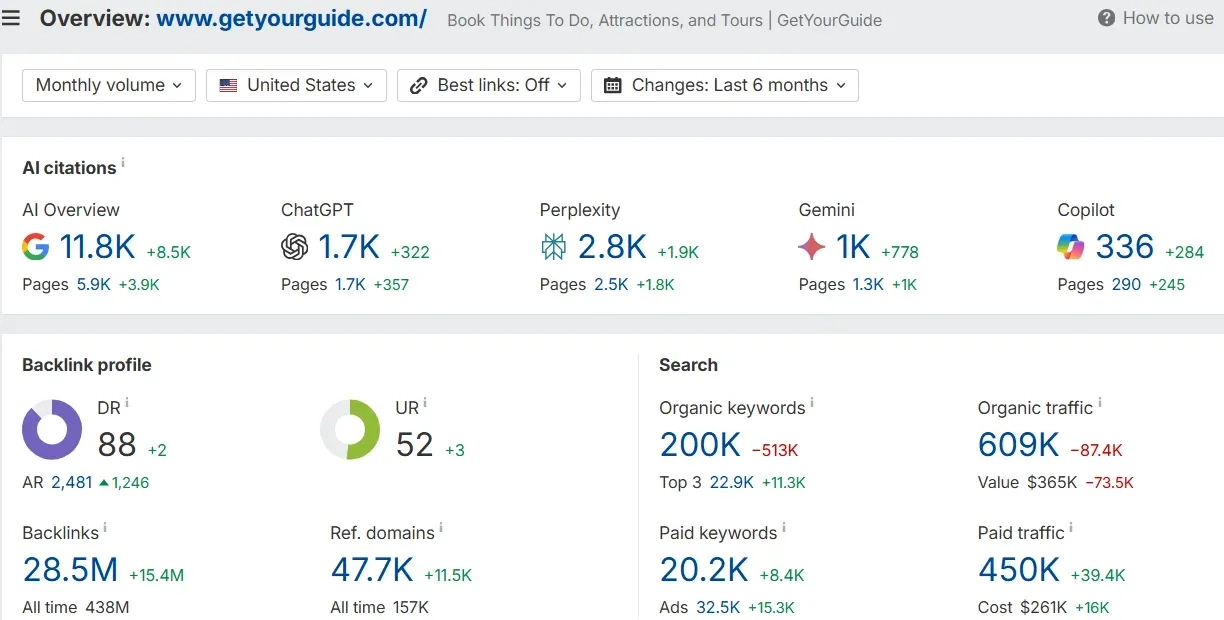
Source note: metrics below are from a user-provided Ahrefs snapshot/export (US database, monthly view, changes shown for last ~6 months). Treat as estimated.
| Metric (US) | Value |
| Domain Rating (DR) | 88 |
| URL Rating (UR) | 52 |
| Organic traffic (US est.) | 609K / month |
| Traffic value (US est.) | $365K / month |
| Organic keywords (US) | 200K |
| Top 3 keywords (US) | 22.9K |
| Referring domains | 47.7K |
| Backlinks | 28.5M |
| AI citations (Google AI Overview) | 11.8K |
| AI citations (Perplexity) | 2.8K |
| AI citations (ChatGPT) | 1.7K |
What GetYourGuide does well (from the snapshot)
- Authority is not the bottleneck: DR 88 + huge RD base.
- Non-brand scale exists (see intent split later).
- AI citations are already meaningful—this is not “future-only”.
What needs improvement (US lens)
- Win more Top 3 on commercial clusters (where CTR and bookings compound).
- Fix locale URL mismatches (US queries → /en-gb/ or /en-au/ pages).
- Indexation rules for faceted demand before it becomes crawl debt.
Competitor Benchmark (High Level) — US “Things To Do” SERP Reality
US “things to do” SERPs are a multi-surface competition:
- Marketplaces (Viator, GetYourGuide, Klook)
- Review ecosystems (Tripadvisor)
- Editorial winners (Rick Steves, Lonely Planet)
- Pass products (Go City, CityPASS)
- Google modules (Things to do, maps) as the default click sink
🇺🇸 US Competitor Benchmark: Traffic vs. DR
TripAdvisor excluded from linear scale scaling due to outlier volume (45.7M). Hover for details.
Benchmark table (US estimates)
| Domain | DR | Est. Traffic (US) | Notes |
| tripadvisor.com | 93 | 45.7M | Review + destination hub dominance (top-of-funnel + modules) |
| ricksteves.com | 76 | 998K | Publisher-like intent capture for itinerary/guide queries |
| viator.com | 89 | 880K | Closest marketplace competitor for “tickets/tours” SERPs |
| getyourguide.com | 88 | 609K | Strong marketplace inventory + booking UX |
| lonelyplanet.com | 89 | 426K | Editorial authority for “best things to do” |
| klook.com | 85 | 302K | Competitive in some attraction/ticket clusters |
| gocity.com | 75 | 255K | Pass product brand + city pass intent |
| citypass.com | 75 | 192K | Pass intent, strong city/attraction associations |
Where GetYourGuide is doing better
- Inventory breadth + marketplace UX (availability-first pages)
- Review volume and trust signals (when surfaced clearly)
- Bookable SKUs that publishers can’t match
Where competitors are ahead
- Publishers: itinerary queries + “best of” informational coverage
- Tripadvisor layer: review gravity + module placements
- Pass brands: “city pass” intent + deal framing
"While GetYourGuide focuses strictly on tours and tickets, alternative accommodation platforms are increasingly moving into this exact 'local experiences' search intent. To see how they use localized hubs to capture this untraditional discovery traffic, check out our masterclass on [SEO for Travel Website Organic Growth]."
The Money Pages That Drive Bookings (US)
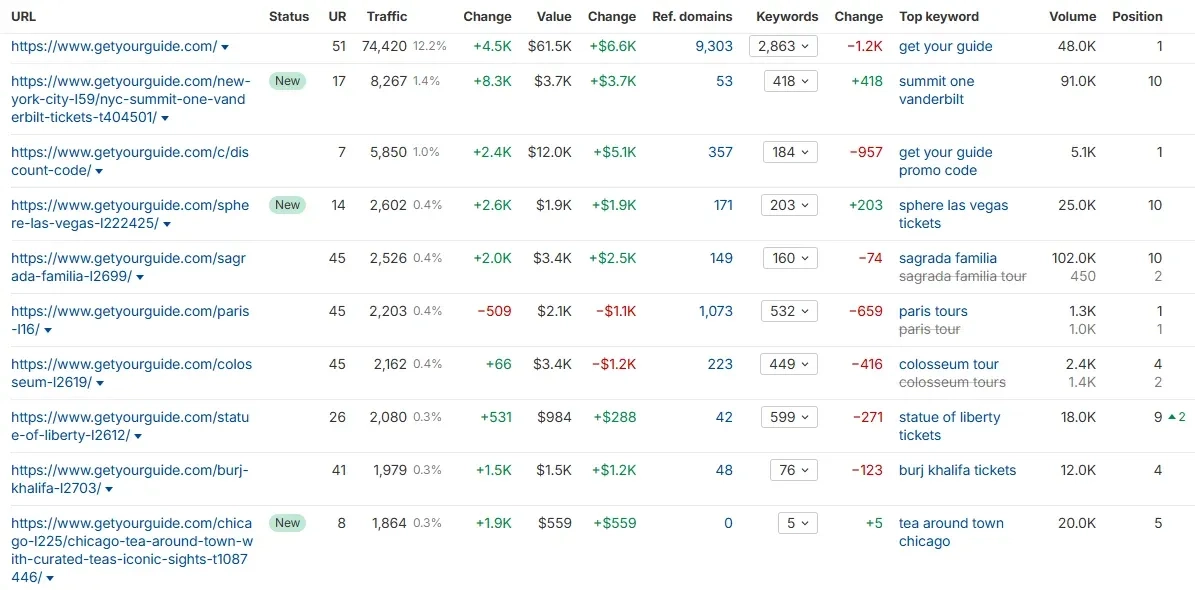
For marketplaces, “money pages” are the pages that move a user from idea → decision → time slot → payment.
Money page types (with examples)
| Page Type | Example URL pattern (generic) | Est. Visits (US) | Intent | Primary conversion |
| Homepage | / | High | Branded/nav | Search → city → SKU |
| City hub | /new-york-city-l59/ | High | Mixed | Browse → activity click |
| Attraction hub | /statue-of-liberty-l2612/ | High | Comm/Trans | Filter → SKU → time slot |
| Activity SKU page | /...-t123456/ | High | Transactional | Availability → checkout |
| Category page | /san-antonio.../family-friendly-activities-tc1094/ | Med | Info/Comm | Subcategory → SKU |
| Promo/trust | /c/discount-code/ | Med | Branded | Purchase enablement |
| Account/login | /login | Med | Navigational | Retention loop |
What the top-pages mix implies (US):
- City/attraction hubs + SKU pages are doing real work, but:
- A meaningful chunk of traffic lands on the homepage or promo pages—often a sign of brand navigation and coupon intent that can be better routed into bookable inventory.
What they do well
- Strong hub architecture: cities, attractions, categories, SKU pages exist.
- “Tickets” language shows up in URLs/keywords (strong US transactional cue).
What to improve (US booking focus)
- Internal linking ladder: city → category → attraction → SKU (and back)
- FAQ schema where it matters: cancellation windows, entry rules, ID requirements, accessibility
- Facet indexation policy: only index facets that represent stable, high-demand search intent
- US seasonal/event pages: Spring Break, summer weekends, Thanksgiving travel, major US events (sports, festivals)
Branded vs Non-Branded Breakdown (US)
From the intent snapshot:
| Split (US) | Keywords | Traffic |
| Branded | 37.9K | 218.7K |
| Non-branded | 162.5K | 390.7K |
Interpretation: ~64% of US organic traffic is non-branded. That’s the lever.
Example query sets
- Branded: “getyourguide”, “get your guide promo code”, “getyourguide login”
- Non-branded: “statue of liberty tickets”, “sphere las vegas tickets”, “edge new york tickets”
Traffic by User Intent (Overlapping)
| Intent (US) | Keywords | Traffic | What it means for bookings |
| Informational | 194.8K | 569.8K | Drives discovery; must funnel to bookable SKUs |
| Commercial | 60.3K | 318.5K | “Compare options” → strongest assisted conversion pool |
| Transactional | 35.8K | 242.4K | Highest conversion intent (“tickets”, “book”) |
| Navigational | 962 | 79.5K | Retention, support, coupons |
Key marketplace insight: informational traffic only matters if you deliberately connect it to inventory without cannibalizing transactional pages.
CTR- & Intent-Aware Projection Model (Travel SEO Strategy)
This model translates US search demand → estimated clicks → modeled bookings → modeled contribution for 10 high-intent “tickets” keywords. These are deliberately bottom-funnel terms (transactional intent), because this is where GetYourGuide turns organic visibility into direct bookings.
Model inputs & assumptions (US-only)
- Search Vol (US), Current Rank, Clicks/mo = from your exported keyword list (Ahrefs “Current organic traffic” estimate, not GA).
- Implied CTR = Clicks/mo ÷ Search Volume (shows how module-heavy the SERP is for each term).
- CVR (modeled) = varies by attraction complexity (2.0%–3.2%).
- AOV (proxy) = realistic ticket price proxy by attraction.
- Contribution proxy = Bookings × AOV × 22% (take-rate / contribution margin proxy; adjust to your real margin).
All numbers below are modeled (except the Ahrefs-est. clicks/positions). Use it as a decision framework, not a forecast.
💰 Revenue Model: Direct vs. Portal
Calculate the "Contribution Proxy" (22% Margin) vs. Affiliate Commissions.
Projection table (US) — Transactional “tickets” cluster
| Keyword | Search Vol (US) | Rank | Implied CTR | Clicks/mo (Ahrefs est.) | CVR (modeled) | Bookings/mo (modeled) | AOV (proxy) | Contribution/mo (proxy) |
| summit one vanderbilt tickets | 17,000 | 4 | 9.60% | 1,626 | 3.00% | 48.8 | $150 | $1,610 |
| statue of liberty tickets | 34,000 | 9 | 3.40% | 1,146 | 2.60% | 29.8 | $140 | $918 |
| sphere las vegas tickets | 23,000 | 10 | 2.40% | 559 | 2.80% | 15.7 | $170 | $585 |
| epic universe tickets | 59,000 | 15 | 0.80% | 481 | 2.00% | 9.6 | $180 | $381 |
| burj khalifa tickets | 9,000 | 4 | 12.30% | 1,104 | 2.80% | 30.9 | $150 | $1,020 |
| notre dame cathedral tickets | 7,500 | 5 | 8.70% | 649 | 2.20% | 14.3 | $85 | $267 |
| teamlab planets tickets | 7,900 | 6 | 6.60% | 524 | 2.40% | 12.6 | $65 | $180 |
| sistine chapel tickets | 4,500 | 4 | 12.50% | 561 | 3.00% | 16.8 | $120 | $444 |
| museum of illusions new york tickets | 4,100 | 3 | 12.80% | 525 | 3.20% | 16.8 | $55 | $203 |
| frick collection tickets | 4,400 | 4 | 9.40% | 415 | 2.80% | 11.6 | $60 | $153 |
Technical flag worth noting: the “museum of illusions new york tickets” keyword is currently ranking to a /en-gb/ URL variant in your export—this is exactly the kind of locale/hreflang + canonical alignment leak that can suppress US conversion and split signals.
Roll-Up Summary (Modeled)
- Total clicks/mo (Ahrefs est.): 7,590
- Total bookings/mo (modeled): 206.9
- Blended contribution per booking (proxy): ~$27.9
- Total monthly contribution (proxy): ~$5,762 / month
Rank-Uplift Opportunity (US) — What happens if we push to #1?
Below is a modeled “rank #1” scenario using a conservative approach:
- We apply a position→#1 click multiplier (based on typical module-suppressed CTR jumps),
- and cap max clickshare at 20% of search volume to avoid unrealistic outcomes.
| Keyword | Rank now | Clicks now | Clicks @ #1 (modeled) | Contribution now | Contribution @ #1 | Monthly upside |
| epic universe tickets | 15 | 481 | 4,329 | $381 | $3,429 | +$3,048 |
| statue of liberty tickets | 9 | 1,146 | 5,730 | $918 | $4,589 | +$3,671 |
| sphere las vegas tickets | 10 | 559 | 3,074 | $585 | $3,220 | +$2,634 |
| summit one vanderbilt tickets | 4 | 1,626 | 3,089 | $1,610 | $3,059 | +$1,449 |
How to use this: this is your SEO prioritization stack—keywords where a few rank positions create a disproportionate booking + margin lift.
Why This Model Matters for SEO For Travel Agency Economics
For US-led growth teams, this is the difference between “we got more traffic” and “we got more bookings”:
- Transactional clusters are compounding assets: rankings + CTR + conversion improvements stack together.
- It tells you where to focus content + internal linking + schema + CRO (not random TOFU expansion).
- It frames direct booking vs portal lead economics:
- Direct booking (on GetYourGuide) captures take rate + retention (account/app).
- A portal lead (aggregator/affiliate click) often trades away margin and repeatability.
- In practice, direct bookings are typically ~2–4× more valuable long-term when you include contribution margin + repeat purchase lift (modeled; calibrate with your real LTV).
If you want, I can also format this model into a city/attraction cluster roadmap (NYC + Vegas + Orlando + “global-from-US” like Dubai/Rome/Paris) so the SEO team and supply team can align on what to build first.
Trust Builders: Referring Domains That Move Rankings in Travel
Travel marketplaces rank better when links come from places that imply real-world legitimacy:
- Tourism boards + city convention bureaus
- Museums, attractions, universities (event pages, visitor resources)
- Major publishers (travel/lifestyle)
- Partnerships + affiliates (when managed cleanly)
- High-authority review ecosystems
In travel, links influence:
- competitiveness for city/attraction SERPs
- conversion (users trust what the internet trusts)
Backlink Quality & Distribution (US context)
Snapshot signals:
- Referring domains: 47.7K
- Followed: 36,285 (76.1%)
- Not followed: 11,406 (23.9%)
- Backlinks: 28.5M
- Followed: 17.3M (60.8%)
- Not followed: 11.2M (39.2%)
- Nofollow: 9.36M (32.8%)
- Sponsored: 2.70M (9.5%)
What’s good
- Scale and diversity are strong.
- Followed RD share is healthy for a marketplace at this size.
What’s risky / improvable
- Link distribution skews toward lower-authority sources (common for marketplaces and affiliates). In the DR-bucket view, ~67.6% of links sit in DR 0–39 ranges.
- Sponsored/nofollow footprint suggests heavy partner/affiliate surfaces—fine, but it increases the need for editorial-grade links that help win top 3.
US link acquisition plays that actually move the needle
- City cluster PR: “Most booked experiences by city (US)”, “ticket price index”, “best time to visit” datasets
- Event-driven assets: major sports weekends, festivals, conferences
- Attraction partner links: visitor resources pages that link to booking options (where allowed)
Technical SEO & Indexation Control for Marketplaces (SEO For Travel Agency scale)
This is where GetYourGuide SEO either compounds—or leaks.
Marketplace technical priorities (US)
- Faceted navigation: crawl/index control
- Canonicals that reflect the primary page version
- Noindex for thin or infinite filter combinations
- Parameter handling for sort/calendar/session parameters
- Duplicate/near-duplicate prevention
- Core Web Vitals on mobile (US behavior is mobile-first)
- Structured data where valid:
- Breadcrumbs
- FAQ (policy + entry rules)
- Reviews/ratings markup (only where compliant and accurate)
"Managing these millions of 'things to do' filters without bleeding crawl budget is the ultimate technical hurdle for massive travel marketplaces. We saw this exact same faceted indexation challenge—and how to govern it effectively at scale—in our blueprint for building enterprise [SEO Strategy for OTA] architecture."
Internal linking architecture (US booking ladder)
- US city hub → categories → attractions → SKU clusters
- Seasonal/event pages that don’t cannibalize city hubs
- “Related experiences” modules that reinforce topical clusters
The Technical Leak (explicit answer): hreflang/locale leakage + index confusion
Observed signal (from US keyword→URL export):
Some US keywords rank to /en-gb/ and /en-au/ URLs (examples include “museum of illusions new york tickets”, “brooklyn bridge tickets”, “alcatraz prison tours”, and even a US “destin dolphin cruise” landing on /en-au/).
That usually indicates at least one of:
- missing or incorrect hreflang return tags
- canonicals pointing to the wrong locale
- inconsistent x-default strategy
- orphaned locale pages getting indexed and winning by accident
- internal links pushing the wrong locale for US users
Why this costs money
- Conversion drag: wrong currency/phrasing/policy expectations reduce checkout completion.
- Ranking drag: Google sees competing variants and splits signals.
- Crawl waste: variants multiply across filters and locales.
How to validate (replicable)
- Crawl a sample of top US city/attraction/SKU pages:
- Verify hreflang sets include en-us (or correct US mapping), return tags, and consistent canonicals.
- In GSC (US property/view):
- Inspect URL indexation for locale paths (/en-gb/, /en-au/) appearing under US queries.
- In log files:
- Look for crawl spikes on parameterized + locale variants.
Fixes (prioritized)
- Align canonical + hreflang: canonical must match the target locale version.
- Ensure US internal links prefer US URL variants consistently.
- Consolidate thin locale duplicates with noindex or stronger canonicalization.
- Define x-default and region mappings so Google stops “guessing”.
AI Citations / LLM Visibility as a New Moat for GetYourGuide SEO
AI answers increasingly shape “what to do” decisions:
- “What are the best things to do in Boston?”
- “Weekend itinerary for Chicago”
- “How to visit the Statue of Liberty”
- “Best neighborhoods in LA for tourists”
The AI Footprint (explicit answer)
🤖 AI Citations & Visibility
From the AI citations snapshot (US view):
- Perplexity ~2.8K citations
- ChatGPT ~1.7K citations
- Google AI Overview citations are even larger at ~11.8K
Interpretation: GetYourGuide is already being referenced, but it’s under-leveraging the format that AI systems cite most.
How to earn more citations (and convert them)
AI engines cite pages that are:
- structured (tables, lists, comparisons)
- explicit (short factual blocks)
- internally consistent (clear hierarchy and interlinking)
High-impact page modules to add (US city + attraction pages):
- “Top experiences (by traveler type)” table: families / couples / solo / accessible
- “2-day / 3-day itinerary” blocks with internal links to bookable SKUs
- “Know before you go” (entry rules, ID, time-slot strategy)
- “Cancellation/refund clarity” in scannable bullets
- “If you’re also considering…” comparisons (avoid cannibalization by keeping it on hub pages, not SKU pages)
This is where GetYourGuide SEO becomes AI-resilient: you become the source, not just the listing.
Site-Wide Booking Engine Projection (Organic → Booking) — Modeled
A marketplace SEO funnel (US) usually looks like:
- Organic visits (US): 609K / month (est.)
- City/attraction hub views: 30–45% of visits
- Activity SKU clicks from hubs: 20–35%
- Activity → checkout start: 6–10%
- Checkout completion: 45–60%
- Repeat bookings via account/app: 10–20% over time
Even small lifts compound:
- +10% hub→SKU CTR (better UX + filters + modules)
- +0.3pp SKU CVR (trust + clarity + policy)
- +1 rank in top transactional clusters (CTR lift)
That’s why a serious Travel SEO Strategy is part growth, part product.
Practitioner Notes (Actionable) — A US Roadmap for SEO For Travel Agency Teams
US city cluster roadmap (sequenced)
- Top demand cities: NYC, Las Vegas, Orlando, Miami, Chicago, LA, SF, DC, Boston, San Diego
- For each city:
- top categories (museums, cruises, shows, day trips)
- top attractions (“tickets” clusters)
- SKU pages + availability UX
- Add seasonal layers:
- Spring Break
- summer weekends
- Thanksgiving/holiday travel
- major events (sports, festivals)
Indexation policy for filters (what to index)
- Index: stable, high-demand intent facets (e.g., “skip-the-line”, “family-friendly” at hub level if unique)
- Don’t index: infinite combinations (calendar/time-slot/session/sort), thin neighborhoods, near-duplicate filter stacks
Conversion improvements on activity pages (US)
- Put “Free cancellation until X” above the fold
- Show availability confidence (remaining spots, next available slot)
- Meeting point + map preview immediately
- Accessibility + “who this is for” scannable blocks
- Reviews: distribution + recent highlights
The Hidden Asset (explicit answer + how to win it)
Hidden asset candidate: “Epic Universe tickets” (high US volume and rising) plus the adjacent cluster (opening timelines, packages, express access, “how to visit”, “best days”, “what’s included”).
Why it’s high intent
- “Tickets” + theme park implies near-purchase behavior.
- Early SERPs are often messy (publishers, forums, partial pages), so a structured marketplace page can win.
What page type should win it
- A dedicated attraction hub + tightly-linked SKU inventory pages, supported by:
- entry rules
- date strategy (best time/day)
- comparison modules (ticket types, add-ons)
- FAQ schema
How to build the moat
- Internal links from Orlando hub → theme park category → Epic Universe hub → SKUs
- PR links from travel/news/event coverage (launch milestones, demand trends)
- AI-friendly modules so the page becomes a cited source
Final Reflection
GetYourGuide SEO (US) isn’t a content volume problem. It’s an execution compounder:
- Architecture that routes discovery to inventory
- Trust that removes booking friction
- Index discipline that prevents scale from becoming crawl debt
- CTR optimization for module-heavy SERPs
- AI readiness that turns citations into customers
Marketplaces that do this now build a 3–5 year compounding advantage in US acquisition.
FAQs (Travel & SEO)
How can a tours and activities marketplace increase bookings from SEO in the US?
Prioritize transactional clusters (tickets and tours), strengthen hub-to-SKU internal linking, improve CTR with clear snippet messaging, and reduce on-page friction around availability, cancellations, and meeting points.
Which pages matter most: city, attraction, or activity pages?
All three serve different roles: city hubs drive discovery, attraction hubs help users narrow decisions, and activity pages act as the conversion engine. A strong travel SEO strategy connects them without cannibalization.
Should tours and activities marketplaces index faceted pages?
Only selectively. Index facets with stable, high-demand intent and noindex or canonicalize the rest to prevent index bloat and ranking signal dilution.
How do you measure SEO ROI for travel experiences?
Map keywords to clicks, hub CTR, SKU views, checkout starts, bookings, and contribution margin (take rate). Segment by intent, as transactional queries typically generate the highest direct ROI.
How does AI visibility impact bookings for travel marketplaces?
AI answers compress discovery. Earning citations through tables, itineraries, and “know before you go” content positions you as the source and routes users into bookable SKUs—now a core part of modern travel SEO.
Disclaimer
This teardown is based on user-provided SEO tool exports/snapshots and modeled assumptions where conversion/CTR economics are required. All revenue, CTR, and conversion figures are illustrative unless independently verified via internal analytics.
- Log in to post comments


 INDIA
INDIA