


Ecommerce SEO Expert Analysis: How Sephora USA Turns Search Visibility Into Revenue Growth
Brand: Sephora
Market: USA
Industry: Beauty Products
Primary conversion: Add to Cart / Checkout / Purchase
Secondary conversion: Sign In
This Sephora teardown is part of Supramind’s central resource hub dedicated to comprehensive Ecommerce SEO Services.
Table of Contents
TL;DR
How to Read This Teardown
Introduction
Executive Hook
Leak Locator
Revenue Model
CEO Math
The Money Pages
Market Reality
Demand Mix
Routing Efficiency
Technical and Indexation Leak
AI Search Visibility as a Moat
Backlink Moat
P&L Model
Roadmap
Final Summary
TL;DR
What matters commercially
- Sephora already has a very large SEO engine in the US: 11.3M organic traffic, 1.8M organic keywords, 84 authority score, 5.2M backlinks, and 103.1K referring domains. This is not a visibility problem. It is a revenue mix and routing problem.
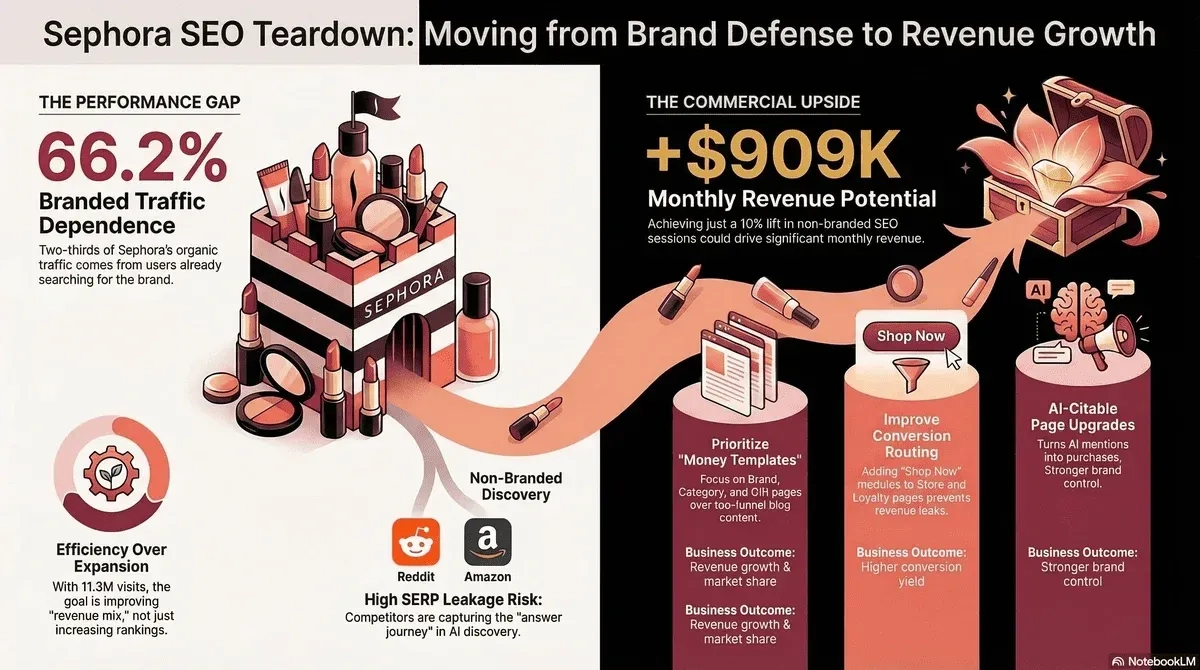
- The biggest commercial issue is brand dependence. The traffic split shows 66.2% branded vs 33.8% non-branded. In plain English, SEO is doing a very strong job protecting existing demand, but a smaller job creating net-new demand.
- The most valuable SEO assets are clearly template pages, not generic content: brand pages, category pages, gift pages, store pages, sale/event pages, and product pages.
- AI visibility is already meaningful in the US: Visibility 82, 145.1K mentions, 33.2K cited pages. That is a real distribution channel now, but Sephora still does not fully control the answer journey because major cited ecosystems include Reddit, YouTube, and Amazon.
- Sephora is competing on multiple fronts at once: Ulta and Kohl’s for retail demand, Allure and Byrdie for research demand, and Fragrantica for fragrance comparison demand.
- The commercial upside comes from shifting more SEO effort into non-branded, high-intent, AI-citable, conversion-friendly templates.
Top 3 funded priorities
| Priority | Why I would fund it | Business outcome |
| Non-branded commercial template growth | Expands beyond branded demand | Revenue growth, market share, CAC relief |
| Store / gift / loyalty routing improvements | Monetizes existing high-volume visits better | Higher conversion yield, more sign-ins |
| AI-citable commercial page upgrades | Turns mentions into purchase journeys | More assisted revenue, stronger brand control |
How to Read This Teardown
What the data says
- I am treating this as a commercial growth teardown, not a technical SEO checklist.
- Every section connects SEO performance to one of these outcomes: revenue, orders, sign-ins, CAC relief, margin protection, or market share.
- Where Sephora’s internal conversion data is not available, I use reasonable ecommerce proxy assumptions and label them clearly.
- I am using the USA market lens first, because the uploaded market-level overview is US-specific and US is clearly Sephora’s main organic revenue market.
So what
This matters because a large brand can look healthy in SEO dashboards while still leaving real money on the table through:
- too much branded dependence,
- weak movement from discovery to commerce,
- poor template economics,
- or AI visibility that does not convert.
What I’d do next
I would use this teardown to make budget allocation decisions, not just SEO decisions.
Introduction
What the data says
Sephora is already highly visible in search. The real business question is not, “Can Sephora rank?” It already can.
The real question is:
How does Sephora USA turn an already large SEO footprint into more non-branded revenue, stronger conversion routing, and better protection against AI-driven discovery shifts?
So what
For a business of this size, the risk is not invisibility. The risk is inefficiency at scale.
If branded traffic dominates too much, if store and gift pages are not routed well, or if AI answer engines cite Sephora without pushing users into commercial journeys, then the brand leaks revenue quietly.
What I’d do next
I would manage SEO like a growth portfolio with three levers:
- acquisition expansion,
- conversion routing,
- and answer-engine control.
Executive Hook
What the data says
KPI Snapshot
Executive KPI Snapshot
Hover over the metrics below to reveal the strategic business translation.
AI Platform Mention Distribution
| KPI | Exact screenshot data | Business read |
| Authority / trust | 84 | Strong ranking durability |
| Organic traffic (US) | 11.3M | SEO is already a major acquisition engine |
| Organic keywords (US) | 1.8M | Broad discoverability |
| Paid traffic (US) | 376.9K | Organic is doing far more heavy lifting than paid |
| Paid keywords (US) | 1.6K | Paid footprint is narrow vs organic footprint |
| Backlinks | 5.2M | Strong link moat |
| Referring domains | 103.1K | Strong authority breadth |
| Traffic share | 25% | Large market presence |
| Branded vs non-branded | 66.2% / 33.8% | Heavy reliance on existing brand demand |
| SERP feature mix | Organic 86.1% / AI Overviews 1.2% / Other SERP Features 12.7% | Organic still dominates, but SERP leakage is real |
| AI visibility (US) | Visibility 82 / Mentions 145.1K / Cited Pages 33.2K | AI is already a meaningful discovery channel |
| AI platform mentions | ChatGPT 30.4K / AI Overview 36.8K / AI Mode 30.5K / Gemini 47.3K | Visibility is diversified across answer engines |
| Worldwide organic traffic | 16.6M | Large global SEO footprint |
| US share of worldwide organic traffic | 11.3M of 16.6M | US is the core SEO revenue market |
So what
My read is straightforward:
- Sephora has scale.
- Sephora has trust.
- Sephora has visibility.
- Sephora’s next win is efficiency and mix improvement, not basic SEO expansion.
The most important executive signal here is the gap between huge visibility and brand-heavy demand mix.
That tells me SEO is excellent at harvesting existing demand, but there is still room to grow market share through non-branded purchase intent.
What I’d do next
I would shift the leadership conversation away from “more rankings” and toward:
- more non-branded commercial sessions,
- better template-to-cart yield,
- stronger AI-to-commerce continuity.
The Bottom Line
What matters commercially for Sephora USA.
The Moat is Massive
Sephora has 11.3M US organic traffic and 5.2M backlinks. This is not a visibility problem. They already have the engine and the authority to rank for almost anything.
The Revenue Leak
66.2% of traffic is branded. SEO is doing an incredible job aggressively protecting existing demand, but it is under-creating net-new discovery in competitive categories.
The Fix
Shift focus to non-branded commercial templates. Tighten conversion routing on store and gift pages, and upgrade pages to capture AI-cited journeys before competitors do.
Leak Locator
What the data says
I use a few custom efficiency metrics to spot the biggest commercial leaks quickly.
| Metric | Formula | Current level | Threshold | What it means commercially |
| Brand Dependence Ratio | Branded traffic share | 66.20% | >60% = high | SEO is protecting demand more than creating it |
| US Revenue Concentration | US traffic / worldwide traffic | 68.10% | >50% = high | US SEO changes matter disproportionately to revenue |
| Purchase-Intent Keyword Share | Commercial + transactional keywords | 51.20% | >45% = strong | The market contains enough monetizable demand to justify heavy template investment |
| AI Citation Density | Mentions / cited pages | 4.37 | >3 = concentrated | Fewer high-value pages can influence many mentions |
| Link Density | Backlinks / referring domains | 50.4 | >20 = strong | Authority is durable and scalable |
| Follow Link Ratio | Follow / total visible links | 87.90% | >70% = healthy | Strong link equity transfer |
So what
This tells me:
- Sephora’s problem is not weak authority.
- Sephora’s problem is not weak market presence.
- Sephora’s biggest commercial opportunity is making more of its SEO footprint behave like a revenue engine instead of only a branded defense engine.
What I’d do next
I would use these metrics as management guardrails:
- bring branded dependence down over time,
- grow non-branded commercial traffic,
- raise the share of AI-cited pages that can actually convert.
Revenue Model
What the data says
The primary SEO conversion path is:
SEO landing page → product/category/brand/store journey → add to cart → checkout → purchase
The secondary path is:
SEO landing page → sign in / loyalty action
I do not have GA4 or internal conversion data, so I am using proxy assumptions for directional modeling only.
Assumptions
| Scenario | % of US organic traffic landing on purchase-ready templates | Purchase CVR assumption | AOV assumption | Notes |
| Conservative | 8% | 2.00% | $65 | Tighter model, lower purchase-ready share |
| Base | 12% | 2.80% | $85 | Reasonable model for a strong beauty ecommerce brand |
| Aggressive | 16% | 3.50% | $100 | Assumes stronger routing and merchandising efficiency |
Scenario Model
| Scenario | Modeled purchase-ready SEO sessions | Modeled monthly orders | Modeled monthly revenue proxy |
| Conservative | 904,000 | 18,080 | $1.18M |
| Base | 1,356,000 | 37,968 | $3.23M |
| Aggressive | 1,808,000 | 63,280 | $6.33M |
So what
The commercial takeaway is simple:
At Sephora’s scale, even modest improvements in template mix, session routing, or page conversion yield can produce meaningful monthly revenue impact.
What I’d do next
I would track these three operational metrics weekly:
- non-branded commercial sessions,
- cart-capable landing page share,
- template-level conversion yield.
"Use the sliders below to see how even a 2% shift in conversion routing impacts Sephora's monthly revenue."
Interactive SEO Revenue Simulator
Model the business impact of routing optimization. Adjust levers to see how routing traffic to "cart-capable" templates impacts revenue.
Target: Move users from low-intent pages to brand/category/PDPs.
Modeled Monthly SEO Revenue
*Based on proxy US organic baseline of 11.3M monthly sessions.
CEO Math
What the data says
I like to reduce the opportunity into a few simple business levers.
| Improvement | Input | Monthly upside proxy |
| Lift non-branded SEO sessions by 5% | Non-branded traffic proxy = 3.82M sessions | +$454.6K / month |
| Lift non-branded SEO sessions by 10% | Same base | +$909.2K / month |
| Lift non-branded SEO sessions by 15% | Same base | +$1.36M / month |
| Improve “valentino perfume” from rank 4 into a top-3 CTR band | Volume 246K, traffic 10.8K | +$21.1K / month |
| Improve routing on “sephora near me” by 1% | Traffic 360K | +$8.6K / month |
| Improve routing on “sephora near me” by 2% | Same base | +$17.1K / month |
| Improve routing on “sephora near me” by 4% | Same base | +$34.3K / month |
| Improve gift / sale / loyalty bridge modules by 5% | Combined traffic proxy = 129.7K | +$15.4K / month |
| Improve gift / sale / loyalty bridge modules by 10% | Same base | +$30.9K / month |
So what
For Sephora, the biggest upside is not squeezing a little more from branded brand-defense terms.
The biggest upside is:
- more non-branded high-intent traffic,
- better routing from mixed-intent pages,
- and stronger monetization of already-ranked assets.
What I’d do next
I would fund in this order:
- non-branded commercial page growth,
- routing improvements on store / gift / loyalty pages,
- rank and CTR lifts on high-intent pages already close to top positions.
The Money Pages
What the data says
The screenshots make it very clear which page types are commercially valuable.
| Page Type | Example URL Pattern | Intent | Primary Conversion Action | Why It Wins |
| Store pages | /happening/stores/... | Navigational + local transactional | Visit store, browse, sign in, shop | “sephora near me” drives 360K traffic |
| Gift card page | /beauty/giftcards | Transactional | Purchase gift card | Direct monetization |
| Birthday / loyalty pages | /beauty/birthday-gift | Loyalty + transactional | Sign in, redeem, shop | Bridges loyalty into revenue |
| Sale / event page | /beauty/black-friday | Transactional | Shop deals | Event-driven conversion intent |
| Homepage | / | Mixed | Route to categories, offers, brands | Captures brand sale intent |
| Brand landing pages | /brand/kayali, /brand/valentino/perfume, /brand/tom-ford/fragrance | Commercial | Browse and add to cart | Strong brand-intent capture |
| Category pages | /shop/value-sets, /shop/lip-liner-lip-pencils | Commercial / transactional | Compare and add to cart | Lower-funnel category demand |
| Product pages | /product/... | Transactional | Add to cart / purchase | Highest direct purchase intent |
So what
This is why I would not lead with “more blog content.”
Sephora’s money is in the templates that help people choose and buy, not in generic top-funnel content alone.
What I’d do next
I would prioritize improvement work on:
- fragrance brand pages,
- gift and value-set pages,
- store pages,
- category pages with strong decision support,
- product pages with stronger comparison and cross-sell logic.
Market Reality
What the data says
Competitor Benchmark
| Domain | Category | Traffic Proxy | Overlap / Keyword Proxy | What They Win On | What Sephora Can Win On |
| ulta.com | Direct beauty retailer | 12.3M | 208.6K common keywords / 2.2M SE keywords / 39% competition | Retail breadth and overlap | Prestige assortment, premium brand pages |
| allure.com | Beauty publisher | 5.2M | 126.2K common keywords / 1.6M SE keywords / 28% competition | Editorial discovery and “best” content | Better commerce routing from discovery |
| byrdie.com | Beauty publisher | 3.2M | 112.9K common keywords / 1.6M SE keywords / 23% competition | Research and education | Stronger decision support on commercial pages |
| kohls.com | Retailer | 12.8M | 61.8K common keywords / 3.7M SE keywords / 15% competition | Retail scale and distribution | Beauty depth and premium authority |
| fragrantica.com | Fragrance community / comparison | 3.2M | 61.1K common keywords / 1.3M SE keywords / 15% competition | Fragrance discovery and comparison | Buy-ready fragrance landing pages |
So what
Sephora is competing against three different business models at once:
- retailers,
- publishers,
- and discovery communities.
That means Sephora needs to win not just on ranking, but on bridging research into purchase better than each of those competitor types.
Competitor Threat Matrix
Sephora is competing against three different business models at once.
What I’d do next
I would build content and templates by competitor type:
- against retailers: win on premium assortment and merchandising,
- against publishers: win on clearer decision support,
- against fragrance communities: win on comparison + commerce on the same page.
Demand Mix
Traffic & Demand Reality
Brand Dependence Ratio
High brand dependence means SEO acts mostly as a defense engine rather than an acquisition engine.
Keyword Intent Mix
Over 51% of keywords represent direct purchase-intent (Commercial + Transactional).
What the data says
Branded vs Non-Branded
| Demand Type | Share |
| Branded | 66.20% |
| Non-branded | 33.80% |
Keyword Intent Mix
| Intent | Share | Keywords | Traffic |
| Informational | 36.90% | 928K | 2.7M |
| Navigational | 12.00% | 301.7K | 6.6M |
| Commercial | 24.20% | 609.3K | 2.2M |
| Transactional | 27.00% | 678.8K | 2.8M |
What these intents mean in plain business language
| Intent | Business meaning |
| Informational | The user is learning or comparing |
| Navigational | The user already knows where they want to go |
| Commercial | The user is evaluating what to buy |
| Transactional | The user is close to purchase |
So what
The commercial meaning is clear:
- branded SEO is strong,
- purchase-adjacent demand exists in scale,
- and Sephora has room to turn more non-branded discovery into transaction-ready traffic.
What I’d do next
I would make two mix goals explicit:
- grow non-branded commercial traffic,
- grow the share of sessions that hit cart-capable pages.
Routing Efficiency
What the data says
Several high-traffic terms land on pages that are valuable, but not always direct checkout pages:
- sephora near me → store page
- sephora birthday gift 2025 → loyalty page
- sephora sale → homepage
- holiday gift sets → category page
- kayali perfume / tom ford perfume / valentino perfume → brand pages
So what
This is a classic revenue routing issue.
If a high-traffic page does not quickly move users to products, sign-in, or checkout, then SEO creates attention but not enough revenue.
What I’d do next
Routing Modules I Would Add First
| Page Type | Routing Module | Why it lifts revenue |
| Store pages | Shop-now block, local bestseller module, sign-in CTA | Turns local intent into ecommerce revenue |
| Gift / birthday pages | Budget filters, recipient filters, redemption + add-on bundle blocks | Raises basket creation |
| Brand pages | Best sellers, “start here” modules, comparison blocks | Helps users self-select faster |
| Category pages | Under-$25 / Under-$50, top-rated, trending, editor picks | Reduces choice friction |
Technical and Indexation Leak
What the data says
I do not have a crawl export or Search Console indexation file here, so I will not pretend I can diagnose exact crawl issues.
What I can do is identify the most likely template-level revenue leaks.
Index / Template Governance Ledger
| URL Pattern | Risk | Profit Impact | Fix | Expected Upside |
| /brand/* | Thin brand pages or weak internal linking | Missed non-branded brand demand | Add best sellers, filters, FAQs, comparisons | Higher revenue yield from brand-intent SEO |
| /shop/* | Facet clutter or weak canonical logic | Ranking leakage on commercial terms | Tighten indexation rules and category governance | Better commercial ranking efficiency |
| /product/* | Thin decision support on PDPs | Lower conversion from search landings | Add richer content, alternatives, comparison support | Higher add-to-cart rate |
| /happening/stores/* | Local pages rank but do not sell hard enough | Traffic-rich but revenue-light journeys | Add local inventory and ecommerce bridges | Better omnichannel monetization |
| /beauty/black-friday, /beauty/giftcards, /beauty/birthday-gift | Seasonal decay or weak evergreen structure | Missed high-intent demand | Preserve page equity and refresh annually | Better seasonal revenue capture |
So what
At Sephora’s size, template inconsistency is not a minor SEO issue. It is a revenue leak.
What I’d do next
I would run a template governance program, not a generic technical audit:
- category rules,
- brand page standards,
- PDP standards,
- store page routing standards,
- seasonal page retention standards.
AI Search Visibility as a Moat
What the data says
AI Visibility Snapshot
| Countries | Visibility | Mentions |
| Worldwide | 70 | 294.7K |
| US | 82 | 145.1K |
| CA | 82 | 37.8K |
| AUS | 75 | 19.5K |
Top Cited Sources in the Ecosystem
| Source | Mentions |
| reddit.com | 25.8K |
| youtube.com | 21.2K |
| amazon.com | 15K |
So what
I see AI citations as a distribution channel.
The real question is not whether Sephora is mentioned. It is whether the pages that get surfaced are built to help the user:
- decide,
- compare,
- sign in,
- and purchase.
What I’d do next
AI Citation Ledger
| Prompt / Topic | Best-Fit Page | What the User Wanted | What Sephora Should Show Next |
| Best Valentino perfume | /brand/valentino/perfume | Compare options quickly | Best sellers, scent notes, ratings, add-to-cart |
| Best holiday gift sets | /shop/value-sets | Curated purchase-ready choices | Budget filters, recipient filters, bundles |
| Best lip liner | /shop/lip-liner-lip-pencils | Compare finish and wear | Shade filters, finish guide, top-rated picks |
| Best Shark hair dryer | /brand/shark-beauty/hair-dryers-blow-dryers | Pick the right model | Compare models, attachments, hair-type use case |
| Sephora birthday gift | /beauty/birthday-gift | Loyalty + product action | Sign-in, gift options, suggested add-ons |
AI-Citable Templates I Would Prioritize First
- fragrance brand pages,
- gift and value-set pages,
- category pages with “best for” logic,
- birthday / loyalty pages,
- store pages with shop-now bridges.
Backlink Moat
What the data says
Link Moat Summary
| Metric | Exact screenshot data |
| Backlinks | 5.2M |
| Referring domains | 103.1K |
| Follow links | 4.5M |
| Nofollow links | 617.63K |
| Text links | 58% / 2.9M |
| Image links | 42% / 2.1M |
| Form links | <1% / 623 |
| Frame links | <1% / 18 |
Sample Authority Referring Domains in the Uploaded Snapshot
| Domain | Backlinks |
| cnn.com | 1,057 |
| pinterest.com | 633 |
| nytimes.com | 334 |
| google.com | 94 |
| bbc.co.uk | 8 |
| bbc.com | 3 |
| canva.com | 3 |
| microsoft.com | 3 |
| dailymotion.com | 1 |
So what
This tells me Sephora’s rankings are supported by a real authority moat, not a fragile one.
The commercial issue is not link quantity. The issue is making sure Sephora’s strongest authority is flowing into the highest-value templates.
What I’d do next
Next 90 Days Link Plays
| Play | Why it matters commercially |
| Prestige fragrance trend / data stories | Supports fragrance ranking durability |
| Seasonal gift and shopping assets | Strengthens event and gift templates |
| Expert-led beauty explainers on commercial pages | Helps both link earning and AI citations |
| Store-led local editorial campaigns | Supports local and omnichannel pages |
| Brand comparison assets | Improves ranking depth and answer-engine usefulness |
P&L Model
P&L Model: Keyword ROI Estimator
Select an opportunity to calculate the monthly upside of executing routing/ranking optimizations.
Select a keyword cluster on the left
to calculate exact CEO Math.
What the data says
I kept the same model structure and expanded it using the exact visible keyword rows from the uploaded Top Non-Branded Keywords screenshot.
Base assumptions used in this table:
- Conversion rate assumption: 2.8%
- Value per conversion: $85
Keyword / Cluster Opportunity Model
| Keyword / Cluster | Volume | Observed Rank | Observed Click Proxy | Conversion Rate Assumption | Modeled Conversions | Value per Conversion | Current Monthly Value Proxy |
| kayali perfume | 110K | 1 | 14.5K | 2.80% | 406 | $85 | $34.5K |
| ariana grande perfume | 110K | 1 | 14.5K | 2.80% | 406 | $85 | $34.5K |
| glossier perfume | 49.5K | 1 | 12.3K | 2.80% | 344 | $85 | $29.3K |
| valentino perfume | 246K | 4 | 10.8K | 2.80% | 302 | $85 | $25.7K |
| holiday gift sets | 135K | 3 | 8.8K | 2.80% | 246 | $85 | $20.9K |
| lip liner | 27.1K | 1 | 6.7K | 2.80% | 188 | $85 | $15.9K |
| tom ford perfume | 49.5K | 2 | 6.5K | 2.80% | 182 | $85 | $15.5K |
| shark hair dryer | 74K | 3 | 6.1K | 2.80% | 171 | $85 | $14.5K |
Uplift Scenario for Improving to Top 3
| Keyword | Current Observed Clicks | Modeled Top-3 Clicks | Incremental Clicks | Incremental Monthly Value Proxy |
| valentino perfume | 10.8K | 19.7K | +8.9K | +$21.1K / month |
So what
This table makes the commercial story very clear:
- Sephora already owns strong value on fragrance and beauty-intent pages.
- The best gains will come from clusters where Sephora is already close, not from chasing random new topics.
- Fragrance and gifting are especially attractive because they sit at the intersection of strong demand, high brand compatibility, and direct purchase intent.
What I’d do next
I would build the next SEO growth queue around:
- prestige fragrance brands,
- gifting and value sets,
- beauty tools,
- decision-heavy beauty categories.
Roadmap
What the data says
The opportunity here is concentrated enough that I would not start with a broad SEO program. I would start with a commercial page program.
What I’d do next
0–30 Days
| Objective | What Changes | Why It Lifts Revenue | KPI |
| Build the US money-page queue | Prioritize brand, category, store, gift, and sale pages | Focuses effort on highest-value pages | Revenue-ranked backlog |
| Improve routing on mixed-intent pages | Add modules to store, birthday, gift card, and sale pages | More users hit product paths faster | Product click-through rate, sign-in rate |
| Set AI-citable page standards | Add answer blocks, comparisons, best sellers, FAQs | Makes pages more useful in AI discovery | Number of AI-ready templates |
31–60 Days
| Objective | What Changes | Why It Lifts Revenue | KPI |
| Upgrade fragrance brand pages | Better comparisons, notes, best sellers, filters | Captures more non-branded purchase intent | Organic clicks, add-to-cart rate |
| Upgrade gift and value-set pages | Budget and recipient modules, bundle logic | Improves seasonal and gifting monetization | Revenue per landing session |
| Tighten category governance | Canonical logic, index rules, internal linking | Protects ranking efficiency at scale | Ranking stability, index quality |
61–90 Days
| Objective | What Changes | Why It Lifts Revenue | KPI |
| Expand into more commercial categories | Lip, tools, skincare, “best for” pages | Grows non-branded acquisition | Non-branded commercial traffic |
| Launch link and PR plays | Seasonal, fragrance, and expert-led assets | Strengthens ranking durability | Referring domains to priority templates |
| Build an executive dashboard | Template-level revenue proxy reporting | Improves budget allocation decisions | Revenue yield by template |
The 90-Day Priority Queue
Routing Repair
-
Build the US money-page queue Prioritize brand, category, store, gift, and sale pages.
-
Improve routing on mixed-intent pages Add robust ecommerce modules to store, birthday, gift card, and sale pages.
-
Set AI-citable page standards Add direct answer blocks, easy comparisons, best sellers, and FAQs to catch AI visibility.
Template Upgrades
-
Upgrade fragrance brand pages Implement better product comparisons, scent notes, best sellers, and refined filters.
-
Upgrade gift and value-set pages Deploy budget modules, recipient filters, and automated bundle logic.
-
Tighten category governance Consolidate canonical logic, indexation rules, and internal linking to preserve link equity.
Non-Brand Expansion
-
Expand into commercial categories Target Lip, Tools, Skincare, and explicit "best for" commercial queries.
-
Launch targeted link & PR plays Focus strictly on seasonal, fragrance, and expert-led assets.
-
Build an executive dashboard Set up automated template-level revenue proxy reporting.
So what
This roadmap is built to lift the numbers leadership should actually care about:
- more non-branded demand,
- better conversion flow,
- stronger revenue yield per ranked page,
- better AI-era defensibility.
Final Summary
What the data says
Sephora USA already has a powerful SEO moat.
The next stage is not “more visibility.” The next stage is:
- better commercial mix,
- better routing,
- better AI conversion continuity.
So what
If Sephora keeps leaning too heavily on branded demand, it will continue defending market share well but may undercapture net-new category demand.
If Sephora improves commercial page economics, it can use its scale to grow revenue more efficiently.
What I’d do next
If I Only Fund 3 Things
| Priority | Why it matters |
| Non-branded commercial template expansion | Grows market share and reduces dependence on brand demand |
| Store / gift / loyalty routing upgrades | Monetizes existing traffic better |
| AI-citable commercial page upgrades | Protects discovery and improves conversion continuity |
Expected 6-Month Impact Range
| Scenario | My directional view |
| Conservative | Modest lift from routing and template improvements |
| Base | Meaningful growth in non-branded commercial sessions and revenue yield |
| Aggressive | Strong compounded gains from ranking lifts, routing gains, and AI readiness |
Risks and How I’d De-Risk Them
| Risk | How I’d de-risk it |
| Too much focus on generic content | Keep investment tied to money templates first |
| AI visibility grows without conversion | Upgrade only pages that can answer and sell |
| Brand traffic masks acquisition weakness | Track non-branded commercial growth separately |
| Seasonal assets lose authority | Refresh evergreen pages instead of replacing them |
Related Ecommerce SEO Links and Resources
Teardowns & Case Studies
Carrefour UAE SEO Strategy
Discover the specific ecommerce SEO strategies driving massive organic traffic for Carrefour in the UAE.
Amazon India vs Flipkart SEO
A detailed comparative SEO teardown of how two ecommerce giants battle for search visibility in India.
Spinneys UAE SEO Teardown
Analyzing the successful ecommerce search and content strategies that work for Spinneys in the UAE market.
Etsy Non-Branded Search
Learn how Etsy successfully captures high-volume non-branded search traffic across thousands of categories.
Chewy SEO Strategy
Uncovering the organic search strategies and architectural choices that fuel Chewy's massive ecommerce revenue.
Technical SEO for Large Stores
Key technical SEO considerations, crawl budget optimization, and teardowns for enterprise-level ecommerce sites.
Wayfair Category Page Teardown
A deep dive into how Wayfair structures and optimizes its category pages for maximum organic search visibility.
Sephora Product Page Teardown
A focused teardown of Sephora's product page SEO structure, rich snippets, and on-page optimization.
Tools
Ecommerce SEO Score Calculator
Calculate and evaluate the overall technical and on-page SEO strength of your ecommerce store.
Product Page SEO Checker
Audit and optimize your individual ecommerce product pages for better rankings and conversions.
Category Page SEO Auditor
Analyze your category pages to ensure they are properly structured for maximum organic traffic.
Product Schema Validator
Ensure your ecommerce product schema markup is perfectly structured to win rich snippets in search results.
Heading Structure Checker
Verify the hierarchy and SEO effectiveness of the H1, H2, and H3 tags across your ecommerce pages.
- Log in to post comments


 INDIA
INDIA