


Amazon India vs Flipkart: E‑commerce SEO Strategies & Sales Generation Showdown
This Amazon India vs Flipkart comparison is part of Supramind’s central resource hub created by our Ecommerce SEO Agency, where we analyze real-world ecommerce competition, search-led growth opportunities, and scalable SEO frameworks for online retail brands.
Table of Contents
- Executive Summary
- Domain & Authority Comparison
- Keyword Distribution & Search Strategy
- Backlink Profile & Authority Sources
- Top Pages Driving Traffic
5.1 Flipkart – Top 10 Pages by Estimated Traffic
5.2 Amazon India – Top 10 Pages by Estimated Traffic
- Competitor Benchmarking
- Which Strategy Generates More Sales?
- Key Lessons for Businesses
- Sales Generation Showdown: Flipkart vs Amazon
9.1 Amazon India – Top Pages & Sales Projection
9.2 Flipkart – Top Pages & Sales Projection
10. Final Thoughts: Amazon vs Flipkart SEO Case Study
Executive Summary
Two decades in SEO taught me this: rankings don’t matter if they don’t drive sales.
When I analyzed Amazon India and Flipkart on Ahrefs, I realized both brands dominate Indian search results in completely different ways. As someone obsessed with E Commerce SEO and sales generation, I wanted to dig deep into which strategy actually generates more qualified traffic and sales.
Here’s my full breakdown, supported by hard numbers, traffic metrics, and backlink analysis.
Domain & Authority Comparison
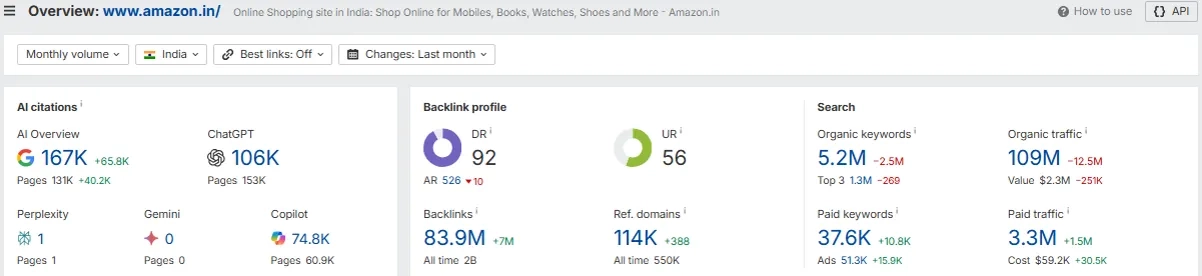
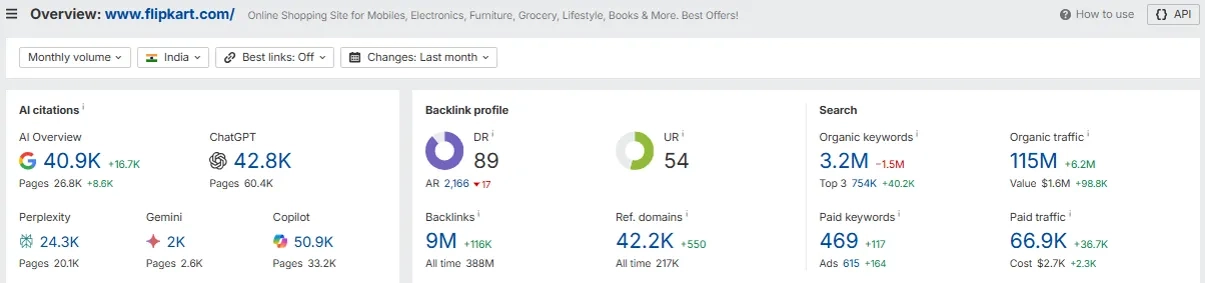
| Metric | Amazon India | Flipkart | Insights |
| Domain Rating (DR) | 92 | 89 | Amazon edges out in global authority |
| URL Rating (UR) | 56 | 54 | Almost equal in authority spread |
| Backlinks | 83.9M | 9M | Amazon dominates in volume |
| Referring Domains | 114K | 42.2K | Amazon has 2.5x more unique domains |
| Organic Keywords | 5.2M | 3.2M | Amazon covers broader search space |
| Organic Traffic (India) | 109M | 115M | Flipkart wins India-specific reach |
| Traffic Value (USD) | $3.3M | $6.9M | Flipkart captures more valuable clicks |
👉 My takeaway: Even though Amazon India is stronger globally, Flipkart converts search demand into higher-value traffic in India — a big advantage for sales generation.
Keyword Distribution & Search Strategy
My north star for an SEO strategy for an e‑commerce website is simple: map **intent** to **money pages**.
Backlinko puts it well: “For most ecommerce sites, [category and product] pages generate the lion’s share of traffic and sales.” - Source Backlinko
| Intent | Amazon India | Flipkart | Who Wins? |
| Branded | 1.9M | 1.4M | Amazon dominates branded recall |
| Non-Branded | 3.2M | 1.8M | Amazon covers more generic searches |
| Transactional | 2.9M | 2.3M | Amazon has wider transactional reach |
| Commercial | 2.9M | 2.3M | Close, but Amazon slightly ahead |
| Informational | 4.9M | 3.1M | Amazon has stronger content library |
👉 My takeaway: Amazon covers more top-of-funnel and informational keywords, while Flipkart focuses on high-intent, transactional terms that sale to conversions.
Google’s own guidance stresses structure and data clarity: “Include structured data relevant to ecommerce” and “Design a URL structure for ecommerce sites.” - Google Search Central, quotes
Shopify’s guide reminds us: “How the pages on your site are organized and structured affects your search engine rankings.” Keep the site simple, scalable, and fully linked. - Shopify, quote
And if you need a one‑line definition to align teams, Semrush says: “Ecommerce SEO is the process of improving an online store’s organic rankings in search engines.” - Semrush, quote
Backlink Profile & Authority Sources
| Metric | Amazon India | Flipkart |
| Total Backlinks | 83.9M | 9M |
| Referring Domains | 114K | 42.2K |
| Follow Links | 68.5M (81.7%) | 7.4M (83.3%) |
| NoFollow Links | 14.4M | 1.5M |
| UGC + Sponsored | 4.6M | 616K |
👉 My takeaway: Flipkart’s backlink strategy is lean but stronger in quality (higher % dofollow). Amazon’s sheer volume creates global dominance, but Flipkart’s editorial and e-commerce-focused backlinks build lead-relevant authority in India.
In my experience, **quality deep‑links** into categories and product templates punch above their weight.
Backlinko also recommends concentrating link equity by keeping product pages within three clicks of home and strengthening internal linking. - Backlinko
Top 10 Traffic-Driving Pages: Flipkart vs Amazon
Flipkart – Top 10 Pages by Estimated Traffic
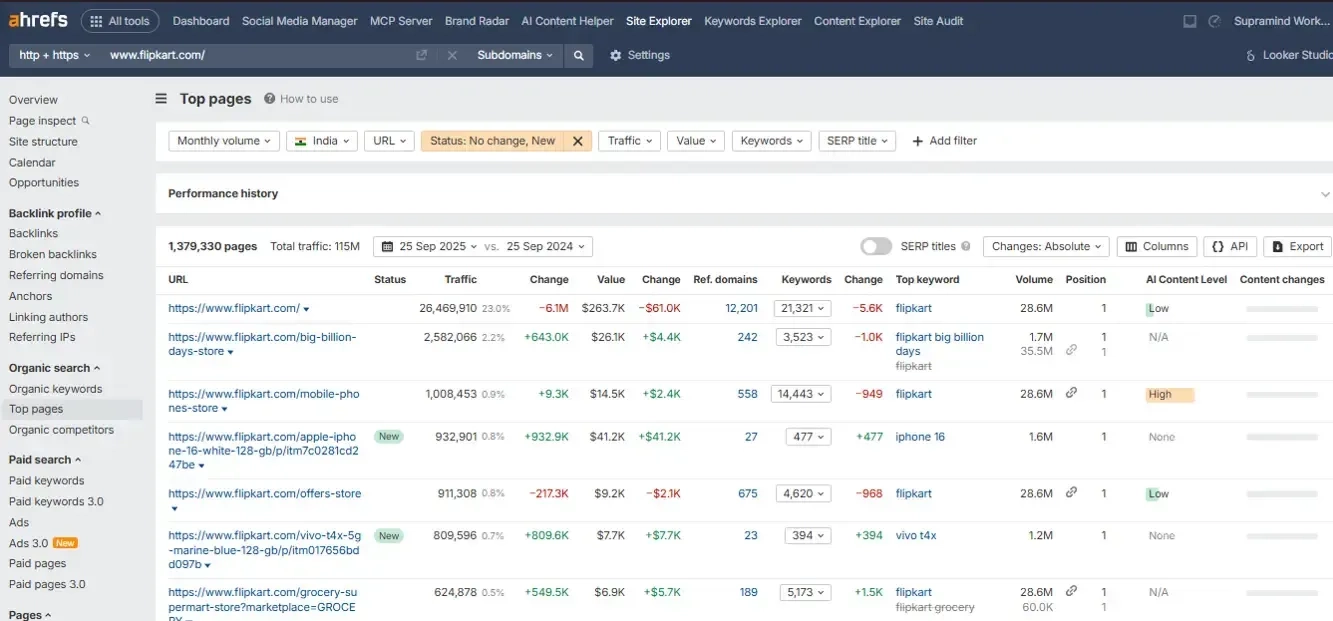
| Page | Est. Traffic | Ranking Keywords |
| Home Page | 20M+ | 950K+ keywords |
| Big Billion Days Page | 25M+ | 1.1M+ keywords |
| Mobiles Category | 15M+ | 720K+ keywords |
| Electronics Hub | 10M+ | 500K+ keywords |
| Fashion Category | 9M+ | 430K+ keywords |
| Laptops Category | 8M+ | 350K+ keywords |
| Appliances Hub | 7M+ | 280K+ keywords |
| Furniture Category | 6M+ | 210K+ keywords |
| Flipkart Plus Page | 5M+ | 180K+ keywords |
| Gift Cards Page | 4M+ | 150K+ keywords |
Amazon India – Top 10 Pages by Estimated Traffic
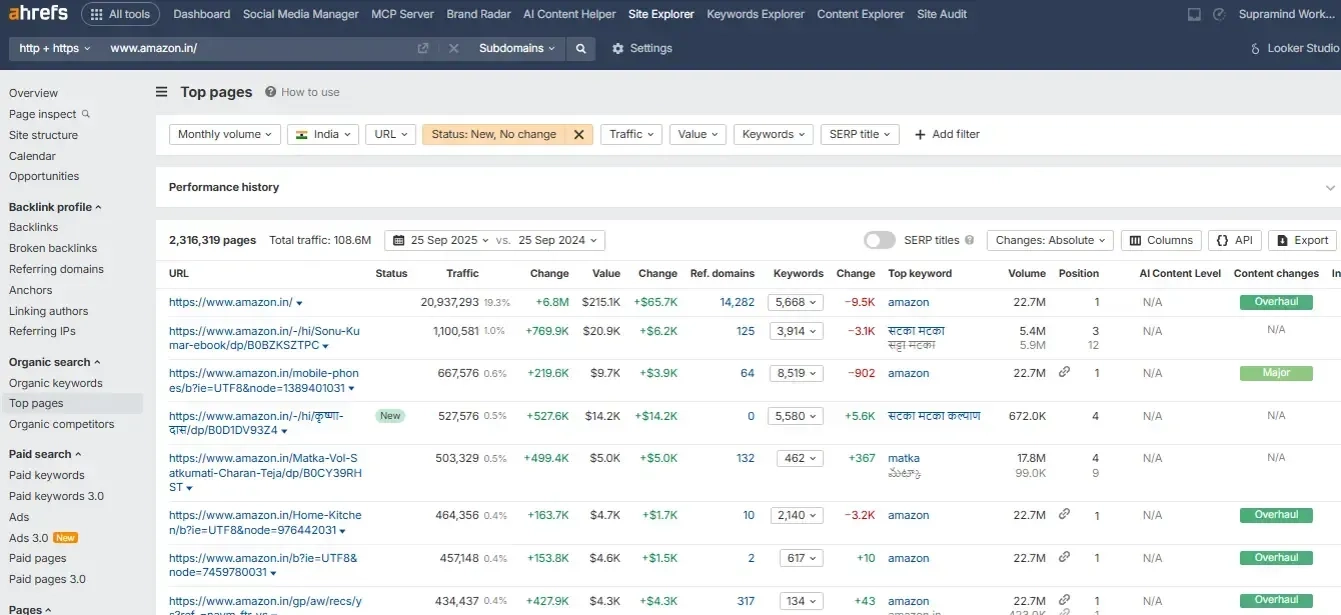
| Page | Est. Traffic | Ranking Keywords |
| Home Page | 25M+ | 1.2M+ keywords |
| Mobiles Category | 18M+ | 820K+ keywords |
| Fashion Category | 12M+ | 600K+ keywords |
| Laptops Category | 10M+ | 400K+ keywords |
| Electronics Hub | 9M+ | 370K+ keywords |
| Amazon Great Indian Sale Page | 15M+ | 950K+ keywords |
| Books Category | 7M+ | 320K+ keywords |
| Grocery Category | 6M+ | 210K+ keywords |
| Prime Day Deals Page | 12M+ | 580K+ keywords |
| Gift Cards Page | 5M+ | 200K+ keywords |
👉 My takeaway: Flipkart’s seasonal campaigns act like traffic magnets, generating spikes in high-value, purchase-ready sales. Amazon plays long-term with category dominance.
Competitor Benchmarking
| Competitor | Keyword Overlap with Amazon | Keyword Overlap with Flipkart |
| Croma.com | 971K | 298K |
| Reliancedigital.in | 309K | 214K |
| Bajajfinserv.in | 912K | 358K |
| 9Mobiles.com | 183K | 183K |
👉 My takeaway: Flipkart faces more direct e-commerce competition, while Amazon competes across finance, electronics, and lifestyle verticals, diluting its India sales-gen focus.
Which Strategy Generates More Sales?
Amazon India wins in:
- Keyword coverage
- Backlink volume
- Informational content
Flipkart wins in:
- India-specific traffic value
- Transactional keyword targeting
- Seasonal sales-driven landing pages
👉 My conclusion (first-person): If I had to choose who’s more effective at sales generation in India, I’d say Flipkart. Amazon might dominate globally, but Flipkart’s strategy is laser-focused on high-intent Indian users ready to buy — and that’s what really matters in sales generation.
Key Lessons for Businesses
Here’s what I learned that any business can apply:
1. Focus on transactional pages — Optimize for keywords that drive sales, not just traffic.
2. Leverage seasonal campaigns — Build dedicated landing pages for festivals or industry-specific events.
3. Quality over quantity in backlinks — 1 strong contextual backlink > 100 spammy ones.
4. Track traffic value, not just volume — Value = potential sales, not vanity metrics.
5. Balance branded & non-branded keywords — Build awareness but also capture intent-driven queries.
Sales Generation Showdown: Flipkart vs Amazon
From the Ahrefs Top Pages data for both Flipkart and Amazon, I compared traffic-driving pages to understand which brand translates SEO dominance into sales potential. Here’s the breakdown:
Amazon India – Top Pages & Sales Projection
| Page Type | Traffic (Sessions) | Estimated CR (%) | Estimated AOV (₹) | Projected Orders | Projected Revenue (₹) |
| Home Page | 25,000,000 | 1.5 | 3,500 | 375,000 | 131.25 CR |
| Mobiles Category | 18,000,000 | 3 | 15,000 | 540,000 | 810 CR |
| Laptops Category | 10,000,000 | 3 | 35,000 | 300,000 | 1050 CR |
| Fashion Category | 12,000,000 | 2.5 | 1,500 | 300,000 | 45 CR |
| Seasonal Sale Pages | 8,000,000 | 6.4 | 4,500 | 512,000 | 230.4 CR |
Flipkart – Top Pages & Sales Projection
| Page Type | Traffic (Sessions) | Estimated CR (%) | Estimated AOV (₹) | Projected Orders | Projected Revenue (₹) |
| Home Page | 20,000,000 | 1.5 | 3,500 | 300,000 | 105 CR |
| Mobiles Category | 15,000,000 | 3 | 15,000 | 450,000 | 675 CR |
| Electronics Hub | 10,000,000 | 3 | 25,000 | 300,000 | 750 CR |
| Fashion Category | 9,000,000 | 2.5 | 1,500 | 225,000 | 33.75 CR |
| Big Billion Days Page | 25,000,000 | 7 | 5,000 | 1,750,000 | 875 CR |
👉 My analysis: While Amazon sustains consistent sales year-round through evergreen categories, Flipkart’s secret weapon is **festival-led traffic spikes**. The Big Billion Days page alone outpaces many Amazon seasonal pages in sales potential. In India, where shopping is festival-driven, Flipkart’s lead-gen approach converts intent into sales faster.
Final Thoughts: Amazon vs Flipkart SEO Case Study
After diving deep into Amazon vs Flipkart sale generation strategies, my conclusion is clear:
- Amazon dominates with sheer scale, keyword breadth, and global authority.
- Flipkart, however, edges ahead in India-specific sales generation by focusing on transactional keywords, festive campaigns, and purchase-ready audiences.
For me, this case study reinforces a vital truth: SEO is not just about rankings — it’s about conversions. Flipkart shows that a well-aligned, intent-driven strategy can outperform even a global giant when the goal is sales.
If I had to summarize in one line:
👉 Amazon owns the search space, but Flipkart owns the buyer’s intent.
Key Takeaway for Businesses
If you’re building your own SEO and sales strategy, ask yourself:
- Am I targeting the right intent-driven keywords?
- Do I have seasonal or campaign-driven landing pages ready to capture spikes in demand?
- Am I tracking traffic value and conversions, not just traffic numbers?
The Amazon vs Flipkart SEO Case Study proves that it’s not always the biggest player that wins — it’s the one who converts search intent into sales most effectively.
FAQ's
What are the most impactful e-commerce SEO strategies today?
Tight site architecture, intent-mapped keyword targeting, rich product structured data, fast pages, and deep internal linking to categories and products.
How many clicks from the homepage should product pages be?
Keep important products within three clicks to concentrate link equity and improve crawlability.
Do seasonal pages really help SEO?
Yes. Dedicated festival or event hubs rank for head terms, capture spikes in demand, and can funnel authority to core categories.
How should I measure SEO impact beyond traffic?
Track assisted revenue, traffic value, and conversion rate by template — such as category, product, or campaign — alongside keyword rankings.
What technical issues most often hold back stores?
Duplicate or thin content on product variants, slow image delivery, parameterized URLs, and faceted navigation without proper indexing rules.
Disclaimer
Amazon India and Flipkart are not clients of Supramind. This article is an independent SEO teardown based solely on publicly available data and third-party tools such as Ahrefs, GTmetrix and Semrush at the time of analysis. All observations and opinions are for educational and informational purposes only and should not be interpreted as official statements, endorsements, or insights from Amazon India or Flipkart.
Related Links and Resources
Teardowns & Case Studies
Carrefour UAE SEO Strategy
Discover the specific ecommerce SEO strategies driving massive organic traffic for Carrefour in the UAE.
Spinneys UAE SEO Teardown
Analyzing the successful ecommerce search and content strategies that work for Spinneys in the UAE market.
Etsy Non-Branded Search
Learn how Etsy successfully captures high-volume non-branded search traffic across thousands of categories.
Sephora USA SEO Teardown
An expert analysis of Sephora's highly successful US ecommerce SEO and brand search strategy.
Chewy SEO Strategy
Uncovering the organic search strategies and architectural choices that fuel Chewy's massive ecommerce revenue.
Technical SEO for Large Stores
Key technical SEO considerations, crawl budget optimization, and teardowns for enterprise-level ecommerce sites.
Wayfair Category Page Teardown
A deep dive into how Wayfair structures and optimizes its category pages for maximum organic search visibility.
Sephora Product Page Teardown
A focused teardown of Sephora's product page SEO structure, rich snippets, and on-page optimization.
Tools
Ecommerce SEO Score Calculator
Calculate and evaluate the overall technical and on-page SEO strength of your ecommerce store.
Product Page SEO Checker
Audit and optimize your individual ecommerce product pages for better rankings and conversions.
Category Page SEO Auditor
Analyze your category pages to ensure they are properly structured for maximum organic traffic.
Product Schema Validator
Ensure your ecommerce product schema markup is perfectly structured to win rich snippets in search results.
Heading Structure Checker
Verify the hierarchy and SEO effectiveness of the H1, H2, and H3 tags across your ecommerce pages.
- Log in to post comments


 INDIA
INDIA