


SEO Strategy for Ecommerce Website: How Chewy Turns SEO Into Revenue (US Market Share Teardown)
Brand: Chewy
Market: USA
Industry: E-commerce Online Pet Supplies / Internet Retail – Pet Care & Pet Products
Primary conversion: Lead / Booking / Click out / Trial / Purchase
Secondary conversion: Optional
This Chewy teardown is part of Supramind’s central resource hub dedicated to comprehensive Ecommerce SEO Services.
Table of Content
Leak Locator - The Discovery-to-Transaction Leak
Market Reality: Competitor Benchmark
AI Search Visibility as a Moat
TL;DR
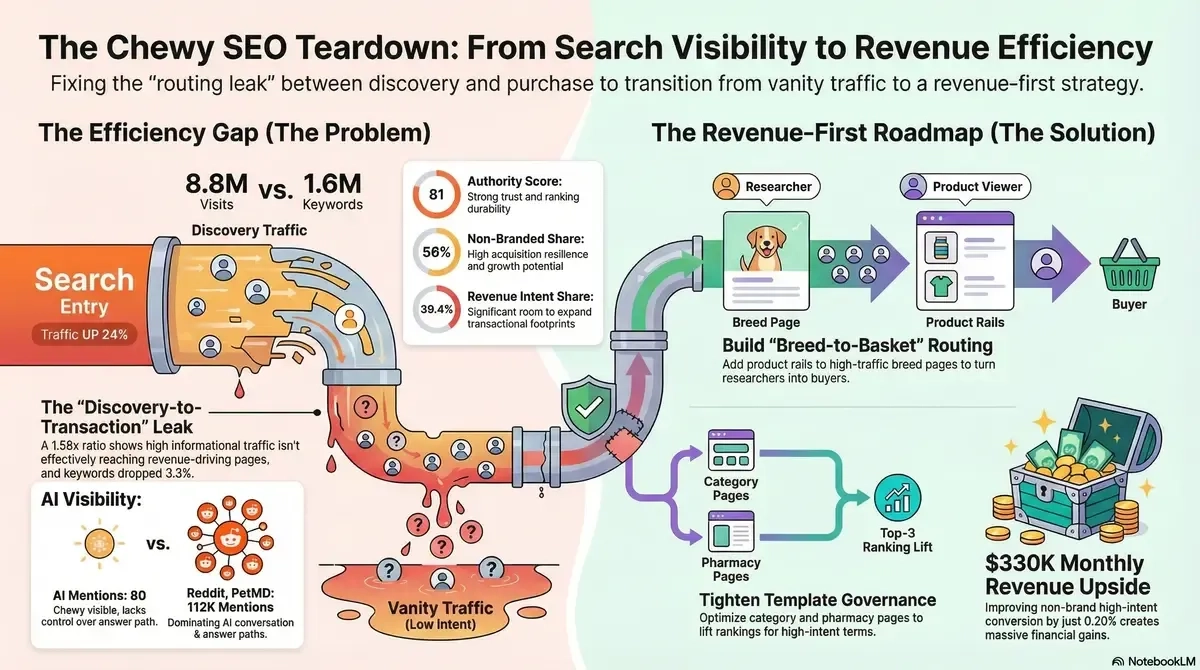
- I see a very large, very real SEO moat: 8.8M US organic traffic, 1.6M US organic keywords, Authority Score 81, 57.6K referring domains, and 2M backlinks. This is not a visibility problem. It is an efficiency and monetization problem.
- The biggest commercial clue is this: organic traffic is up 24% while organic keywords are down 3.3%. In my experience, that means growth is getting concentrated into a smaller set of winners. That is good for near-term traffic, but risky for long-term market share if those pages soften.
- Chewy’s non-branded share is 56%, which is healthy. But the top non-branded winners are overwhelmingly education pages like breed and pet-care content, not direct purchase pages. That tells me the brand is excellent at capturing attention, but still has room to turn attention into baskets more efficiently.
- AI visibility is already material in the US: AI Visibility 80, 112K AI mentions, 53.6K cited pages. But the top cited ecosystem sources are YouTube (21.7K), Reddit (21.7K), and PetMD (15.9K). So Chewy is in the conversation, but not always controlling the answer path.
- My read: the next layer of growth will not come from “more content” in general. It will come from better template economics: stronger routing from education pages into category/product pages, tighter category/pharmacy page governance, and AI-citable pages that also convert.
- Top 3 funded priorities
- Build breed/species/condition-to-basket routing on top education pages
- Tighten category + pharmacy template governance to lift high-intent rankings and conversion
- Create AI-citable commercial content so Chewy owns both discovery and the next click
- Build breed/species/condition-to-basket routing on top education pages
How to read this teardown
- I am treating this as a business growth problem, not a technical audit.
- I only used the attached screenshots/files. I do not claim access to GA4, internal revenue, margin, CRM, or conversion data.
- Where the screenshot is global rather than US-only, I say so clearly and use it as a proxy assumption, not a fact.
- All opportunity math below is directional. I use it to size decisions, not to pretend I can see Chewy’s internal books.
Introduction
What the data says
Chewy already has scale. The issue is not “can SEO work?” The issue is whether Chewy is converting its authority into the right kind of traffic and then turning that traffic into purchases at lower CAC.
So what
As an ecommerce SEO consultant, this is exactly where I focus: not vanity traffic, but how much of the organic footprint actually protects margin and grows market share. Chewy’s current footprint suggests a strong engine that still leaks value between discovery and purchase.
What I’d do next
I would run this teardown as a commercial operating plan: what pages attract demand, what pages monetize demand, where the handoff breaks, and what fixes pay back fastest.
Executive Hook: Revenue Math First Scale vs. Efficiency
What the data says
This is not a visibility problem. It is an efficiency problem.
KPI snapshot
| KPI | Value | Business read |
| Authority Score | 81 | Strong trust and ranking durability |
| Organic Traffic (US) | 8.8M | Massive acquisition channel |
| Organic Traffic Change | +24% | Strong recent growth |
| Organic Keywords (US) | 1.6M | Large search footprint |
| Organic Keywords Change | -3.3% | Breadth is shrinking while traffic rises |
| Paid Traffic | 661.6K | Paid still meaningful, but SEO is the bigger lever |
| Paid Keywords | 10.4K | Paid footprint narrower than organic |
| Paid Keywords Change | -7.5% | Paid coverage is tightening |
| Referring Domains | 57.6K | Strong authority base |
| Backlinks | 2M | Large off-site moat |
| Traffic Share | 21% | Strong share of voice |
| Branded Traffic Share | 44% | Healthy, but not low-dependency |
| Non-Branded Traffic Share | 56% | Good acquisition resilience |
| SERP Organic Share | 85.7% | Most visibility still comes from classic organic |
| AI Overviews Share | 3.6% | AI is already visible in the SERP mix |
| Other SERP Features | 10.7% | More zero-click pressure around organic |
AI visibility snapshot
| AI KPI | Value | Business read |
| US AI Visibility | 80 | Strong presence in AI discovery |
| US AI Mentions | 112K | High answer-surface participation |
| Cited Pages | 53.6K | Wide citation footprint |
| Worldwide AI Visibility | 58 | US is stronger than global average |
| Worldwide AI Mentions | 130.2K | US drives most AI presence |
| Canada AI Visibility / Mentions | 66 / 6.3K | Secondary foothold |
| UK AI Visibility / Mentions | 48 / 4.1K | Smaller foothold |
AI platform split
| Platform | Mentions | Cited Pages |
| AI Overviews | 48.9K | 18.1K |
| AI Mode | 21.7K | 18.1K |
| ChatGPT | 21.6K | 30K |
| Gemini | 19.7K | 7.7K |
Top cited sources in AI environment
| Domain | Mentions |
| youtube.com | 21.7K |
| reddit.com | 21.7K |
| petmd.com | 15.9K |
So what
I see a business with major search authority, but the commercial question is not “are we visible?” It is “where does that visibility land, and how fast does it turn into orders?” Chewy wins attention at scale. The commercial unlock is turning that attention into more purchase-ready traffic without paying for it again in paid media.
What I’d do next
I would manage SEO like a margin channel:
- protect the authority moat,
- route education demand into money pages,
- build pages that are citable in AI and monetizable on-site.
Leak Locator - The Discovery-to-Transaction Leak
What the data says
I built four operating metrics from the attached data.
| Custom Metric | Formula | Result | Threshold | What it means commercially |
| Revenue Intent Share | Commercial + Transactional share | 39.4% | >45% strong / 35–45% workable / <35% weak | Chewy has decent revenue-ready intent, but most of the footprint is still not directly transactional |
| Discovery-to-Transaction Ratio | Informational traffic ÷ Transactional traffic | 1.58x | <1.2 tight / 1.2–1.5 manageable / >1.5 leak | Too much discovery relative to purchase-ready traffic usually means routing inefficiency |
| Breadth-to-Traffic Divergence | Traffic growth minus keyword growth | +27.3 pts | 0–10 healthy / 10–20 watch / >20 concentration risk | Growth is being carried by fewer winners; good now, risky later |
| Link Depth Efficiency | Backlinks ÷ Referring domains | 34.7 | >25 strong / 15–25 fair / <15 weak | Chewy’s authority depth is strong; the issue is where that equity lands |
Notes:
- Revenue intent share uses global intent mix from S7 as a proxy.
- Breadth-to-traffic divergence uses +24% traffic and -3.3% keywords from S1.
- Link depth uses 2M backlinks / 57.6K referring domains from S1.
So what
The core leak is simple: Chewy is excellent at attracting search demand, but not enough of that demand lands on, or gets handed off to, revenue-driving pages. In business terms, that means organic CAC can go lower, but only if the routing layer improves.
What I’d do next
I would set one KPI above the SEO team’s desk:
“How much non-brand organic traffic reaches a revenue page within one session?”
That is the efficiency number that matters.
Revenue Model
What the data says
Primary conversion model
- Primary conversion: Purchase
- Secondary conversion: Not modeled due to missing internal data
Assumptions used for the model
| Assumption | Value | Why I used it |
| US organic traffic base | 8.8M | From S1 / S3 |
| High-intent share proxy | 39.4% | Commercial 22% + Transactional 17.4% from S7 |
| Non-branded share | 56% | From S3 |
| Modeled non-brand high-intent visits | 1.94M | 8.8M × 39.4% × 56% |
| AOV | $75 / $85 / $95 | Proxy assumption only |
| Conversion rate | 1.8% / 2.4% / 3.0% | Proxy assumption only |
3-scenario sensitivity
- Conversion Rate 1.8%
- Average Order Value $75
- Modeled Orders 34,949
- Conversion Rate 2.4%
- Average Order Value $85
- Modeled Orders 46,599
- Conversion Rate 3.0%
- Average Order Value $95
- Modeled Orders 58,249
| Scenario | Modeled Non-Brand High-Intent Visits | CVR Assumption | AOV Assumption | Modeled Orders | Modeled Monthly Revenue |
| Conservative | 1.94M | 1.8% | $75 | 34,949 | $2.62M |
| Base | 1.94M | 2.4% | $85 | 46,599 | $3.96M |
| Aggressive | 1.94M | 3.0% | $95 | 58,249 | $5.53M |
So what
Even with conservative assumptions, non-brand organic is not a side channel. It is a multi-million-dollar monthly revenue surface. That means even small efficiency gains matter financially.
Interactive Revenue Model
Adjust CVR and AOV to see the multi-million-dollar monthly upside of efficiency gains.
Monthly Orders
46,560
Annual Run Rate
$47,491,200
What I’d do next
I would not spend the next quarter chasing more broad traffic. I would spend it improving the yield of the traffic Chewy already earns.
CEO Math
What the data says
Here are four simple improvements I would show a CEO.
| Improvement | Assumption | Monthly Impact Logic | Directional Monthly Revenue Upside |
| Route 2% of informational US visits into money pages | US informational proxy = 8.8M × 53.9% = 4.74M | 94,864 routed visits × 3.0% CVR × $85 AOV | $241.9K |
| Improve non-brand high-intent CVR by 0.20 pts | Base pool = 1.94M visits | 1.94M × 0.20% × $85 | $330.1K |
| Increase high-intent traffic mix by 1 point | 1% of 8.8M = 88,000 extra high-intent visits | 88,000 × 2.4% × $85 | $179.5K |
| Lift 4 commercial clusters into Top 3 | Proxy cluster model in Section 15 | Summed modeled upside | $139.8K |
So what
None of these are heroic assumptions. In my experience, this is the right executive frame: small efficiency lifts on a giant traffic base create large revenue outcomes.
What I’d do next
I would fund the fixes that improve:
- click quality,
- page-to-page routing,
- conversion readiness on top entry pages.
The Money Pages
What the data says
The visible winners tell me Chewy’s page economics break into two groups: demand capture pages and demand conversion pages.
| Page Type | Example URL Pattern | Intent | Primary Conversion Action | Why It Wins |
| Homepage / brand entry | www.chewy.com/ | Navigational | Purchase / account entry | Captures massive branded demand like “chewy” (2.7M traffic) and “chewy login” (59.2K) |
| Category pages | /b/food-332 /b/food-387 /b/pharmacy-2515 | Commercial / Transactional | Purchase | Closest visible pages to direct revenue in the screenshots |
| Education / breed pages | /education/dog-breeds/* /education/cat-breeds/* | Informational | Indirect purchase | Drive very large non-brand traffic, but need stronger monetization bridges |
| Education / species care pages | /education/reptile-and-amphibian/* /education/small-pet/* | Informational | Indirect purchase | Strong discovery surface for niche pet categories |
| Vet/service adjacency | /b/connect-vet-16616 | Advisory / retention | Service adoption / downstream purchase | High trust bridge between care and commerce |
| Product detail pages (assumption) | /dp/* | Transactional | Purchase | Standard ecommerce close page, but not visible in the provided screenshots |
Missing or weak templates I would expect
| Template Gap | Why it matters commercially |
| Breed-to-basket landing pages | Converts breed research into food, toys, health, grooming baskets |
| Condition-to-product hubs | Captures high-intent health demand with stronger conversion |
| Comparison pages | Useful for “best”, “vs”, “for X” commercial queries |
| Vet-reviewed commercial guides | Bridges trust and purchase better than generic guides |
| AI-ready answer pages with embedded product logic | Important for ChatGPT / AI Overview click-through behavior |
So what
Chewy’s best visible non-brand pages are excellent at creating consideration, but not yet optimized enough for capturing order value in the same journey.
What I’d do next
I would treat the education layer as a revenue feeder, not a content library.
Market Reality: Competitor Benchmark
What the data says
Chewy is not fighting one kind of competitor. It is fighting two:
- Retail competitors for bottom-funnel orders
- Authority publishers/reference sites for top-funnel trust and citations
| Domain | Category | Traffic Proxy | Overlap / Keyword Proxy | What They Win On | What Chewy Can Win On |
| petmd.com | Vet/publisher authority | 8.7M | 204.7K common keywords | Medical trust, care content, AI citation friendliness | Route trust into commerce, pharmacy, and vet-to-basket paths |
| petco.com | Retail competitor | 6.4M | 131.5K common keywords | Retail categories, direct product demand | Selection depth, autoship, content + commerce integration |
| akc.org | Breed/reference authority | 10.1M | 113.6K common keywords | Breed authority, informational trust | Turn breed intent into breed-specific product journeys |
| petsmart.com | Retail competitor | 7.6M | 117.5K common keywords | Retail scale, category breadth | Better online routing, subscription logic, content depth |
| thesprucepets.com | Publisher/media | 2.1M | 97.9K common keywords | Accessible informational content | Better next-step actions and direct monetization |
So what
This is the key strategic point: Chewy is not just competing for rankings. It is competing for who earns the right to shape pet-care demand before purchase happens.
What I’d do next
I would split Chewy’s SEO operating model into two lanes:
- Authority lane: beat PetMD, AKC, The Spruce Pets on answer quality + citable structure
- Conversion lane: beat Petco and PetSmart on category depth + frictionless next steps
What the data says
Demand Mix
Branded vs non-branded
| Demand Type | Share | Business meaning |
| Branded | 44% | Efficient, high-converting traffic, but not true market expansion |
| Non-Branded | 56% | Real acquisition and category growth opportunity |
Keyword intent mix (global proxy)
Informational (53.9%)
1M Keywords. User is learning; good for demand capture, weak unless routed.
Commercial (22.0%)
421K Keywords. User is comparing options; crucial for CAC reduction.
Transactional (17.4%)
333.7K Keywords. User is ready to buy; most direct revenue opportunity.
Navigational (6.7%)
128.8K Keywords. User already wants Chewy; highly efficient.
| Intent | Share of Keywords | Keywords | Traffic | Business meaning |
| Informational | 53.9% | 1M | 4.1M | User is learning; good for demand capture, weak unless routed |
| Navigational | 6.7% | 128.8K | 3.5M | User already wants Chewy; usually efficient and high-converting |
| Commercial | 22% | 421K | 1.2M | User is comparing options; crucial for CAC reduction |
| Transactional | 17.4% | 333.7K | 2.6M | User is ready to buy; most direct revenue opportunity |
So what
Chewy has the right to play in both awareness and purchase. The risk is letting the informational layer become an island, rather than a feeder into commercial and transactional pages.
What I’d do next
I would explicitly set a goal to move more of the 53.9% informational footprint into assisted or direct revenue.
Routing Efficiency
What the data says
The top visible non-branded winners are all education-led:
- french bulldog — 91.3K traffic
- bernese mountain dog — 74.6K
- bearded dragon — 49.8K
- chinchilla — 49.8K
- husky — 33.5K
- plus more breed/species pages after that
That means the discovery engine is working. The routing layer is where I expect the biggest missed revenue.
So what
If a French bulldog page answers the question but does not move the visitor toward breed-appropriate food, allergy support, toys, beds, crates, or health products, Chewy pays the cost of earning the visit without capturing the full order value.
| Routing Module | Where I’d Deploy It | Revenue Job |
| “Shop products for this breed/species” rail | Top of education pages | Turn research into basket starts |
| Life-stage / condition recommendation block | Mid-page | Increases relevance and AOV |
| Vet-reviewed “what to buy first” checklist | After care sections | Bridges trust into purchase |
| Sticky autoship savings CTA | Throughout high-intent pages | Improves repeat purchase economics |
Technical + Indexation Leak
What the data says
I do not have a crawl export or indexation file here, so I am not going to pretend I can diagnose exact technical issues. What I can say is this: traffic up, keyword breadth down usually means template governance needs work.
So what
Technical SEO is not a hygiene task here. It is a revenue leakage task. If duplicate or low-value URLs absorb crawl, links, or internal equity, Chewy loses rankings exactly where commercial pages need help.
What I’d do next
Index / Template Governance Ledger
| URL Pattern | Risk | Profit Impact | Fix | Expected Upside |
| /education/* | High traffic, weak commercial handoff | Lost assisted revenue | Add dynamic product rails, contextual category links, and autoship modules | Higher routed sessions and better conversion |
| /b/* category pages | Underlinked or thin category intent capture | Lost transactional share | Strengthen internal linking, unique copy, comparison content, review signals | More Top 3 rankings on purchase-intent terms |
| /app/content/* and parameterized URLs | Possible canonical/link equity split | Diluted authority, crawl waste | Canonical consolidation, param handling, noindex where needed | Cleaner authority transfer |
| Query/referral URLs in backlink targets | Link equity fragmentation | Reduced ranking efficiency | Normalize link targets to preferred canonical URLs | Durable ranking lift |
| Faceted/filter pages (assumption) | Index bloat and cannibalization | Lower keyword breadth quality | Tight allow/block logic by template value | Better crawl efficiency and cleaner demand capture |
Assumption clearly labeled: facet/index governance requires crawl validation.
AI Search Visibility as a Moat
What the data says
Chewy’s AI footprint is strong:
- US AI Visibility: 80
- US AI Mentions: 112K
- Cited Pages: 53.6K
But the AI ecosystem around Chewy still leans heavily on external authority and community domains:
- YouTube: 21.7K mentions
- Reddit: 21.7K
- PetMD: 15.9K
So what
I treat AI citations as a distribution channel. The business question is not just “are we cited?” It is “does the citation land on a page that can move the user to a purchase or high-value next step?”
What I’d do next
AI citation ledger
| Prompt / Topic Proxy | Page Cited / Landing Pattern | What User Wanted | What Chewy Should Show Next |
| french bulldog | /education/dog-breeds/french-bulldog | Breed traits, care, suitability | Breed-specific food, allergy support, harnesses, toys |
| bernese mountain dog | /education/dog-breeds/bernese-mountain-dog | Size, shedding, health, care | Large-breed food, joint support, beds, crates |
| bearded dragon | /education/reptile-and-amphibian/general/bearded-dra… | Habitat and feeding guidance | Habitat kit, UVB light, supplements, food |
| chinchilla | /education/small-pet/chinchilla/10-reasons-why-chinch… | Ownership and care basics | Cage, hay, dust bath, food |
| savannah cat / persian cat | /education/cat-breeds/* | Breed fit, grooming, care | Food, litter, grooming, enrichment |
Templates I would make AI-citable first
- Breed/species hubs
- Condition + care hubs
- Ingredient and nutrition explainers
- Pharmacy FAQs and treatment explainers
- Comparison pages with clear answers and next-step CTAs
Backlink Moat
What the data says
Link moat summary
| Link Metric | Value | Commercial read |
| Backlinks | 2M | Strong authority moat |
| Referring Domains | 57.6K | Broad trust base |
| Follow Links | 1.57M | Good ranking fuel |
| Nofollow Links | 324.89K | Strong brand visibility, less direct ranking value |
| Text Links | 64% / 1.2M | Best format for durable category ranking support |
| Image Links | 36% / 658.6K | Useful for brand, weaker for deep commercial relevance |
Referring domain quality signals visible
Chewy shows links from high-authority domains including:
- adobe.com
- apple.com
- bbc.com
- britannica.com
- cambridge.org
- cnn.com
- github.com
- google.com
- indeed.com
- mayoclinic.org
So what
The authority moat is real. My concern is not link quantity. My concern is link landing efficiency. If most authority lands on brand or utility pages, Chewy protects the domain but does not fully expand category rankings.
What I’d do next
Next 90 days link plays
| Link Play | Target Page Type | Why It Lifts Revenue |
| Vet-reviewed data studies | Pharmacy and care hubs | Earns editorial links that help high-intent health queries |
| Breed association / rescue partnerships | Breed pages and breed-to-basket pages | Transfers trust into monetizable education pages |
| “Best for X pet” research assets | Comparison and recommendation pages | Supports commercial-intent rankings |
| Publisher outreach around pet cost / care data | Category hubs + education pages | Grows both AI citations and organic rankings |
P&L Model
What the data says
I do not have the raw keyword export for high-intent, non-branded terms in positions 4–20. So I am building an assumption-led cluster model, not claiming exact live rankings.
So what
This is still useful for budgeting. A CEO does not need fake precision. A CEO needs to know whether moving commercial clusters into the Top 3 is worth funding. My answer is yes.
What I’d do next
Cluster opportunity model (assumption-led)
| Keyword / Cluster | Volume Proxy | Rank Proxy | Intent | Current CTR | Current Clicks | Conversion Rate Assumption | Current Conversions | Value per Conversion | Current Monthly Value |
| Dog food category cluster | 300,000 | 6 | Transactional | 4.0% | 12,000 | 3.0% | 360 | $85 | $30,600 |
| Cat food category cluster | 180,000 | 5 | Transactional | 5.0% | 9,000 | 2.8% | 252 | $80 | $20,160 |
| Pet pharmacy cluster | 140,000 | 8 | Transactional | 3.0% | 4,200 | 3.5% | 147 | $95 | $13,965 |
| Breed-specific nutrition cluster | 220,000 | 9 | Commercial | 2.5% | 5,500 | 2.2% | 121 | $82 | $9,922 |
Uplift if improved to Top 3
| Keyword / Cluster | Top 3 CTR Assumption | Incremental Clicks | Conversion Rate Assumption | Incremental Conversions | Incremental Monthly Value |
| Dog food category cluster | 12.0% | 24,000 | 3.0% | 720 | $61,200 |
| Cat food category cluster | 11.0% | 10,800 | 2.8% | 302 | $24,192 |
| Pet pharmacy cluster | 10.0% | 9,800 | 3.5% | 343 | $32,585 |
| Breed-specific nutrition cluster | 8.0% | 12,100 | 2.2% | 266 | $21,828 |
| Total modeled incremental monthly value | $139,805 |
Important assumption noteThis table is not based on a raw 4–20 export from the screenshots. It is a directional budget model built to show the economics of moving purchase-intent clusters higher.
Roadmap
What the data says
Chewy does not need a giant reinvention. It needs a focused 90-day commercial SEO sprint.
So what
I would sequence this around fast revenue lifts first, then scale the systems.
What I’d do next
| Timeframe | Objective | What Changes | Why It Lifts Revenue | KPI |
| 0–30 days | Fix the routing leak | Add breed/species product rails, contextual category links, autoship CTAs on top education pages | Converts existing traffic better | Routed sessions to money pages, assisted revenue proxy |
| 0–30 days | Clean template governance | Canonical review, parameter handling, app/utility URL consolidation, internal linking review | Improves ranking efficiency | Indexed URL quality, keyword breadth stability |
| 31–60 days | Upgrade money-page templates | Improve category and pharmacy pages with better copy, comparison blocks, review trust, FAQ structure | More commercial click-through and better conversion intent fit | CTR, Top 10 to Top 3 movement, conversion proxy |
| 31–60 days | Build AI-citable commercial pages | Launch answer-first pages for breed nutrition, condition care, and pet product recommendations | Owns AI discovery and next click | AI mentions, cited pages, organic entries |
| 61–90 days | Scale winner templates | Extend successful routing and commercial blocks across top templates | Turns pilots into channel growth | Incremental non-brand sessions, revenue proxy |
| 61–90 days | Build link depth to target pages | Digital PR and partnership links into category/pharmacy/breed-commercial hubs | Converts domain authority into page authority | Referring domains to target templates |
Final Summary
What the data says
Chewy is already strong. But strong brands can still leak money. I see a company winning visibility at scale and still leaving room on the table between answer and order.
So what
If I were acting as Chewy’s ecommerce SEO expert, I would not ask for a blank-check content budget. I would ask for funding against three very specific levers.
What I’d do next
If I only fund 3 things
- Route education traffic into purchase paths
- Strengthen category/pharmacy template economics
- Build AI-citable commercial pages
Expected 6-month impact range (directional)
- Conservative: $0.8M incremental revenue
- Base: $1.4M incremental revenue
- Aggressive: $2.4M incremental revenue
These are directional estimates based on the modeled uplift logic above, not internal performance data.
Risks + how I’d de-risk
| Risk | How I’d de-risk it |
| Third-party traffic estimates differ from GA4 | Pilot on a controlled page set and measure relative lift |
| Routing modules may not convert as expected | A/B test on top 25 education pages first |
| Technical fixes may uncover deeper template issues | Run crawl + index validation before full rollout |
| AI visibility may shift fast | Build durable first-party answer pages, not platform-specific hacks |
FAQ
Traffic is already up 24%. Why change anything?
Because traffic growth with keyword decline (-3.3%) usually means concentration. I like the growth, but I do not like depending on fewer winners than before.
Do we need more content?
Not first. My team would prioritize better monetization of existing winners before adding net-new content volume.
Why not just buy more paid traffic?
Because SEO is already the bigger surface: 8.8M organic vs 661.6K paid traffic. Improving organic yield lowers blended CAC and protects margin.
Is AI really material yet?
Yes. The screenshot already shows US AI Visibility 80 and 112K mentions. I would not treat AI as future-state. I would treat it as today’s distribution layer.
What would you measure first?
I would measure:
Related Ecommerce SEO Links and Resources
Teardowns & Case Studies
Carrefour UAE SEO Strategy
Discover the specific ecommerce SEO strategies driving massive organic traffic for Carrefour in the UAE.
Amazon India vs Flipkart SEO
A detailed comparative SEO teardown of how two ecommerce giants battle for search visibility in India.
Spinneys UAE SEO Teardown
Analyzing the successful ecommerce search and content strategies that work for Spinneys in the UAE market.
Etsy Non-Branded Search
Learn how Etsy successfully captures high-volume non-branded search traffic across thousands of categories.
Sephora USA SEO Teardown
An expert analysis of Sephora's highly successful US ecommerce SEO and brand search strategy.
Technical SEO for Large Stores
Key technical SEO considerations, crawl budget optimization, and teardowns for enterprise-level ecommerce sites.
Wayfair Category Page Teardown
A deep dive into how Wayfair structures and optimizes its category pages for maximum organic search visibility.
Sephora Product Page Teardown
A focused teardown of Sephora's product page SEO structure, rich snippets, and on-page optimization.
Tools
Ecommerce SEO Score Calculator
Calculate and evaluate the overall technical and on-page SEO strength of your ecommerce store.
Product Page SEO Checker
Audit and optimize your individual ecommerce product pages for better rankings and conversions.
Category Page SEO Auditor
Analyze your category pages to ensure they are properly structured for maximum organic traffic.
Product Schema Validator
Ensure your ecommerce product schema markup is perfectly structured to win rich snippets in search results.
Heading Structure Checker
Verify the hierarchy and SEO effectiveness of the H1, H2, and H3 tags across your ecommerce pages.
Disclaimer
Chewy is not a client of Supramind. This case study is an independent analysis conducted using publicly available information and third-party SEO tools, including Ahrefs and Semrush, at the time of writing.
All findings, interpretations, and opinions are solely those of Supramind and are intended for educational and informational purposes only. This content does not constitute official communication, endorsement, or representation of Chewy or any of its affiliates. "
- Log in to post comments


 INDIA
INDIA