


Ecommerce SEO Consultant Playbook: Etsy USA’s Market Share Strategy for Non-Branded Search
Brand: Etsy
Market: USA
Industry: Unique Gift Ideas, Personalized Shopping, Craft Supplies, Fashion
Primary conversion: Add to Cart / Checkout / Purchase
Secondary conversion: Sign In
This Etsy teardown is part of Supramind’s central resource hub built by our eCommerce SEO Agency, where I break down real-world non-branded growth opportunities, revenue levers, and search-driven ecommerce expansion strategies.
Table of Contents
Executive Hook (Revenue Math First)
Market Reality: Competitor Benchmark
AI Search Visibility as a Moat
TL;DR (what matters commercially)
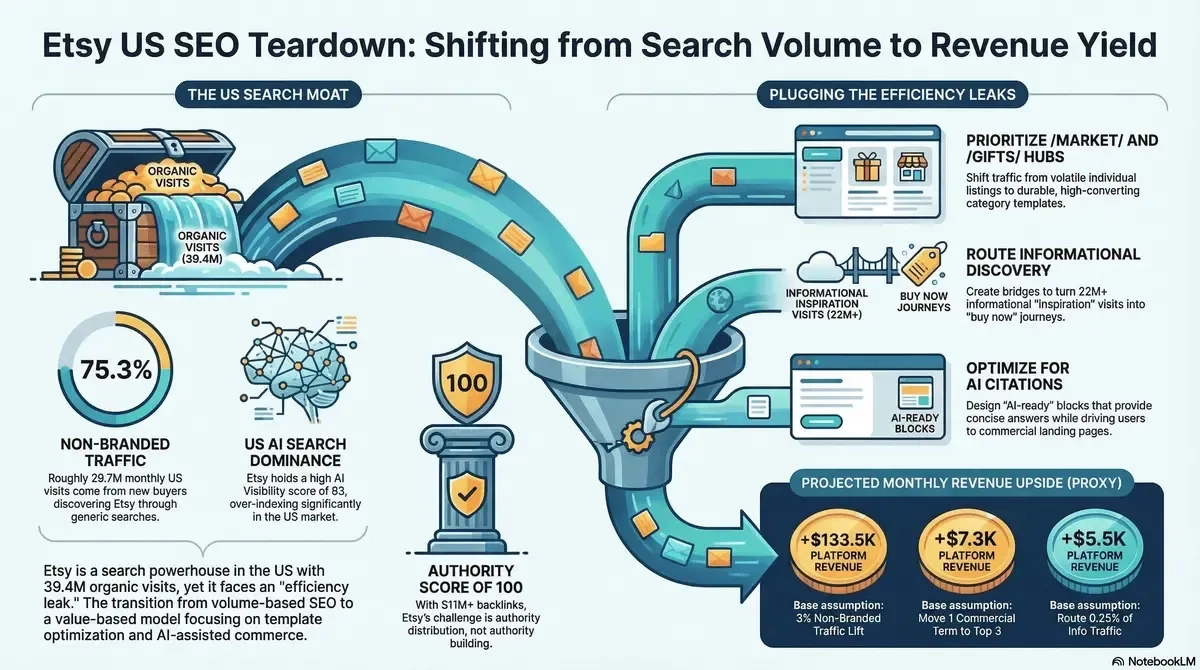
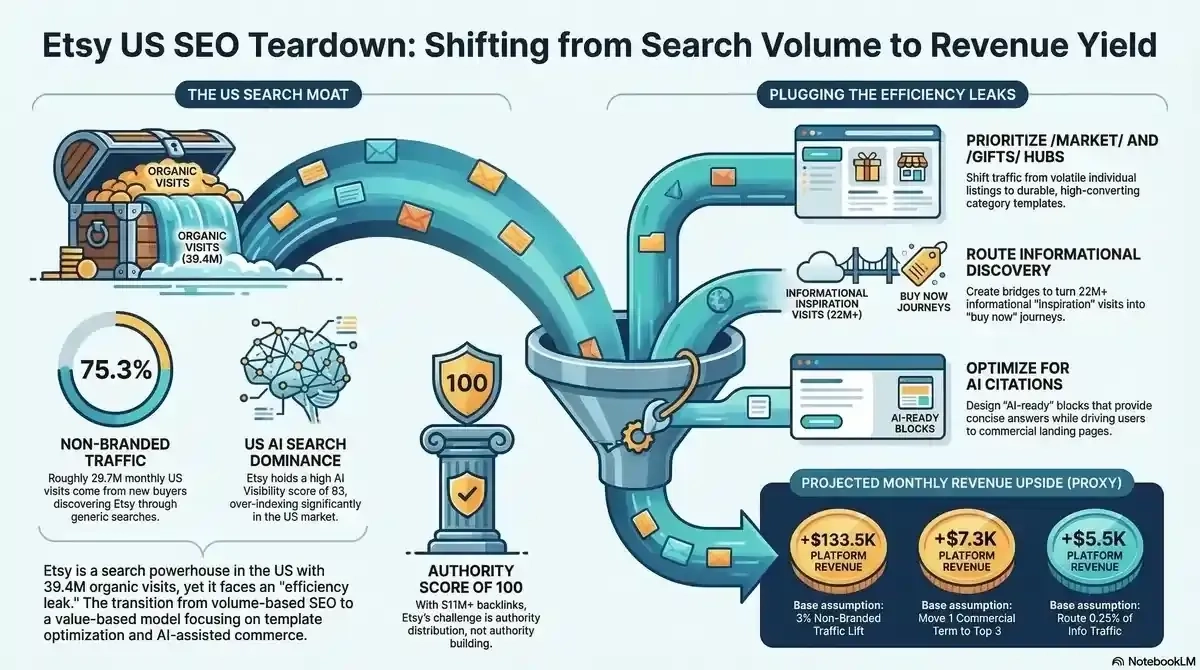
- Etsy is already a search giant in the US: 39.4M organic visits, 27.5M organic keywords, Authority Score 100, 1.3M referring domains, and 511.8M backlinks. The issue is not “more SEO.” The issue is better monetization of the traffic Etsy already earns.
- The growth engine is mostly discovery, not pure brand demand. 75.3% of search traffic is non-branded, which means SEO is directly tied to new buyer acquisition, lower CAC, and market share protection.
- Etsy is unusually strong in AI discovery. US AI Search shows Visibility 83, 2M mentions, and 2.4M cited pages. More importantly, the US accounts for about 69.0% of AI mentions versus only 47.1% of Google organic traffic worldwide-to-US share. In plain English: AI matters more in the US for Etsy than classic Google share alone suggests.
- The biggest commercial leak I see is template economics. Too much broad demand is landing on individual listings, where inventory churn, seller changes, and dead-end experiences can leak revenue. Etsy needs to turn /market/ and /gifts/ pages into stronger “buy now” hubs.
- Etsy’s link moat is massive, but some of the biggest referring-domain rows look noisy and sitewide-heavy. That is not a crisis, but it does mean durability will come more from directing authority to the right templates than from chasing raw link volume.
The Bottom Line
The Moat is Massive
Etsy has 39.4M US organic traffic and 511.8M backlinks. Visibility and authority are absolutely not the problem.
The Revenue Leak
Only 1.43 visits per keyword. Too much broad demand lands on individual listings where inventory churns, leaking commercial intent.
The Fix
Shift authority focus to non-branded commercial templates (/market/ and /gifts/), and build AI-citable buyer answer blocks.
Top 3 Funded Priorities
| Priority | Why I would fund it | Business outcome |
| Non-branded commercial template growth | Captures more high-intent demand through /market/ and /gifts/ pages | Revenue growth, market share, CAC relief |
| Informational to purchase routing improvements | Converts more existing discovery traffic into shoppable journeys | Higher conversion yield, more purchases |
| AI-citable commercial page upgrades | Turns AI mentions into conversion-ready acquisition paths | More AI-assisted revenue, stronger brand control |
How to read this teardown
- I am reading this as a commercial growth problem, not a technical audit.
- I will connect each SEO point to purchases, click-outs, CAC protection, margin protection, or market share.
- Where Etsy’s internal conversion data is missing, I use clearly labeled proxy assumptions.
- I prioritize page-type economics over content volume. For Etsy, the big money is in how templates convert, not how many URLs exist.
What the data says
The dataset is strong enough to see where traffic is coming from and which page patterns win.
So what
That is enough to make funding decisions, even without GA4 or internal checkout data.
What I’d do next
I would use this teardown to decide what gets resourced in the next 90 days, then validate the model against internal conversion cohorts.
Introduction
Etsy does not have a visibility problem in the US. Etsy has a commercialization problem at scale.
In my experience, that is a much better problem to have. It means the brand has already won attention. The harder and more valuable question is this:
How do we turn a very large pool of non-branded and AI-assisted discovery into more purchases without needing to buy that traffic back through paid media?
That is the business problem I am solving in this teardown.
What the data says
Etsy is already dominant in US search and visible across AI platforms.
So what
The next growth layer comes from better capture, routing, and template design, not from chasing vanity SEO output.
What I’d do next
I would run Etsy’s SEO program as a revenue optimization system with three priorities: capture, route, convert.
Executive Hook (Revenue math first)
KPI Snapshot
Etsy US Market: Interactive KPI Snapshot
Hover over metrics for business context
Traffic Distribution: Branded vs Non-Branded
Based on 39.4M US VisitsBusiness Meaning: The 75.3% non-branded share means SEO is heavily tied to new buyer acquisition. Etsy's growth relies on search discovery, not just loyal brand searches.
| KPI | Etsy US Snapshot | Business Meaning |
| Authority / trust | Authority Score 100 | Third-party signal that Etsy is already in the top trust tier |
| Organic traffic | 39.4M | Organic is a major acquisition engine |
| Organic keywords | 27.5M | Huge search footprint, especially in long-tail demand |
| Paid traffic | 809K | Paid is small relative to organic, which helps CAC protection |
| Paid keywords | 5.2K | Paid support exists, but organic carries the load |
| Referring domains | 1.3M | Enormous link moat |
| Backlinks | 511.8M | Authority is not the bottleneck |
| Traffic share | 4% | Material US search presence |
| Branded share | 24.7% | Roughly 9.7M US visits if applied to 39.4M |
| Non-branded share | 75.3% | Roughly 29.7M US visits if applied to 39.4M |
| SERP mix | 88.6% Organic / 0.4% AI Overviews / 11% Other SERP Features | Google is still dominant, but search is more crowded than “10 blue links” |
| AI Visibility | 83 | Strong AI presence in the US |
| AI Mentions | 2M | Etsy is being surfaced frequently in AI Search |
| AI Cited Pages | 2.4M | Broad page-level eligibility for citation |
| AI platform mentions | ChatGPT 633.4K / AI Overview 201.2K / AI Mode 550.2K / Gemini 636.9K | AI exposure is diversified; not just Google |
| AI platform cited pages* | ChatGPT 1.2M / AI Overview 195.7K / AI Mode 976.9K / Gemini 273.4K | Citation depth is strongest in ChatGPT and AI Mode |
| Top cited sources in AI export | ebay.com 427.7K / amazon.com 315.6K / reddit.com 280K | Etsy is competing with marketplaces and community trust sources |
Country Split Snapshot
| Channel | Worldwide | US | UK | DE / CA | Other |
| Google Search Traffic | 83.7M | 39.4M | 8.3M | DE 6.3M | 29.7M |
| Google Search Keywords | 63.2M | 27.5M | 4.2M | DE 4.5M | 27M |
| AI Search Visibility | 68 | 83 | 75 | CA 72 | — |
| AI Search Mentions | 2.9M | 2M | 183.9K | CA 129.3K | — |
What the data says
Etsy has already built a search moat in the US across both Google and AI surfaces.
So what
This protects acquisition cost, but it also means the next dollar of SEO investment should be judged by how much more revenue it extracts from existing search authority, not by raw traffic bragging rights.
What I’d do next
I would reframe Etsy’s SEO KPI stack around:
- non-branded revenue,
- template conversion yield, and
- AI-assisted commerce landings
Efficiency Leak Locator
These are my operating metrics. They are not “industry laws.” I use them to spot where commercial efficiency is leaking.
| Custom Metric | Formula | Etsy US | My Threshold | What It Means Commercially |
| Non-branded dependence ratio | Non-branded share of organic traffic | 75.3% | >70% = discovery-heavy | Etsy depends heavily on search discovery. That is great for growth, but any ranking slip hits new-customer acquisition fast. |
| Organic yield per keyword | 39.4M traffic / 27.5M keywords | 1.43 visits per keyword | <2 = shallow yield | Etsy has huge keyword breadth, but too many ranking keywords produce low per-keyword yield. Better templates matter more than more URLs. |
| Link density | 511.8M backlinks / 1.3M ref. domains | 393.7 backlinks per referring domain | >100 = sitewide / noisy profile risk | The moat is real, but raw link count is inflated by heavy repeat linking. Authority distribution matters more than new volume. |
| US AI concentration ratio | US AI share of mentions ÷ US Google share of traffic | 1.46x | >1.2 = AI over-indexes in market | AI discovery is disproportionately important in the US. Etsy should treat AI citations as an acquisition channel, not just branding. |
Derived context behind the AI concentration ratio
- US share of AI mentions: 2.0M / 2.9M = 69.0%
- US share of Google traffic: 39.4M / 83.7M = 47.1%
- Ratio: 69.0% / 47.1% = 1.46x
How I Read the Leak Locator
- A high non-branded dependence ratio means Etsy relies heavily on search discovery for growth. That is powerful, but it also makes revenue more exposed to ranking volatility.
- A low organic yield per keyword means Etsy ranks for a huge number of terms, but too many of those rankings are not producing enough traffic relative to the footprint.
- A high link density ratio means the authority moat is real, but a large share of backlinks may be repetitive or sitewide, so the focus should shift from volume to authority distribution.
- A high US AI concentration ratio means AI discovery matters disproportionately in Etsy’s US market, so AI citations should be treated as an acquisition channel, not just a visibility win.
What the data says
Three of the four leak metrics are in the red.
That tells me Etsy is not suffering from weak demand or weak authority. Etsy is suffering from efficiency leakage at scale.
The site already has massive reach. The issue is that too much of that reach is either:
- spread too thinly across a very large keyword set,
- supported by a backlink profile whose raw size is less useful than it looks,
- or exposed to discovery channels where the wrong page type may be winning.
The one metric I would not frame as a leak alone is the US AI concentration ratio. I see that as both a warning and an opportunity. It tells me Etsy’s US market is moving faster into AI-assisted discovery than Google traffic alone would suggest.
So what (Business Impact)
This matters commercially for four reasons.
New-customer revenue is exposed
Because 75.3% of Etsy’s organic traffic is non-branded, SEO is carrying a large share of new-user acquisition. If Etsy loses rankings in high-value non-branded categories, the impact is not just traffic loss. It is new-customer revenue loss.
Etsy’s keyword footprint is broader than its monetization efficiency
With 1.43 visits per keyword, Etsy’s footprint is enormous, but the return per ranking keyword is relatively shallow. In plain business terms, Etsy has built reach faster than it has built yield.
The backlink moat is strong, but not fully efficient
At 393.7 backlinks per referring domain, Etsy clearly has scale and authority. But this also suggests heavy repetition. That means future gains will come less from “more links” and more from better authority allocation to revenue-driving pages.
AI is now a real part of the US acquisition mix
The 1.46x US AI concentration ratio tells me Etsy’s AI visibility is stronger, relative to its US Google share, than many leadership teams would expect. That means Etsy should actively design pages that can both earn citations and convert visits.
What I’d do next
Priority 1: Protect and grow non-branded revenue pages
I would identify the top commercial non-branded page groups and protect them first:
- /market/ pages
- /gifts/ pages
- seasonal intent pages
- selected listing clusters with proven purchase intent
The goal is to reduce Etsy’s exposure to ranking volatility by making the best commercial templates win more of the right searches.
Priority 2: Improve yield before expanding footprint
I would not start by publishing more pages. I would first improve the performance of the traffic Etsy already earns.
That means:
- better internal linking into revenue templates,
- stronger “shop this style / shop this occasion” routing,
- better filtering and merchandising on high-intent landings,
stronger conversion bridges from informational pages into purchasable collections.
Priority 3: Reallocate authority, not just build more links
I would treat Etsy’s link profile like capital allocation. The question is not whether Etsy has enough authority. It does. The question is whether the authority is flowing into the page types that drive purchases.
Priority 4: Turn AI visibility into conversion-ready landings
Because the US AI concentration is 1.46x, I would prioritize:
- AI-citable gift hubs
- AI-citable market pages
- concise buyer-answer blocks
- trust and personalization modules
- clear next-click paths into products
Leak Locator Summary for Executives
If I had to summarize the Leak Locator in one line for a CEO, I would say this:
Etsy does not have a visibility problem in US search. Etsy has a yield problem — and that is exactly where the next revenue lift will come from.
Revenue Model (assumption-based)
Primary conversion model
- Primary conversion: Purchase
- Secondary conversion: Sign In
Assumptions
I am not claiming Etsy’s internal numbers. I am using directional proxy assumptions because internal checkout and order-value data were not provided.
| Assumption | Conservative | Base | Aggressive |
| Incremental non-branded traffic lift | 1% | 3% | 5% |
| Incremental visits from non-branded base | 296.7K | 890.0K | 1.48M |
| Purchase conversion rate | 1.0% | 1.5% | 2.0% |
| Incremental purchases | 2,967 | 13,351 | 29,668 |
| GMV proxy per purchase | $40 | $50 | $60 |
| Monthly GMV proxy | $118.7K | $667.5K | $1.78M |
| Platform revenue proxy per purchase | $7 | $10 | $13 |
| Monthly platform revenue proxy | $20.8K | $133.5K | $385.7K |
Why I used non-branded as the base
- US organic traffic: 39.4M
- Non-branded share: 75.3%
- Derived non-branded traffic pool: ~29.7M
What the data says
The biggest revenue upside sits inside Etsy’s non-branded search engine, because that is where the scale is.
So what
Even a small lift in non-branded capture or conversion is worth real money because the starting base is so large.
What I’d do next
I would underwrite SEO investment against incremental non-branded purchases, not just sessions or rankings.
Revenue Engine Modeler
I use this model to show how small gains in Etsy’s non-branded SEO can translate into incremental purchases, GMV, and platform revenue.
Revenue Engine Modeler
Calculate the commercial upside of non-branded SEO improvements.
Base Non-Branded Traffic Pool: 29,700,000 visits
Projected Monthly Impact
Executive framing
This model answers one simple leadership question:
If Etsy improves non-branded SEO performance slightly, what is the likely monthly commercial upside?
Instead of making the model complicated, I would keep it focused on five inputs:
- Non-branded traffic base
- Traffic lift %
- Purchase conversion rate
- GMV per purchase
- Platform revenue per purchase
That is very close in spirit to your Skyscanner example, where the page uses a simple input/output structure to turn traffic and efficiency assumptions into monthly revenue and upside.
My takeaway: because Etsy’s non-branded search base is so large, even small improvements in capture or conversion can create meaningful monthly upside without increasing paid acquisition costs.
"CEO Math" Opportunity
Monthly impact of four simple improvements
These are directional examples using the base assumptions above. They are not stacked together because they may overlap.
| Improvement | Current State | Simple Change | Monthly Impact Proxy |
| Lift one high-volume commercial term | “shop disco cowboy hat” ranks #5, traffic 29.3K, volume 1.2M | Move into Top 3 territory | +$7.3K/month platform revenue proxy |
| Lift one high-volume seasonal term | “calendar 2025” ranks #9, traffic 15.6K, volume 823K | Move into Top 3 territory | +$1.2K/month platform revenue proxy |
| Grow non-branded US traffic by just 1% | Non-branded base is ~29.7M visits | Better template capture and internal links | +$29.7K/month platform revenue proxy |
| Route a tiny share of informational traffic into commerce | Using global intent mix as proxy, US informational traffic is ~22.0M | Shift just 0.25% into better commercial paths | +$5.5K/month platform revenue proxy |
Assumption behind the routing example
- Global informational share from export: 55.8%
- Applied directionally to US organic traffic: 39.4M × 55.8% = ~22.0M
- Routed share: 0.25% = ~55.0K sessions
- Assumed purchase CVR after better routing: 1.0%
- Assumed platform revenue per purchase: $10
What the data says
Etsy does not need heroics. Small efficiency gains on huge traffic pools create meaningful upside.
So what
This is exactly the kind of SEO work a CEO should fund: low-CAC growth from traffic the brand already earns.
What I’d do next (ROI levers)
I would set a 90-day target around incremental non-branded purchase yield, not just rank movement.
The Money Pages (what actually drives conversions)
Page types that actually drive revenue
| Page Type | Example URL Pattern | Intent | Primary Conversion Action | Why It Wins |
| Category / market hub | /market/mens_disco_cowboy_hat | Commercial | Add to Cart / Purchase | Aggregates supply, matches buying intent, scales better than a single listing |
| Individual listing | /listing/4359204988/... | Exact-match informational + commercial | Purchase | Wins fast on long-tail specificity |
| Seller storefront | /shop/BagsbyBagsofStyle | Commercial | Purchase | Captures shop-level trust and assortment demand |
| Gift hub | /gifts/for-her/gifts-for-mom | Commercial | Add to Cart / Purchase | Strong occasion-led discovery page with buying intent |
| Sign-in page | /signin | Navigational / transactional support | Sign In | Supports retention, repeat purchase behavior, and seller re-entry |
Weak or missing template opportunities
| Weak / Missing Template | Why I Think It Matters |
| Durable commercial hubs for volatile listing-led demand | Too much broad demand appears to land on single listings, which can churn or go stale |
| Better seasonal bridge pages | Terms like calendar queries show Etsy wins demand, but the route into broader purchase intent can improve |
| AI-citable buyer answer pages | AI visibility is strong, but AI should land users on pages built to convert, not just pages that rank |
| Stronger merchandising on /shop/ pages | Storefront demand is useful, but it needs clearer bridges into higher-converting category and gift journeys |
What the data says
Etsy wins through multiple template types, but the most scalable commercial upside sits in /market/ and /gifts/ rather than in one-off listings.
So what
Listings are great for long-tail capture, but category and gift templates are where Etsy can create more durable revenue, better routing, and stronger conversion consistency.
What I’d do next
I would treat /market/ and /gifts/ as the primary revenue templates, and use listings as demand capture nodes that feed those hubs.
Market Reality: Competitor Benchmark
Who Etsy is really competing against in US search — Semrush (E-Commerce SEO)
| Domain | Category | Traffic Proxy | Overlap / Keyword Proxy | What They Win On | What Etsy Can Win On |
| amazon.com | Mass retail marketplace | 596.5M | 4.9M common keywords | Head-term scale, fulfillment confidence, broad product demand | Unique products, personalization, handmade credibility |
| pinterest.com | Discovery / inspiration platform | 149.9M | 4.0M common keywords | Top-of-funnel idea discovery and visual inspiration | Turning inspiration into purchase-ready inventory |
| ebay.com | Marketplace | 84.8M | 3.6M common keywords | Marketplace breadth and AI citation presence | Curated gifting, personalized shopping, creator-led trust |
| walmart.com | Retail | 149.4M | 2.3M common keywords | Structured retail categories, price/value trust | Long-tail uniqueness and occasion-led buying |
| target.com | Retail | 60.4M | 1.1M common keywords | Retail trust and mainstream seasonal demand | Niche taste, customization, handmade differentiation |
AI reality layered onto competitor reality
In the AI Search export, the top cited sources shown are:
- ebay.com — 427.7K
- amazon.com — 315.6K
- reddit.com — 280K
That matters because Etsy is not just fighting other retailers. In AI, Etsy is also competing with community trust signals.
What the data says
In classic SEO, Etsy fights retailers and marketplaces. In AI discovery, Etsy also fights community-led trust sources like Reddit.
So what
That means Etsy cannot rely on product grids alone. It needs pages that are citable, understandable, and purchase-ready.
What I’d do next
I would build AI-friendly template blocks around:
- what the item is,
- why it is unique,
- personalization options,
- proof and reviews,
- shipping / gift-readiness.
Demand Mix (USA): Branded vs Non-branded + Intent
Branded vs Non-branded
| Demand Type | Share | Derived US Traffic | Business Meaning |
| Branded | 24.7% | ~9.7M | Loyal demand, lower CAC, retention and re-entry |
| Non-Branded | 75.3% | ~29.7M | New-user growth, discovery, and market-share capture |
Keyword Intent Mix (USA)
The export appears global, so I use it directionally.
Keyword Intent Distribution
Share of 35.9M tracked organic keywords
Derived from the keyword totals you provided: 20M + 1.2M + 8.2M + 6.5M
US Keyword Intent Distribution
Based on ~35.9M tracked organic keywords. Hover to explore.
Informational
People want ideas, inspiration, or templates.
Commercial
People are comparing or shopping with purchase intent.
Transactional
People are ready to act now.
Navigational
People already know the brand destination.
Strategic Takeaway: With over 55% of keywords being informational, Etsy excels at discovery. The biggest commercial opportunity is building bridges from these informational landings directly to commercial intent hubs.
Etsy’s organic keyword footprint is dominated by informational demand at 55.8%, which tells me the brand wins heavily at the discovery stage. That is useful for acquisition, but the commercial opportunity comes from how effectively Etsy routes that discovery demand into commercial and transactional pages, which together account for 41.0% of the tracked keyword mix.
| Intent | Keyword Share | Keywords | Traffic | What It Means in Plain English |
| Informational | 55.8% | 20M | 22.6M | People want ideas, answers, inspiration, or templates |
| Navigational | 3.3% | 1.2M | 9.7M | People already know the brand or destination |
| Commercial | 22.8% | 8.2M | 12.6M | People are comparing or shopping with purchase intent |
| Transactional | 18.2% | 6.5M | 5.4M | People are ready to act now |
Why this mix matters commercially
- Informational traffic feeds the future purchase pool.
- Commercial traffic is close to revenue.
- Transactional traffic is near-checkout value.
- Navigational traffic protects retention and repeat use.
What the data says
Etsy’s search engine is dominated by informational and non-branded discovery, with a very meaningful commercial layer underneath.
So what
That is why routing matters so much. Informational traffic is not “bad traffic.” It is pre-revenue traffic that needs a stronger bridge into purchase.
What I’d do next
I would map every major informational cluster to a matching /market/, /gifts/, or high-converting listing bundle.
Routing Efficiency
How informational traffic should move into revenue
| Landing Type | Current Risk | Better Conversion Bridge | Why It Lifts Revenue |
| Individual listing on informational query | User solves one narrow need and leaves | “More like this”, “Ready to personalize”, “Shop this style” modules | Increases product depth and basket-building |
| Seasonal / calendar landing | User gets one printable and exits | Occasion-led cross-sell modules and “popular this month” blocks | Turns a one-off visit into broader shopping intent |
| Gift-hub landing | User browses but does not choose | Recipient, price, personalization, and shipping filters above the fold | Reduces decision friction |
| Storefront landing | User sees one seller only | Related market hubs and adjacent gift categories | Expands inventory exposure without losing trust |
Four routing modules I would add or strengthen
- Recipient / occasion / price jump modules on gift and market pages
- Personalization-first cross-sells on listing pages
- Seasonal intent bridges on calendar and event-led pages
- Trust + urgency blocks showing reviews, gift-ready shipping, and best-seller labels
What the data says
A large share of Etsy’s demand starts informationally or at a narrow listing level.
So what
Without routing, Etsy captures the click but leaves money on the table. With routing, Etsy turns search breadth into more purchases.
What I’d do next
I would prioritize routing upgrades on the templates already winning search, instead of launching new content that creates more complexity.
Technical + Indexation Leak
Indexation means the pages Google keeps eligible to rank. I do not have crawl logs or internal index data here, so this ledger is based on the page patterns visible in the ranking exports.
Index / Template Governance Ledger
| URL Pattern | Risk | Profit Impact | Fix | Expected Upside |
| /listing/ | Broad demand lands on single, volatile URLs | Lost revenue when listings change, expire, or under-convert | Strong fallback modules to /market/ and related listings; replacement logic when listing quality is weak | Better retention of long-tail demand |
| /market/ | High-intent hubs are not yet the obvious center of gravity in all clusters | Revenue scales more slowly than it should | Add richer intro copy, merchandising logic, internal links, FAQ-style answer blocks | Better capture on high-intent non-branded queries |
| /shop/ | Good for trust, weaker for broader discovery | Lower basket expansion | Add adjacent market and gift modules, not just shop inventory | Higher product exposure and AOV potential |
| /il-en/ appearing for US brand query | Geo mismatch on a branded path | Friction on high-intent sessions | Review canonicals, regional signals, and US-preferred destination logic | Cleaner branded journey and fewer dead-end sessions |
| /signin for seller and buyer re-entry | Search becomes a critical support route | Any friction here can affect repeat demand and seller supply | Audit speed, clarity, and post-login routing | Better retention and ecosystem health |
What the data says
The technical risk is not lack of authority. It is template leakage—where the wrong page shape wins the click.
So what
When the wrong page ranks, Etsy still gets traffic, but not the best commercial outcome. That is revenue leakage, even if rankings look healthy.
What I’d do next
I would run a template governance review, not a generic technical audit. The goal would be to make sure the right page type wins the right query.
AI Search Visibility as a Moat (ChatGPT / AI Overview / Gemini)
“To beat AI, become more human.”
— Wesley van der Hoop via Backlinko
Why AI matters here
AI citations are now a distribution channel. In plain English, they are another way users discover Etsy before they ever run a traditional search click path.
AI Platform Split
| ChatGPT | 633.4K | 1.2M |
| AI Overview | 201.2K | 195.7K |
| AI Mode | 550.2K | 976.9K |
| Gemini | 636.9K | 273.4K |
Strategic read
- ChatGPT, Gemini, and AI Mode together account for about 90% of the mention volume shown in the export.
- AI Overviews matter, but they are not the whole story.
- Etsy’s US AI visibility (83) is stronger than its worldwide visibility (68), which tells me the US market is where Etsy should push hardest.
AI citation ledger
Prompt-level exports were not attached, so this ledger uses visible keyword and page-pattern proxies from the data you supplied.
Prompt → Page cited → What user wanted → What ETSY should show next
| Prompt / Topic Proxy | Page Cited or Best-Fit Template | What User Wanted | What the Brand Should Show Next |
| Personalized gifts for recipient / occasion | /gifts/ pages | Curated ideas with buying confidence | Filters for recipient, price, ship-by date, personalization |
| Niche product category searches | /market/ pages | Fast comparison across relevant options | Best-sellers, reviews, price bands, personalization availability |
| Exact printable / template terms | /listing/ pages | One specific downloadable product | Immediate CTA plus related printable bundles |
| Shop-specific discovery | /shop/ pages | Confidence in a seller and their range | Related categories and high-converting products |
| Brand / seller re-entry terms | /signin or seller hub routes | Quick access and continuity | Fast sign-in and clear next step |
Which templates should become AI-citable first
- /gifts/
- /market/
- high-performing seasonal hubs
- selected exact-match listings with strong conversion blocks
What the data says
Etsy is already present across AI platforms, especially in the US.
So what
That is not just brand visibility. It is future acquisition inventory. But it only matters if AI sends users to pages that can close the sale.
What I’d do next
I would design AI-ready commerce templates with:
- concise answer blocks,
- clear product intent,
- structured trust proof,
- and conversion paths above the fold.
Backlink Moat (only what matters for ROI)
Link Moat Summary
| Metric | Value | What I Take From It |
| Referring domains | 1.3M | Etsy has a very large authority moat |
| Backlinks | 511.8M | Raw link volume is massive |
| Follow links | 428.54M | Most link equity is followable |
| Nofollow links | 80.04M | Healthy supporting mention layer |
| Text backlinks | 375.3M (94%) | Link profile is text-heavy |
| Image backlinks | 22.9M (6%) | Visual link support exists but is smaller |
| Form backlinks | 268.4K (<1%) | Minimal |
| Frame backlinks | 108.4K (<1%) | Minimal |
My read on the link moat
The moat is real. But in my experience, when backlink volume is this large and some top referring rows look unusual, the correct move is not “get more links.” The correct move is to make existing authority work harder for the pages that monetize best.
What I’d do next (90-day link plays)
| Play | Why It Matters |
| Earn links to /gifts/ and /market/ pages, not just brand pages | Strengthens the templates that turn non-branded demand into purchases |
| Publish linkable trend stories around gifting, handmade, and personalization | Builds category authority where Etsy is differentiated |
| Create seller economy / buyer trend assets | Gives journalists and creators a reason to cite Etsy beyond product pages |
| Monitor noisy sitewide patterns | Protects ranking durability and reduces reliance on inflated link count optics |
What the data says
Etsy has enough authority. The question is where that authority flows.
So what
Better authority routing strengthens ranking durability for the pages that actually drive purchases.
What I’d do next
I would shift the link strategy from volume accumulation to template-targeted authority distribution.
P&L Model (CTR- & Intent-aware projection in USD)
“These new features reduce clicks on traditional blue links.”
— Backlinko (Travel SEO guide)
Current keyword / cluster value model
P&L Model: Keyword ROI Estimator
Select an opportunity to calculate the monthly upside of executing routing/ranking optimizations.
shop disco cowboy hat
Rank 5calendar 2025
Rank 9bags by bags
Rank 1Keyword / Cluster Opportunity Model
| Keyword / Cluster | Volume | Rank | Intent | CTR | Clicks | Conversion Rate Assumption | Conversions | Value per Conversion | Monthly Value |
| shop disco cowboy hat | 1.2M | 5 | Commercial | 2.4% | 29.3K | 1.50% | 440 | $10 | $4,395 |
| november 2025 calendar | 165K | 1 | Informational | 13.2% | 21.8K | 0.35% | 76 | $10 | $763 |
| calendar 2025 | 823K | 9 | Informational | 1.9% | 15.6K | 0.35% | 55 | $10 | $546 |
| april 2025 calendar | 135K | 2 | Informational | 8.2% | 11.1K | 0.35% | 39 | $10 | $388 |
| bags by bags | 40.5K | 1 | Commercial | 24.7% | 10K | 1.50% | 150 | $10 | $1,500 |
| shop heart-shaped charcuterie boards | 110K | 2 | Commercial | 8.2% | 9K | 1.50% | 135 | $10 | $1,350 |
Top 3 uplift scenarios
Only rows outside the Top 3 create direct rank-lift upside in this snapshot.
| Keyword / Cluter | Current Rank | Target Top 3 CTR Assumption | Target Clicks | Incremental Clicks | Incremental Conversions | Incremental Monthly Value |
| shop disco cowboy hat | 5 | 6.5% | 78.0K | 48.7K | 731 | $7,305 |
| calendar 2025 | 9 | 6.0% | 49.4K | 33.8K | 118 | $1,182 |
Why this matters
The visible P&L model tells me two things:
- Etsy already owns several non-branded terms in Top 1–2 positions that need protection and better conversion yield.
- Even a small number of mid-rank, high-volume terms can create real monthly upside if Etsy pushes the right page type into Top 3.
What the data says
The biggest upside in the visible sample comes from commercial and seasonal clusters where Etsy is not yet fully maximizing rank or routing.
So what
This is exactly where SEO becomes a P&L function: not more keyword count, but more value from rank positions and better page types.
What I’d do next
I would build a larger version of this P&L model internally around:
- all US non-branded keywords in positions 4–20,
- grouped by template type,
- then prioritized by monthly revenue proxy, not by search volume alone.
Roadmap
0–30 days
| Objective | What Changes | Why It Lifts Revenue | KPI |
| Clarify revenue pages | Identify top-converting /market/, /gifts/, /listing/ cohorts | Focuses effort on the templates that matter most | Revenue-template inventory completed |
| Fix template routing | Add commercial bridges from listings and informational pages | Turns existing traffic into more purchase-ready sessions | Routed session rate |
| Prioritize AI-ready pages | Define which /market/ and /gifts/ pages should be AI-citable first | Captures AI-assisted demand where Etsy is already visible | AI-citable template list live |
| Review geo and destination logic | Audit US pathways where pages like /il-en/ appear for US terms | Reduces friction on high-intent traffic | Clean destination routing on branded paths |
What the data says
The first 30 days should be about decisions, not production sprawl.
So what
Fast wins will come from making the current estate work harder.
What I’d do next
I would start with a template and routing sprint before any major content expansion.
31–60 days
| Objective | What Changes | Why It Lifts Revenue | KPI |
| Upgrade /market/ pages | Better merchandising, copy, filters, internal links, and answer blocks | Improves non-branded capture and conversion | Non-branded clicks to /market/ |
| Strengthen /gifts/ pages | Occasion, recipient, budget, and ship-by modules | Better conversion from gift discovery demand | Gift-hub purchase yield |
| Improve listing-to-hub bridges | “More like this”, “popular in this style”, personalization flows | Increases product depth and basket expansion | Click-through to adjacent purchase paths |
| Protect seller and buyer re-entry | Improve /signin clarity and post-login next steps | Supports retention and seller supply | Sign-in completion / routed next action |
What the data says
This is where Etsy can start converting authority into better purchase economics.
So what
These are the changes most likely to improve revenue without waiting on new domain authority.
What I’d do next
I would deploy changes on a limited set of high-opportunity template cohorts first, then expand.
61–90 days
| Objective | What Changes | Why It Lifts Revenue | KPI |
| Scale winning templates | Roll out successful template logic across more categories | Multiplies proven revenue gains | Incremental non-branded purchases |
| Push authority to money pages | Internal links and link earning aimed at /market/ and /gifts/ | Improves rank durability where it matters | Share of rankings on target templates |
| Launch AI commerce blocks | Make citable pages more useful in AI-assisted journeys | Turns visibility into actual acquisition | AI-origin landing performance |
| Expand P&L SEO forecasting | Move from sample model to full keyword-cluster model | Lets leadership fund SEO with financial confidence | Revenue-weighted SEO backlog |
What the data says
By 90 days, Etsy should already know which template changes move revenue.
The 90-Day Priority Queue
A phased commercial SEO rollout designed for speed to revenue.
Routing Repair
- Clarify revenue pages (/market/, /gifts/)
- Add commercial bridges from listings
- Define AI-citable template standards
- Clean destination routing on branded paths
Template Upgrades
- Overhaul /market/ pages (merchandising, filters)
- Strengthen /gifts/ pages (recipient modules)
- Improve listing-to-hub bridge clicks
- Improve /signin clarity for retention
Non-Brand Expansion
- Scale successful template logic to more categories
- Push internal link authority to money pages
- Launch AI commerce blocks on live URLs
- Expand P&L SEO forecasting dashboard
So what
That lets the team scale proven economics, not opinions.
What I’d do next
I would only scale what improved purchase yield, not what merely improved traffic.
Final Summary
If I only fund 3 things
- Make /market/ and /gifts/ the center of non-branded SEO growth
- Route informational and listing-led traffic into broader purchase flows
- Turn AI visibility into AI-ready commerce landings
Expected 6-month impact range (USD — modeled)
Using the scenario model above, I would underwrite roughly:
- Conservative: $125K incremental platform revenue proxy over 6 months
- Base: $801K incremental platform revenue proxy over 6 months
- Aggressive: $2.31M incremental platform revenue proxy over 6 months
On a GMV proxy basis, that equates to roughly:
- Conservative: $712K
- Base: $4.01M
- Aggressive: $10.68M
Risks and how I’d de-risk them
| Risk | Why It Matters | How I’d De-Risk |
| Third-party traffic estimates are directional | Absolute traffic and conversion values may differ from internal data | Validate on internal cohort pages before scaling |
| Listing volatility | A ranking listing can change quality or disappear | Route demand toward more durable /market/ and /gifts/ pages |
| AI visibility does not equal AI clicks | Mentions and citations are not direct visits | Track AI-origin landing performance once instrumented |
| Template changes can overlap in impact | Revenue gains may not stack cleanly | Use holdouts and phased rollouts |
What the data says
Etsy already has the hard part: visibility, trust, and breadth.
So what
The next growth layer is operational: route better, convert better, and make the right pages win.
What I’d do next
I would fund a 90-day commercial SEO program, not a classic SEO audit.
FAQs
Do we really need more content when Etsy already ranks for 27.5M keywords?
Not first. I would improve template yield before adding more content. Etsy already has enormous reach. The bigger upside is better monetization of the pages that already rank.
Why push /market/ and /gifts/ pages when listings already perform?
Because listings are fragile. They win long-tail demand, but they can churn, under-convert, or go stale. Category and gift hubs are more durable revenue assets.
Why should leadership care about AI now if Google organic is still bigger?
Because in the data you provided, the US over-indexes in AI visibility. Etsy has 2M US AI mentions and an AI visibility score of 83, versus worldwide visibility of 68. That is too large to treat as a side channel.
Is Etsy’s backlink profile already strong enough?
Yes on volume. No focus. I would not chase raw link count. I would direct authority to the templates that monetize best.
Will this reduce dependence on paid media?
That is the goal. Etsy already gets 39.4M organic visits versus 809K paid visits in the US snapshot. Better SEO yield protects CAC by generating more purchases from traffic the brand already owns.
Disclaimer
- This teardown is based on third-party platform exports and screenshots only and AI Search screenshots provided (US traffic/keywords, authority, backlinks/referring domains, branded vs non-branded split, intent mix, competitor set, and AI visibility metrics), plus the US Organic Positions used for the Top 5 keyword projection. .
- I do not claim access to Etsy GA4, internal conversion data, order values, or revenue reporting.
- Any conversion rate, GMV, or revenue math in this teardown is a directional assumption model, not a guarantee.
- ETSY is not our client; this is an independent, external analysis.
- The intent-mix export appears global, so I used it as a directional proxy where a US-only intent split was not supplied.
- Any number I calculate myself is labeled as derived or assumed.
Related Ecommerce SEO Links and Resources
Teardowns & Case Studies
Carrefour UAE SEO Strategy
Discover the specific ecommerce SEO strategies driving massive organic traffic for Carrefour in the UAE.
Amazon India vs Flipkart SEO
A detailed comparative SEO teardown of how two ecommerce giants battle for search visibility in India.
Spinneys UAE SEO Teardown
Analyzing the successful ecommerce search and content strategies that work for Spinneys in the UAE market.
Sephora USA SEO Teardown
An expert analysis of Sephora's highly successful US ecommerce SEO and brand search strategy.
Chewy SEO Strategy
Uncovering the organic search strategies and architectural choices that fuel Chewy's massive ecommerce revenue.
Technical SEO for Large Stores
Key technical SEO considerations, crawl budget optimization, and teardowns for enterprise-level ecommerce sites.
Wayfair Category Page Teardown
A deep dive into how Wayfair structures and optimizes its category pages for maximum organic search visibility.
Sephora Product Page Teardown
A focused teardown of Sephora's product page SEO structure, rich snippets, and on-page optimization.
Tools
Ecommerce SEO Score Calculator
Calculate and evaluate the overall technical and on-page SEO strength of your ecommerce store.
Product Page SEO Checker
Audit and optimize your individual ecommerce product pages for better rankings and conversions.
Category Page SEO Auditor
Analyze your category pages to ensure they are properly structured for maximum organic traffic.
Product Schema Validator
Ensure your ecommerce product schema markup is perfectly structured to win rich snippets in search results.
Heading Structure Checker
Verify the hierarchy and SEO effectiveness of the H1, H2, and H3 tags across your ecommerce pages.
- Log in to post comments


 INDIA
INDIA