


Small Business SEO Maturity Framework: How to Know What to Fix First
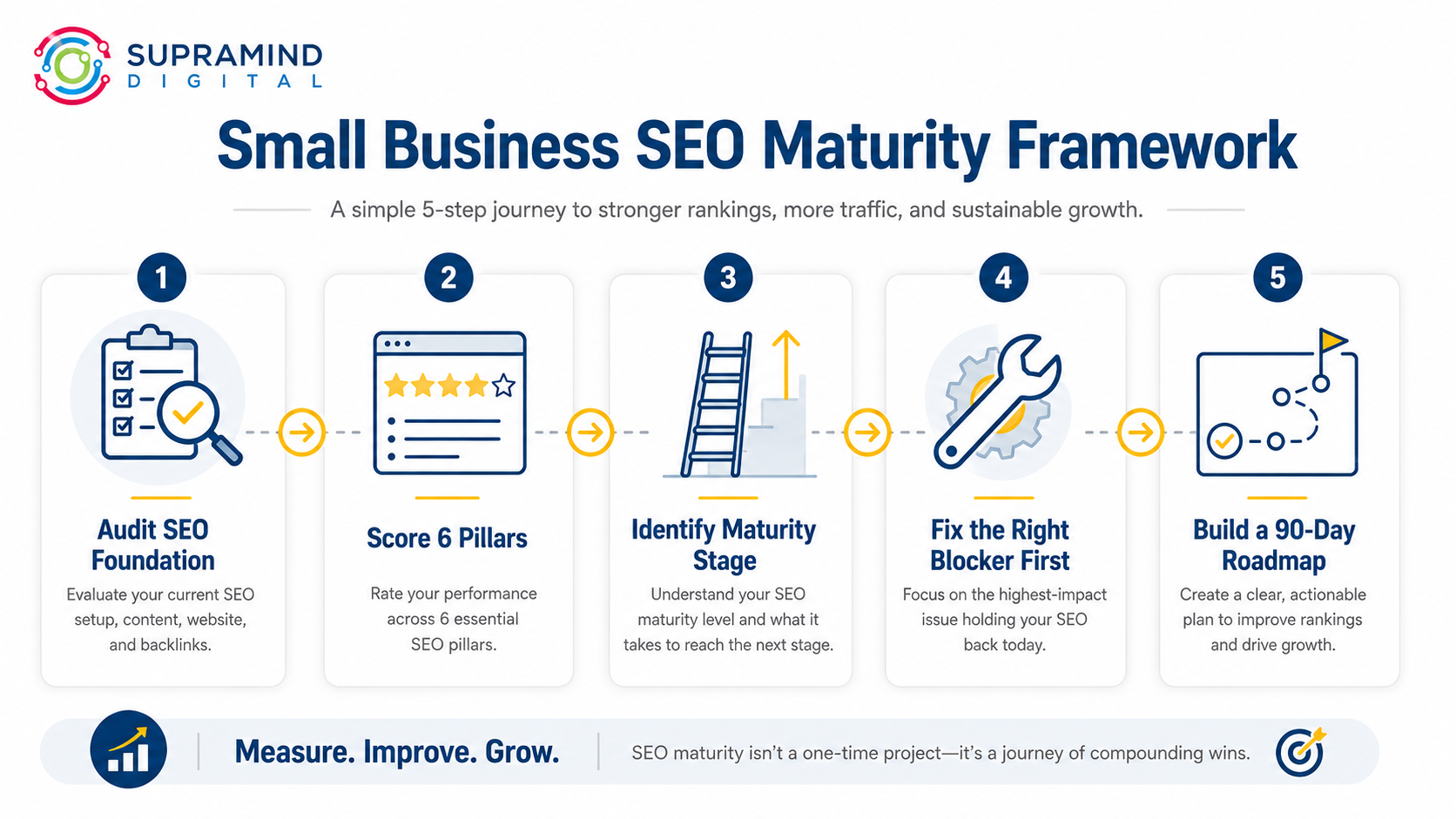
As part of our Small Business SEO Company resource hub, this Small Business SEO Maturity Framework helps founders and local business owners understand what to fix first before spending more on SEO. Use it to score your crawl health, website foundation, Google Business Profile, reviews, service pages, content, internal links, and authority — then turn that score into a practical 30/60/90-day roadmap for stronger rankings, better local visibility, AI-search readiness, calls, enquiries, and sales.
Most small businesses do not fail at SEO because they skipped one random checklist item. They fail because they fix things in the wrong order.
A clinic may start writing blogs before its treatment pages are strong. A home service business may buy backlinks while its Google Business Profile is incomplete. A D2C brand may publish guides while its collection pages, product templates and faceted URLs are still messy. A B2B service provider may create thought leadership content without strong service pages or case studies.
That is why small businesses need an SEO maturity framework, not just another SEO checklist. This framework helps founders, clinics, local businesses, D2C brands, real estate consultants, B2B service providers, coaching businesses, local retailers and professional firms understand where they stand today and what they should fix first.
Why Small Businesses Need This Framework
Small businesses usually do not fail at SEO because they missed one checklist item. They fail because they fix the wrong thing first. A founder may publish blogs before the service pages are strong. A clinic may run ads while reviews are weak. A home service business may build backlinks before its Google Business Profile is complete.
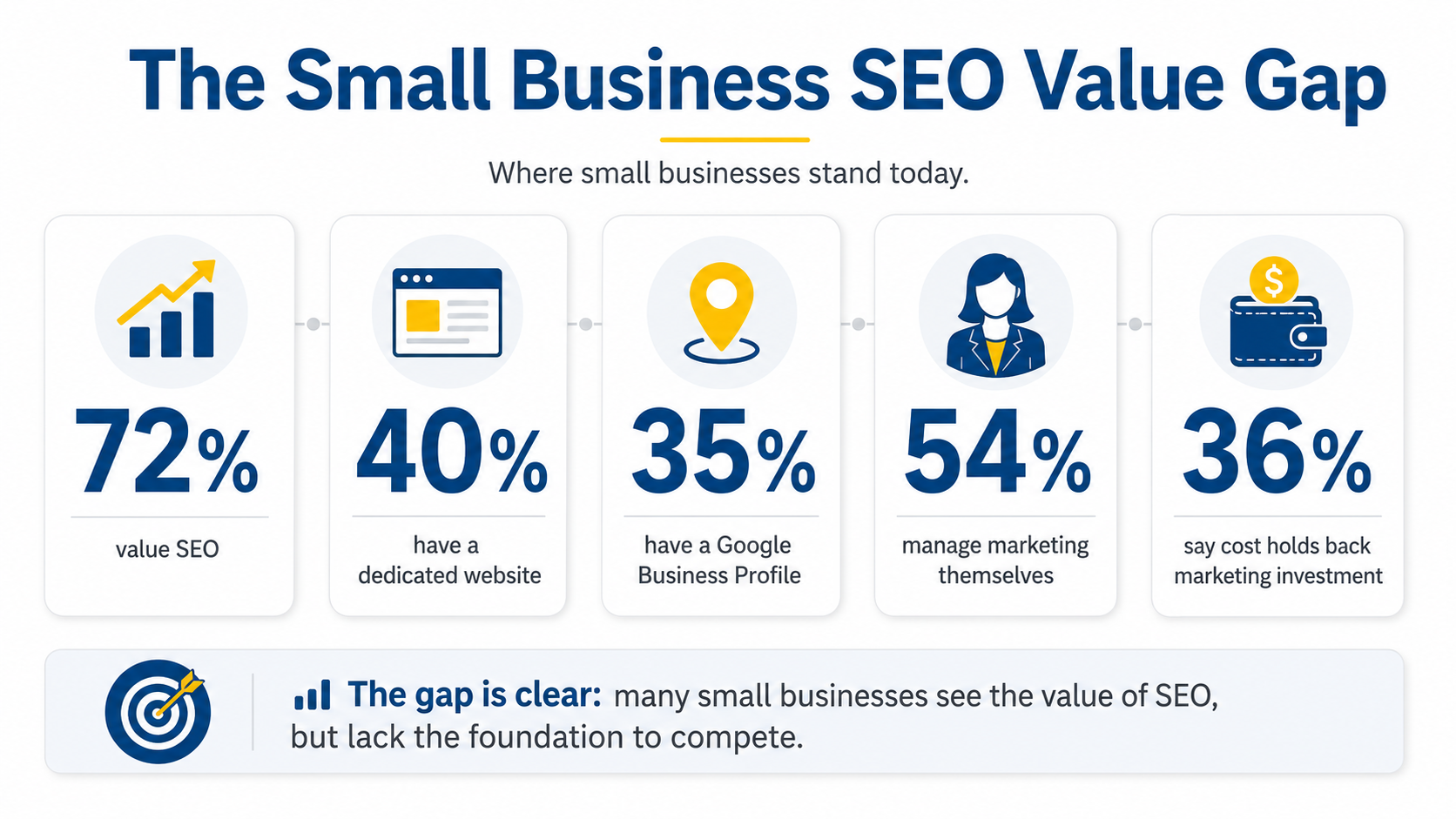
of SMBs say SEO has medium-high impact.
have a dedicated website.
have a Google Business Profile.
of owners manage marketing themselves.
say cost holds back marketing investment.
So what: The framework helps a business avoid spending on blogs, ads or backlinks before the foundation can support growth.
SEO Budget Waste Checker
Use this quick check immediately after the problem section when a business is already spending on SEO, ads, content or backlinks. It tests whether the basics — owned website, service pages, Google Business Profile and recent reviews — are strong enough to absorb that spend. If the checker shows a high waste risk, the framework priority is clear: fix the foundation before scaling SEO activity.
SEO Maturity Scorecard
Use this first to turn the framework into a practical starting point. The scorecard connects the 6-pillar model to the main question behind the Small Business SEO Maturity Framework: what is weak enough to block rankings, trust, leads or sales right now? Score each pillar, identify the lowest layer, and use the result to decide the next SEO priority before spending on advanced work.
The 6 Pillars of Small Business SEO Maturity
The framework scores a business across six areas. Together, they show whether SEO is missing, incomplete, locally discoverable, growth-ready or strong enough to become a competitive moat.
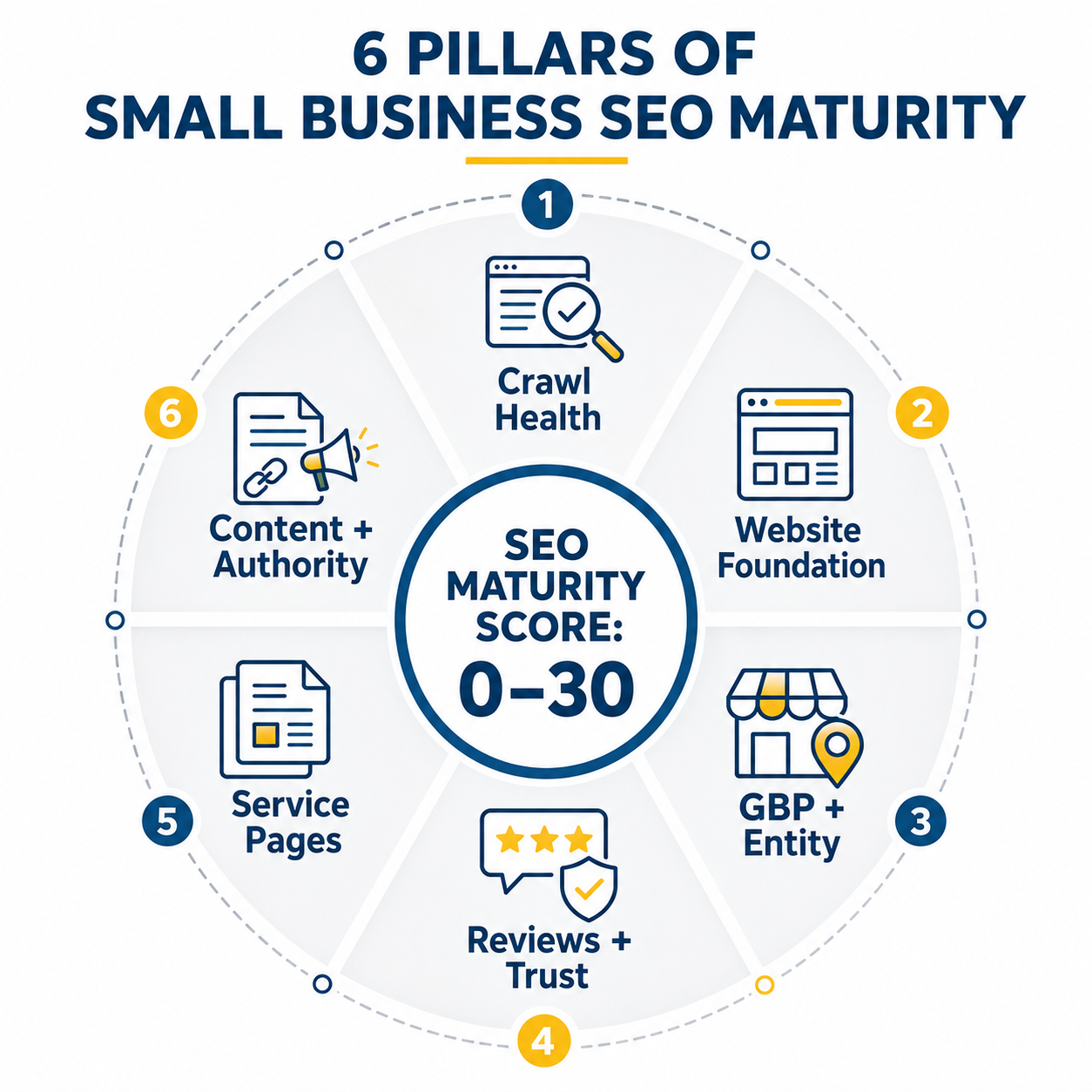
| Pillar | Customer-friendly question | What a weak score usually means |
|---|---|---|
| Crawl Waste & Technical Health | Can Google find and index the right pages? | Money pages are missing, blocked, duplicated or buried. |
| Website Foundation | Does the website clearly explain the offer? | Users land on the site but do not know what to do next. |
| GBP & Local Entity | Can Google understand the business location and services? | Profile, category, hours, photos or NAP details are incomplete. |
| Reviews & Trust | Do customers have enough proof to trust the business? | Competitors look safer because they have more recent reviews. |
| Service Pages | Do money-making services have proper pages? | One generic page is trying to rank for many different intents. |
| Content & Authority | Do pages have enough support to rank and convert? | Blogs, internal links, case studies and backlinks are weak or disconnected. |
Pillar 1: Crawl Waste and Technical Health
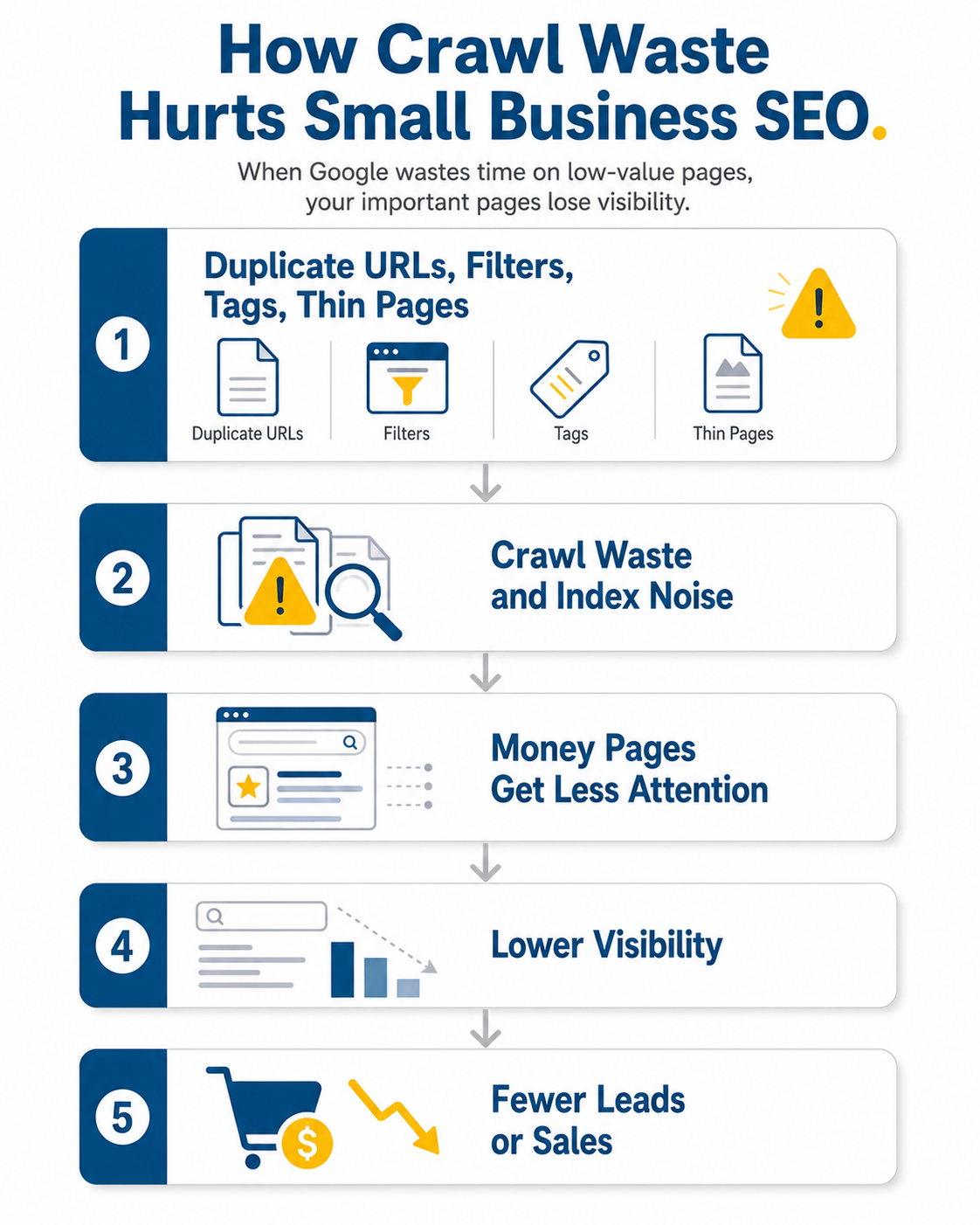
This pillar checks whether Google can find, crawl, understand and index the pages that matter. For a small business, technical SEO is not about fixing every audit warning. It is about making sure the pages that can generate enquiries are visible and crawl waste is not distracting Google from them.
What to audit
- Indexation of homepage, service, product and location pages
- Tag, filter, search, archive and duplicate URLs
- Canonical tags, redirects, sitemap and robots/noindex rules
- Mobile usability and whether users can convert easily
Fix-first trigger
- Money pages are not indexed
- Duplicate or thin pages are indexed
- Filters, tags or parameters create crawl traps
- Important pages are buried with weak internal links
| Score | Meaning |
|---|---|
| 0 | Core pages are blocked, absent or not indexed. |
| 1 | Major duplicate, canonical or crawl issues exist. |
| 2 | Core pages are mostly indexable, but crawl waste remains. |
| 3 | Money pages are indexed with basic sitemap and canonical setup. |
| 4 | Index set is clean and monitored. |
| 5 | Technical governance is mature, scalable and regularly checked. |
When Technical SEO Should Come First
Technical SEO should come first only when crawl or indexation issues block important pages. A small business does not need every audit warning fixed before growth. It needs the issues fixed that stop money pages from being found.
Crawl Waste Risk Checker
Use this checker inside Pillar 1 when crawl waste or indexation may be the first blocker. It helps decide whether Google is spending attention on duplicate URLs, filters, tags, archives or thin location pages instead of the money pages that should generate calls, leads, appointments or sales.
Pillar 2: Website and Core Page Foundation
This pillar checks whether the website clearly explains what the business does, who it helps, where it operates, why it can be trusted and how users can contact, book or buy.
What to audit
- Homepage clarity, offer and CTA
- Dedicated service or product pages
- About, contact, proof, testimonials and certifications
- Mobile UX, forms, call buttons and conversion tracking
Common problems
- One generic Services page
- Weak proof and unclear CTAs
- Poor mobile experience
- No analytics or lead tracking
Fix this first when: the website does not clearly explain services, users cannot easily enquire, or traffic exists but leads are weak.
Pillar 3: Google Business Profile and Local Entity Signals
For any business that depends on local leads, Google Business Profile is part of SEO maturity. Local visibility is shaped by business information, categories, services, photos, reviews, map data, website consistency and user actions.
What to audit
- Verification, name, primary category and services
- Hours, address/service-area setup and photos
- Landing page linked from GBP
- Name, address and phone consistency across listings
Common problems
- Wrong or broad category
- Inconsistent NAP across website, GBP and directories
- Duplicate listings
- Weak photo proof or poor service-area setup
Fix this first when: the business depends on calls, appointments or visits but GBP is incomplete, unverified or inconsistent.
Pillar 4: Reviews, Trust and Reputation
Reviews are no longer only a reputation asset. For local businesses, they influence trust, conversion, prominence and how customers understand the business before visiting the website. Review themes also matter because Maps and AI summaries can surface repeated patterns from review text.
What to audit
- Review count, average rating and review recency
- Response rate and response quality
- Review themes mentioning main services
- Use of testimonials and reviews on service pages
Common problems
- Very few or old reviews
- No responses to reviews
- Generic reviews that do not mention services
- Visible competitor review gap
Fix this first when: competitors have more recent reviews, rankings exist but leads are weak, or local pages lack visible proof.
Pillar 5: Service Pages and Commercial Intent Coverage
This pillar checks whether the business has pages for the searches that create leads, appointments, enquiries or sales. For most small businesses, service pages, treatment pages, product collection pages and location pages are more important than blogs.
| Business type | Money page examples |
|---|---|
| Clinic | Treatment pages, doctor pages, condition pages |
| Home service | Service pages, service-area pages, emergency pages |
| D2C ecommerce | Collection pages, product pages, buying guides |
| B2B service | Service pages, industry pages, use-case pages |
| Real estate | Locality pages, buyer/seller pages, property service pages |
| Coaching | Program pages, course pages, tutor profile pages |
Fix this first when: core services have no dedicated pages, pages are thin, blogs rank but money pages do not, or city/location pages are duplicated.
Pillar 6: Content, Internal Links and Authority
Content and backlinks matter, but they should usually come after the website foundation, local entity signals, reviews and commercial pages are strong enough to benefit from them.
What to audit
- Blogs that answer real buyer questions
- Internal links from support content to money pages
- Topic clusters around services, products or local intent
- Case studies, local links, industry mentions and brand references
Fix-first trigger
- Service pages are strong but not ranking
- Support content is orphaned
- No case studies or proof assets exist
- Competitors have stronger local or industry authority
6-Pillar Self-Scoring Tool
Use this tool to score the six maturity pillars one by one. It helps non-technical founders see whether the real blocker is crawl health, website clarity, GBP/entity data, reviews, service pages or authority instead of guessing from a generic SEO checklist.
Score Your SEO Maturity from 0 to 30
Each pillar gets a score from 0 to 5. The total score gives the stage. The goal is not to jump stages overnight; the goal is to identify the blocker that should be fixed first.
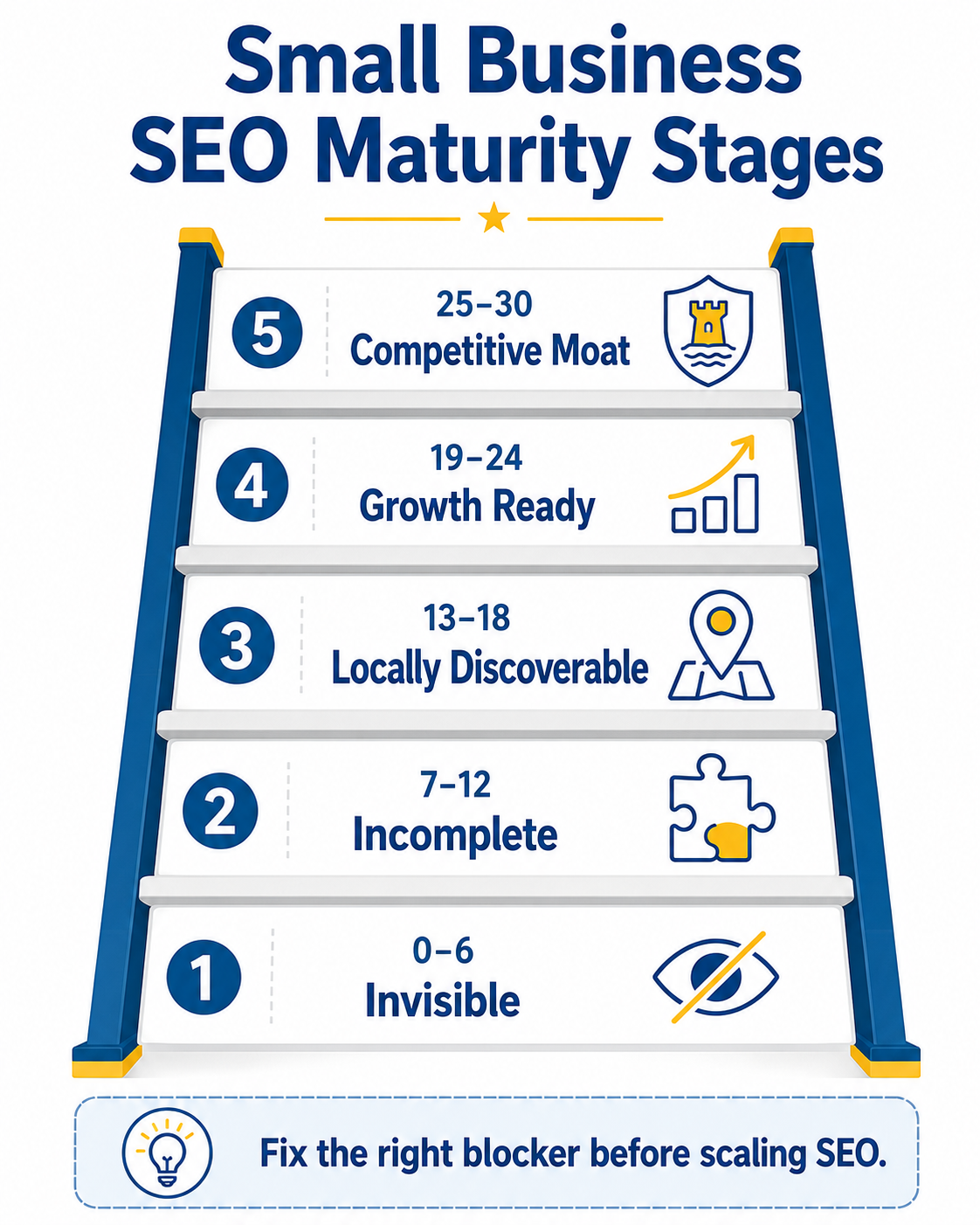
| Score | Stage | Meaning | Fix first |
|---|---|---|---|
| 0-6 | Invisible | SEO foundation is missing or broken. | Indexing, website basics, GBP setup. |
| 7-12 | Incomplete | Some assets exist but are disconnected. | Service architecture, entity consistency, reviews. |
| 13-18 | Locally Discoverable | The business appears, but does not consistently win. | Reviews, service-page proof, internal links. |
| 19-24 | Growth Ready | Foundation is ready to scale. | Content clusters, authority, CRO. |
| 25-30 | Competitive Moat | SEO is becoming defensible. | Protect rankings, expand assets, build PR/tools. |
Hard-Stop Scoring Rules
These rules stop the scorecard from becoming a shallow checklist. If a hard-stop rule applies, that pillar should not receive a high score even if some smaller checks look fine.
| Hard-stop rule | Why it matters |
|---|---|
| If important service, product or location pages are not indexed, technical health cannot score above 1. | Google cannot rank what it cannot properly access. |
| If the website has no clear money pages, website foundation or commercial coverage cannot score above 1. | A business cannot convert SEO demand without destination pages. |
| If a local business does not have a verified or accurate GBP, local entity signals cannot score above 1. | Local discovery depends on accurate business data. |
| If reviews are stale or far behind competitors, reviews and trust cannot score above 2. | Local users rely heavily on recent and credible proof. |
| If city/location pages are copied with only the city name changed, commercial coverage cannot score above 2. | Thin location pages can create quality and doorway-page risk. |
| If blog content does not link to money pages, content and authority cannot score above 2. | Content must support commercial pages, not sit separately. |
What Each Maturity Stage Means
Score 0-6. Search presence is structurally weak or missing. Fix indexing, website basics, GBP setup and first reviews before investing in blogs or links.
Score 7-12. Some assets exist but are disconnected. Fix service architecture, local consistency, review baseline and conversion proof.
Score 13-18. The business appears in search but does not consistently convert or compete. Improve review velocity, service-page depth and internal links.
Score 19-24. Foundations are ready to scale. Build clusters, proof assets, authority and conversion improvements.
Score 25-30. SEO becomes a defensible growth asset. Protect index quality, expand profitable topics and build AI-citable assets.
SEO Stage Finder
Use this after calculating the total score. It translates a 0-30 score into a clear maturity stage so the business understands whether it is still invisible, incomplete, locally discoverable, growth ready or building a competitive moat.
What Should You Fix First?
The strongest output of this framework is the fix-first decision. A score tells you where you are; the decision flow tells you where the next rupee or dollar should go.
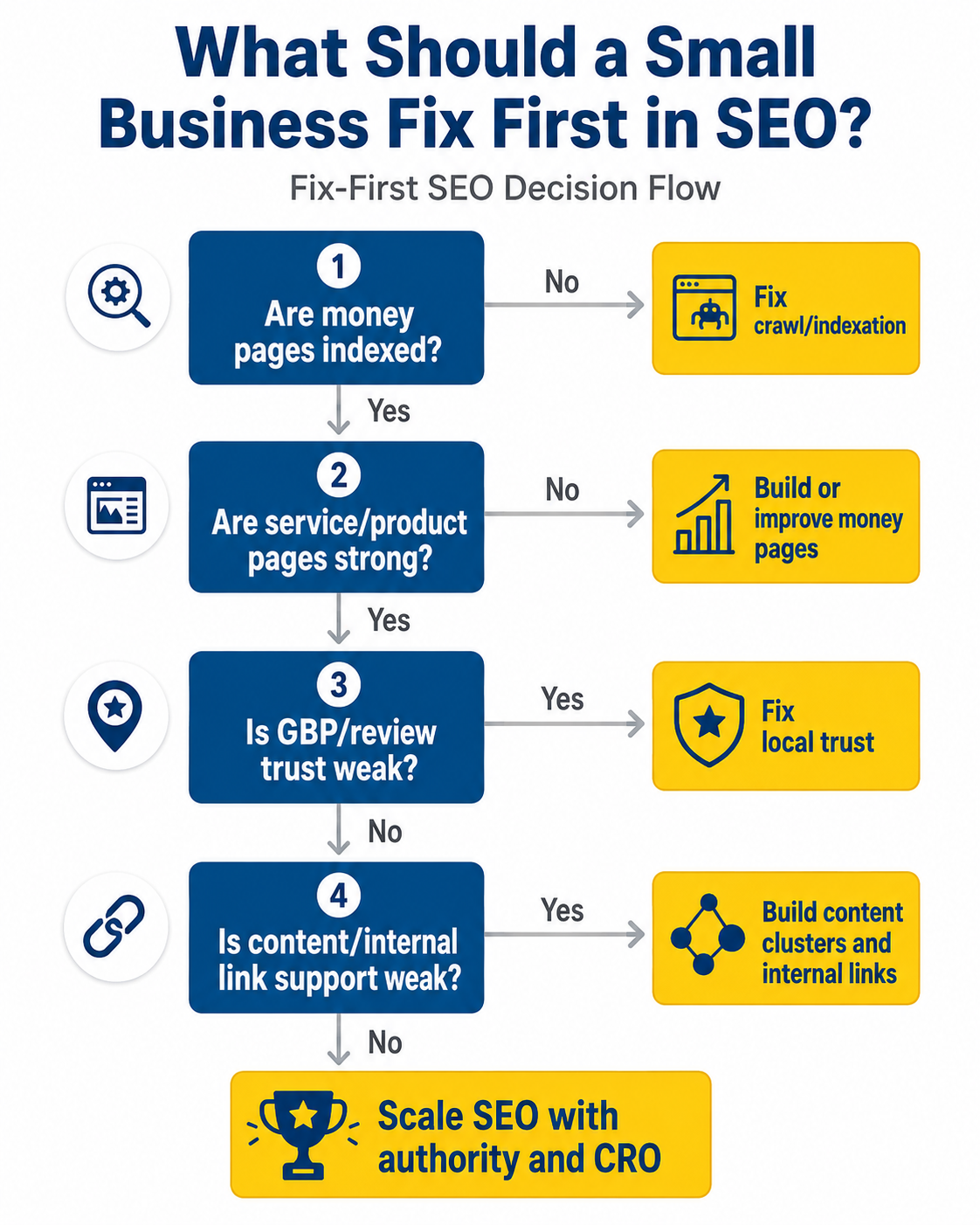
| Symptom | Likely maturity gap | What to fix first | Why this comes first | What to avoid initially |
|---|---|---|---|---|
| Important pages are not indexed | Crawl waste and technical health | Canonicals, sitemap, noindex, robots and internal links | Ranking cannot grow from missing pages. | Blogs and backlinks |
| Website has no clear service pages | Website foundation and commercial coverage | Dedicated service pages with CTAs and proof | Traffic needs a destination. | Top-of-funnel content |
| GBP is incomplete or inconsistent | GBP and local entity signals | Verify profile, fix categories, hours, services and NAP | Local visibility depends on entity clarity. | Broad local content expansion |
| Reviews are weak vs competitors | Reviews and trust | Review acquisition, response workflow and proof integration | Reviews influence trust and local decisions. | Fake or incentivized reviews |
| Blogs exist but money pages do not rank | Service pages and internal links | Strengthen money pages and link blogs to them | Content must support revenue pages. | More unguided blog posts |
| Service pages exist but lack support | Content and authority | Create support content and internal links | Commercial pages need topical support. | Link campaigns before content structure |
| Rankings exist but leads are poor | Website foundation and CRO | Improve CTAs, trust proof, forms, calls and intent match | The issue may be conversion, not visibility. | Chasing more traffic |
| Duplicate location pages exist | Technical and commercial coverage | Consolidate or rewrite unique location pages | Thin pages create quality risk. | More city-page rollout |
| D2C brand has weak collection pages | Technical and commercial coverage | Collection SEO, schema, facets and internal links | Ecommerce demand lands on category and product pages. | Generic blog content |
| B2B firm has no case studies | Website foundation and authority | Add service proof, case studies and comparison pages | B2B SEO depends on trust and proof. | Awareness blogs only |
Fix-First SEO Recommender
Use this tool when the business has too many possible SEO tasks and no clear order. It connects symptoms such as missing indexed pages, weak service pages, incomplete GBP, poor reviews or low conversion to the first action that should be fixed before anything else.
Different Businesses Have Different SEO Maturity Gaps
A clinic, home service company, ecommerce brand and B2B service provider usually do not have the same SEO blocker. This map helps readers understand which pillars often need attention by business model.
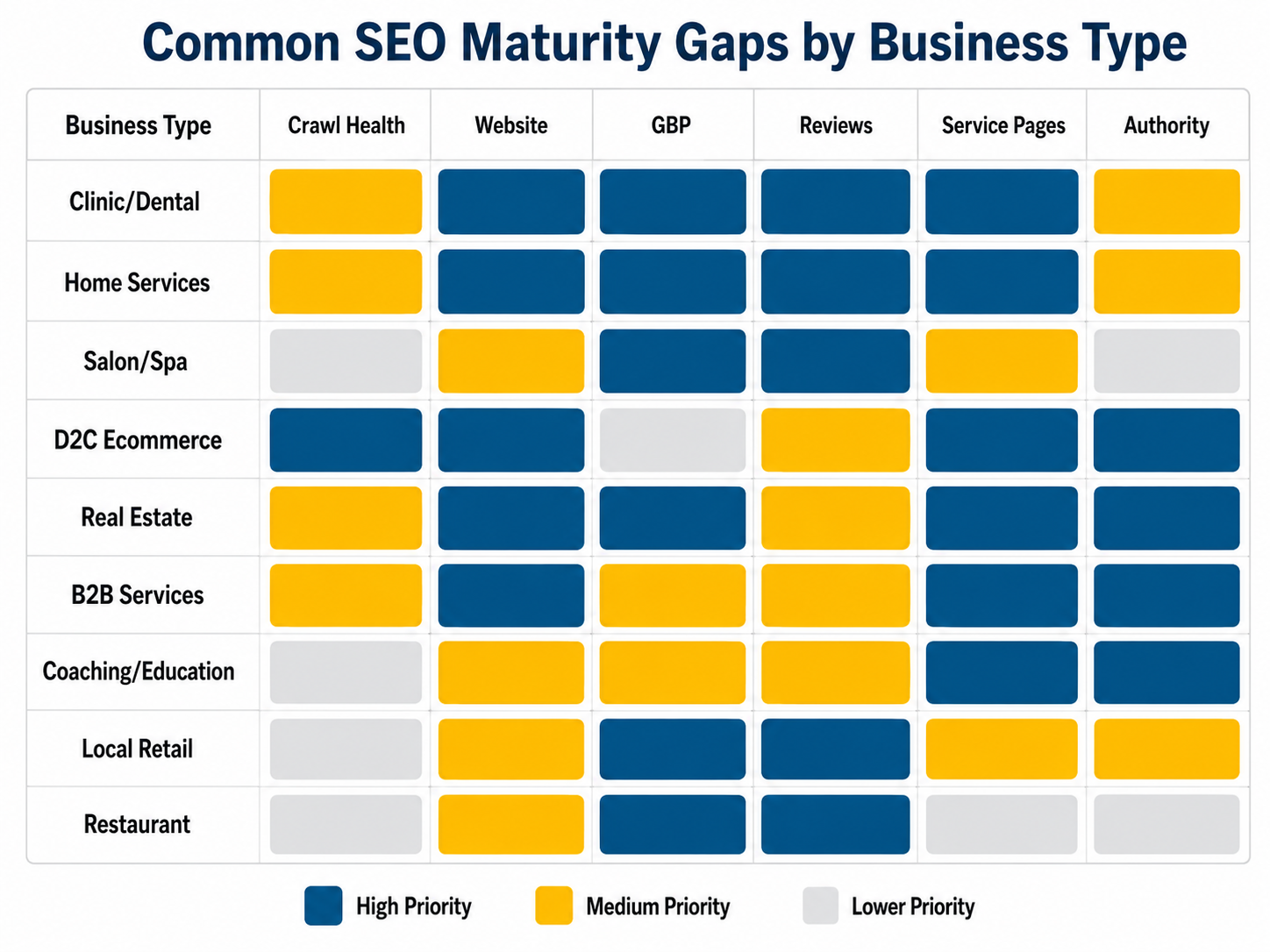
| Business type | Common SEO maturity problem | Weakest pillar usually | What to fix first | Expected outcome |
|---|---|---|---|---|
| Dental clinic / healthcare clinic | Weak treatment pages and inconsistent reviews | Reviews or commercial coverage | GBP, treatment pages, doctor proof and review recency | More calls and appointment leads |
| Home service business | Over-reliance on GBP with weak service-area pages | GBP and service coverage | SAB setup, service pages and review themes | Better map visibility and call quality |
| Salon / spa / aesthetic clinic | Strong social presence but weak website | Website foundation and reviews | Booking-ready service pages, pricing cues, photos and reviews | More organic-assisted bookings |
| D2C ecommerce brand | Weak collection pages and faceted URL bloat | Technical and commercial coverage | Collection architecture, schema, canonicals and internal links | More product and category traffic |
| Real estate consultant | Thin locality pages and weak proof | Commercial coverage and authority | Area pages, market guides, lead forms and proof | Better local search visibility |
| B2B service provider | Thought leadership without service proof | Website foundation and authority | Service pages, case studies and comparison content | Better-quality non-brand leads |
| Coaching / education business | Generic course pages and weak outcome proof | Commercial coverage and trust | Program pages, tutor/faculty bios, testimonials and FAQs | More course enquiries |
| Local retailer | GBP exists but the website does not support discovery | GBP and site foundation | Store page, product categories, local inventory and hours | More visits and local enquiries |
| Restaurant / local food business | Review and Maps visibility drive decisions | Reviews and local entity signals | Menu, hours, photos, ordering links and review responses | More visits and fewer drop-offs |
Business-Type SEO Priority Selector
Use this selector to make the framework practical by business model. A dental clinic, home service business, D2C store and B2B service firm usually have different weak pillars, so this tool maps the most likely first priority by business type.
Your First 90 Days Based on SEO Maturity Stage
Once the stage is known, the next step is a practical roadmap. This stops a business from spending on advanced SEO before the foundation is ready.
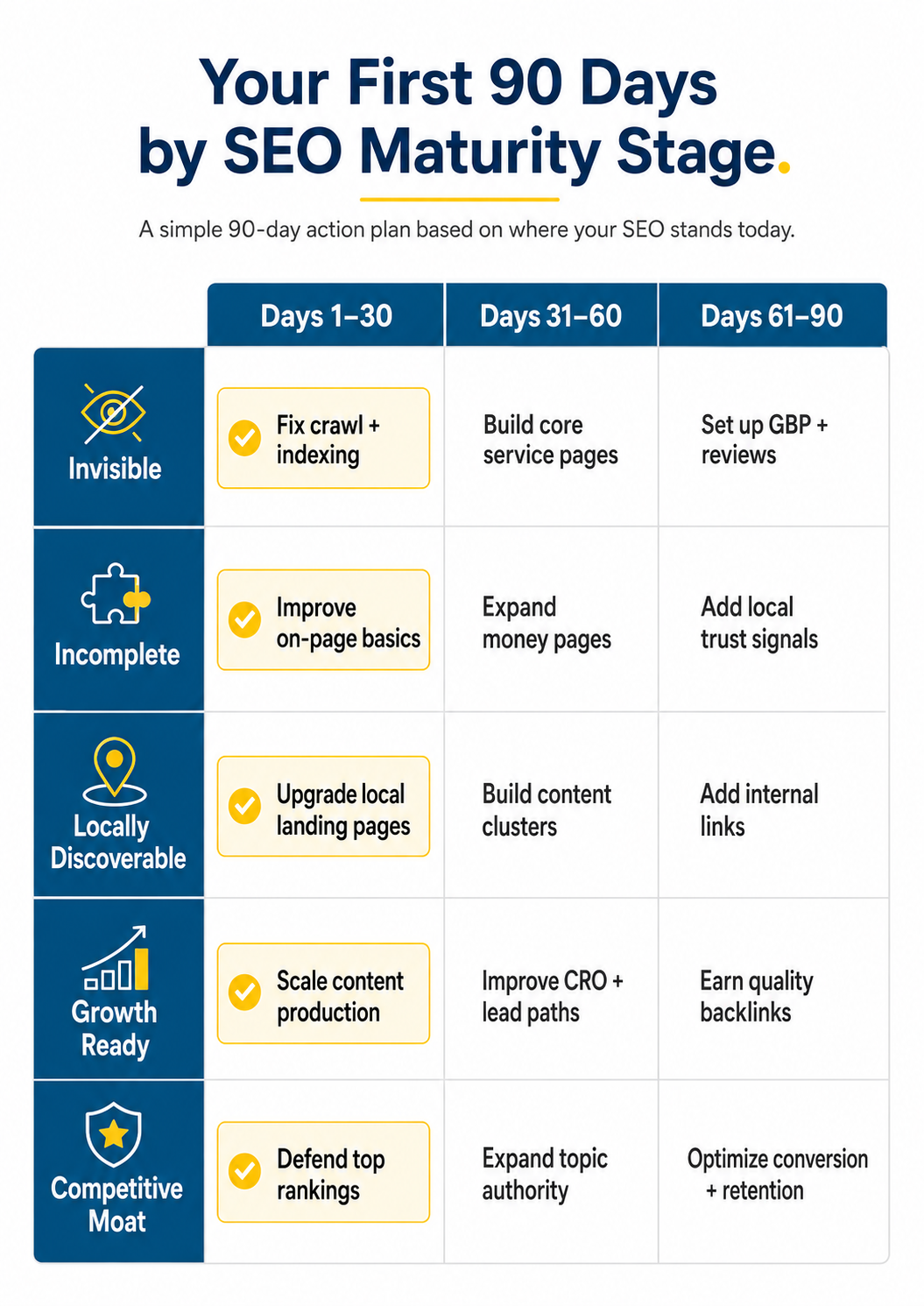
| Maturity stage | First 30 days | Days 31-60 | Days 61-90 | Success metric |
|---|---|---|---|---|
| Stage 1: Invisible | Fix indexation, sitemap, analytics, homepage clarity and GBP setup | Build core service/product/location pages and correct entity data | Add proof sections, FAQs, reviews and internal links | Key pages indexed, GBP verified and first non-brand impressions |
| Stage 2: Incomplete | Repair thin/duplicate pages and improve site architecture | Add reviews, proof, FAQs, CTAs and citation consistency | Build support content tied to money pages | More profile actions and better service-page clicks |
| Stage 3: Locally Discoverable | Run competitor, GBP and review gap analysis | Improve review velocity and service-page depth | Add local/industry links and case studies | More calls, bookings and qualified enquiries |
| Stage 4: Growth Ready | Identify high-opportunity services, cities, products or buyer stages | Build content clusters, proof assets and internal links | Launch authority-building and CRO tests | Higher non-brand leads and assisted conversions |
| Stage 5: Competitive Moat | Protect index quality and entity consistency | Expand into adjacent search opportunities | Build research, tools, digital PR and AI-citable assets | Stable rankings plus new growth surfaces |
90-Day SEO Roadmap Generator
Use this once the maturity stage and weakest pillar are known. It converts the framework into a 30/60/90-day action plan so the business can move from diagnosis to execution without jumping into random SEO activity.
Why Website, GBP and Reviews Must Work Together
For local businesses, SEO does not happen only on the website. Customers discover and judge businesses through Google Search, Maps, reviews, business profile actions, AI summaries and the website.
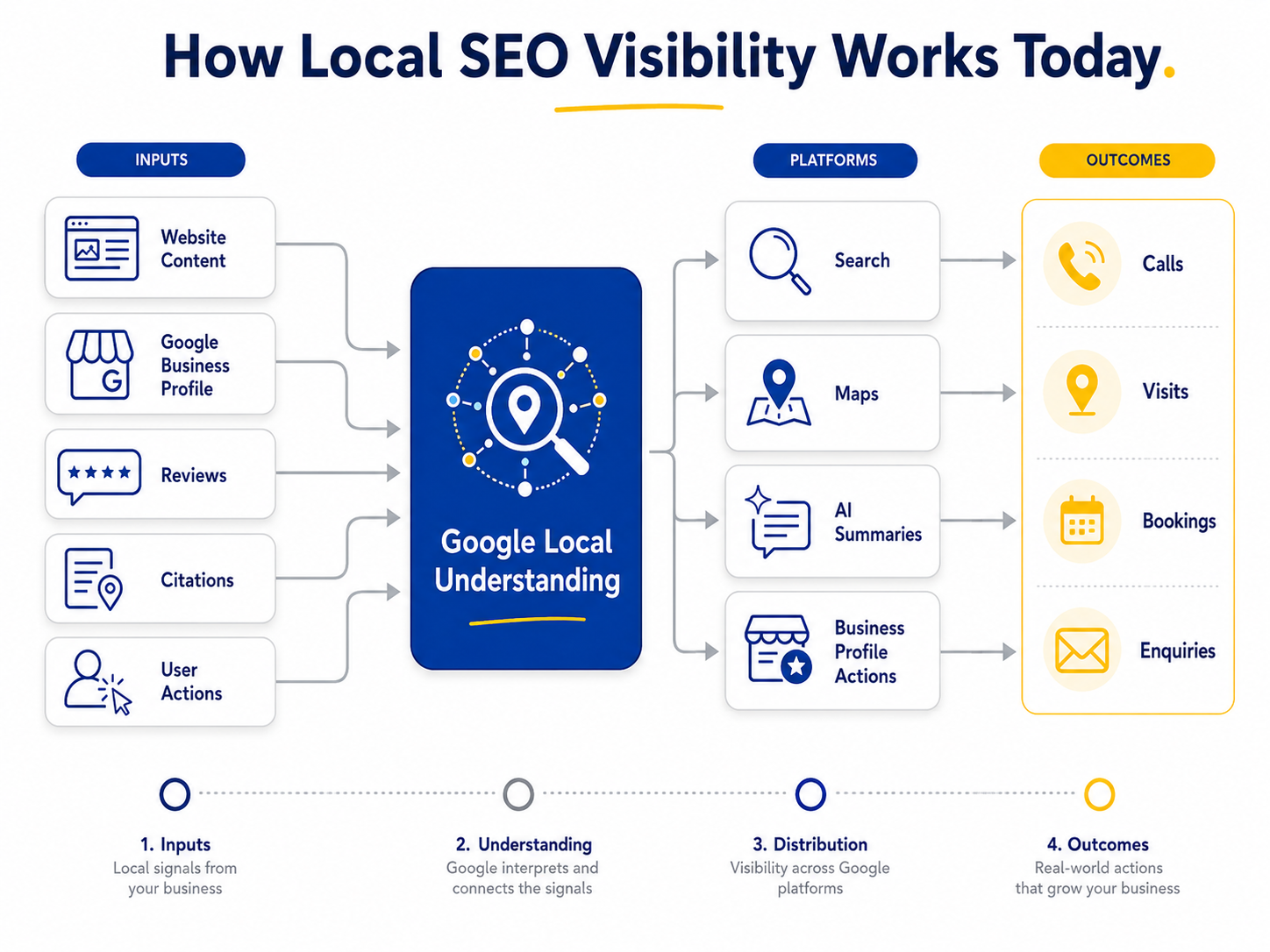
Local Visibility Readiness Checker
Use this for businesses that depend on calls, visits, appointments or local enquiries. It checks whether website content, Google Business Profile, reviews, citations and user actions are aligned enough for local discovery to turn into real conversions.
Useful Statistics Behind This Framework
The framework is designed around a practical market gap: small businesses understand the value of SEO, but many do not have the website, GBP, review and trust foundation needed to turn search visibility into leads.
| Statistic | Source | Caveat | How it supports the framework |
|---|---|---|---|
| 72% of SMBs say SEO has medium-high impact, but only 40% have a dedicated website. | BrightLocal SMB Marketing Report | Survey data; validate geography before country-specific claims. | Supports website foundation as a maturity pillar. |
| Only 35% of SMBs have a Google Business Profile. | BrightLocal SMB Marketing Report | Survey data; local adoption varies by market. | Supports a separate GBP and local entity pillar. |
| 54% of small business owners manage marketing themselves. | BrightLocal SMB Marketing Report | Founder-led businesses need simpler prioritization. | Supports a simple score-first framework. |
| 36% of SMBs say cost holds back marketing investment. | BrightLocal SMB Marketing Report | Budget sensitivity varies by industry. | Supports fix-first sequencing to reduce wasted spend. |
| 97% of consumers read reviews for local businesses. | BrightLocal Local Consumer Review Survey | Consumer behavior varies by category and geography. | Supports reviews as a full maturity pillar. |
| 62% would avoid a business if they found incorrect information online. | BrightLocal Local Business Discovery and Trust Report | Survey-based consumer trust data. | Supports NAP, GBP and local entity consistency. |
| Google says local results are mainly based on relevance, distance and prominence. | Google Business Profile Help | Google guidance; exact ranking weights are not public. | Supports the GBP, reviews and authority scoring logic. |
| Google search share is above 90% in India, UAE and the UK, and above 80% in the US and Germany. | StatCounter Search Engine Market Share | Market share changes over time; refresh before publishing claims. | Supports a Google-first prioritization model. |
Download the Small Business SEO Maturity Scorecard
The article can convert readers into leads with a downloadable scorecard. The template should include the 6-pillar checklist, 0-30 scoring table, fix-first matrix and 90-day roadmap.
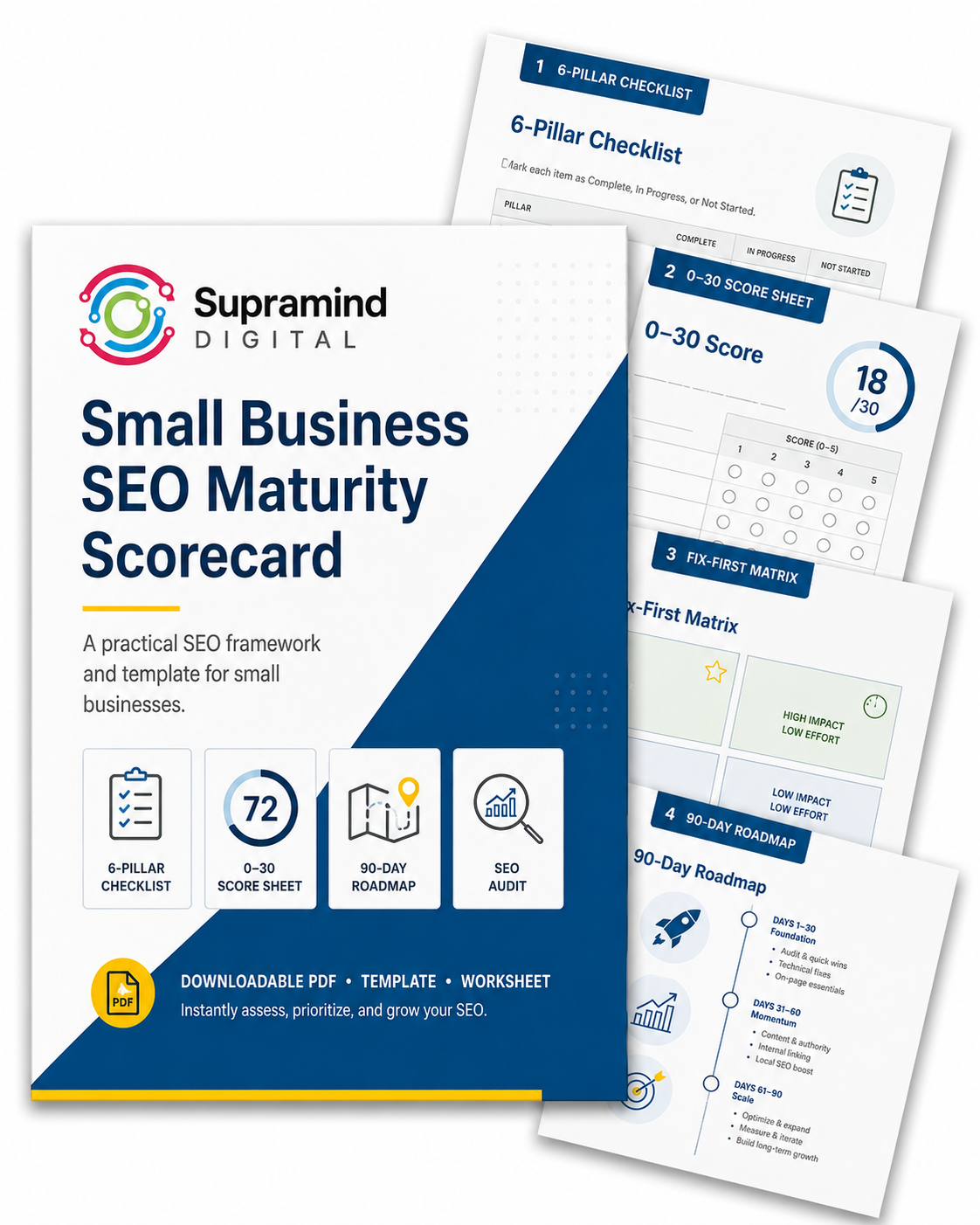 Download SEO Maturity Scorecard PDF
SEO Maturity Scorecard Summary Generator
Use this near the end of the framework to turn the assessment into a simple takeaway for the reader. It summarizes the business name, score, weakest pillar, main goal and fix-first recommendation so the scorecard can work as a downloadable audit or consultation starter.
Sources and Caveats
| Source | Used for | Caveat |
|---|---|---|
| BrightLocal SMB Marketing Report | SMB SEO value, website, GBP and marketing ownership statistics. | Survey data; validate geography before using country-specific claims. |
| BrightLocal Local Consumer Review Survey | Review usage, recency and trust behaviour. | Consumer behaviour varies by category and market. |
| Google Business Profile Help: Local ranking | Relevance, distance, prominence, complete business info and reviews. | Google does not disclose exact ranking algorithm weights. |
| Google Search Central: Helpful content | People-first content and quality signals. | Use as quality guidance, not as a scoring formula. |
| Schema.org LocalBusiness | Local entity markup reference. | Schema supports understanding; it does not guarantee rankings. |
AI-Friendly Glossary
| Term | Simple meaning |
|---|---|
| SEO maturity | How ready a business is to turn search visibility into leads or sales. |
| Crawl waste | When Google spends time crawling low-value or duplicate pages instead of important pages. |
| Money page | A page designed to generate leads, sales, appointments or enquiries. |
| Google Business Profile | The business listing that appears on Google Search and Maps. |
| Local entity signals | Business details that help Google understand who the business is, where it operates and what it offers. |
| Review velocity | The pace at which a business earns new reviews. |
| Commercial intent | Search intent from users close to buying, booking, calling or enquiring. |
| Internal linking | Links between pages on the same website. |
| Authority | Trust built through links, mentions, reviews, case studies and external validation. |
FAQs
What is SEO maturity for small businesses?
SEO maturity is how ready a business is to turn Google visibility into calls, leads, appointments or sales. It includes crawl health, website foundation, GBP, reviews, service pages, content, internal links and authority.
How do I know what SEO task to fix first?
Start with the issue that blocks visibility or conversion. If pages are not indexed, fix crawl/indexation. If the business is local and GBP is incomplete, fix local entity signals. If traffic exists but leads are weak, fix CTAs, service pages and trust proof.
Should small businesses write blogs before service pages?
Usually no. Service, product, treatment and location pages should come first because they capture commercial intent. Blogs should support those pages through internal links and buyer education.
Is Google Business Profile part of SEO maturity?
Yes. For local businesses, GBP is a core part of SEO maturity because customers often discover and evaluate businesses inside Google Search and Maps before visiting the website.
When should a small business invest in backlinks?
Backlinks are more useful after the website foundation, core pages, GBP, reviews and internal links are in place. Links to weak pages usually waste budget.
What is a good SEO maturity score?
A score above 13 means the business is at least locally discoverable. A score above 19 usually means it is ready to scale with content, authority and conversion improvements.
Final Summary
Most small businesses do not need more random SEO tasks. They need the right SEO sequence. Use this framework to decide whether to fix crawl waste, website structure, Google Business Profile, reviews, service pages, internal links, content or authority first.
Explore Small Business SEO Services- Log in to post comments


 INDIA
INDIA