


Small Business Keyword Opportunity Finder for SEO Growth
As part of our Affordable Small Business SEO hub, this Small Business Keyword Opportunity Finder helps you turn business details into practical keyword and page ideas before building new content.
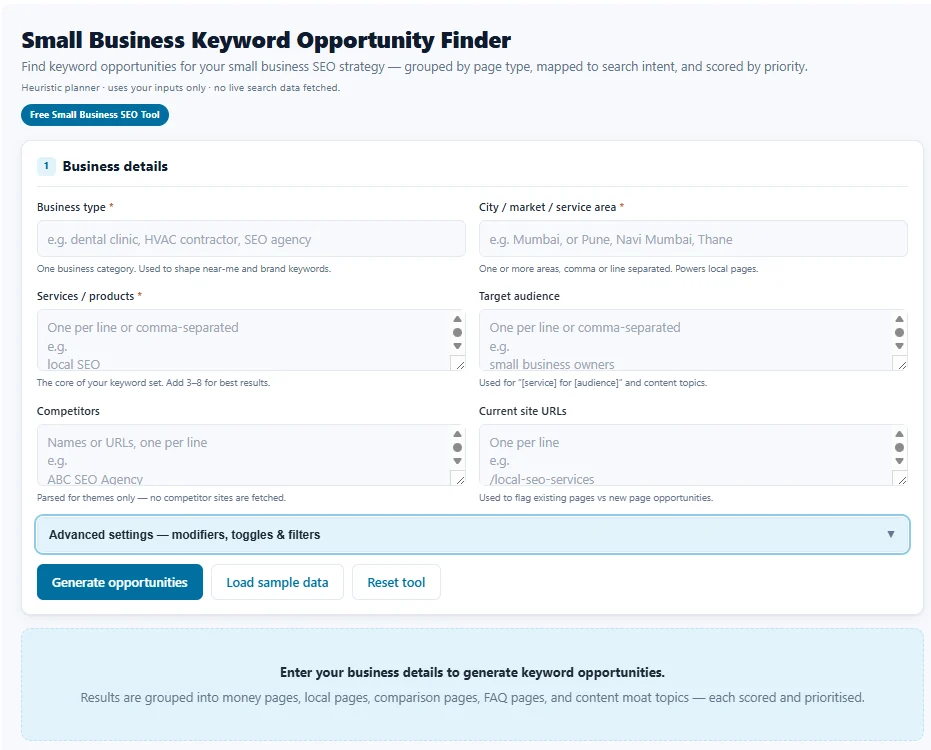
Small Business Keyword Opportunity Finder
Find keyword opportunities for your small business SEO strategy — grouped by page type, mapped to search intent, and scored by priority.
Heuristic planner · uses your inputs only · no live search data fetched.
Business details
These recommendations are heuristic-based and should be validated with real keyword data, SERP review,
and business priorities before implementation.
Need hands-on help turning this plan into rankings? Explore our
small business SEO services.
Table of Contents
What this Small Business Keyword Opportunity Finder does and why it matters
Small businesses often know their services, locations, and customers well, but they struggle to convert that knowledge into a useful SEO roadmap. This tool helps bridge that gap by turning basic business inputs into page-level keyword opportunities.
Instead of giving one long keyword list, it groups ideas by page type so you can decide what to create first, what to optimize, and which topics can support your revenue pages.
Inputs you can put into the tool
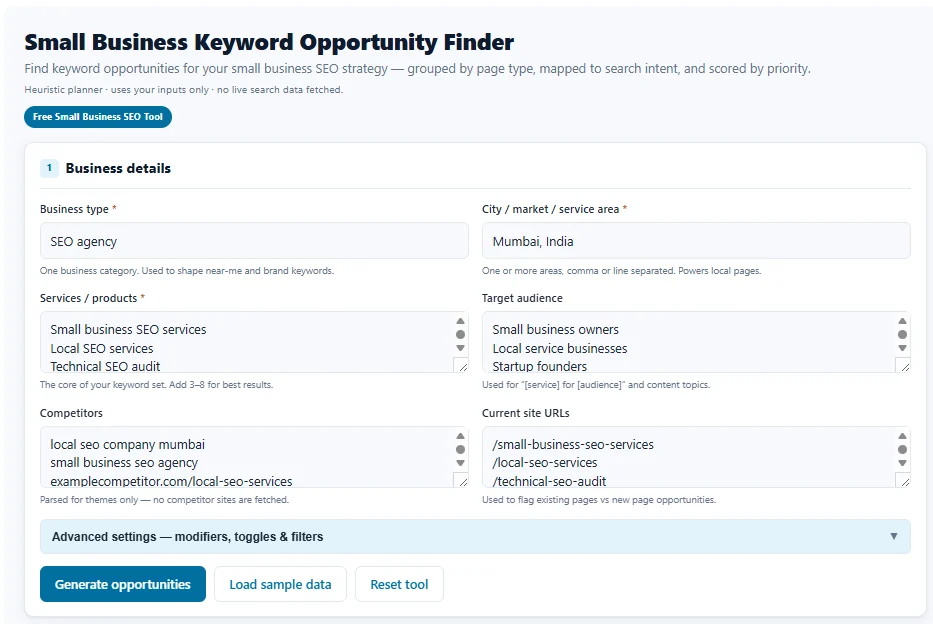
The tool works best when you add clear, specific business details. Use the table below as a quick input checklist.
| Input | What to add | Example |
|---|---|---|
| Business type | Your main business category or niche. | SEO agency, dental clinic, HVAC contractor, accounting firm |
| City / market | Your target city, region, country, or service areas. | Mumbai, Dallas, Dubai, Toronto, Pune, Navi Mumbai, Thane |
| Services / products | Your main offers, one per line or comma-separated. | Small business SEO services, local SEO, technical SEO audit, content optimization |
| Target audience | The people or businesses you want to attract. | Small business owners, local service businesses, startup founders, homeowners, clinics, B2B companies |
| Competitors | Competitor names or URLs for theme hints. The tool does not fetch competitor websites. | ABC SEO Agency, competitor.com/seo-pricing, competitor.com/local-seo-services |
| Current site URLs | Existing service, location, and blog URLs to identify new page ideas versus pages to optimize. | /small-business-seo-services, /local-seo-services, /blog/how-to-choose-seo-agency |
Tip: Add at least 3 to 8 services and your most important city or market. This gives the tool enough context to create stronger money page, local page, and content ideas.
What the tool analyzes and outputs
The Small Business Keyword Opportunity Finder groups your keyword opportunities into five practical SEO buckets:
Money Pages
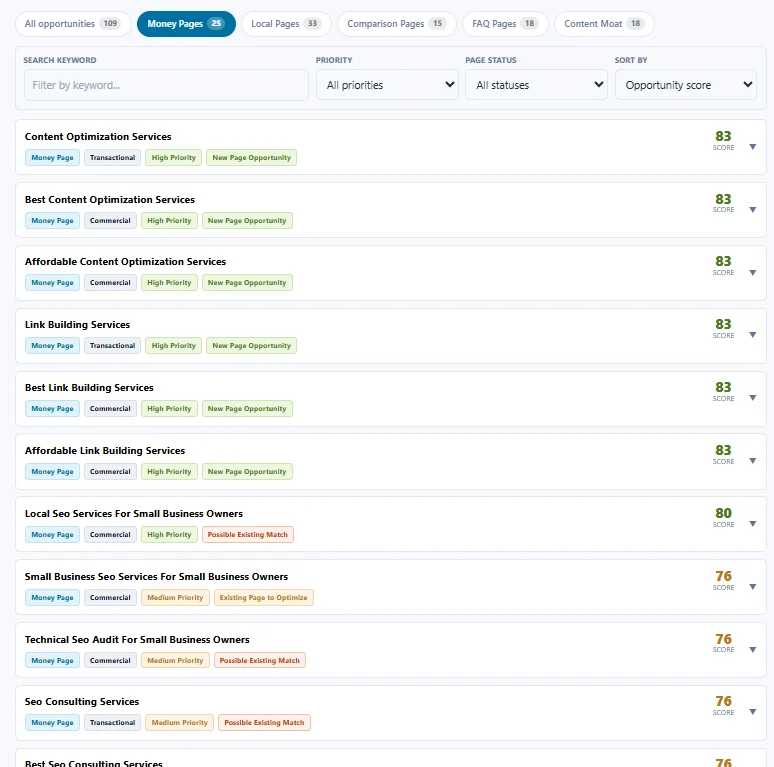
Commercial service or product pages that target high-intent searches and support lead generation.
Local Pages
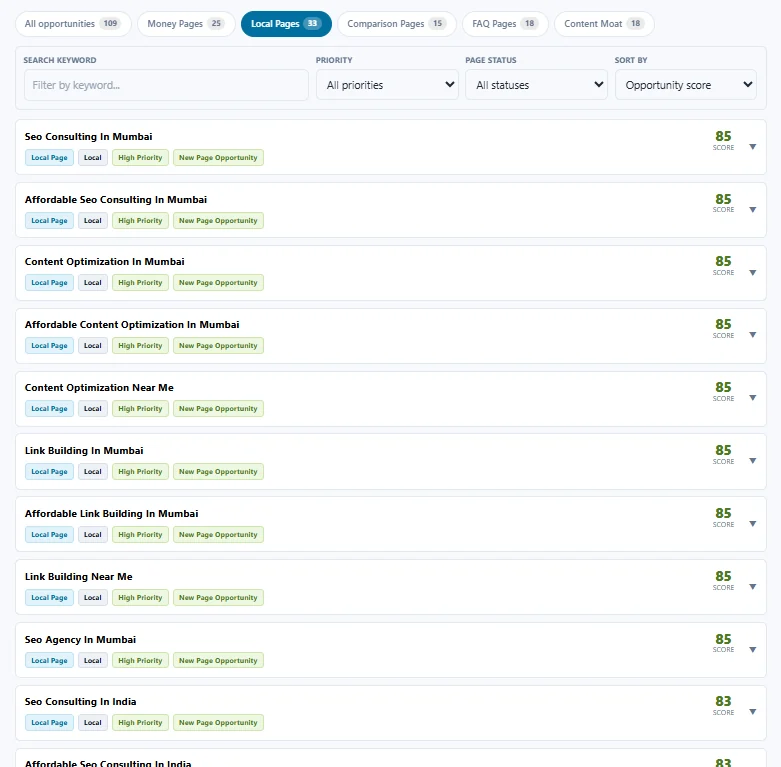
City, market, service-area, and near-me opportunities for businesses that depend on local visibility.
Comparison Pages
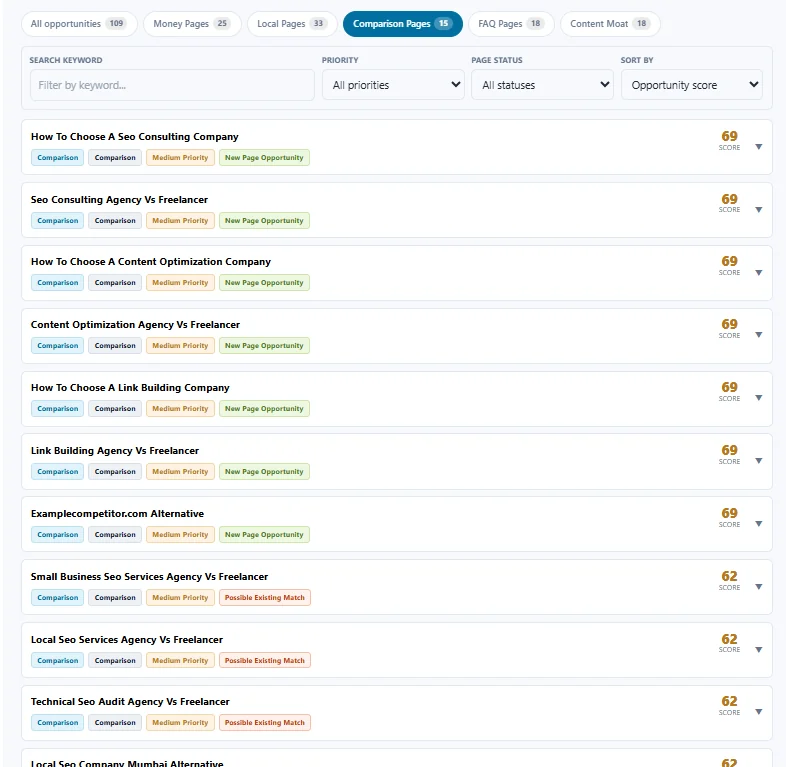
Decision-stage topics such as alternatives, versus pages, and how-to-choose pages.
FAQ Pages
Question-led ideas that answer buyer objections around cost, process, timelines, and value.
Content Moat Topics
Supportive guides, checklists, and educational topics that build topical authority around your services.
Each recommendation includes a suggested keyword, page type, priority, score, suggested URL slug, page status, CTA direction, and a short reason explaining why the opportunity matters.
How to use the tool
1. Start with your business details
Open the tool and begin with your business type, market, services, audience, competitors, and current URLs.
2. Adjust advanced settings if needed
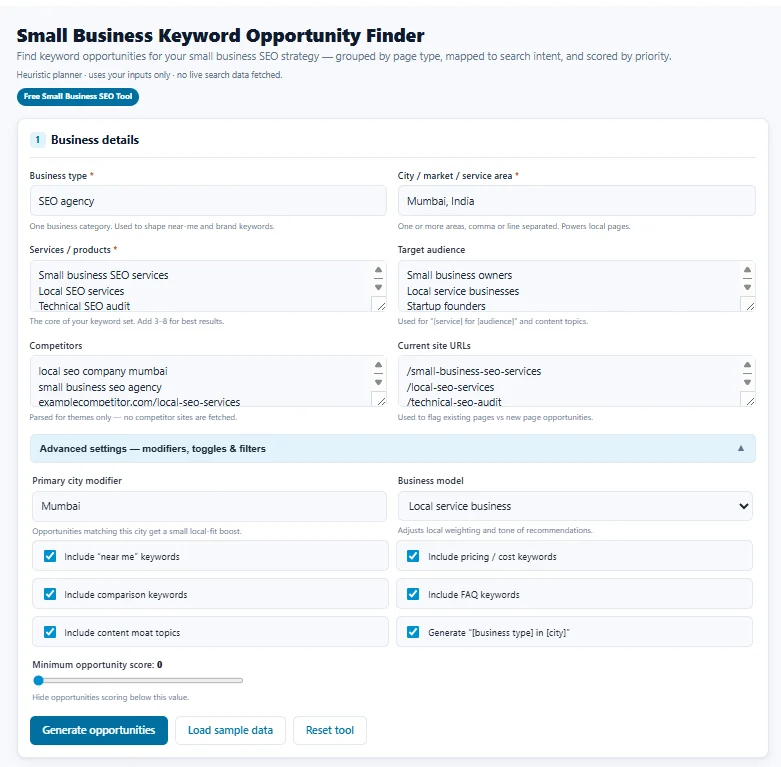
Use advanced settings to include near-me keywords, pricing keywords, comparison ideas, FAQ ideas, content moat topics, or a minimum opportunity score.
3. Review the executive summary
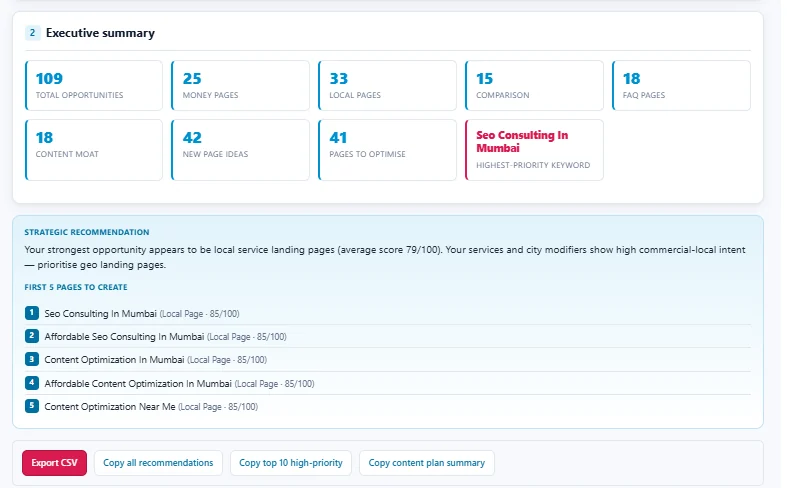
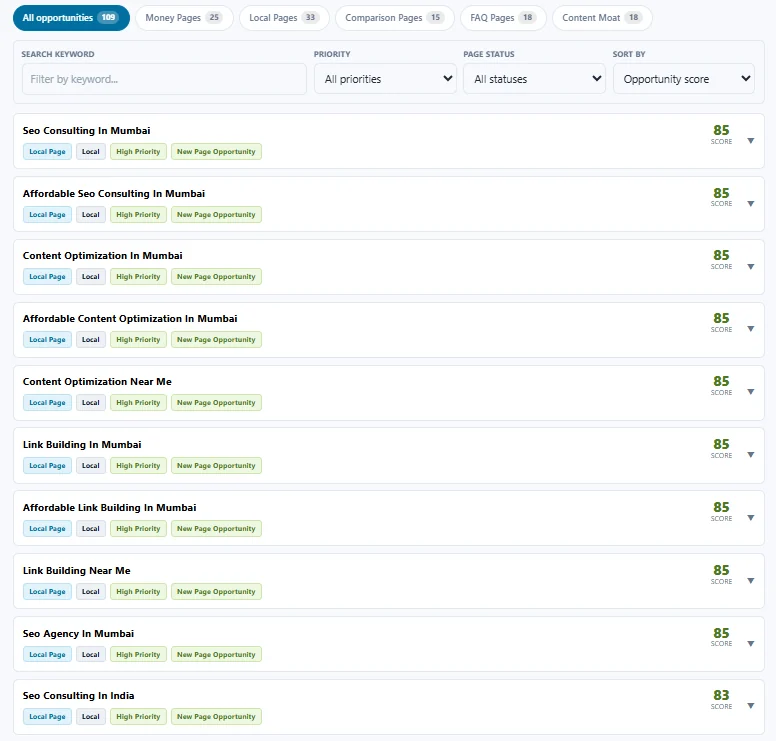
After running the tool, start with the executive summary. It shows total opportunities, page-type counts, new page ideas, pages to optimize, and the highest-priority keyword.
4. Check each opportunity group
Use the tabs to review all opportunities, then go deeper into money pages, local pages, and comparison pages. This makes it easier to prioritize what should be created first.
5. Understand the score before acting
The score is based on commercial intent, service relevance, local fit, page gap, and audience fit. Treat it as a prioritization guide, not as live keyword difficulty or search volume.

Who should use this tool
This Small Business Keyword Opportunity Finder is useful for anyone who needs a clearer page and keyword roadmap before creating new SEO content.
Small Business Owners
Use it to understand which service, local, and FAQ pages can support leads before investing in content.
Local Service Businesses
Plan city, service-area, and near-me landing pages for markets where visibility matters most.
SEO Consultants
Create a fast first-pass keyword and page roadmap for audits, proposals, and implementation planning.
Content Teams
Turn business inputs into structured content briefs for money pages, comparison pages, FAQs, and topical guides.
Agencies
Use the output to explain priorities, page gaps, and content sequencing to small business clients.
Where this fits in affordable small business SEO
This tool is a planning asset for small businesses that want SEO growth without wasting content budget. It helps you identify which pages can support leads, local visibility, and topical authority before writing or redesigning pages.
For best results, validate the output with keyword research, SERP review, internal linking checks, and content quality planning. The tool gives structure; your business priorities and real search data should guide final implementation.
Want a Practical SEO Growth Plan for Your Small Business?
Use the tool to find your keyword gaps, then let Supramind help you turn those opportunities into optimized service pages, local pages, and content that supports leads.
Build My Small Business SEO Growth PlanFAQs on Small Business Keyword Opportunity Finder Tool
What is the Small Business Keyword Opportunity Finder?
It is a free SEO planning tool that converts your business type, location, services, audience, competitors, and current URLs into keyword opportunities grouped by page type.
Does this tool use live keyword volume or ranking data?
No. It is a heuristic planner. It does not fetch live Google, SERP, search volume, ranking, or competitor data. Use it for planning, then validate important keywords with keyword research and SERP review.
What inputs should I add to get useful results?
Add your business type, target city or market, main services or products, target audience, competitor names or URLs, and your current site URLs. The more specific your inputs are, the better the page ideas become.
What page types does the tool suggest?
It groups opportunities into money pages, local pages, comparison pages, FAQ pages, and content moat topics so you can plan both commercial landing pages and supportive content.
How should small businesses use the output?
Start with high-priority money and local pages, then build comparison, FAQ, and content moat pages to support those revenue-focused pages with internal links.
Is this enough to finalize a full SEO strategy?
No. Treat the output as a starting point. Before implementation, validate the opportunities with real keyword data, SERP analysis, business priorities, and content quality checks.
Final note
The Small Business Keyword Opportunity Finder is designed to make SEO planning faster and clearer. Use it to organize your next page ideas, spot missing opportunities, and support your affordable small business SEO strategy with a stronger content roadmap.
Related Small Business SEO Resources
Teardowns, Frameworks & Case Studies
Use these resources to connect this keyword opportunity tool with Supramind's broader small business SEO strategy and implementation assets.
Teardowns
Urban Company SEO Teardown: What Small Home Service Businesses Can Learn From Local Service Marketplaces
A practical teardown showing how local service marketplaces structure visibility, service demand, and city-led discovery.
Justdial SEO Teardown: How Indian Local Directories Capture Small Business Search Demand
A breakdown of Justdial's SEO strategy, showcasing how local directories dominate small business search results.
Frameworks
Small Business SEO Maturity Framework: How to Know What to Fix First
Use this framework to score SEO maturity, identify the weakest growth blocker and decide what to fix before scaling content, links or paid campaigns.
Local Visibility Flywheel: A Small Business SEO Framework for More Calls and Leads
The framework connects Google Business Profile accuracy, reviews, local pages, trust proof, conversion actions, and recurring local signals into one practical growth loop.
Small-Brand Content Moat Framework: How Small Businesses Compete With Bigger Brands
Learn how small businesses can build a content moat to compete with larger brands and earn sustainable organic traffic.
Tools
Local SEO Readiness Checker for Small Businesses
Use this tool to audit local SEO readiness across GBP, reviews, local pages, trust proof, calls, forms, and tracking before scaling local SEO work.
Case Studies
WordPress Dental SEO Case Study
A practical example of how focused local SEO, service-page improvements and technical fixes can support appointment-led growth for a dental business.
Technical SEO Case Study for a Parenting Blog
A technical SEO example showing how crawl, indexation and site-structure improvements can recover visibility and improve organic performance.
- Log in to post comments


 INDIA
INDIA