


Small-Brand Content Moat Framework: How Small Businesses Compete With Bigger Brands
As part of our Small Business SEO Company resource hub, this Small-Brand Content Moat Framework helps boutique ecommerce brands, small B2B firms, consultants, coaches, D2C brands, and local service businesses compete with bigger brands without trying to outpublish them. Use it to turn niche expertise, buyer questions, comparison content, proof assets, and internal links into a focused content moat that supports rankings, AI-search visibility, and qualified enquiries.
Framework Spoke
Small-brand content moat snapshot
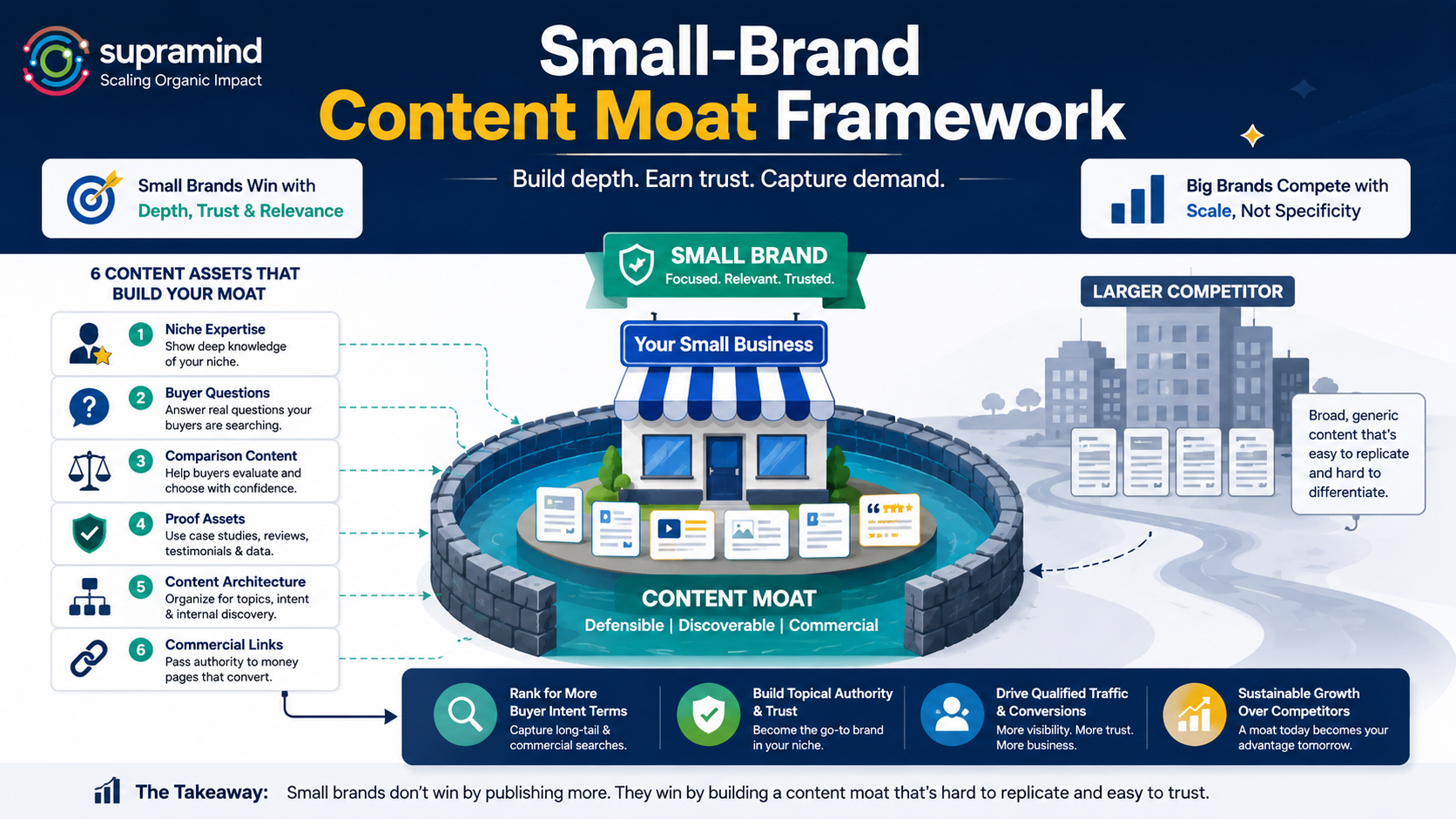
This framework shows how smaller businesses compete with larger brands by building a focused moat around niche expertise, buyer questions, comparison content, proof assets, internal links, and revenue pages.
Why this framework matters
Small brands should not copy big-brand content strategy. Big brands can rely on volume, broad authority, and larger budgets. Smaller brands need a more defensible system: sharper niche expertise, real buyer questions, comparison content, proof assets, and clear links into revenue pages.
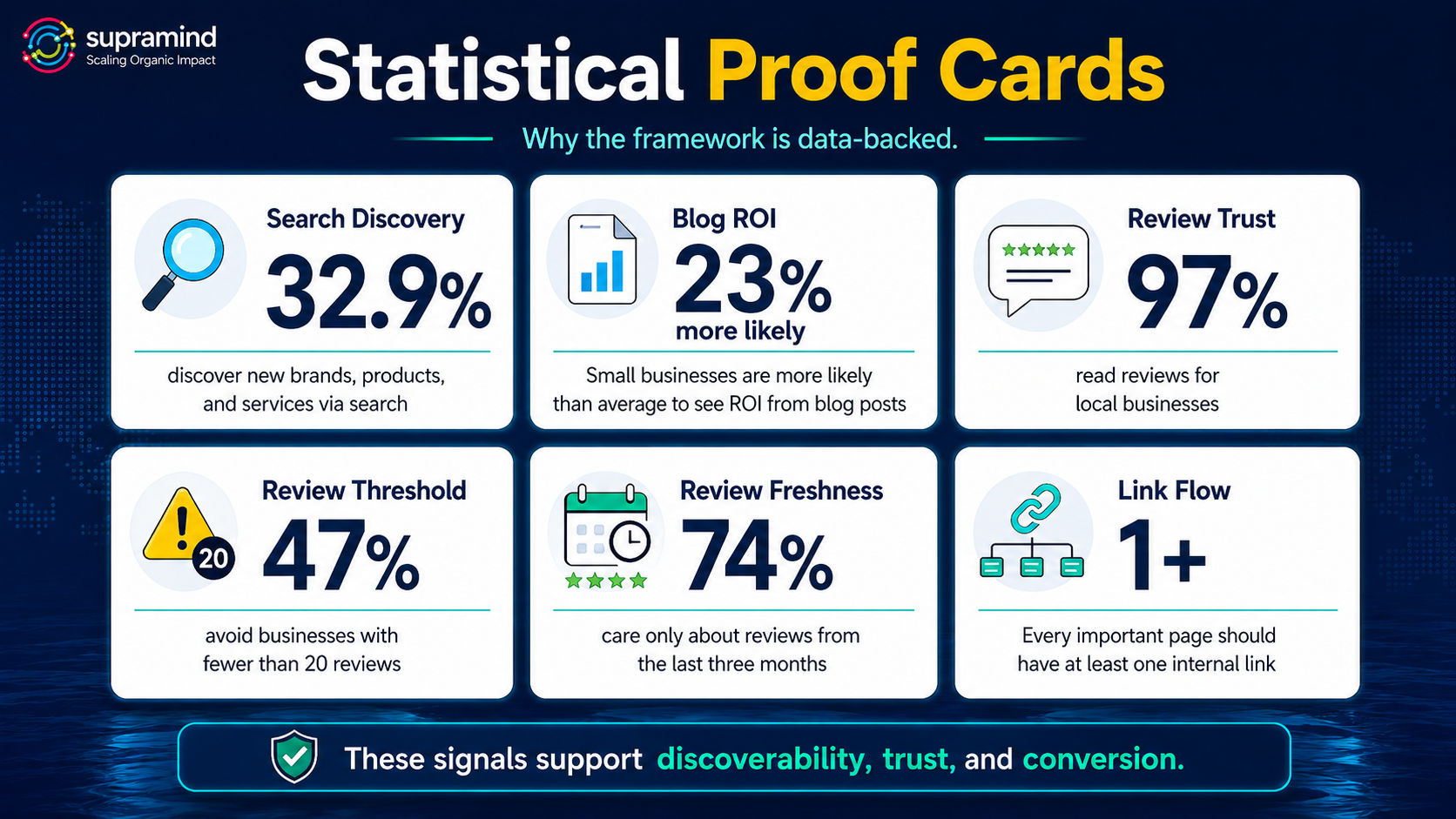
| Signal | What it tells us | Small-business action |
|---|---|---|
| Search discovery | Search engines still help users discover new brands, products, and services. | Own narrow search questions and commercial investigation topics. |
| Blog ROI | Blog content can still produce ROI when it is focused and useful. | Prioritize specialist guides over broad generic posts. |
| Reviews and proof | Trust signals influence whether buyers believe the content and enquire. | Add reviews, testimonials, case studies, screenshots, and data snapshots near CTAs. |
| Internal links | Content needs crawlable, descriptive links to pages that matter. | Link buyer questions, comparisons, and proof assets to service, product, and category pages. |
How Small Businesses Compete With Bigger Brands
Small businesses do not compete with larger brands by copying their publishing volume. They compete by becoming more specific, more useful, and easier to trust for a narrower buyer segment.
| Big-brand advantage | Small-brand moat response | What to fix first |
|---|---|---|
| Large publishing volume | Fewer but deeper niche assets | Choose one narrow audience and topic cluster. |
| Broad authority | Specific expertise and buyer-led answers | Turn real sales questions into content briefs. |
| Brand familiarity | Proof assets that make claims believable | Add reviews, testimonials, screenshots, or case examples near CTAs. |
| Large content library | Clear internal links to revenue pages | Connect guides, comparisons, and FAQs to commercial pages. |
What is a small-brand content moat?
A small-brand content moat is a connected set of content assets that makes a smaller business more discoverable, more trusted, and harder to replace in its niche. The moat is not built by publishing more. It is built by answering buyer problems better than generic competitors and linking every support asset back to a commercial page.
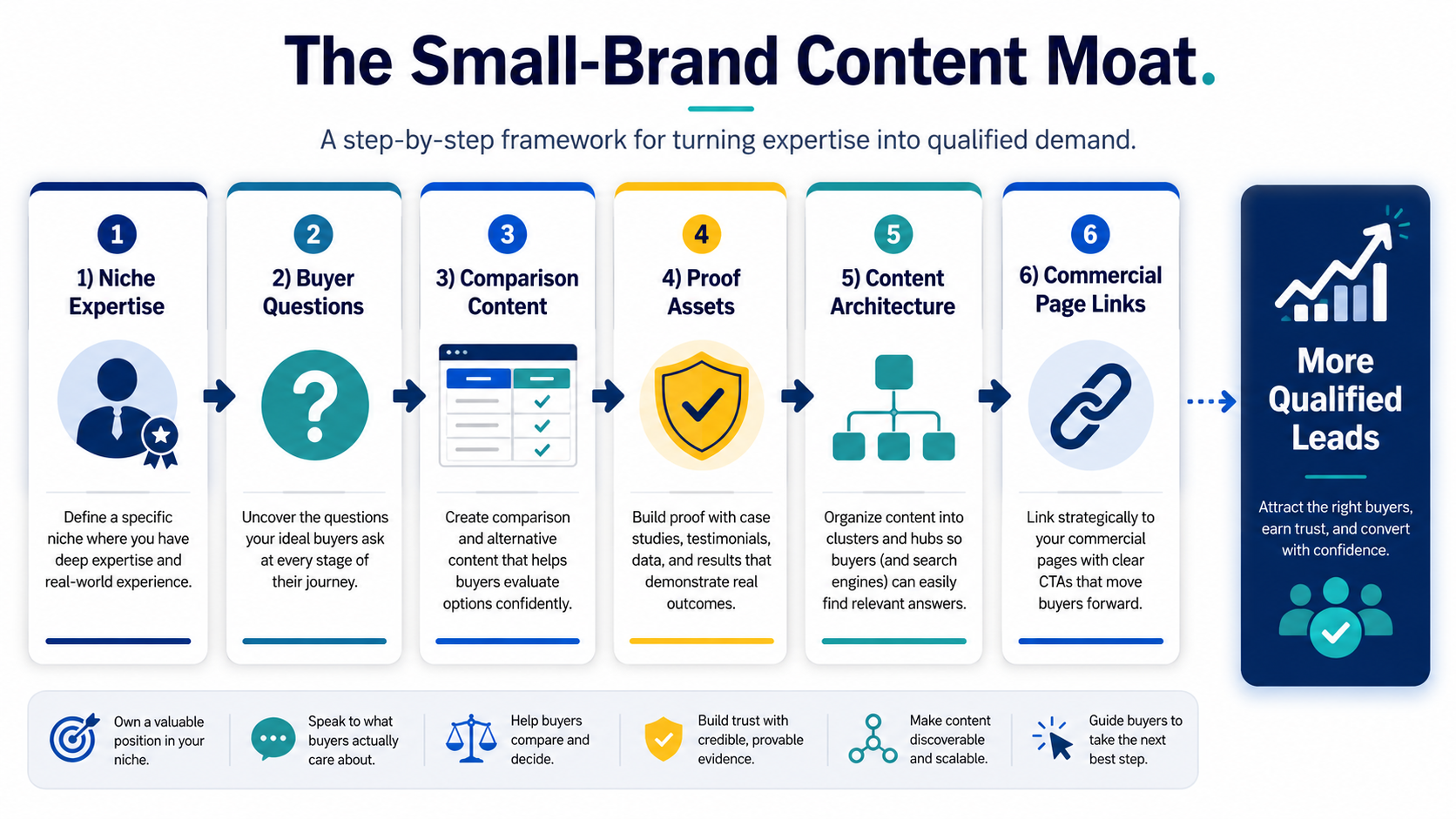
The 6-layer content moat model
| Layer | What it means | What to build | What to fix first |
|---|---|---|---|
| Niche expertise | The narrow area where the brand can be more useful than bigger competitors. | Specialist guides, POV articles, frameworks. | Define one narrow audience and three core problems. |
| Buyer questions | Real questions buyers ask before enquiry or purchase. | FAQs, objection-led posts, buying guides. | Collect sales, chat, support, and call questions. |
| Comparison content | Content for users comparing options. | Vs pages, alternatives pages, best-for pages. | Create one honest comparison page. |
| Proof assets | Evidence that supports claims. | Reviews, testimonials, case studies, screenshots, before-after proof. | Add proof to top commercial pages. |
| Content architecture | Connected hub-and-spoke structure. | Hubs, clusters, internal links, breadcrumbs. | Link related content together. |
| Commercial page links | Contextual links from content to money pages. | Service, product, category, quote, consultation, or booking links. | Add relevant CTA and internal link to every asset. |
Layer 1: Niche expertise
Niche expertise is the part of the framework that gives the small brand its edge. A boutique ecommerce store, consultant, coach, or small B2B service firm should not begin with broad topics like “marketing tips” or “best products.” It should define the specific buyer, use case, market problem, or transformation it can explain better than larger generic competitors.
Clear niche positioning, specific page angles, expert explanations, real examples, and content that would still be useful if search engines did not exist.
Choose one narrow audience and write down the three problems that audience must solve before buying.
Layer 2: Buyer questions
Buyer questions convert sales friction into search assets. Instead of guessing blog topics, collect the exact questions buyers ask before paying, booking, enquiring, comparing, or switching providers.
| Question type | Example | Best page format | Commercial page to support |
|---|---|---|---|
| Cost | How much does this cost? | Pricing guide | Service or quote page |
| Trust | Can I trust this provider? | Proof-led FAQ or case study | Consultation page |
| Fit | Is this right for my business? | Fit guide | Product, service, or package page |
| Comparison | Which option is better? | Comparison page | Category or service page |
| Process | What happens after enquiry? | How-it-works guide | Contact or booking page |
| Result | What outcome can I expect? | Case study or proof article | Service page |
Buyer Question Mapper
Use this lightweight tool to convert one buyer question into a content topic, page format, proof asset, and internal link target.
How Much Does Small Business SEO Services Cost for Small Business Owner?
Cost of small business SEO services for small business owner
Answer the pricing concern directly, explain what drives cost, and show when the investment makes sense.
Layer 3: Comparison content
Comparison content works because it meets buyers during evaluation. A small business can use comparison pages to clarify the right fit, expose trade-offs, add proof, and link to the most relevant product or service page.
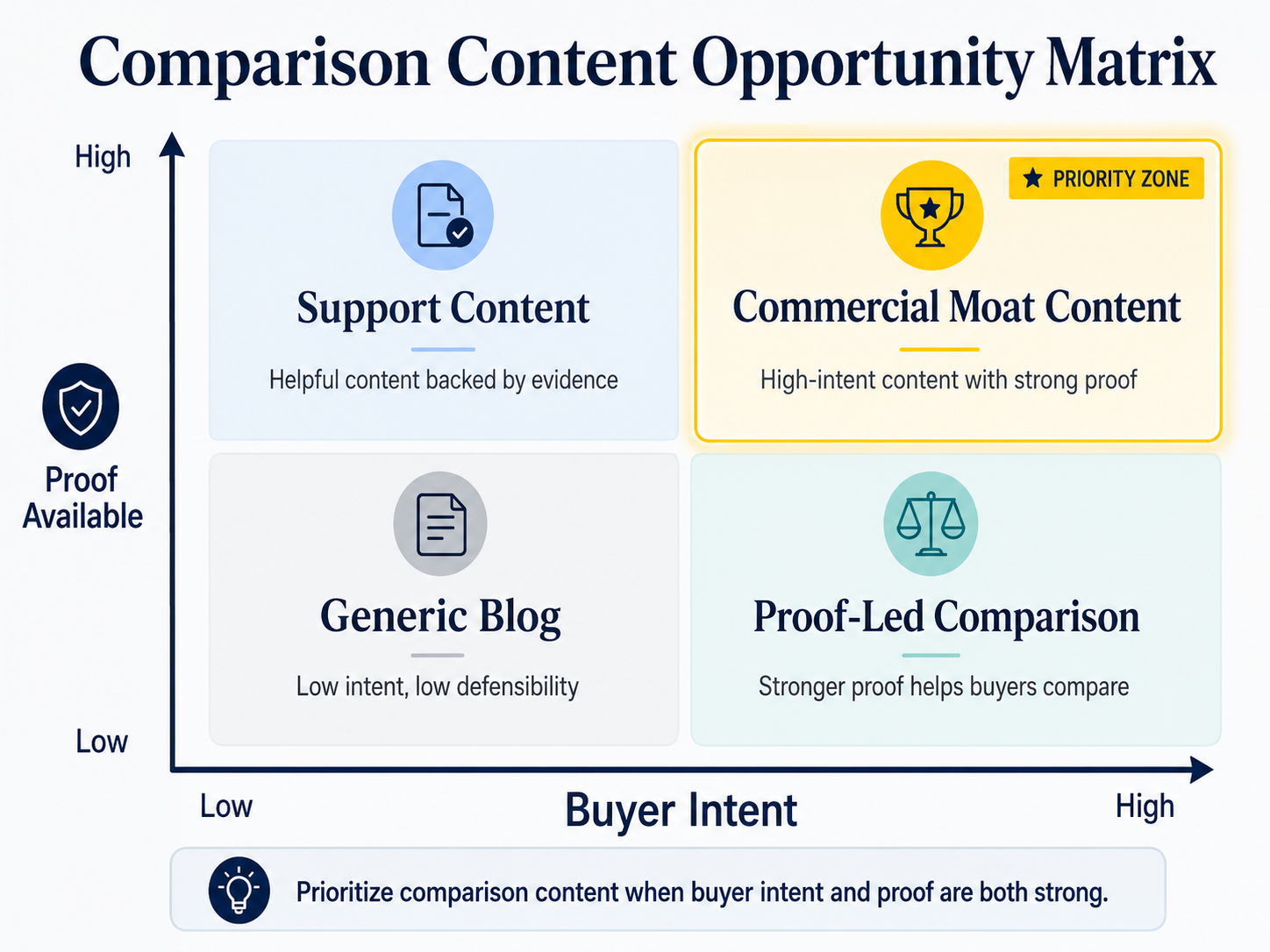
| Comparison type | Example | Buyer intent | Best CTA |
|---|---|---|---|
| Product vs product | Organic cotton vs bamboo bedsheets | Commercial investigation | Shop category |
| Service vs service | SEO retainer vs SEO audit | Commercial investigation | Book consultation |
| Brand alternative | Best Shopify SEO agency alternatives | High commercial | Enquire now |
| DIY vs expert | DIY SEO vs SEO agency | Decision-stage | Request audit |
| Cheap vs premium | Affordable vs premium website maintenance | Budget qualification | Get quote |
Layer 4: Proof assets
Proof assets make the moat difficult to copy. A bigger competitor can copy topics, but it cannot copy your customer reviews, screenshots, outcomes, before-after work, client examples, certifications, or process evidence.
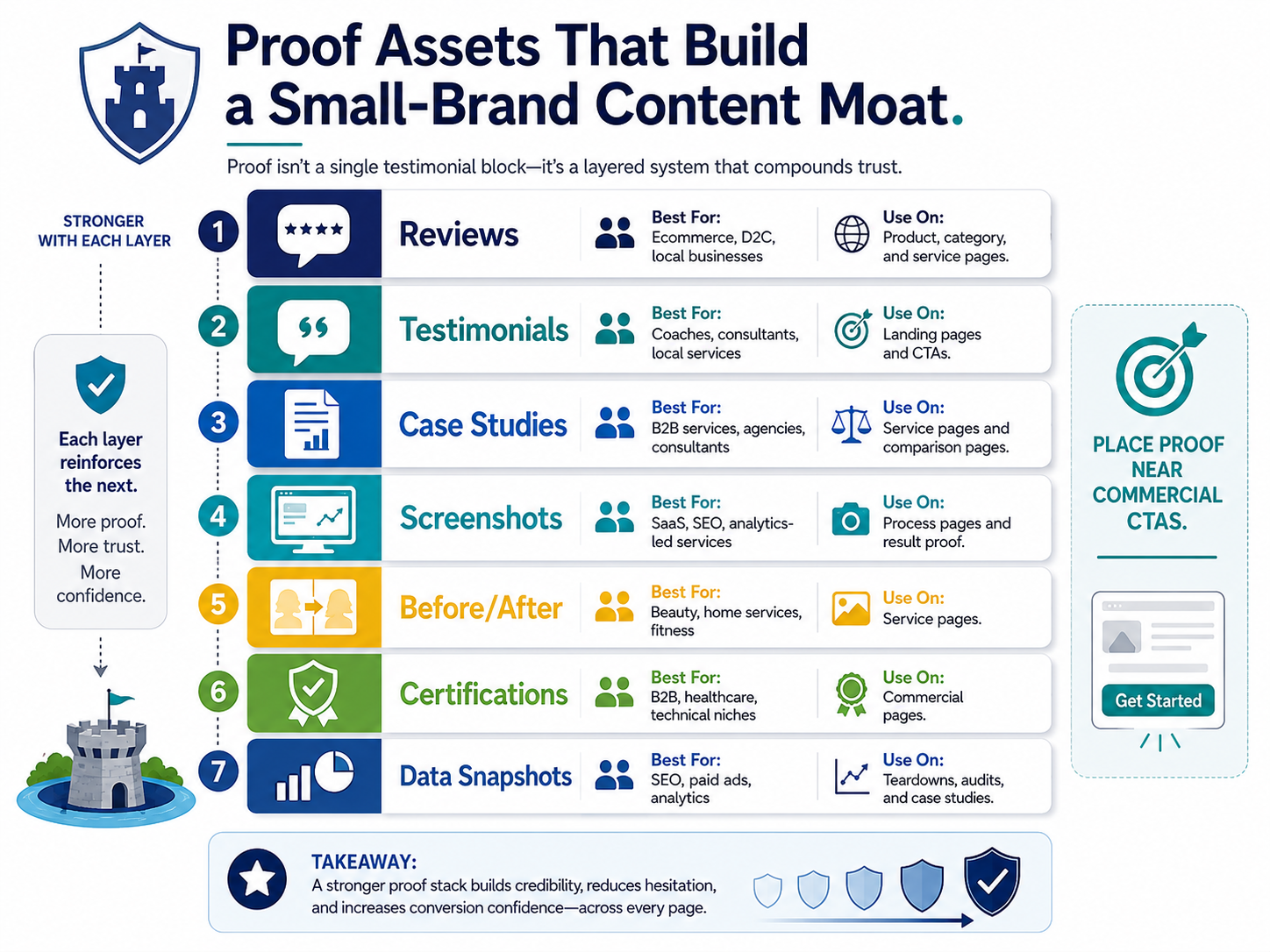
Reviews, testimonials, customer quotes, and UGC that show other people have trusted the brand.
Screenshots, methods, checklists, workflows, and service steps that show how work gets done.
Case studies, data snapshots, before-after assets, and measurable results that show what changed.
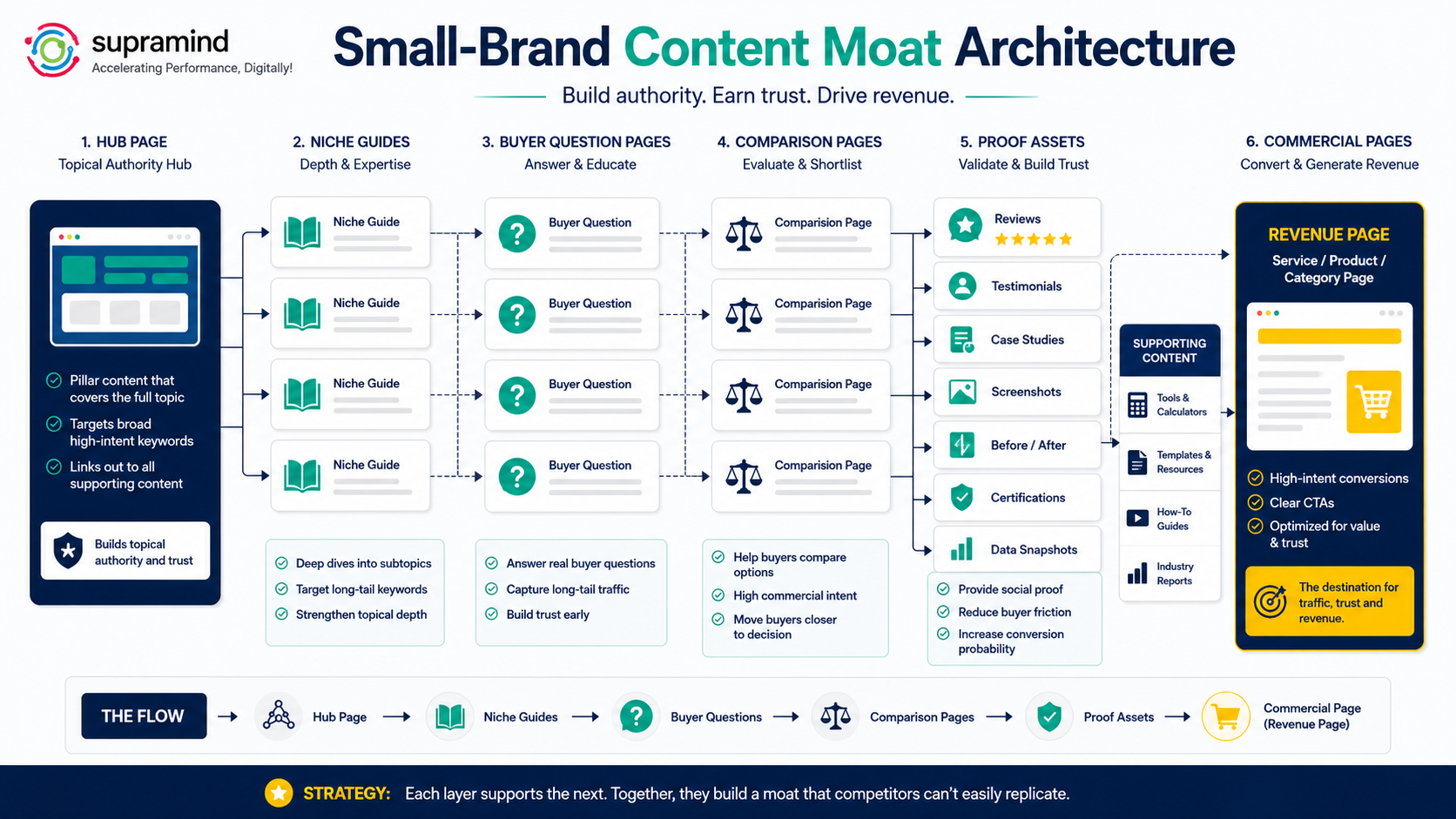
Layer 5: Content moat architecture
A content moat is not a pile of blog posts. It is a mapped system where hubs, niche guides, buyer questions, comparison pages, proof assets, tools, and commercial pages support each other.
Layer 6: Commercial page links
Commercial links are what stop content from becoming an informational dead-end. Every helpful guide, FAQ, comparison, case study, and tool should point users toward a relevant service, product, category, consultation, quote, or booking page.
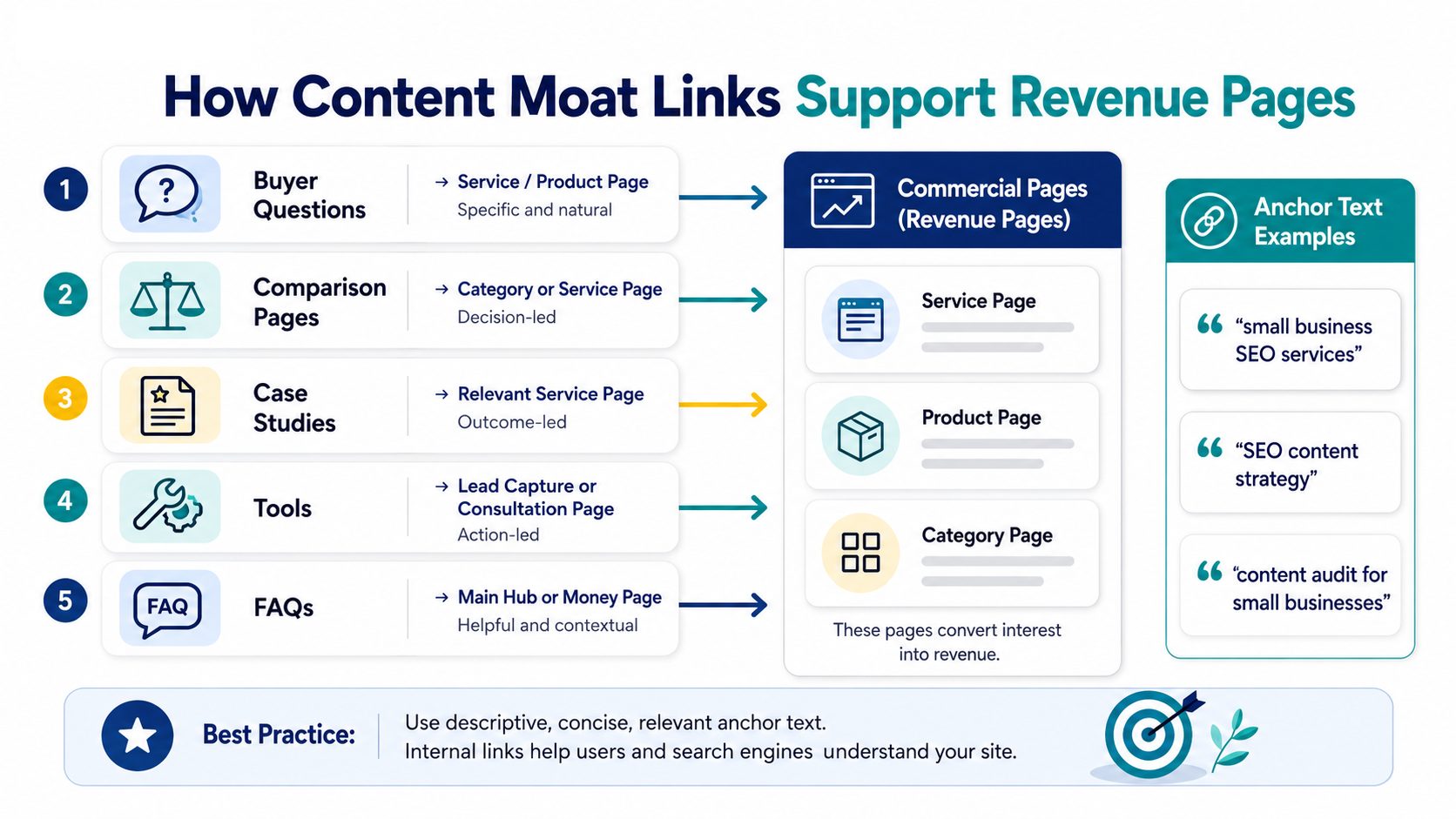
| Content asset | Link to | Anchor style |
|---|---|---|
| Buyer question article | Relevant service or product page | Specific and natural |
| Comparison page | Category or service page | Decision-led |
| Case study | Relevant service page | Outcome-led |
| Tool or calculator | Lead capture or consultation page | Action-led |
| FAQ | Main hub or money page | Helpful and contextual |
Small-brand content moat scorecard
Use this scorecard to identify the weakest layer before publishing more content. The goal is not to score perfectly. The goal is to find the one layer that is currently preventing content from supporting rankings, trust, and enquiries.
| Area | Score 0 | Score 1 | Score 2 | Score 3 |
|---|---|---|---|---|
| Niche expertise | Generic content | Some niche mention | Clear niche topics | Strong POV and specialist guides |
| Buyer questions | No FAQ/Q&A content | Basic FAQs | Buyer questions used | Sales/support questions turned into assets |
| Comparison content | None | Generic comparison | One or two strong comparisons | Multiple proof-led comparison pages |
| Proof assets | No proof | Testimonials only | Reviews/case proof on some pages | Proof integrated across commercial journey |
| Content architecture | Isolated pages | Basic navigation | Some clusters and links | Clear hub-to-money-page flow |
| Commercial links | No CTAs | Generic CTA only | Some contextual CTAs | Every asset supports a revenue page |
Small-Brand Content Moat Scorecard
Score six moat layers from 0 to 3. The tool will show your stage, weakest layer, first fixes, and recommended 30-day priority.
4/18
Your content exists, but it is not yet working as a connected moat.
Comparison Content
Create one high-intent comparison page that links to a relevant commercial page.
Map buyer questions, add proof, and connect one comparison asset to a revenue page.
Business-type examples
| Business type | Best first moat asset | Best proof asset | Commercial page to support | Fix first |
|---|---|---|---|---|
| Boutique ecommerce | Buying guide | Reviews + product photos | Category/product page | Product comparison |
| Small B2B service | Buyer objection guide | Case study | Service page | Proof-led service content |
| Consultant | Framework article | Client result snapshot | Consultation page | Niche POV |
| Coach | Transformation guide | Testimonials | Program page | Audience-specific questions |
| D2C brand | Product comparison | UGC + reviews | Product/category page | Use-case content |
| Local service | Service FAQ | Google reviews | Local service page | Trust proof near CTA |
| Clinic / salon | Treatment or service guide | Before-after + reviews | Appointment page | Proof-led FAQs |
| B2B supplier | Technical buying guide | Certifications + specs | Enquiry page | Comparison and quote CTA |
90-day content moat roadmap
Define niche, collect buyer questions, audit proof assets, and list commercial pages that need support.
Publish two buyer-question pages, one comparison page, one proof asset, and add internal links.
Add CTAs, link support assets to commercial pages, refresh metadata, and track leads or assisted conversions.
What small brands should avoid
| Mistake | Why it hurts | Better alternative |
|---|---|---|
| Copying big-brand blog topics | No differentiation and weak information gain. | Publish niche-specific expertise. |
| Publishing generic AI content | It is easy to replicate and hard to trust. | Add examples, proof, experience, and POV. |
| Only writing top-of-funnel blogs | Traffic may not convert. | Add comparison and proof-led content. |
| Hiding proof on one testimonials page | Proof is missing at decision points. | Add proof near CTAs and commercial sections. |
| No internal links to money pages | Content does not support revenue. | Link every asset to a relevant commercial page. |
| Publishing without tracking | No learning loop. | Track rankings, clicks, CTA clicks, forms, and assisted conversions. |
Statistics, sources, and caveats
| Statistic / Source Claim | Source | Why it matters | Caveat |
|---|---|---|---|
| Google says helpful content should provide original information, research, analysis, substantial value, and clear expertise. | Google Search Central | Supports the information-gain and niche expertise layers. | Google does not disclose an exact scoring formula. |
| Google warns against producing lots of content on many topics mainly to attract search visits. | Google Search Central | Supports the “do not outpublish big brands” argument. | Needs editorial judgment by topic and site. |
| Google recommends descriptive, concise, relevant anchor text and crawlable links. | Google Search Central Link Best Practices | Supports commercial page links and internal architecture. | Link quality depends on page context and usefulness. |
| 32.9% of internet users aged 16+ discover new brands, products, and services through search engines. | HubSpot Marketing Statistics | Shows search still drives discovery. | Global discovery statistic, not SMB-specific. |
| HubSpot reports small businesses are 23% more likely than average to see ROI from blog posts. | HubSpot Marketing Statistics | Supports focused blog/content investment for smaller brands. | Marketer-reported ROI; validate with GA4, GSC, and CRM data. |
| BrightLocal reports 97% of consumers read reviews for local businesses. | BrightLocal Local Consumer Review Survey 2026 | Supports review and proof asset layers. | US consumer survey; use directionally for other markets. |
| BrightLocal reports 47% of consumers will not use businesses with fewer than 20 reviews, and 74% care only about reviews from the last three months. | BrightLocal Local Consumer Review Survey 2026 | Shows review depth and freshness affect trust. | Thresholds vary by industry and market. |
Small-Brand Content Moat Framework FAQs
What is the Small-Brand Content Moat Framework?
It is a small business SEO framework that helps smaller brands compete by building content around niche expertise, buyer questions, comparison content, proof assets, internal links, and commercial page CTAs.
How can small businesses compete with bigger brands in SEO?
Small businesses should avoid broad, generic content and instead focus on narrow buyer problems, specific use cases, proof-led comparisons, and commercial page support.
Why are buyer questions important?
Buyer questions reveal what people need before they enquire or purchase. Turning these questions into content helps small businesses capture long-tail search demand and support sales conversations.
What is comparison content?
Comparison content helps buyers evaluate options. Examples include “X vs Y,” “best X for Y,” “DIY vs expert,” and “cheap vs premium” pages.
What proof assets should small brands use?
Useful proof assets include reviews, testimonials, case studies, screenshots, before-after images, certifications, client examples, and data snapshots.
What should small brands fix first?
They should fix the lowest-scoring layer in the scorecard. If niche is unclear, fix niche first. If proof is missing, add proof. If CTAs are weak, connect content to commercial pages.
Glossary
| Term | Meaning |
|---|---|
| Content moat | A defensible set of content assets that builds search visibility, trust, and conversion support. |
| Niche expertise | Deep knowledge in a narrow market, audience, product, or service area. |
| Buyer questions | Real questions customers ask before enquiry or purchase. |
| Comparison content | Content that helps buyers compare options, products, services, or approaches. |
| Proof assets | Reviews, testimonials, case studies, screenshots, before-after visuals, certifications, and data snapshots. |
| Commercial page | A page designed to generate leads, sales, bookings, calls, or enquiries. |
| Information gain | Original value, examples, proof, or analysis that goes beyond existing search results. |
Build a content moat that supports revenue, not just traffic.
If your business is publishing content but not generating enough qualified enquiries, Supramind’s Small Business SEO Services can help you build a stronger content moat — from niche expertise and buyer questions to proof assets, internal links, and commercial page support.
Explore Small Business SEO Services- Log in to post comments


 INDIA
INDIA