


Local Visibility Flywheel: A Small Business SEO Framework for More Calls and Leads
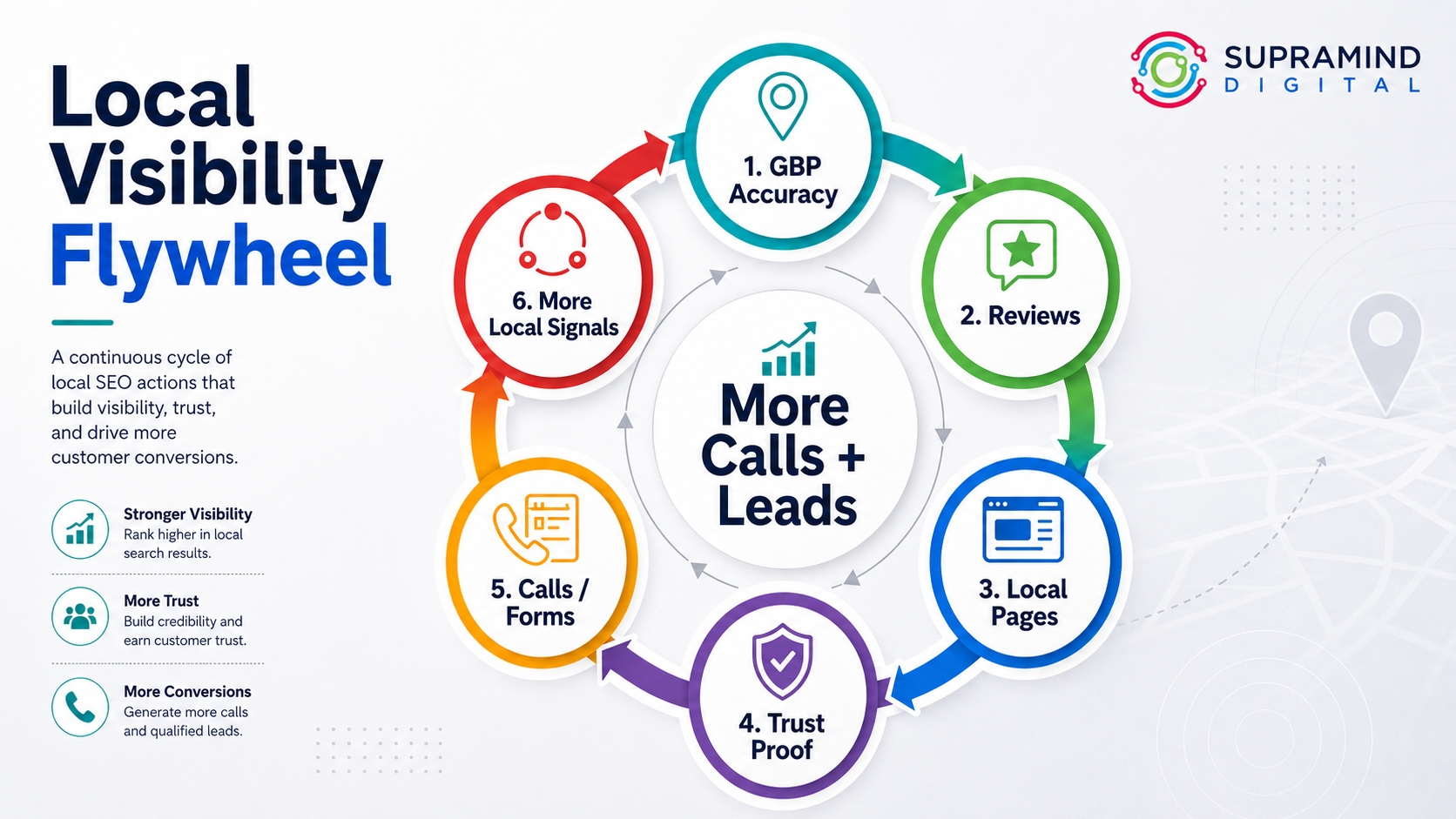
As a Small Business SEO Company, Supramind Digital uses the Local Visibility Flywheel to help local service businesses, clinics, salons, real estate consultants, franchises, restaurants, and professional service firms turn local discovery into more calls, forms, bookings, direction clicks, WhatsApp enquiries, and appointments. The framework connects Google Business Profile accuracy, reviews, local pages, trust proof, conversion actions, and recurring local signals into one practical growth loop.
Executive Summary
The Local Visibility Flywheel is a small business SEO framework that explains how local discovery, trust, and conversion reinforce each other over time.
Google says local results are mainly shaped by relevance, distance, and prominence, and it specifically notes that complete, accurate business information helps Google better match a business to relevant local searches. Reviews, positive ratings, links, and web references also contribute to prominence.
For small businesses, this means local SEO should not be treated as a one-time Google Business Profile setup or a list of isolated tasks. The framework shows that accurate business data improves local relevance, reviews improve trust, local pages support service intent, trust proof improves conversion, and customer actions create the next round of local signals.
| Flywheel Insight | What It Means for a Small Business | Fix-First Action |
|---|---|---|
| Accuracy creates relevance | Google and users need the same business name, category, hours, phone, service area and website URL. | Audit GBP and NAP before adding more pages. |
| Reviews create trust | Recent, service-specific reviews reduce buyer hesitation and support local prominence. | Build a safe review request and reply process. |
| Local pages create service intent match | Service and area pages explain what you offer, where you serve and why customers should choose you. | Build fewer, stronger local pages with proof and CTAs. |
| Trust proof creates action | Customers need reviews, photos, credentials, process clarity, guarantees and pricing guidance near the decision point. | Move proof near calls, forms, bookings and WhatsApp CTAs. |
| Actions create the next loop | Calls, bookings, direction clicks, reviews and local proof help the business improve the next cycle. | Track outcomes, not rankings alone. |
Why Local Visibility Needs a Flywheel
Local SEO should not be treated as a one-time checklist. Google explains local visibility around relevance, distance and prominence, while local buyers also check reviews, business profiles, websites and proof before they take action. That means local SEO works best when every layer strengthens the next one.
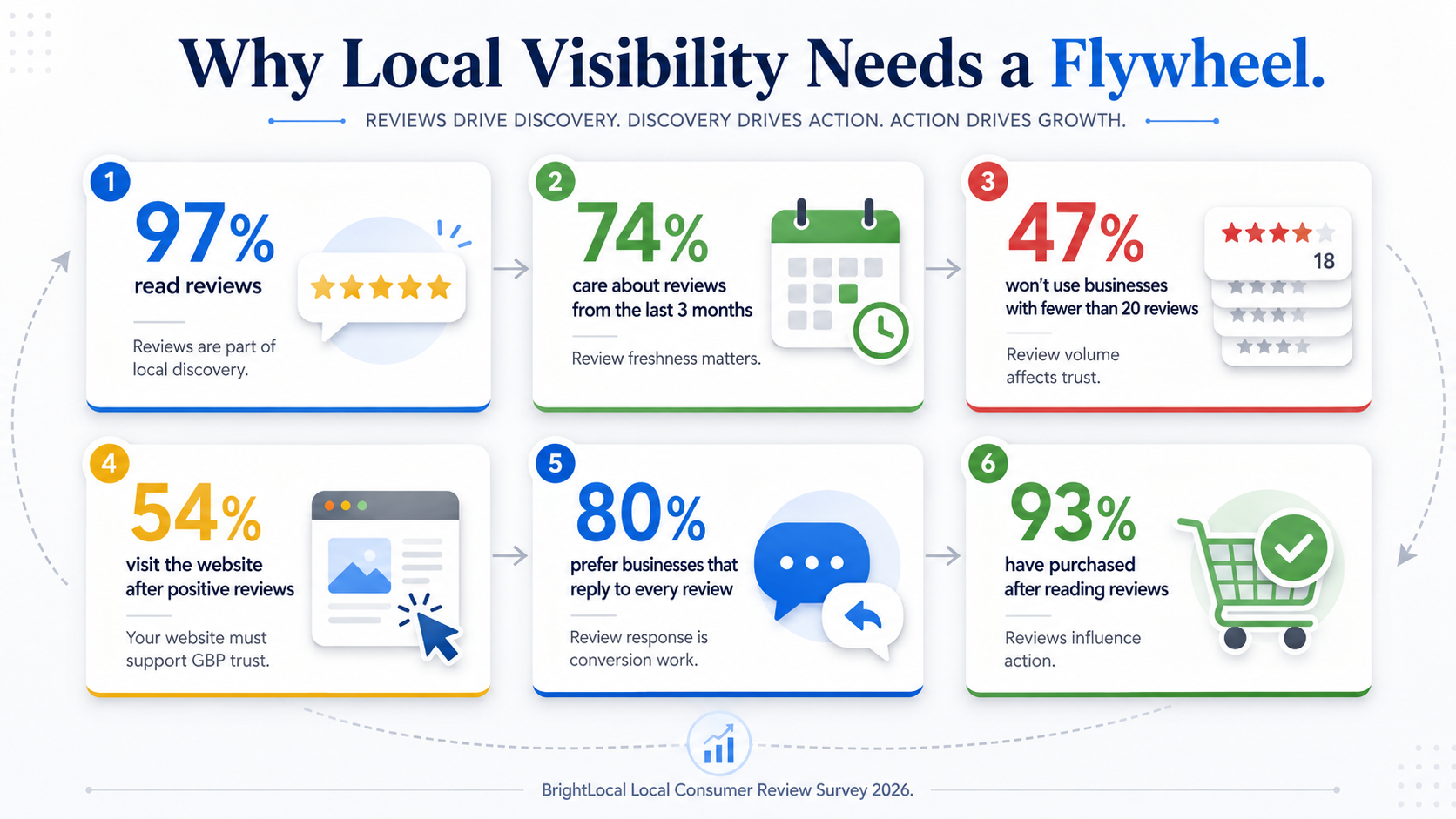
BrightLocal’s 2026 consumer survey found that reviews are part of how almost every local buyer researches businesses.
Review freshness matters because an old five-star profile may still feel inactive to a buyer.
Review response quality is part of conversion work, not only reputation management.
Framework insight: A business that has correct GBP data but no recent reviews is discoverable but not trusted. A business that has strong reviews but weak local pages is trusted but not fully relevant. A business that ranks but hides CTAs is visible but not conversion-ready.
What Is the Local Visibility Flywheel?
The Local Visibility Flywheel is a six-stage framework for turning local SEO into a repeatable lead-generation system. It starts with entity accuracy, builds trust through reviews, matches service demand with local pages, proves credibility on the page, converts visitors through calls/forms/bookings, and then uses customer actions to create more reviews, branded searches, direction clicks, repeat visits and local proof.
| Flywheel Stage | Input | Output | Business Impact |
|---|---|---|---|
| 1. GBP accuracy | Correct name, category, address or service area, hours, phone, website and services | Clearer local entity | Better eligibility for local discovery |
| 2. Reviews | Recent, genuine, service-specific reviews and replies | More trust and prominence | Higher click and enquiry confidence |
| 3. Local pages | Service pages, branch pages, locality pages and FAQs | Better service and area relevance | More qualified local traffic |
| 4. Trust proof | Reviews, photos, credentials, guarantees, process proof and local examples | Lower buyer hesitation | More calls, forms and bookings |
| 5. Calls/forms/bookings | Tap-to-call, WhatsApp, forms, booking links and direction CTAs | Measurable customer actions | Lead and appointment growth |
| 6. More local signals | New reviews, branded searches, repeat visits, mentions and page updates | Compounding visibility | More stable local growth over time |
Local Visibility Flywheel Scorecard
The scorecard turns the framework into a quick diagnostic. Score each flywheel stage from 0 to 3. A low score does not mean “do everything.” It means fix the weakest stage before spending on advanced SEO activity.
Local Visibility Flywheel Scorecard
Use this tool to identify whether your local business has a foundation gap, visibility gap, trust and conversion gap, or a working local flywheel.
Download the Local Visibility Flywheel Scorecard PDF
Want to review your local visibility gaps without losing the framework? Download the scorecard PDF, rate your GBP accuracy, reviews, local pages, trust proof, CTAs and local signals, then use the 90-day roadmap to decide what to fix first.
Inside the PDF
- 6-stage local visibility checklist
- 0-18 scoring sheet and maturity bands
- Fix-first rules for prioritizing work
- Business-type priority matrix
- 90-day local visibility roadmap
How to Use It
Score the foundation, identify the weakest flywheel stage, and turn that diagnosis into a practical plan for more calls, forms, bookings, direction clicks and local enquiries.
Stage 1: GBP Accuracy and Local Entity Setup
Google says businesses with complete and accurate information are more likely to show in local results. This makes GBP accuracy the first blocker to fix before scaling local pages, review campaigns, or backlinks.
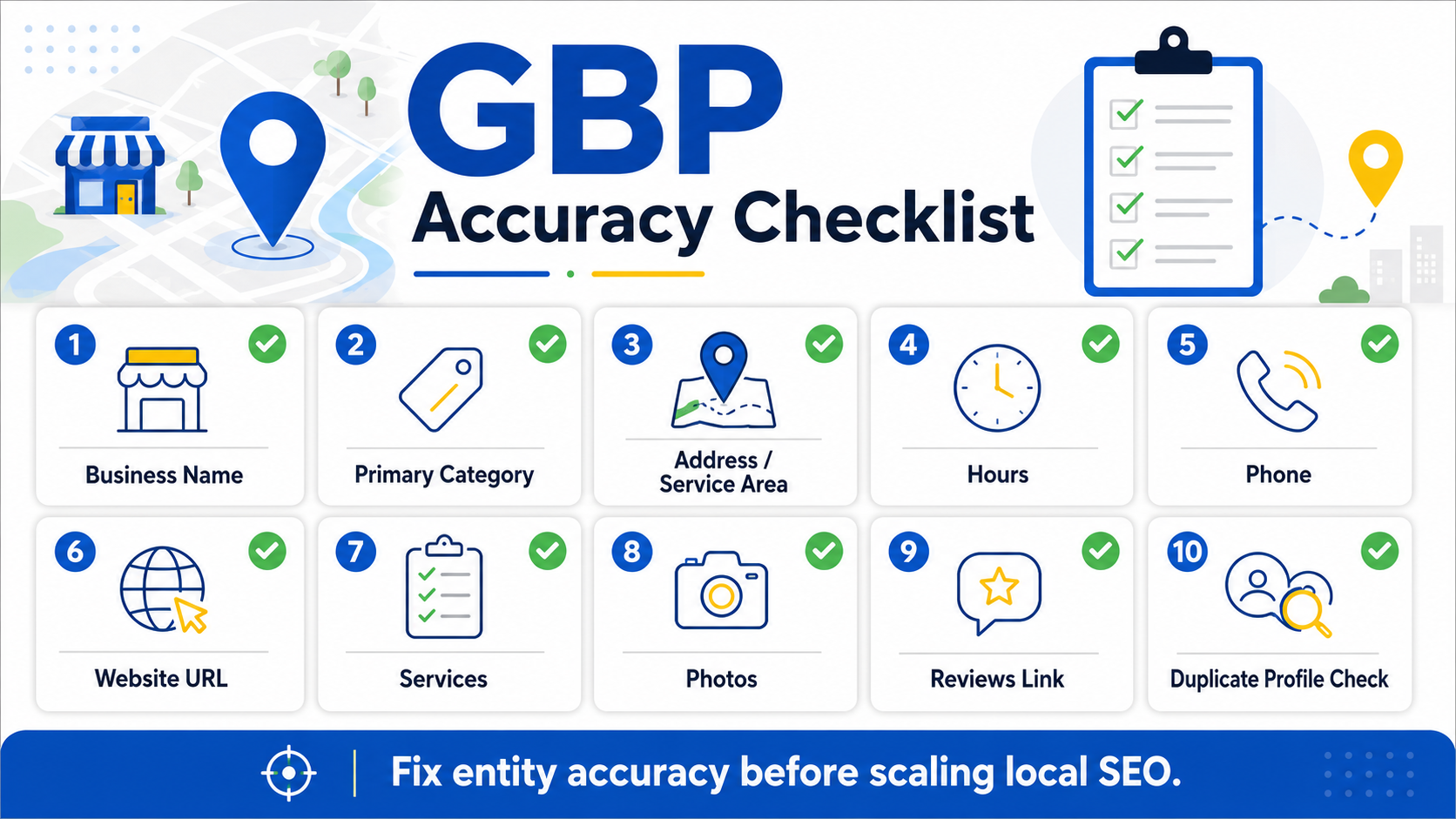
Check whether your local entity is clean enough to scale
This checker helps small businesses confirm whether Google and customers can clearly understand who they are, where they operate, when they are open, and how to contact them.
Do not scale before this is clean: keyword-stuffed GBP names, fake service locations, duplicate profiles, wrong hours, and weak category selection can damage the entire local flywheel.
Stage 2: Review Growth and Review Quality
Reviews are the trust layer of the flywheel. They influence whether prospects click, call, book, or keep comparing. The maturity goal is not only more reviews, but recent reviews, service-specific themes, and meaningful owner replies.
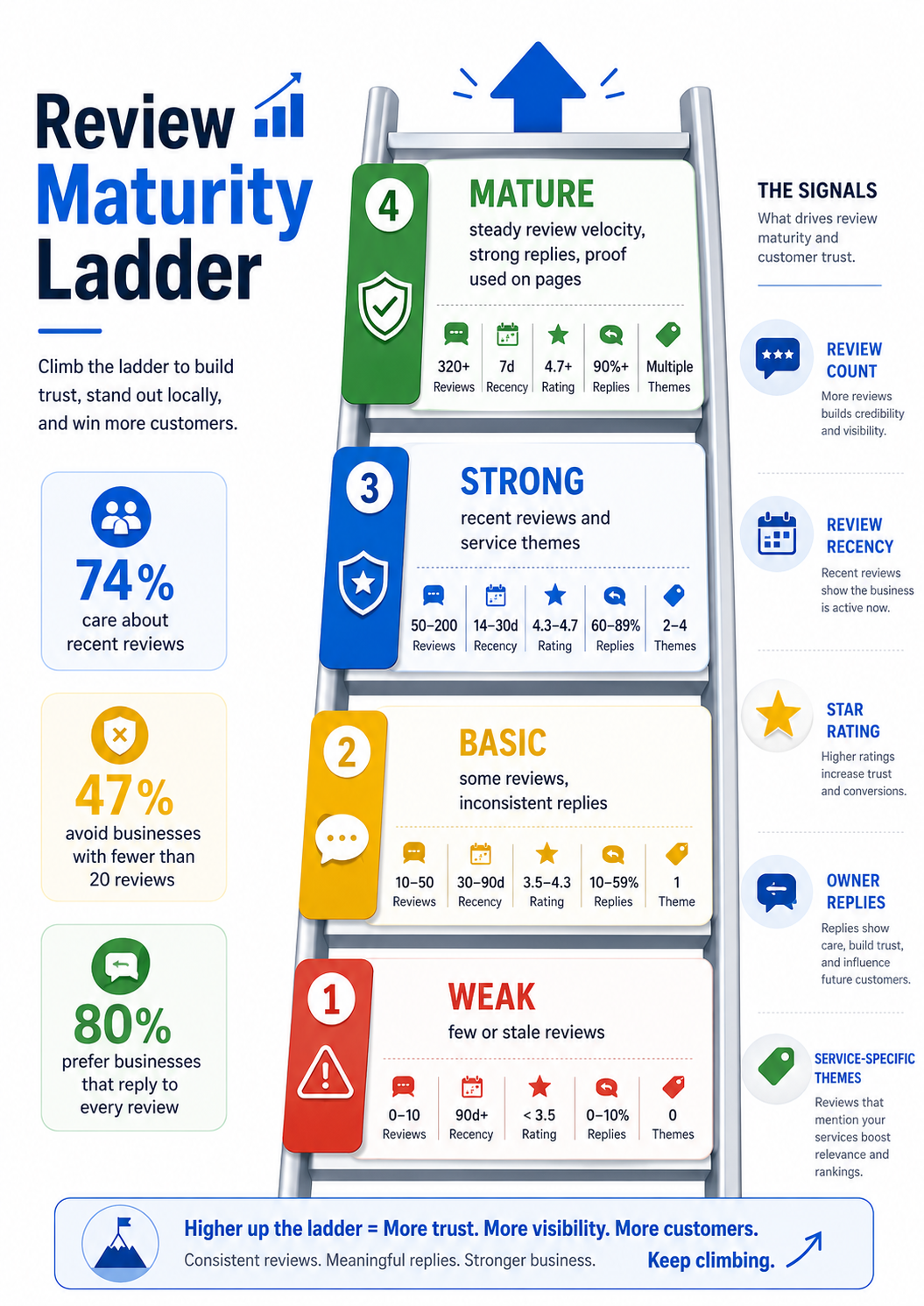
Plan a realistic review growth target
Use this planner to set a review target that supports trust without pushing fake, gated, or unnatural review activity.
Stage 3: Local Service Pages and Area Coverage
Local pages create relevance for service and location intent. The goal is not to create hundreds of city pages. The goal is to build fewer, stronger pages with real service coverage, local proof, FAQs, internal links, and clear conversion paths.
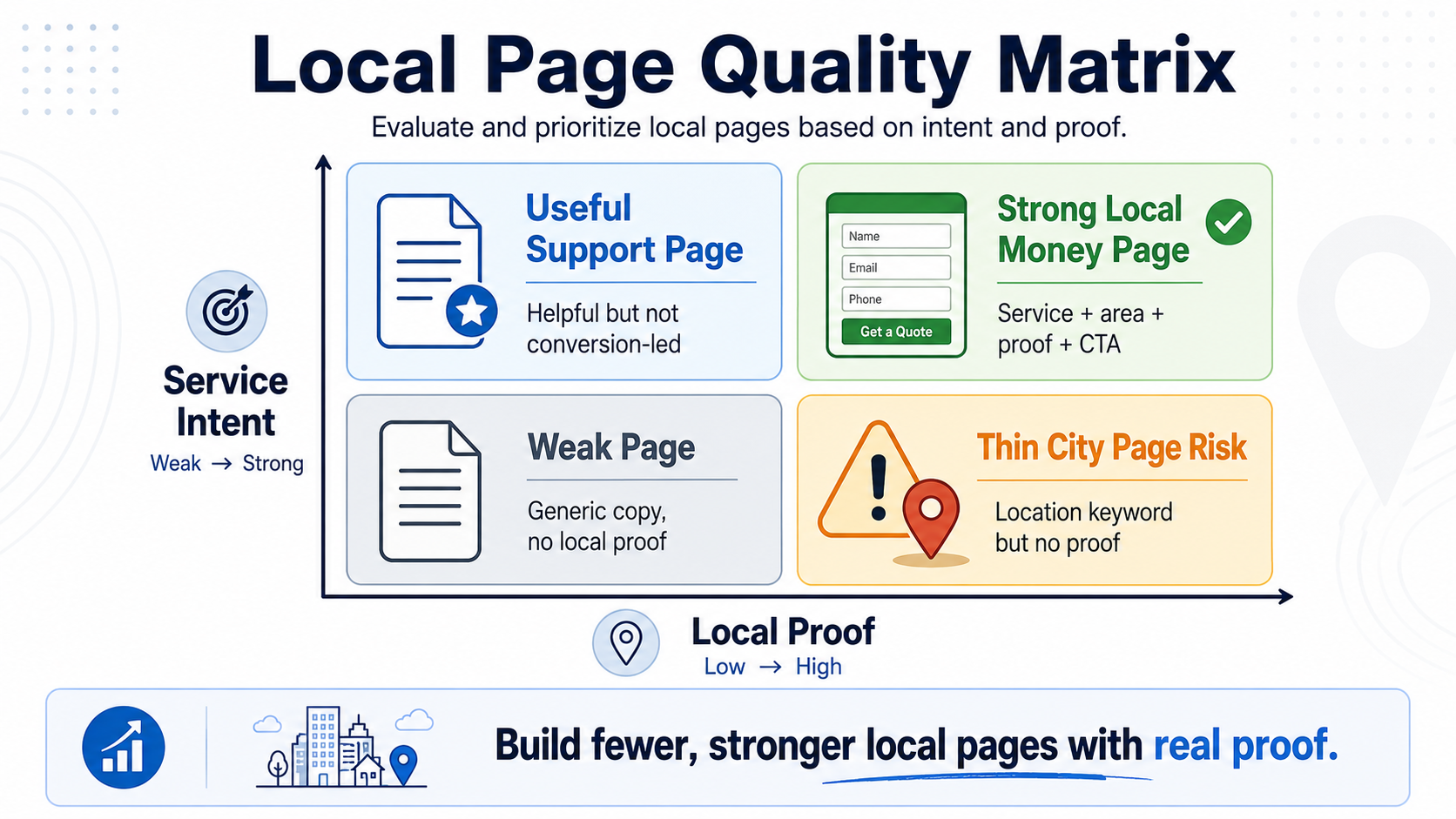
Check whether a local page deserves to exist
This checker helps prevent thin location pages by testing whether a local page has enough intent, proof, uniqueness, and conversion support.
Stage 4: Trust Proof on Local Landing Pages
Trust proof works best near the decision point. A testimonial page alone is not enough. The local service page should show reviews, real photos, team proof, credentials, local examples, process details, pricing guidance, guarantees, and FAQs close to the CTA.
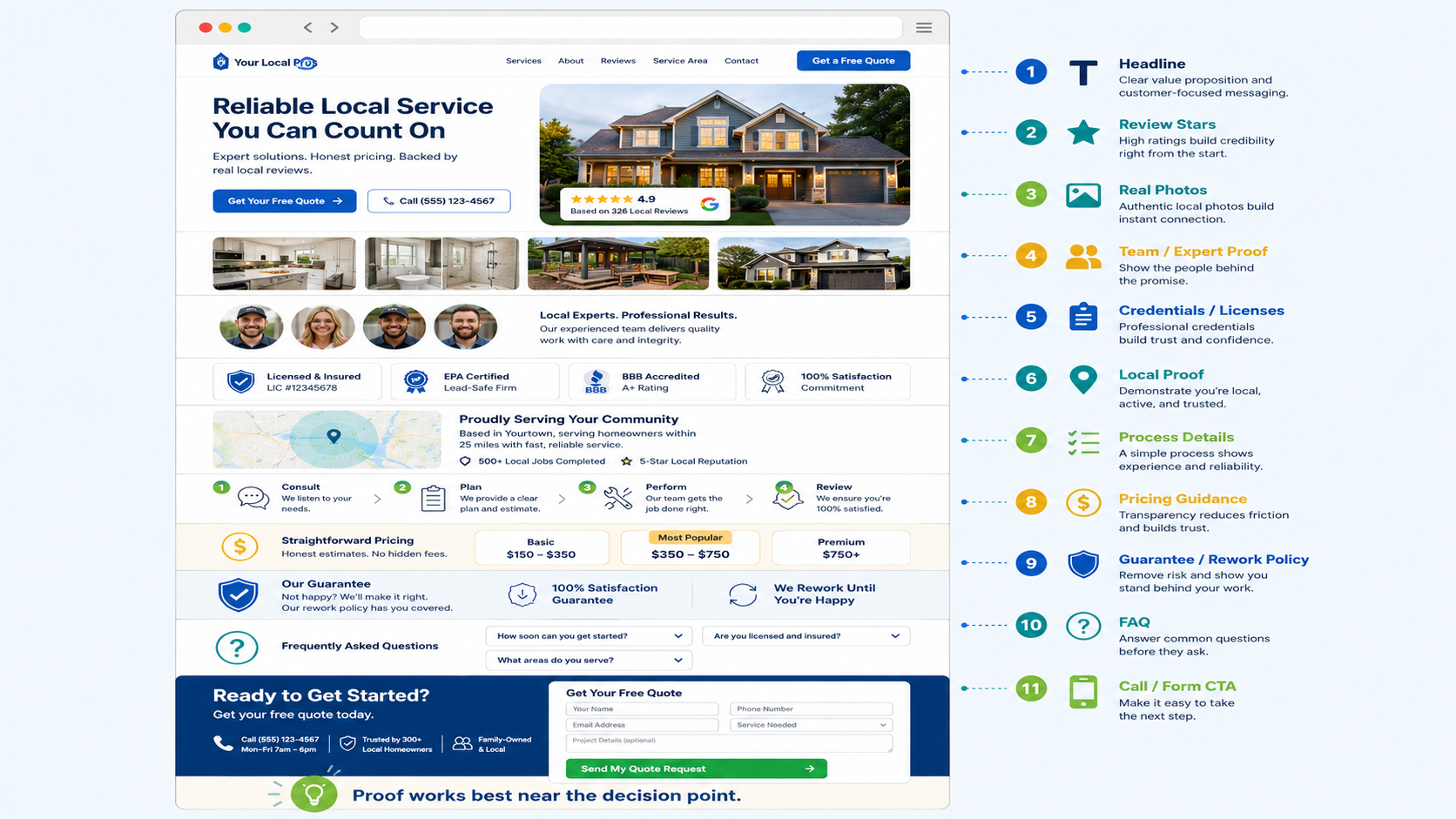
| Trust Proof Type | Best For | Best Placement | Why It Matters |
|---|---|---|---|
| Review stars and snippets | All local businesses | Hero, CTA block, form area | Reduces hesitation before contact |
| Real photos | Clinics, salons, restaurants, local services | Near service explanation | Shows the business is real and active |
| Credentials and licenses | Clinics, electricians, pest control, legal and finance firms | Near risk-sensitive claims | Builds safety and expertise confidence |
| Guarantee or rework policy | Home services and repair businesses | Near pricing and CTA | Removes risk from the enquiry decision |
| Process details | High-consideration services | Before FAQs | Explains what happens after the user contacts you |
Stage 5: Calls, Forms, Bookings and User Actions
A local page that ranks but does not produce action is not mature. Google’s Business Profile performance documentation lets owners track calls, directions, website clicks, bookings, messages, and search terms. GA4 allows businesses to measure specific interactions as events and to elevate important actions into key events for reporting. That makes it possible to manage local SEO by business outcomes instead of by vanity metrics alone.
BrightLocal’s 2026 survey is useful here because it shows how reviews bridge into action. After reading positive reviews, 66% of consumers do further research and 34% are ready to buy or book; 31% visit the business location, 20% contact the business, and 20% make an appointment. In other words, the job of the page is not just to rank; it is to stop the customer needing to leave your ecosystem to find basic answers.
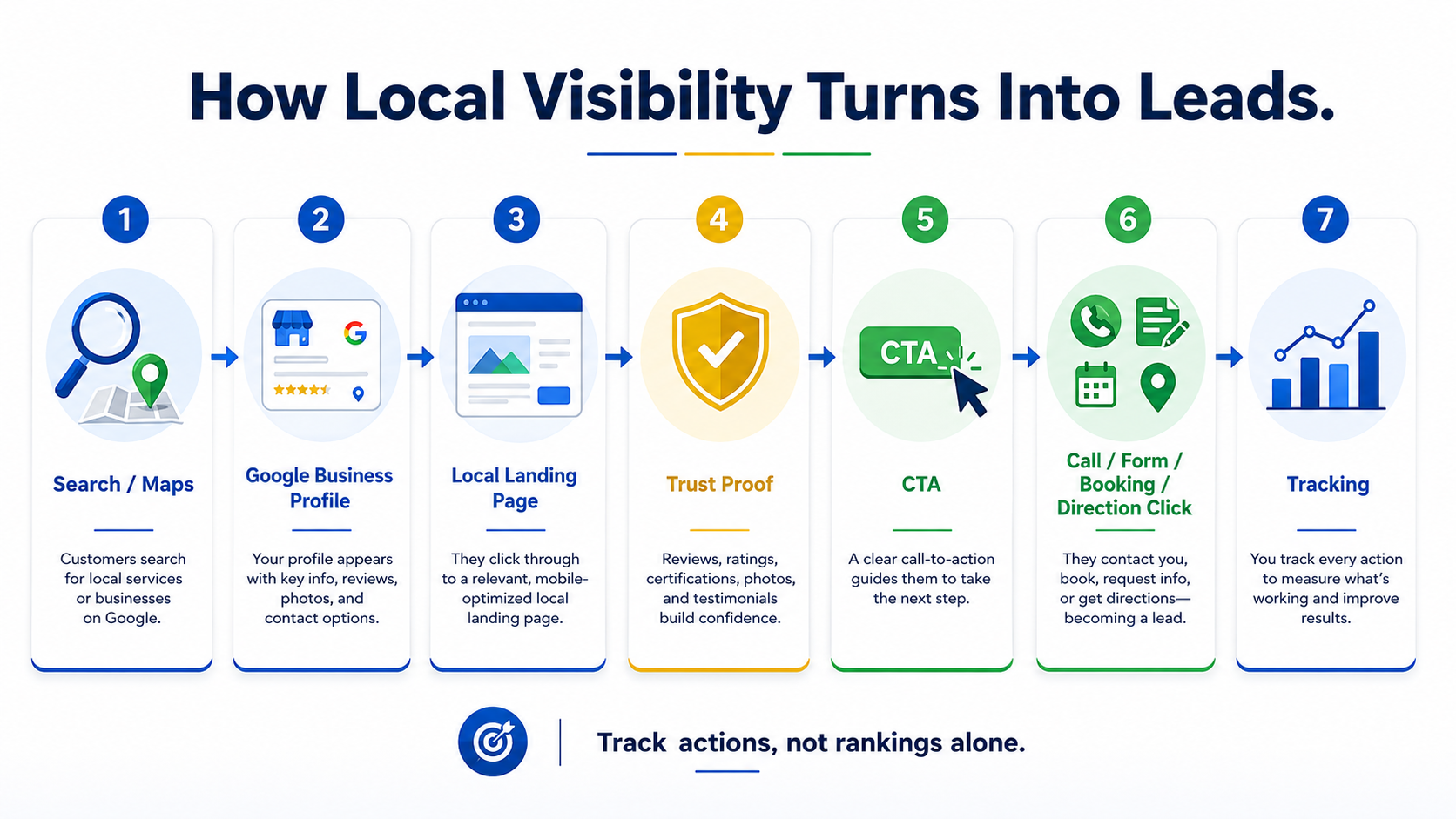
Check whether your local page is ready to convert
This checker shows whether a service page makes it easy for users to call, book, message, request a quote, or get directions.
Stage 6: More Local Signals and Compounding Visibility
The final stage turns customer activity into the next round of visibility. Calls, bookings, visits, completed jobs, review requests, review replies, branded searches, local mentions, repeat visits and fresh proof assets keep the flywheel moving.
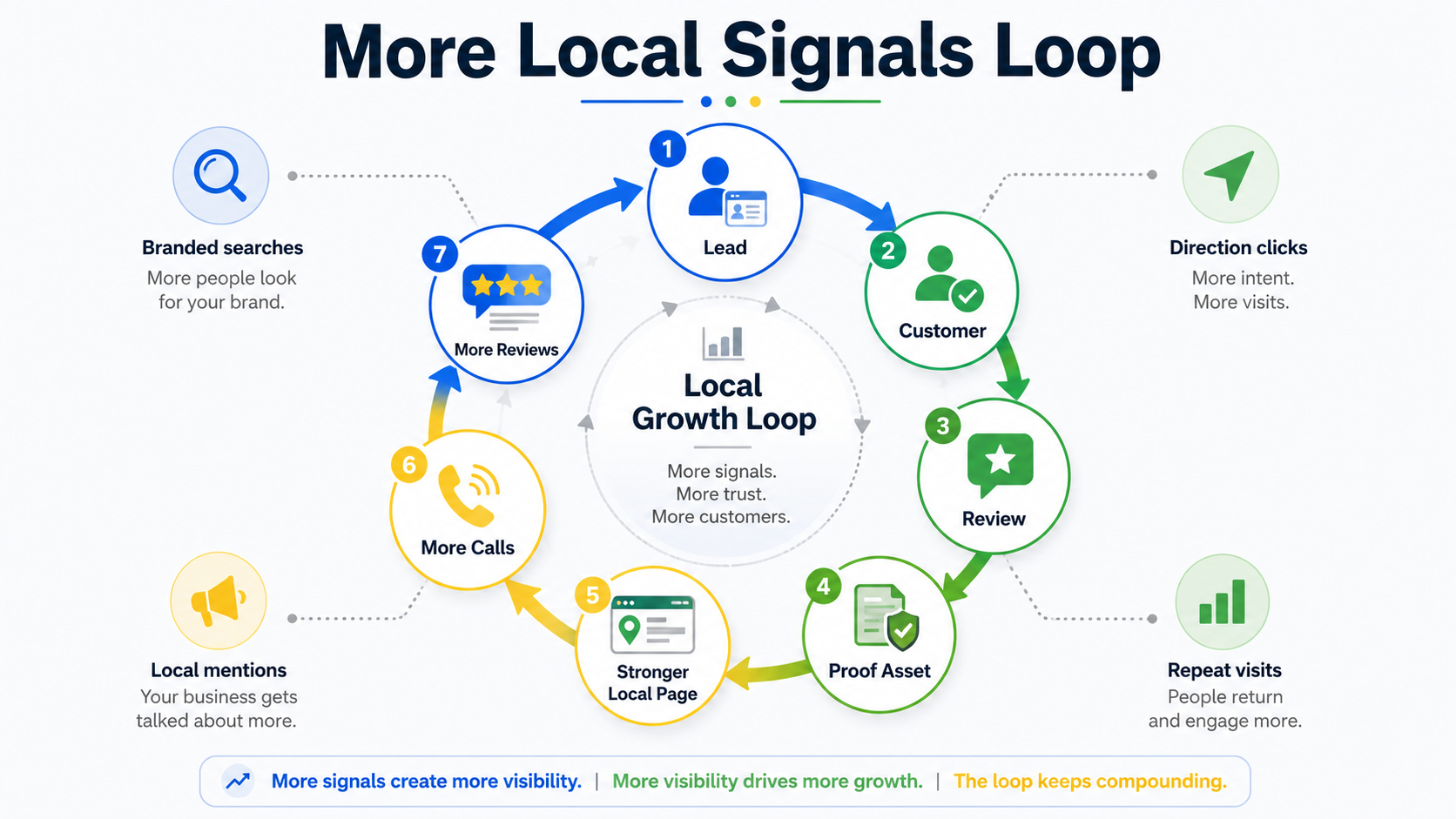
| Action | Signal Created | How It Supports the Next Loop | Example |
|---|---|---|---|
| Completed job | Review opportunity | Improves recency and trust | Plumber asks for a post-repair review |
| Direction click | Visit intent | Validates location demand | Clinic improves branch page and parking info |
| Call or booking | Conversion data | Shows which pages deserve more investment | Salon improves high-call service pages |
| Review response | Public trust repair | Improves customer confidence | Restaurant replies to negative feedback constructively |
| Local photo or case proof | Fresh proof asset | Improves service and local page credibility | Real estate consultant adds locality transaction proof |
How Different Business Models Should Apply the Framework
Every small business should use the same flywheel, but not every business should fix the same stage first. The priority depends on how people choose the business, what trust proof matters, which CTA fits the buying journey, and whether the business depends on appointments, emergency calls, store visits, consultations, reservations, or direction clicks.
The priority matrix below converts the framework into practical “fix first” guidance for clinics, salons, home service companies, real estate consultants, franchises and restaurants.
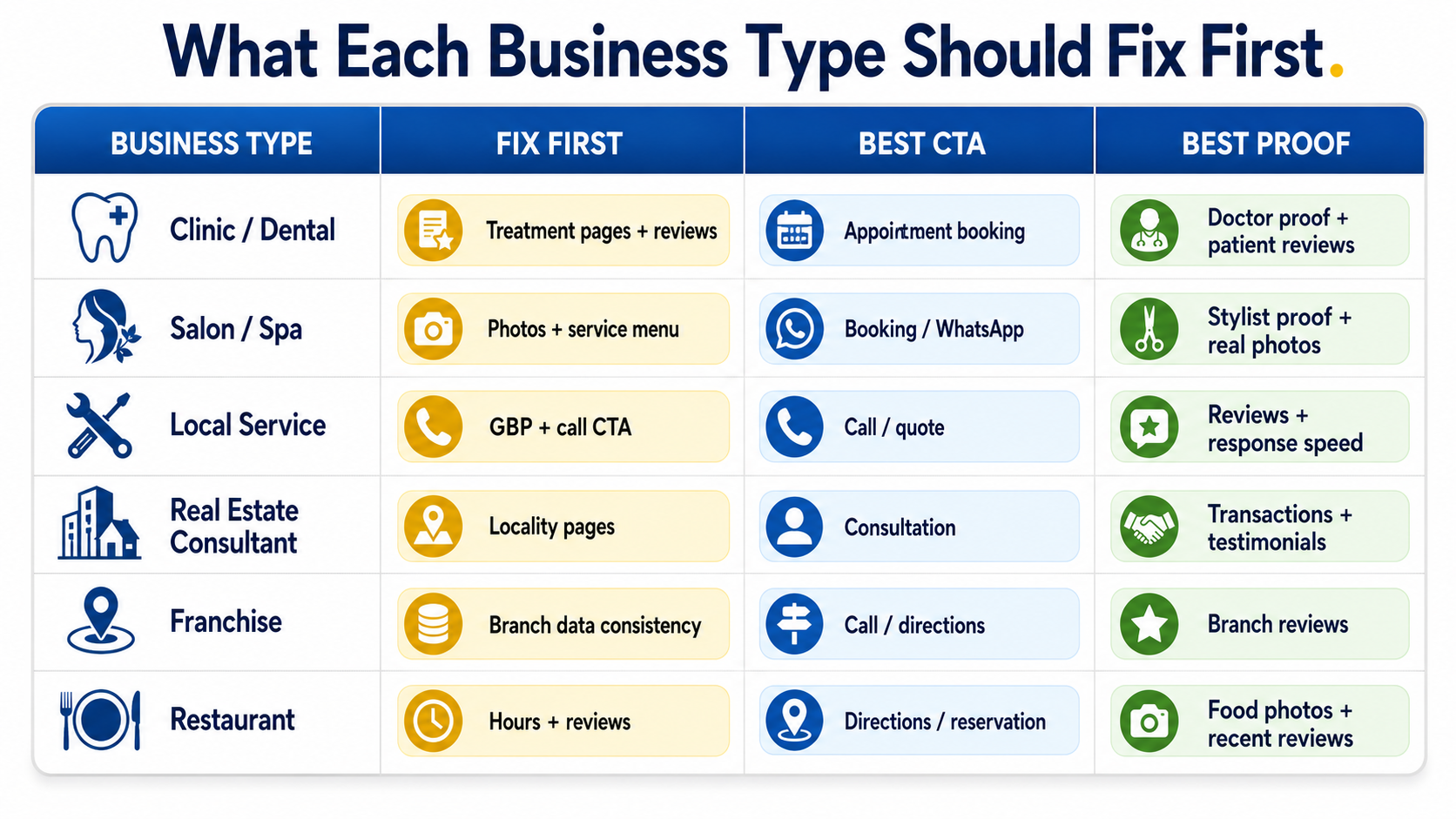
| Business Type | Fix First | Best CTA | Best Proof |
|---|---|---|---|
| Clinic / Dental | Treatment pages and reviews | Appointment booking | Doctor proof and patient reviews |
| Salon / Spa | Photos and service menu | Booking / WhatsApp | Stylist proof and real photos |
| Local Service | GBP and call CTA | Call / quote | Reviews and response speed |
| Real Estate Consultant | Locality pages | Consultation | Transactions and testimonials |
| Franchise | Branch data consistency | Call / directions | Branch reviews |
| Restaurant | Hours and reviews | Directions / reservation | Food photos and recent reviews |
90-Day Local Visibility Roadmap
The roadmap keeps the flywheel practical. Small businesses should not begin with scale tactics. They should first fix accuracy, then build trust and local pages, then improve conversion and tracking.
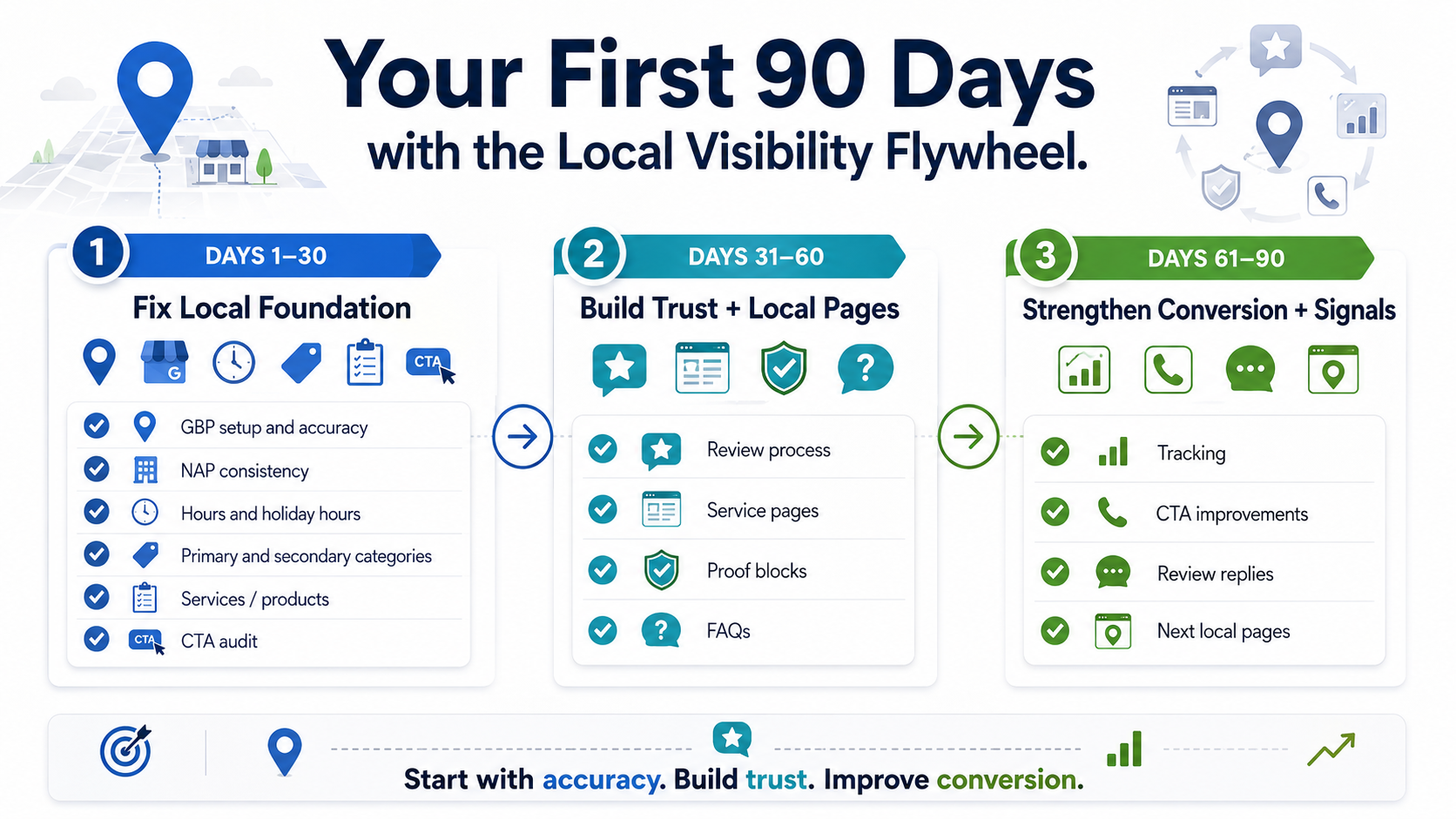
Audit GBP, categories, NAP, hours, services, photos, duplicate profiles, CTA visibility and basic tracking.
Improve service pages, add review proof, build local FAQs, add real photos, improve internal links and activate review requests.
Track calls/forms/bookings, improve mobile CTAs, reply to reviews, add local proof and plan the next page buildout.
What Small Businesses Should Not Do
The flywheel is also a filter for avoiding budget waste. If a tactic does not strengthen accuracy, trust, relevance, conversion or recurring signals, it should not be prioritized early.
| Mistake | Why It Hurts | Better Alternative |
|---|---|---|
| Creating many thin city pages | Can create doorway-style quality risk and weak user value | Build fewer local pages with real proof and coverage |
| Keyword-stuffing the GBP name | Can violate Google’s profile guidelines | Use the real-world business name |
| Buying fake reviews | Creates policy and trust risk | Request honest reviews after real service |
| Tracking only rankings | Misses calls, bookings, directions and lead quality | Track GBP actions, GA4 events and CRM leads |
| Hiding CTAs below the fold | Wastes mobile traffic | Add visible call, form, WhatsApp or booking paths |
| Building links before fixing local pages | Sends authority to weak conversion assets | Fix GBP, reviews, pages and proof first |
Data and Signals to Track
The Local Visibility Flywheel should be measured by business actions, not rankings alone. The goal is to understand whether visibility is turning into calls, forms, bookings, direction clicks and repeat local demand.
| Signal | Tool / Source | What It Tells You | Action to Take |
|---|---|---|---|
| GBP calls, website clicks, directions, bookings and messages | Google Business Profile performance | Which profile actions are generating buyer movement | Improve profile completeness and landing page match |
| Local page traffic and queries | GSC and GA4 | Which service and city pages attract demand | Improve pages with impressions but low action |
| Form submissions and WhatsApp clicks | GA4 events or CRM | Which CTAs create leads | Reduce friction and improve CTA placement |
| Review count, rating and recency | GBP and review platforms | Whether trust is active or stale | Build ongoing review requests and reply process |
| Branded searches and repeat visits | GSC, GA4, CRM | Whether the local entity is gaining recall | Add proof assets and retarget high-intent pages |
FAQs: Local Visibility Flywheel
What is the Local Visibility Flywheel?
The Local Visibility Flywheel is a small business SEO framework that connects GBP accuracy, reviews, local pages, trust proof, calls/forms/bookings and recurring local signals into one compounding local SEO system.
How does local SEO create more calls and leads?
Local SEO creates more calls and leads when the business is discoverable, trusted and easy to contact. GBP accuracy helps discovery, reviews build trust, local pages match intent, and CTAs convert demand into action.
Why is Google Business Profile accuracy important?
GBP accuracy helps Google and customers understand what the business is, where it operates, when it is open and how people can contact it. Incorrect profile data weakens both relevance and trust.
Do reviews help local SEO?
Google says more reviews and positive ratings can help local ranking, while consumer research shows reviews strongly influence whether buyers call, visit, book or continue comparing.
Should small businesses create city pages?
Small businesses should create city or area pages only where there is real coverage, unique proof and a real conversion path. Thin city pages that only swap location names should be avoided.
What trust proof should local pages include?
Useful proof includes review snippets, real photos, licenses, credentials, team profiles, local case examples, guarantees, pricing guidance, service process details and FAQs.
Which metrics should small businesses track?
Track GBP calls, direction clicks, website clicks, bookings, messages, review count, review recency, review responses, local page traffic, form submissions, WhatsApp clicks and GA4 events.
Sources and Caveats
Use these sources as supporting references. Google documentation explains platform guidance and policy, while BrightLocal statistics are survey-based consumer research and should be validated against Supramind client data, GBP exports, GA4, GSC and CRM lead quality.
- Google Business Profile Help: Tips to improve your local ranking on Google
- Google Business Profile Help: Guidelines for representing your business on Google
- Google Business Profile Help: Understand your Business Profile performance and insights
- Google Search Central: Spam policies for Google web search
- Google Search Central: Local Business structured data
- BrightLocal: Local Consumer Review Survey 2026
- Google Analytics Help: Events and key events
Final Takeaway
If your local business is getting impressions but not enough calls, forms, bookings, WhatsApp enquiries or direction clicks, Supramind’s Small Business SEO Services can help you identify the weak stage in your Local Visibility Flywheel and fix it first.
Explore Small Business SEO Services- Log in to post comments


 INDIA
INDIA