


HubSpot in Google’s AI Overviews: A B2B SEO Query Teardown
I’m writing this from Supramind, a b2b seo agency, after reviewing HubSpot’s Semrush domain and URL data, keyword exports, backlink profile, SERP analysis, AI Overview screenshots, and live page structure. The pattern is measurable: HubSpot does not win B2B SEO visibility through one guide alone. It combines domain authority, answer-ready structure, internal topic depth, and business-outcome framing to make its content easier to rank, retrieve, summarize, and trust.
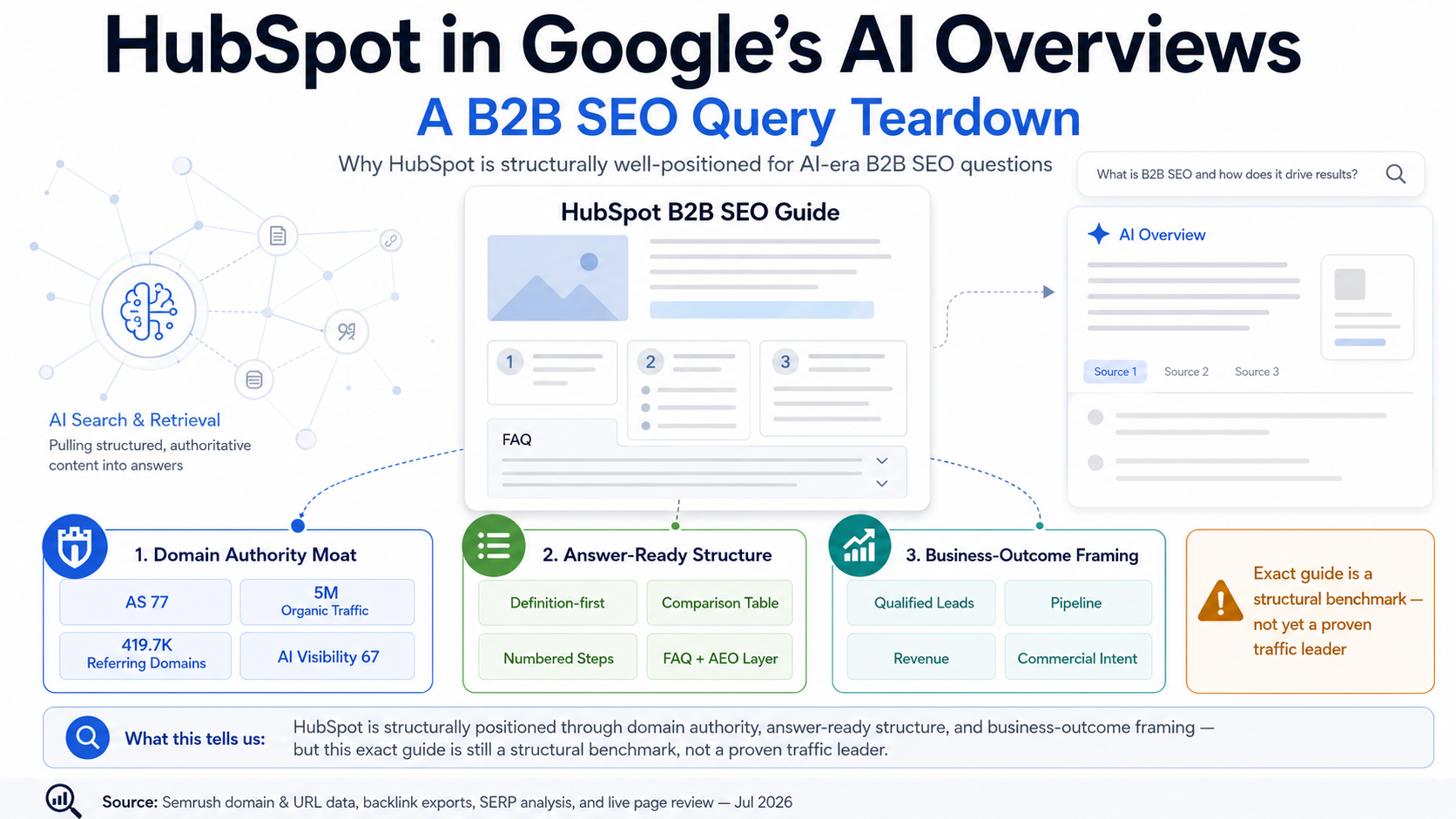
The question is not does HubSpot know SEO? That answer is obvious. The better question is this: why is HubSpot structurally positioned to be retrieved or cited for AI-era B2B SEO questions, and what should a B2B services company copy without turning its service page into a generic guide?
This teardown uses Semrush domain and URL data, keyword exports, backlink data, SERP analysis, AI Overview screenshots, and live page-structure review from July 2026. One caveat matters: the provided data shows strong HubSpot domain-level AI visibility, but it does not prove this exact B2B SEO guide is currently cited in target-query AI Overviews.
Methodology & Data Sources
This is not a brand admiration piece. It is a structured teardown built from domain data, URL-level evidence, keyword exports, backlink data, SERP observations, AI Overview screenshots, and page-structure analysis.
| Data source | Tool/report | What it measures | Pull date |
|---|---|---|---|
| HubSpot domain overview | Semrush Domain Overview | Authority, traffic, keyword base, AI visibility | Jul 1, 2026 |
| HubSpot B2B SEO guide URL overview | Semrush URL/domain overview screenshot | Page authority, URL keywords, backlinks, SERP distribution | Jul 3, 2026 |
| Exact keyword rankings | Semrush Positions export | HubSpot ranking URLs and AIO mentions for target terms | Jul 2026 |
| SERP analysis | Manual Google SERP report | Competitors, intent, page types, SERP patterns | Jul 2, 2026 |
| AI Overview screenshots | Manual Google screenshots | Adjacent B2B/marketing AI Overview proof | Jul 2026 |
| AI-era keyword overview | Semrush Keyword Overview | Volume, KD, intent, SERP features | Jul 2026 |
| Backlink analytics | Semrush Backlink Analytics export | Referring domains and backlink counts | Jul 2026 |
| Live page review | HubSpot B2B SEO guide | Structure, CTAs, AEO section, measurement framing | Jul 2026 |
The Benchmark Asset: HubSpot's B2B SEO Guide at a Glance
HubSpot's domain strength is not the story by itself. The story is the contrast between a massive authority domain and a relatively young, low-traffic URL built with strong extractable structure.
HubSpot's domain carries an Authority Score of 77, 5M organic traffic, 419.7K referring domains, and 79.2M backlinks.
The URL shows Page Authority Score 29, 22 organic keywords, 84 referring domains, 258 backlinks, and 0 organic traffic in the supplied screenshot.
The guide is useful because of its answer-ready architecture, not because the supplied data proves traffic dominance for the exact URL.
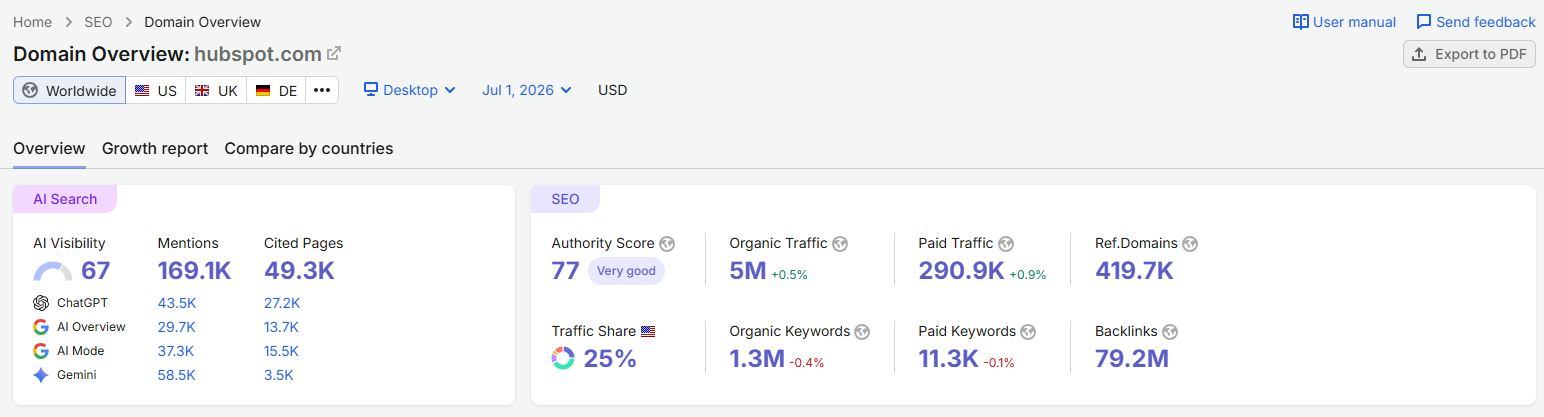
HubSpot Domain-Level Snapshot
| Metric | hubspot.com |
|---|---|
| Authority Score | 77 |
| Organic traffic | 5M |
| Organic traffic change | +0.5% |
| Organic keywords | 1.3M |
| Organic keyword change | -0.4% |
| Paid traffic | 290.9K |
| Referring domains | 419.7K |
| Backlinks | 79.2M |
| AI Visibility | 67 |
| AI mentions | 169.1K |
| AI cited pages | 49.3K |
| ChatGPT mentions | 43.5K |
| Google AI Overview mentions | 29.7K |
| Google AI Mode mentions | 37.3K |
| Gemini mentions | 58.5K |
| US traffic share | 25% |
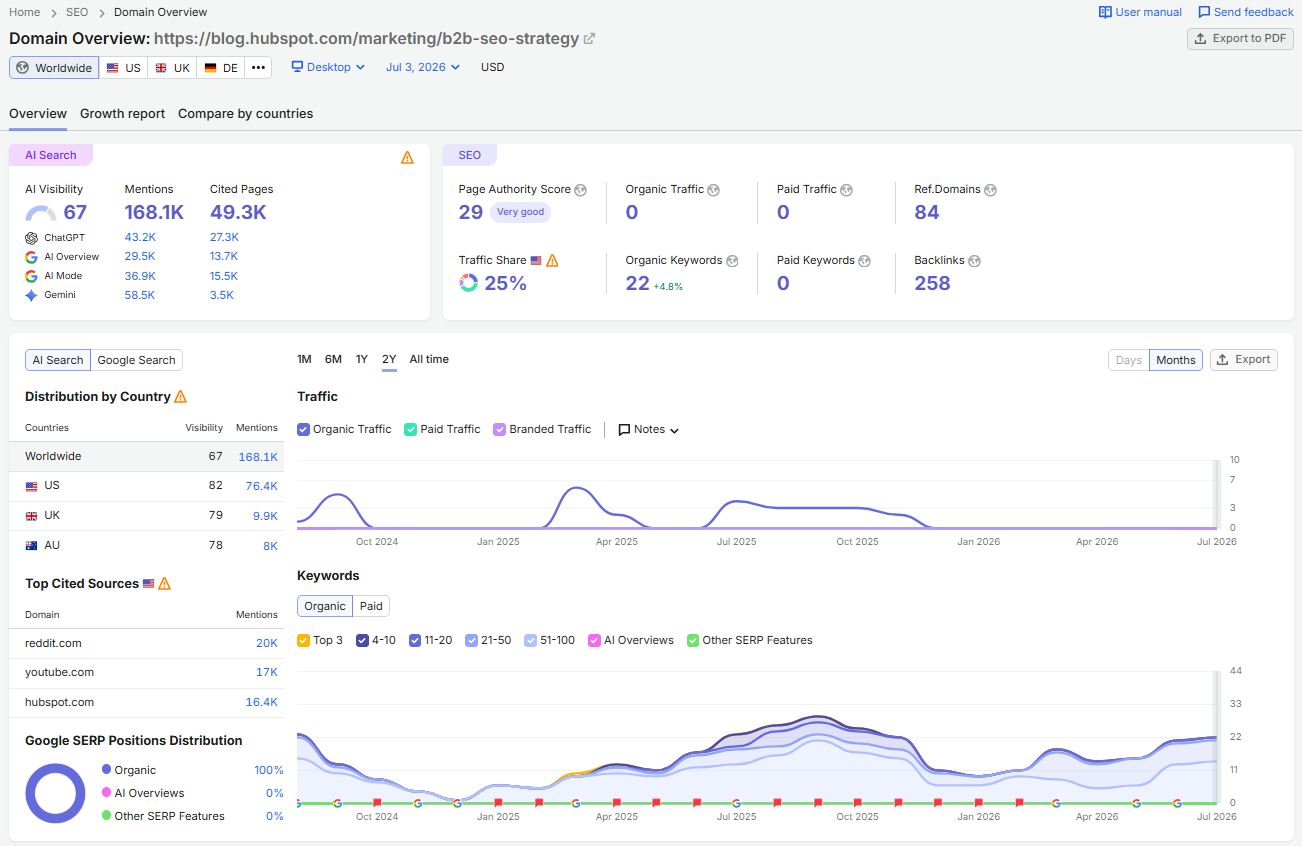
URL-Level Snapshot for HubSpot's B2B SEO Guide
| Metric | HubSpot B2B SEO guide |
|---|---|
| Page Authority Score | 29 |
| Organic traffic | 0 |
| Paid traffic | 0 |
| Referring domains | 84 |
| Backlinks | 258 |
| Organic keywords | 22 |
| Organic keyword change | +4.8% |
| Paid keywords | 0 |
| Traffic share shown | 25% US |
| Google SERP position distribution | 100% organic |
| AI Overview distribution | 0% |
| Other SERP features distribution | 0% |
| Top pages export keyword count | 15 |
| Top pages export traffic | 0 |
| Top pages export answer engine | |
| Top pages export top keyword | seo b2b strategy |
| Top pages export LLM prompts | 5 |
HubSpot's advantage comes from a powerful domain ecosystem, while the exact guide is still better treated as a structural benchmark than a proven traffic leader.
Keyword & SERP Footprint: What This One URL Ranks For
The provided keyword export prevents a lazy conclusion. HubSpot's domain ranks for several B2B SEO and AEO terms, but the ranking URLs are not always the B2B SEO guide. In several cases, the exact guide is not the URL ranking for the term.
Target Keyword Footprint from Positions Export
| Keyword | Google US rank | HubSpot ranking URL shown | Google AIO mentions | Visibility | Volume |
|---|---|---|---|---|---|
| seo for b2b companies | 4 | HubSpot Community thread | 1 | 0.9 | 1000 |
| b2b keyword research | 28 | HubSpot keyword research article | 1 | 0.1 | 210 |
| b2b seo strategy | Not in top 100 | None shown | 0 | 0 | 590 |
| b2b seo | Not in top 100 | None shown | 0 | 0 | 1000 |
| seo for b2b | Not in top 100 | None shown | 0 | 0 | 720 |
| b2b seo marketing | Not in top 100 | None shown | 0 | 0 | 720 |
Keyword Footprint Heatmap
| Keyword | HubSpot ranks? | Exact guide ranks? | AIO mention shown? | Opportunity status |
|---|---|---|---|---|
| seo for b2b companies | Yes | No | 1 mention | Domain visible, URL mismatch |
| b2b keyword research | Yes | No | 1 mention | Related-topic visibility |
| b2b seo strategy | No | No | No | Open opportunity |
| b2b seo | No | No | No | Open opportunity |
| seo for b2b | No | No | No | Open opportunity |
| b2b seo marketing | No | No | No | Open opportunity |
SERP Landscape and AI Overview Evidence
| Query | HubSpot in AI Overview? | SERP intent pattern |
|---|---|---|
| b2b seo strategy | AIO mentions 0 in positions export | Long-form strategy guides |
| b2b seo | AIO mentions 0 in positions export | Broad educational guides |
| seo for b2b companies | AIO mentions 0 in positions export | Mix of guides and agency/listicle pages |
| what is b2b seo | No | Definition-led educational results |
| how to create a b2b seo strategy | No | Step-by-step procedural guides |
The AI-Era Query Layer
The AI-era keyword set is still small. That matters. A B2B services company should not overbuild a separate page for every AEO/GEO phrase. The better move is to add a concise AI-search layer to strong existing SEO assets, then support it with one dedicated AEO resource only where demand or product strategy justifies it.
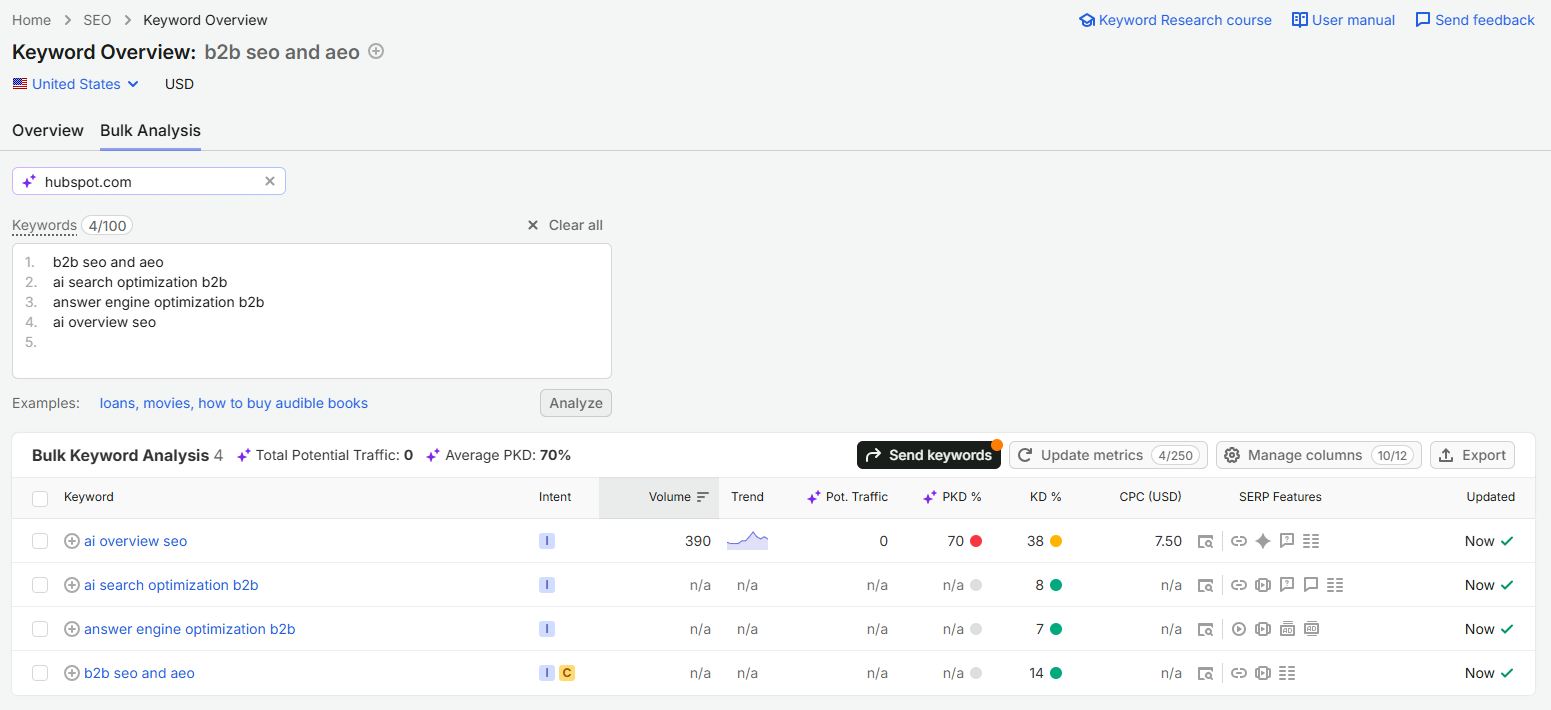
AI-Era Keyword Overview
| Keyword | Volume | Intent | PKD % | KD % | CPC | Trend | Notes |
|---|---|---|---|---|---|---|---|
| ai overview seo | 390 | Informational | 70 | 38 | $7.50 | Visible upward trend | Only query with measurable volume in screenshot |
| ai search optimization b2b | n/a | Informational | n/a | 8 | n/a | n/a | Low KD, early demand |
| answer engine optimization b2b | n/a | Informational | n/a | 7 | n/a | n/a | Low KD, early demand |
| b2b seo and aeo | n/a | Informational + Commercial | n/a | 14 | n/a | n/a | Strong topical bridge term |
AI Visibility Breakdown
This shows domain-level AI visibility. It does not prove that the exact B2B SEO guide is cited for the target B2B SEO queries.
HubSpot is widely surfaced across AI platforms, which supports the case for strong entity and content authority. It is not a page-level citation claim for this exact guide.
Page Anatomy: Why This Guide Is Quotable, Not Just Rankable
HubSpot's guide is updated for 2026, starts with a definition, connects B2B SEO to pipeline, uses buyer-journey language, and includes a dedicated B2B SEO and AEO section that names ChatGPT, Google AI Overviews, Gemini, and Perplexity. The live page also uses repeated kit CTAs, internal links, related resources, and a numbered strategy sequence.
In my experience auditing B2B content programs, this is the pattern that separates content that ranks from content that gets reused as an answer source: clear definitions, compact frameworks, business-outcome language, and proof paths.
HubSpot Page Anatomy
| Page element | What HubSpot does | Why it aids ranking | Why it aids AI retrieval/quotability |
|---|---|---|---|
| Updated 2026 framing | Uses current title/date framing and updated language | Freshness supports competitive SEO SERPs | Signals topical recency for AI-era questions |
| Definition-first section | Explains what B2B SEO is early | Satisfies definition intent | Creates an extractable answer block |
| Buyer journey language | Maps awareness, consideration, and decision stages | Matches B2B search intent depth | Helps AI systems connect subtopics and stages |
| B2B vs B2C table | Uses comparison format | Supports featured-snippet-style scanning | Comparison rows are easy to summarize |
| Numbered steps | Gives a 9-step strategy sequence | Matches how-to intent | Steps are reusable answer units |
| High-intent keyword framing | Prioritizes intent over raw volume | Aligns with B2B commercial search | Produces a clear, opinionated takeaway |
| AEO section | Mentions ChatGPT, AI Overviews, Gemini, Perplexity | Adds modern search coverage | Creates AI-search relevance without replacing SEO |
| Measurement section | Uses qualified leads, conversion rates, influenced pipeline, revenue | Differentiates from traffic-only guides | Shows business expertise, not generic SEO advice |
| CTA blocks | Repeats free SEO Starter Pack CTA | Converts educational traffic | Keeps commercial next step visible |
| Internal links | Links to related HubSpot resources and tools | Builds topic architecture | Reinforces entity and topic relationships |
| FAQ/answer-style writing | Uses short explanatory blocks | Supports long-tail intent | Improves extractability |
Quotable Page Anatomy Map
Authority Signals: The Backlink Profile Behind the Rankings
The URL has enough link data to be taken seriously, but not enough to explain everything by itself. The stronger signal is the combination of URL-level links plus HubSpot's domain-level authority. That combination is difficult for a smaller B2B services company to copy directly.
Backlink Snapshot for the Exact URL
| Metric | Value |
|---|---|
| Page Authority Score | 29 |
| Referring domains shown in URL screenshot | 84 |
| Backlinks shown in URL screenshot | 258 |
| Referring domains in export | 73 |
| Backlinks counted in export rows | 241 |
| Average referring domain Authority Score in export | 8.3 |
| Highest referring domain Authority Score | 85 |
| Earliest first-seen link in export | Aug 23, 2024 |
| Latest last-seen link in export | Jul 2, 2026 |
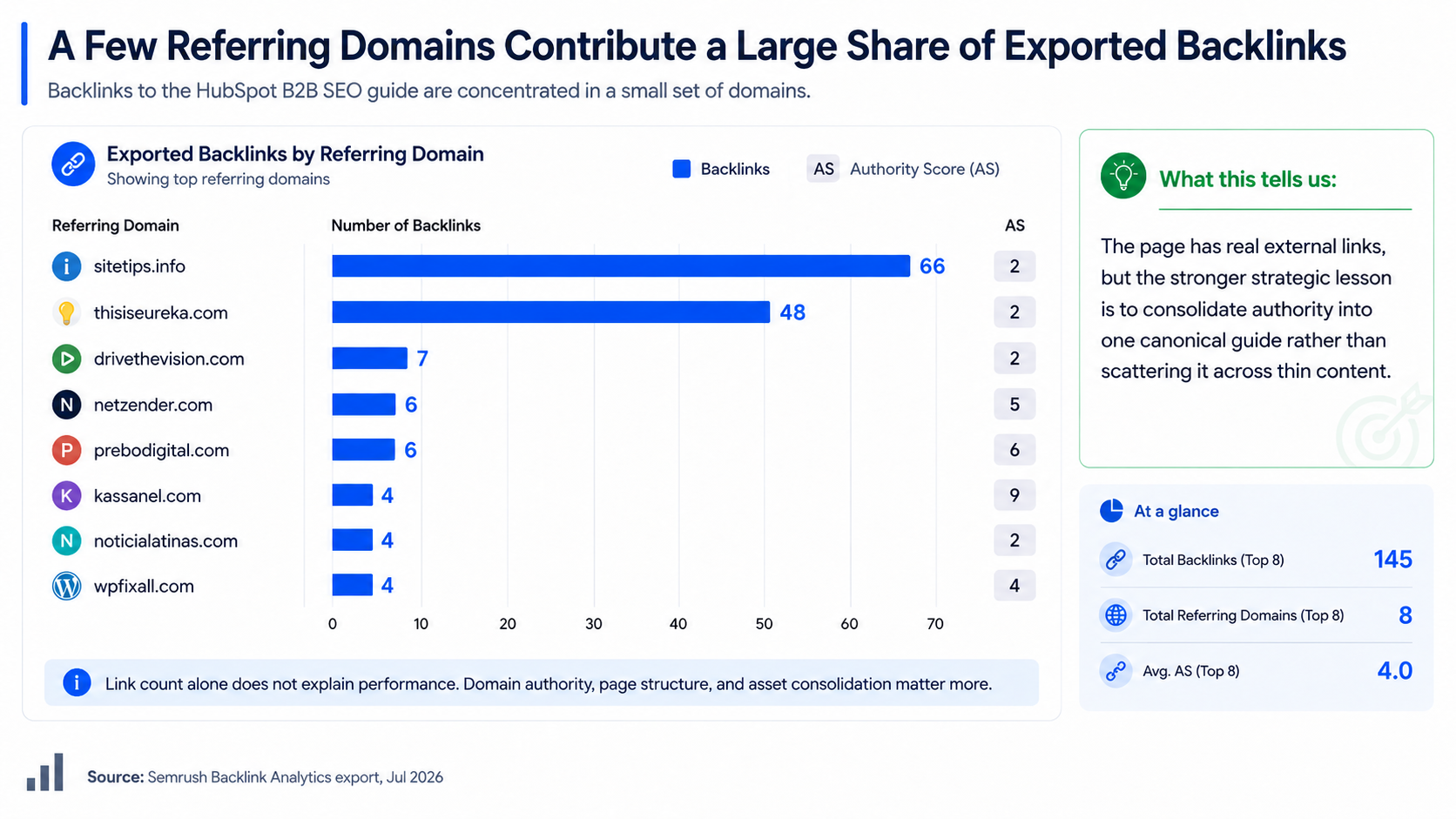
Top Referring Domains by Backlinks in Export
| Referring domain | Domain AS | Backlinks | Country | First seen | Last seen |
|---|---|---|---|---|---|
| sitetips.info | 2 | 66 | US | 2025-11-09 | 2026-07-02 |
| thisiseureka.com | 2 | 48 | US | 2025-12-06 | 2026-06-29 |
| drivethevision.com | 2 | 7 | US | 2025-08-02 | 2026-06-26 |
| netzender.com | 5 | 6 | SG | 2025-12-27 | 2026-07-01 |
| prebodigital.com | 6 | 6 | US | 2026-03-09 | 2026-06-29 |
| kassanel.com | 9 | 4 | PT | 2026-01-02 | 2026-07-01 |
| noticialatinas.com | 2 | 4 | CA | 2026-04-24 | 2026-06-30 |
| wpfixall.com | 4 | 4 | 47 | 2026-01-10 | 2026-06-09 |
What Google Actually Says About AI Overviews
This is the reality check. Google says the same SEO best practices remain relevant for AI Overviews and AI Mode. It also says there are no additional requirements to appear in AI Overviews or AI Mode, and no special technical requirements beyond being indexed and eligible to appear in Google Search with a snippet.
Google's generative AI guidance frames AEO and GEO as terms used for AI-search visibility work, but from Google's Search perspective, optimizing for generative AI search is still SEO. Google also advises against AI-specific hacks such as special AI markup, unnecessary machine-readable files, and rewriting only for AI systems.
That means this teardown is not recommending AI Overview hacks. It is recommending clearer, more useful, more extractable SEO content.
- AEO is a separate ranking system.
- You need special AI markup.
- You can guarantee AI Overview citations.
- Write only for AI answers.
- AI visibility sits within Search eligibility and standard SEO best practices.
- No special markup is required for AI Overviews or AI Mode.
- No citation guarantee exists; clarity, helpfulness, and eligibility matter.
- Create helpful, reliable, people-first content for users first.
The Replication Playbook: What to Copy and What Not to Copy
A B2B services company should not blindly copy HubSpot's guide format. HubSpot can afford a long educational guide because it has brand authority, internal link depth, product CTAs, and a huge content ecosystem. A services company needs a sharper split between commercial pages and educational support pages.
Replication Playbook for B2B Service Companies
| Tactic to replicate | How to adapt for a service page | Trap to avoid |
|---|---|---|
| Definition-first answer block | Add a 40-60 word What is B2B SEO section near the top | Turning the hero section into a beginner guide |
| Buyer journey mapping | Show how your service supports awareness, consideration, and decision pages | Writing theory without service deliverables |
| B2B vs B2C comparison | Use a compact comparison table to prove category understanding | Making the table generic and competitor-like |
| High-intent keyword logic | Explain how you prioritize low-volume commercial keywords | Chasing volume to look impressive |
| Measurement by pipeline | Show qualified leads, SQLs, demos, influenced pipeline, revenue | Reporting only traffic and rankings |
| AEO section | Add a short AI-search visibility section tied to standard SEO | Promising AI Overview rankings |
| Numbered framework | Use a service delivery framework: audit, strategy, pages, content, links, reporting | Copying HubSpot's 9 steps without proof |
| CTAs | Keep audit, demo, or contact CTAs visible before and after educational sections | Hiding the offer below 2,000 words |
| Internal links | Link to supporting blogs, case studies, tools, and service pages | Sending commercial visitors only to more guides |
| Proof assets | Add case studies, screenshots, sample reports, and KPI examples | Publishing advice without evidence |
Service Page vs Guide Decision Tree
Use this decision tree before copying HubSpot's long-guide structure into a commercial page.
Optimising a B2B service page?
- Keep commercial intent primary.
- Add a short definition block.
- Add proof assets and buyer FAQs.
- Frame KPIs around leads, pipeline, and revenue.
- Avoid a 3,000-word generic beginner guide.
Creating a blog or resource guide?
- Go deeper on education.
- Add frameworks and templates.
- Add buyer-journey mapping.
- Use internal links back to service pages.
- Use CTAs without overselling too early.
Covering AI or AEO?
- Add an AI-search section only if it matches intent.
- Do not promise AI Overview rankings.
- Position AEO as clearer, more extractable SEO.
- Keep Google's guidance as the ceiling.
Verdict
HubSpot is likely to be retrieved or cited for AI-era B2B marketing questions because it combines three things most companies separate: authority, answerable structure, and business-outcome framing.
But the provided data does not prove that the exact B2B SEO guide currently owns AI Overview citations for the target B2B SEO queries. That distinction matters.
The real lesson is not write for AI. It is this: build one strong, crawlable, internally linked, commercially grounded asset that answers buyer questions clearly enough to rank, be summarized, and convert.
FAQ
What is B2B SEO?
B2B SEO is the process of optimizing a company's website and content so business buyers can find it while researching problems, comparing solutions, and evaluating vendors. The goal is not just traffic. The real goal is qualified demand, pipeline influence, and revenue.
Does Google have special requirements for AI Overviews?
No. Google says there are no additional requirements to appear in AI Overviews or AI Mode beyond standard Search eligibility, technical requirements, policies, and SEO best practices. That means AEO work should improve clarity and usefulness, not rely on hacks.
How should B2B SEO be measured?
B2B SEO should be measured by qualified leads, conversion rates, sales-qualified opportunities, influenced pipeline, and revenue. Rankings and sessions still matter, but they are leading indicators. In B2B, a low-volume commercial keyword can outperform a high-volume informational keyword if it attracts real buyers.
Should a service page be rewritten as a guide to appear in AI answers?
No. A B2B service page should stay commercially focused. Add a concise definition layer, comparison table, buyer questions, proof, FAQs, and measurement language. Put the deeper educational guide on a supporting blog or resource page, then internally link it back to the service page.
What is AEO and how is it different from SEO?
AEO, or Answer Engine Optimization, focuses on how clearly a brand or page can be understood, retrieved, and cited in AI-generated answers. For Google Search, it should still be treated as SEO discipline: helpful content, crawlability, internal links, technical clarity, and expert-led information.
Sources Referenced
- Semrush Domain Overview, URL-level screenshot, Positions export, Keyword Overview, Backlink Analytics export, Jul 2026.
- HubSpot B2B SEO guide, live page review, Jul 2026.
- Google Search Central: AI features and your website.
- Google Search Central: AI optimization guidance.
- Google Search Central: creating helpful, reliable, people-first content.
- Log in to post comments


 INDIA
INDIA