


The Buyer Confidence Content Framework
As part of Supramind Digital’s B2B SEO services methodology library, the Buyer Confidence Content Framework explains how a B2B SEO agency, in-house team, or content strategist can turn buyer doubts, proof needs, and internal objections into content that reduces risk and supports confident decisions
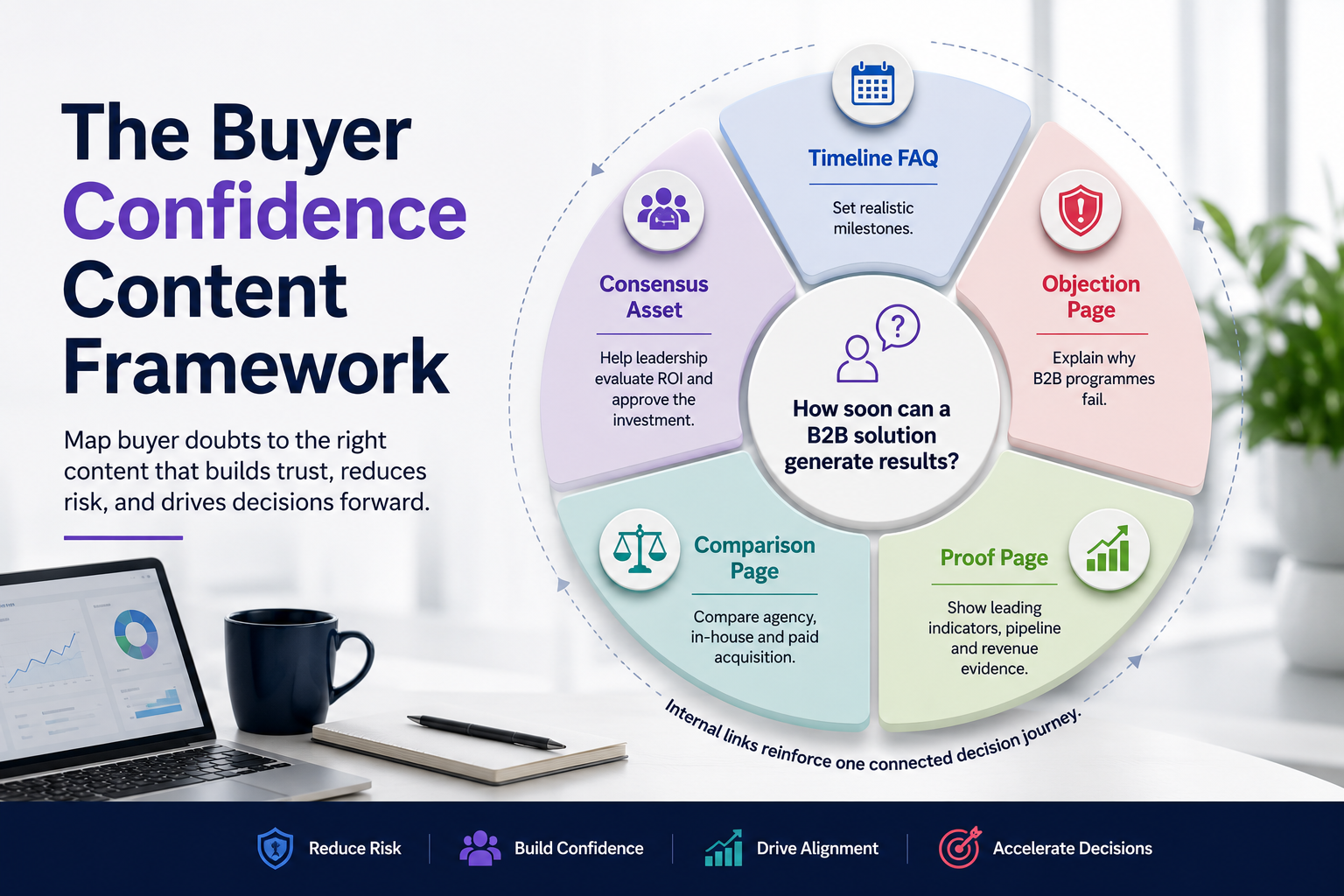
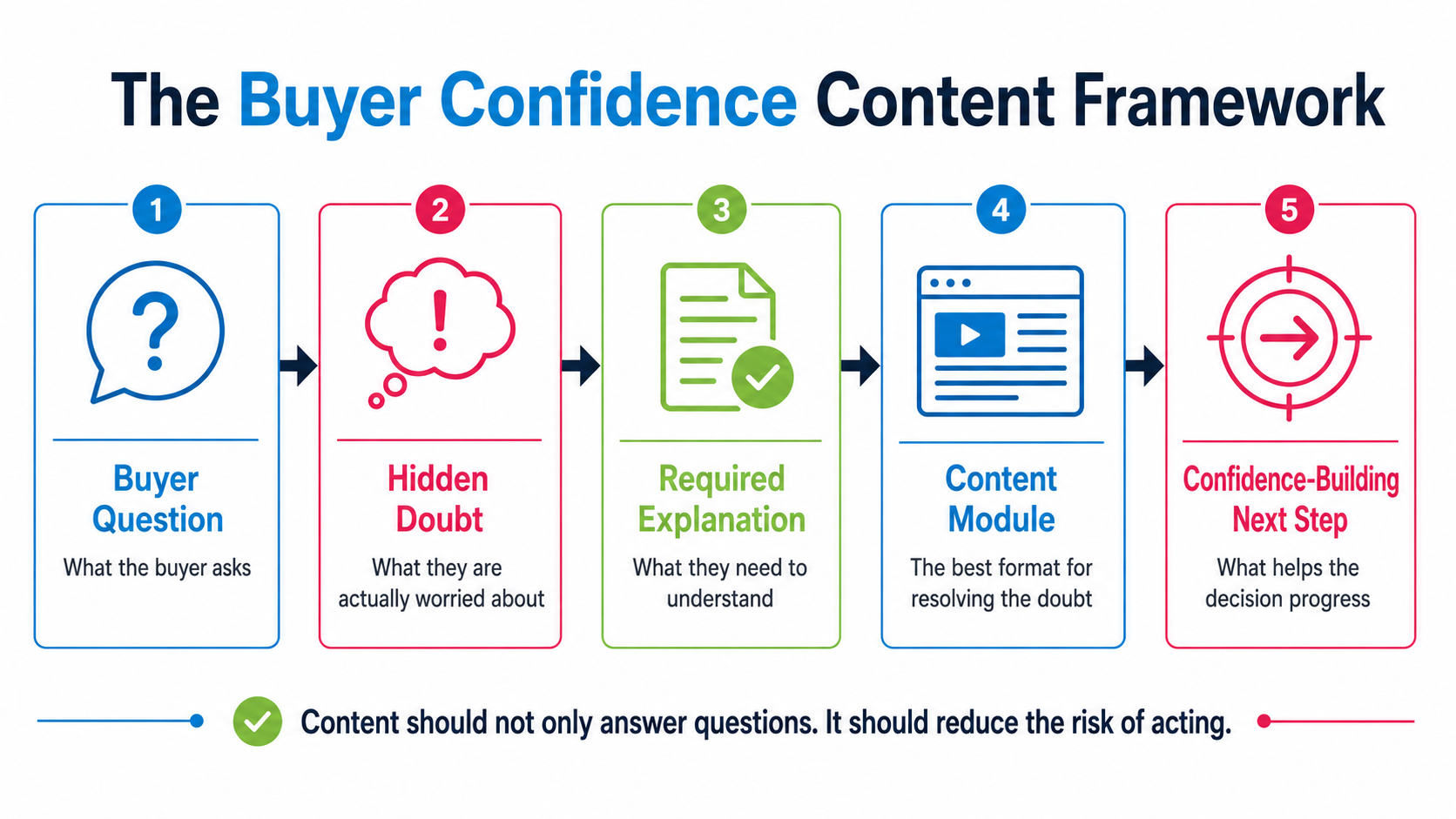
The Buyer Confidence Content Framework is a method for turning buyer doubts into content that makes a B2B decision feel safer, clearer, and easier to defend internally. Instead of organising content only around keywords or funnel stages, it connects each buyer question to an underlying risk, the explanation or proof needed to reduce that risk, the most suitable content module, and a next step that improves decision clarity.
Why Informed B2B Buyers Still Do Not Buy
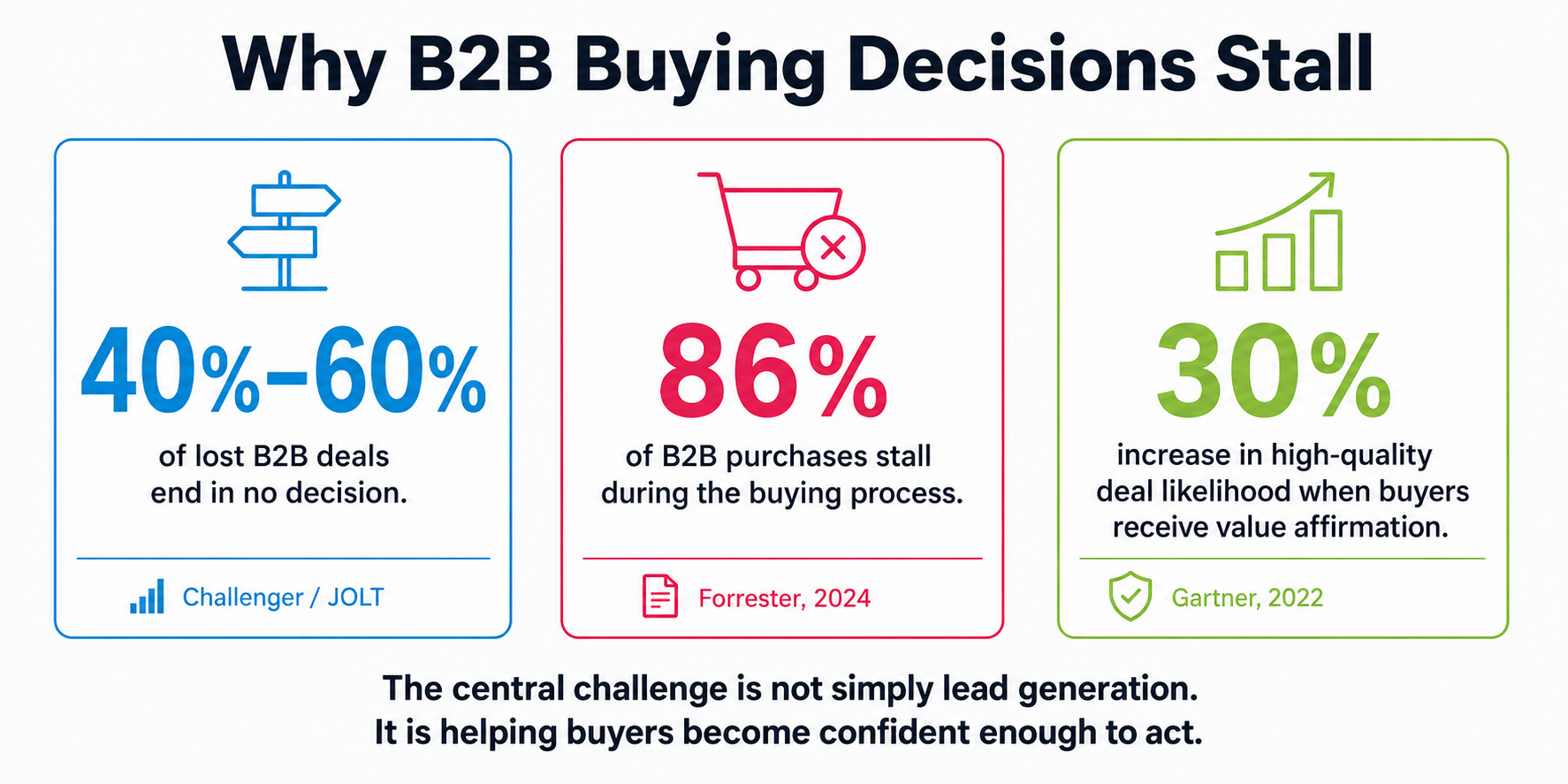
B2B buyers rarely lack information. They often lack enough confidence to act on it. The strongest evidence is the size of the no-decision problem: Challenger's JOLT Effect research found that 40%-60% of lost deals end in no decision. Win rates fell from 30% with moderate indecision to 6% with high indecision (2020 research, published in 2022).
Forrester's State of Business Buying 2024 similarly reported that 86% of B2B purchases stall. The implication is practical: an apparently qualified buyer can understand the problem, compare suppliers, and still choose postponement because the decision remains hard to justify or defend.
The confidence gap usually appears as a risk question:
- Will this deliver the expected result?
- Can we defend the cost?
- Will implementation disrupt operations?
- Is the provider a safe choice?
- Will finance, legal, IT, and leadership approve it?
Gartner's analysis of value affirmation found that helping buyers validate that they are making the right decision increased the likelihood of a high-quality deal by 30%, compared with 20% for conventional value framing (Gartner buyer research, 2022; analysed in Gartner's seller-skills research and high-value content research). Information explains value; affirmation reduces the perceived risk of acting on it.
The Core Framework Flow
The framework converts a surface-level question into a decision-supporting content requirement:
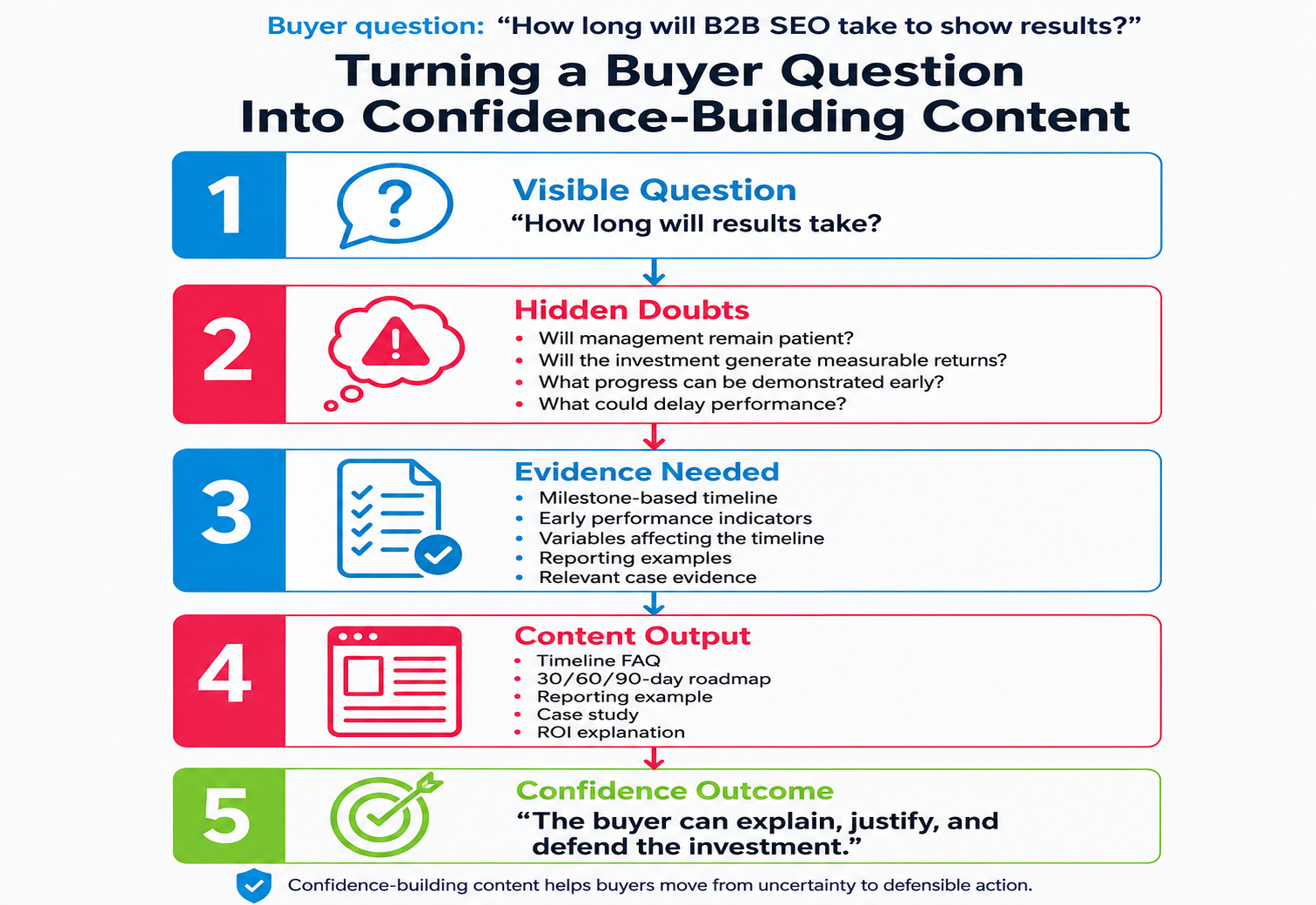
Consider the question, “How long will B2B SEO take to show results?” The visible topic is time, but the hidden concerns are wider: whether management will remain patient, whether early progress can be demonstrated, whether the investment will produce measurable returns, and which dependencies could delay performance.
A generic answer such as “six to twelve months” informs the buyer but does little to reduce those risks. A confidence-building answer would include a milestone-based timeline, early indicators, variables affecting performance, reporting examples, relevant case evidence, and realistic 30-, 60-, and 90-day expectations.
Confidence Mapping Matrix
The matrix aligns buyer doubts with six B2B buying jobs: problem identification, solution exploration, requirements building, supplier selection, validation, and consensus creation. Expand each row to see the stakeholders, risks, evidence, content modules, and next-step pattern associated with that job.
Interactive decision-enablement tool
Buyer Confidence Mapping Matrix
Use the controls or open individual buying jobs to inspect the complete confidence requirement.
Problem identificationIs this problem serious enough to solve?Benchmark report, diagnostic, cost calculator
Example questions
- What happens if we do nothing?
- How serious is this compared with peers?
Hidden risk
Investing in a low-priority problem or failing to justify urgency.
Stakeholders
Department leadership, operations, finance, executive sponsor.
Evidence required
Cost of inaction, benchmarks, current-state diagnostics.
Content modules
Benchmark study, diagnostic guide, cost calculator.
Next step
Assess the scale and cost of the problem.
Solution explorationWhich approach fits our situation?Solution guide, selection framework, use-case comparison
Example questions
- Should we build, buy, or outsource?
- Which model offers the safest trade-off?
Hidden risk
Choosing the wrong solution category or creating future switching costs.
Stakeholders
Business leadership, functional specialists, operations, IT.
Evidence required
Category comparisons, limitations, fit criteria, use cases.
Content modules
Solution guide, build-versus-buy page, selection framework.
Next step
Identify the best-fit solution approach.
Requirements buildingWhat capabilities do we actually need?Checklist, planning template, configuration guide
Example questions
- Which requirements are essential?
- What dependencies must be planned?
Hidden risk
Missing a critical capability or paying for unnecessary scope.
Stakeholders
End users, operations, IT and security, procurement.
Evidence required
Requirements criteria, dependencies, integrations, priorities.
Content modules
Requirements checklist, template, technical specification page.
Next step
Build a practical requirements checklist.
Supplier selectionWhy should we choose this provider?Comparison page, case study, credentials page
Example questions
- Has this provider solved a similar problem?
- Can it support our scale?
Hidden risk
Selecting an inexperienced provider or trusting unsupported claims.
Stakeholders
Executive sponsor, evaluation committee, procurement, functional leads.
Evidence required
Differentiation, methodology, relevant results, credentials.
Content modules
Provider comparison, methodology page, case study, credentials.
Next step
Compare provider fit and evidence.
ValidationCan the claims be independently verified?Proof page, testimonials, reference or pilot
Example questions
- Can we verify the stated results?
- Can we speak with a relevant customer?
Hidden risk
Claims may be exaggerated or may not transfer to this context.
Stakeholders
Evaluation team, subject experts, references, risk and compliance.
Evidence required
Verified results, reviews, references, trials, third-party proof.
Content modules
Proof library, case study, reference programme, pilot plan.
Next step
Review relevant proof or validate through a pilot.
Consensus creationHow will we secure internal approval?Business case, executive summary, approval pack
Example questions
- How do we justify the investment?
- What will finance, IT, and legal need?
Hidden risk
Stakeholders may block the purchase or reject the business case.
Stakeholders
Leadership, finance, IT, legal, procurement, operations, end users.
Evidence required
ROI, security, implementation plan, stakeholder-specific answers.
Content modules
Business-case template, executive summary, security pack.
Next step
Build an internal approval case.
The consensus stage is especially important. Gartner's 2025 buying-group research found that 74% of B2B buying teams experience unhealthy conflict. Groups reaching consensus were 2.5 times more likely to report a high-quality deal. Content designed for buying-group relevance improved consensus by 20%, while content tailored only to individuals had a 59% negative impact on consensus.
The Five Confidence-Building Content Modules
Each module resolves a different type of decision risk. Use the navigator to move directly to the relevant format.
FAQ Spokes
FAQ spokes answer narrow questions that create hesitation: timelines, pricing structure, eligibility, implementation requirements, or expected outcomes. A useful answer explains the direct answer, the variables that change it, the important limitations, and where the buyer can obtain deeper proof. The appropriate next step is another clarity action, such as reviewing a checklist or estimating a timeline.
Objection Pages
Objection pages address concerns strong enough to delay or block the purchase. Examples include outsourcing risk, implementation failure, integration uncertainty, contractual exposure, and cost control. They should acknowledge when the concern is legitimate, explain the factors that increase or reduce the risk, and show how the process controls it. The aim is bounded risk, not unsupported reassurance.
Proof Pages
Proof pages convert claims into evidence through measured results, case studies, methodology, customer references, reviews, certifications, and implementation examples. In Forrester's 2023 content-preference survey, 86% of respondents said they were more likely to trust vendor thought leadership when claims were backed by objective third-party content or data (Forrester, 2023). Proof becomes stronger when the buyer can see context, measurement period, constraints, and transferability.
Comparison Pages
Comparison pages reduce choice uncertainty by explaining where each option fits, what it requires, and which trade-offs it creates. A credible comparison covers suitability, cost implications, implementation demands, limitations, and decision criteria. It should help the buyer identify fit rather than declaring one option universally superior.
Consensus Assets
Consensus assets help the champion carry the decision into finance, leadership, IT, procurement, legal, and operational review. Useful formats include ROI models, executive summaries, security documentation, implementation plans, business-case templates, and approval packs. Their value lies in giving the buying group shared language, shared assumptions, and evidence that can survive internal scrutiny.
How to Find the Doubts Buyers Do Not State Publicly
The strongest confidence gaps usually appear closer to revenue than keyword tools. Five evidence sources are especially useful:
Translate every signal into a complete matrix row: actual buyer language, feared outcome, buying job, stakeholder, explanation needed, evidence standard, content module, and next clarity action. The tool below helps prioritise those rows by frequency and commercial impact.
Content opportunity tool
Buyer Doubt Prioritisation Matrix
Scores of 4-5 are treated as high. Add a doubt to classify it by frequency in buyer conversations and impact on purchase progression. Data stays in the browser.
Create Specialist Content
Create Content First
Monitor
Address in FAQs or Existing Pages
Worked Example: A B2B SEO Agency
A company asks, “How soon can a B2B SEO agency generate leads?” A conventional page may provide a broad timeline and promote the agency. The Buyer Confidence Content Framework identifies the risks beneath the question and assigns a distinct content response to each one.
| Hidden doubt | Required content | Confidence outcome |
|---|---|---|
| SEO may take too long | Milestone-based results timeline | Sets realistic expectations |
| Leadership may lose patience | Executive reporting example | Provides early proof of progress |
| Traffic may not become pipeline | Lead attribution and conversion methodology | Connects visibility to commercial outcomes |
| Previous agencies failed | Failure analysis and qualification criteria | Helps evaluate fit and avoid repetition |
| Budget may be rejected | ROI model and cost-of-inaction analysis | Supports internal financial approval |
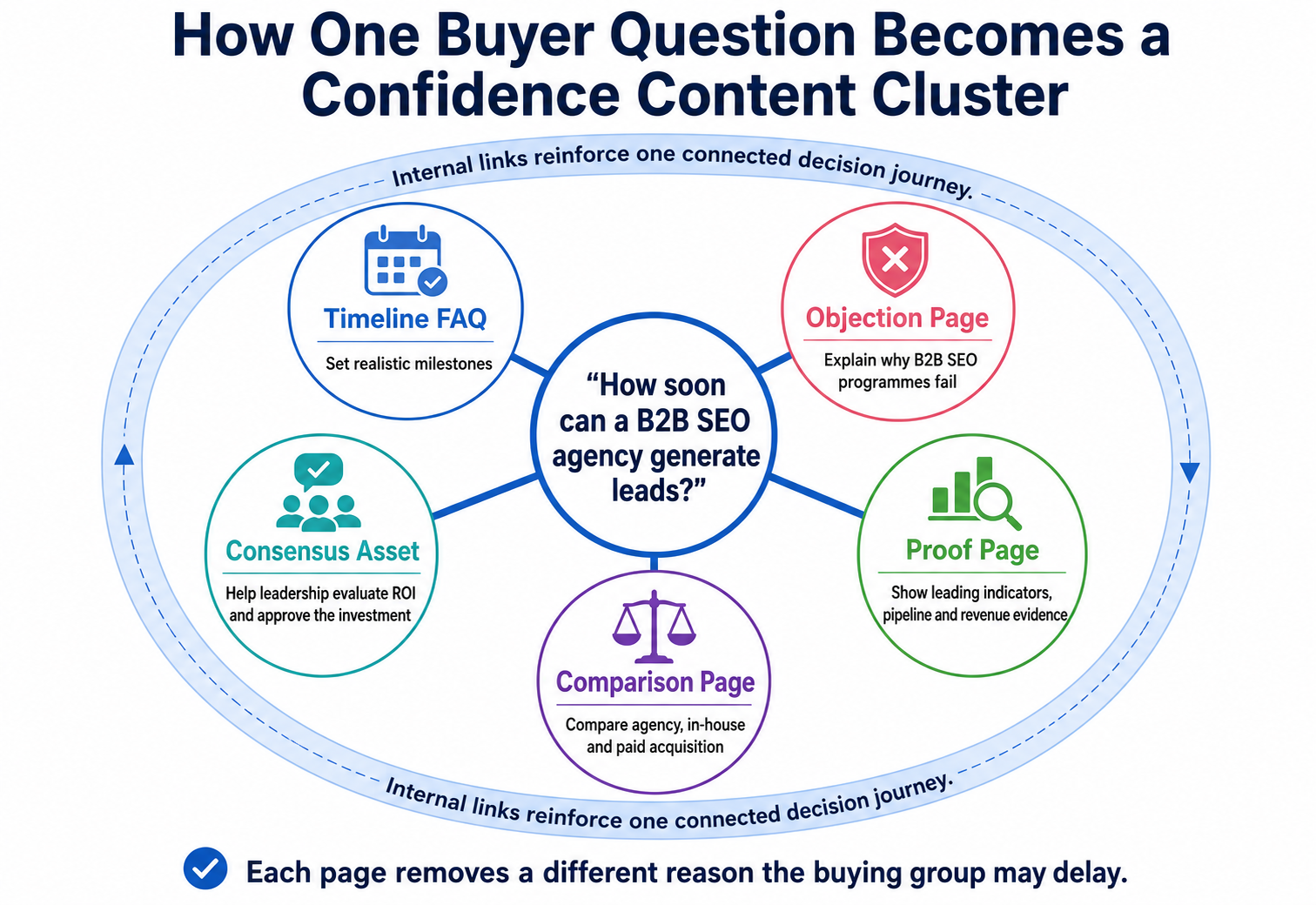
The resulting cluster contains a timeline FAQ, an objection page explaining why programmes fail, a proof page connecting leading indicators to pipeline and revenue, a comparison page covering agency versus in-house versus paid acquisition, and a consensus asset for leadership approval. Internal links connect these pages into one decision journey. The purpose is not to create five pages for five keyword variations; it is to resolve five different reasons the buying group may hesitate.
Final Summary
The Buyer Confidence Content Framework reframes B2B SEO content as decision infrastructure. It begins with the buyer's visible question, identifies the feared consequence, specifies the explanation and evidence needed, assigns the right page or module, and ends with a next step that improves clarity. This creates information gain because the content does more than define a topic: it makes risk, proof, trade-offs, and internal approval requirements visible.
Buyer Confidence Content Framework FAQ
What is the Buyer Confidence Content Framework?
It is a method for mapping a buyer's visible question to the underlying doubt, the explanation and evidence needed, the most suitable content module, and a next step that helps the decision progress.
How is it different from traditional funnel content?
Traditional funnel content groups assets around awareness, consideration, and conversion. The Buyer Confidence Content Framework organises content around the risks preventing progression, including financial justification, implementation uncertainty, provider safety, proof, and internal consensus.
Does every buyer question need a separate page?
No. A question deserves a dedicated page when it represents meaningful demand, a complex objection, a repeated sales barrier, or a doubt requiring substantial evidence. Narrower questions can be resolved in FAQs or existing commercial pages.
Which content module should be created first?
Prioritise doubts that appear frequently in lost deals, delay proposals, or require repeated explanation from sales. Pricing, ROI, implementation, integration, security, expected results, and provider differentiation are common high-impact areas.
Why is peer proof important?
TrustRadius's 2024 B2B Buying Disconnect found that 68% of buyers sought peer conversations to gain confidence to move forward. Peer evidence helps buyers validate whether a decision worked in a comparable context.
Should pricing be included?
Pricing transparency can reduce uncertainty. The G2 2024 Buyer Behavior Report found that 64% of C-suite buyers were less likely to purchase when personal information was required before pricing was shown. TrustRadius also reported that 51% of enterprise buyers wanted more transparent pricing in 2024.
Can AI-generated answers replace confidence-building content?
AI can support research, but validation remains important. Gartner reported in 2026 that 69% of B2B buyers preferred sales representatives to validate AI-generated insights. Comprehensive answers still need checkable evidence and human context.
Research Sources Used in This Framework
Evidence library
View the research supporting the statistics and framework
Challenger / JOLT
Study: The JOLT Effect research on customer indecision, 2020 data / 2022 publication.
Finding used: 40%-60% of lost deals end in no decision; win rates decline sharply as indecision rises.
Forrester
Study: The State of Business Buying, 2024.
Finding used: 86% of B2B purchases stall during the buying process.
Gartner
Study: B2B buyer research on value affirmation and high-quality deals, 2022.
Finding used: Value affirmation increased the likelihood of a high-quality deal by 30%; value framing by 20%.
Gartner
Study: Buying-group conflict and consensus research, 2025.
Finding used: 74% unhealthy conflict; consensus groups 2.5x more likely to report high-quality deals; group relevance improved consensus by 20%.
Forrester
Study: Customer-centric content preference survey, 2023.
Finding used: 86% were more likely to trust vendor thought leadership backed by objective third-party content or data.
TrustRadius
Study: The 2024 B2B Buying Disconnect.
Finding used: 68% used peer conversations to gain confidence to move forward; 51% of enterprise buyers wanted greater pricing transparency.
G2
Study: 2024 Buyer Behavior Report.
Finding used: 64% of C-suite buyers were less likely to purchase when personal information was required before pricing was shown.
Gartner
Study: AI-generated buying insight validation survey, published 2026.
Finding used: 69% of B2B buyers preferred to validate AI-generated insights with sales representatives.
- Log in to post comments


 INDIA
INDIA