


Cloudflare SASE SEO Teardown: The Trust Metrics Behind a Cybersecurity Page
I’m writing this from Supramind, a team providing B2B SEO services, after reviewing Cloudflare’s Semrush domain and URL data, keyword exports, backlink profile, SERP visibility, AI Overview evidence, and the live SASE page structure. The pattern is measurable: Cloudflare’s /sase/ page does not win trust through one landing page alone. It sits inside a larger authority system built on domain strength, product-led topical depth, analyst validation, technical documentation, and buyer-specific proof. This teardown breaks down how Cloudflare turns cybersecurity SEO visibility into enterprise trust before a buyer is ready to convert.
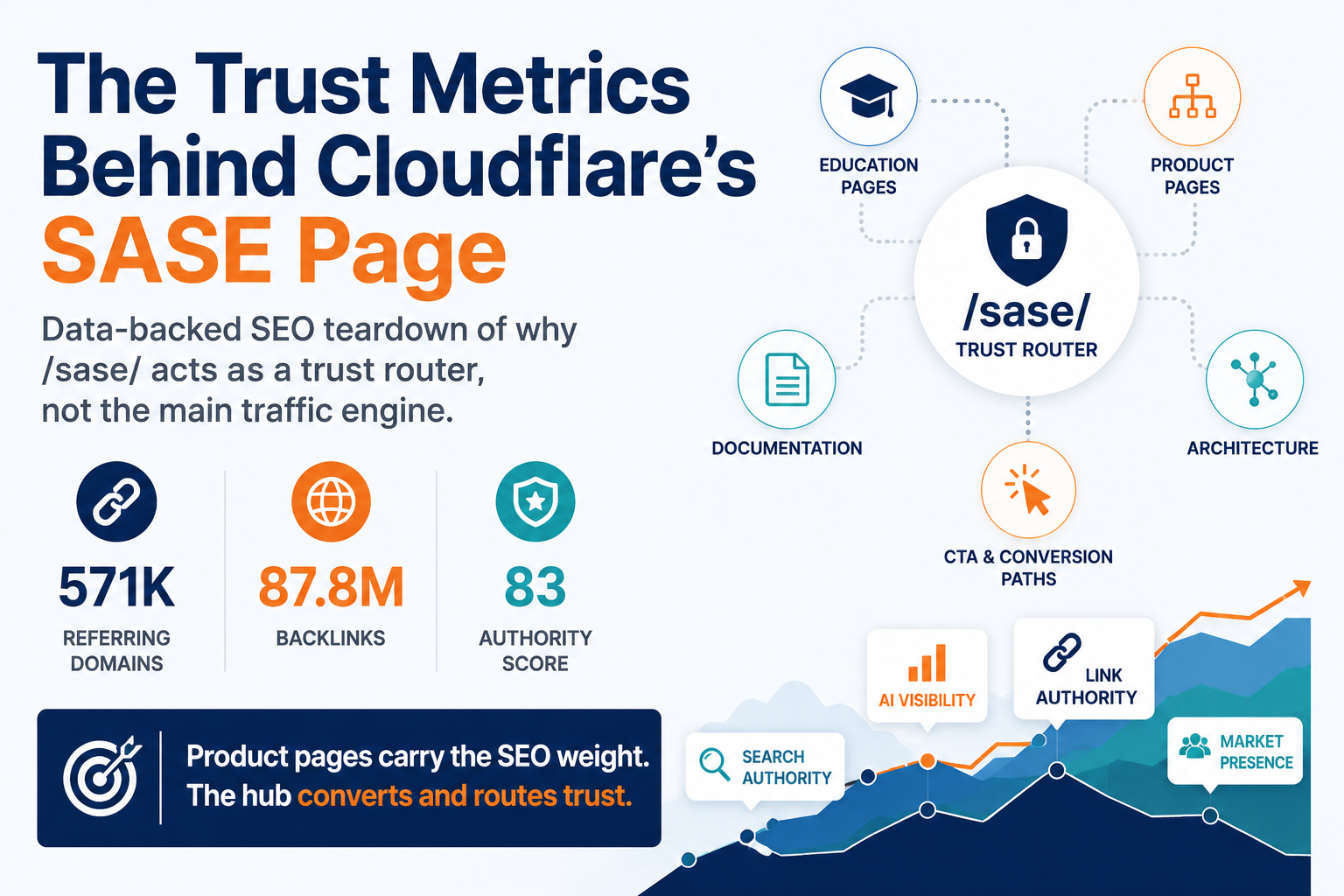
TL;DR: What trust signals should a cybersecurity SEO page include?
A cybersecurity SEO page should not only claim security expertise. It must prove it through authority, technical depth, third-party validation, use-case clarity, and conversion paths that match how enterprise buyers evaluate risk.
Cloudflare’s SASE page does this through a distributed trust system: an 83 Authority Score, 10.5M organic traffic, 570.4K referring domains, a 72-page SASE content ecosystem, and on-page proof such as Gartner/Forrester validation, customer outcomes, technical docs, and AI-agent security messaging.
Core answer: before a cybersecurity buyer feels safe enough to convert, the page must prove four things numerically: authority, relevance, technical depth, and risk reduction.
Why this page, why trust?
Cybersecurity buyers are skeptical because the cost of choosing the wrong vendor is not just poor ROI. It can mean operational disruption, procurement risk, security gaps, audit exposure, and internal blame.
Cloudflare’s page reduces that risk by stacking proof before pushing the buyer into a sales conversation. This is exactly where technical B2B SEO services need to go beyond keyword insertion and audit whether the page gives buyers enough evidence to move forward.
Buyer risk vs. page proof
| Buyer risk | Page proof needed | Cloudflare evidence |
|---|---|---|
| “Is this vendor credible?” | Authority, analyst proof, customer outcomes | AS 83, Gartner/Forrester recognition, case-study outcomes |
| “Can this handle enterprise complexity?” | Product taxonomy and architecture | ZTNA, SWG, CASB, DLP, NaaS, FWaaS, RBI, DEM |
| “Is this current enough for AI-era risk?” | AI-agent and GenAI security language | AI agents, MCP servers, prompt analysis, shadow AI |
| “Can my technical team validate this?” | Docs and reference architecture | “Read reference architecture” and “Read technical docs” |
| “Is this only marketing?” | Quantified outcomes | 35% time savings, 90% fewer VPN-related tickets, ~$5.2M savings |
| “Can I test or talk?” | Dual CTA paths | “Talk to an expert” and “Try Cloudflare One” |
In 20 years of auditing security vendors, I have seen weak pages lose buyers because they hide proof behind generic copy. Cloudflare does the opposite: it surfaces proof early.
The numbers behind the page
Cloudflare’s /sase/ page is not working alone. It sits inside a large domain authority system where search visibility, AI visibility, link authority, and commercial presence all support the landing page.
Interactive trust layer
Cloudflare’s Trust Stack: Search, AI, and Link Authority in One View
Cloudflare’s SASE page does not start from zero. It sits on top of a domain with strong search authority, AI visibility, organic footprint, and link equity. Select each trust layer below to see how the domain reduces buyer doubt before a visitor reaches the /sase/ page.
Exact /sase/ URL metrics
| URL | Traffic | Keywords | Traffic change | Answer engines | Top keyword | Intent | LLM prompts |
|---|---|---|---|---|---|---|---|
| /sase/ | 482 | 48 | +467 | Gemini, Google, Google AI, SearchGPT | cloudflare one | Informational | 14 |
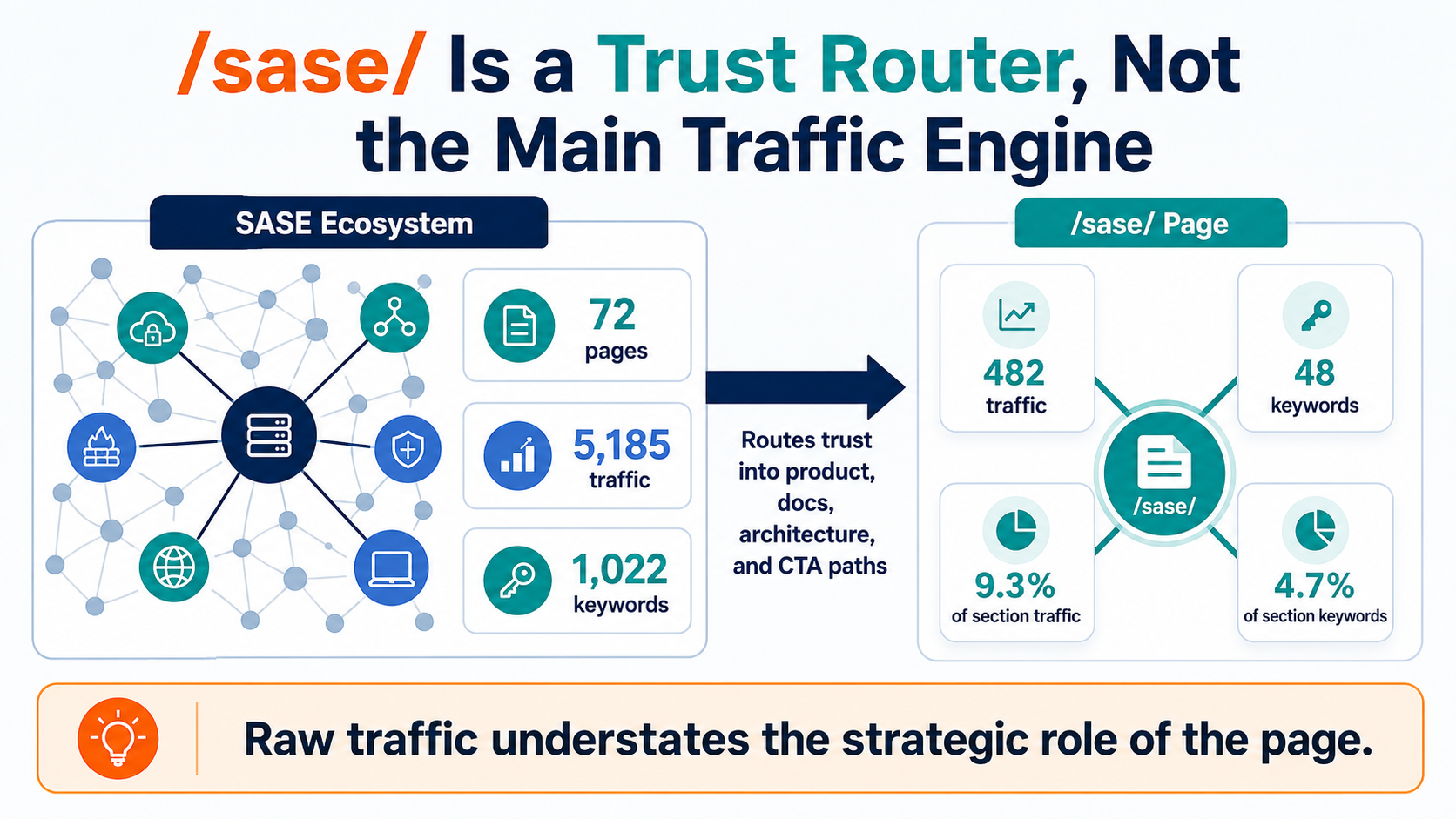
The /sase/ page has modest standalone traffic, but strong strategic value. Its role is not just traffic acquisition. It is trust routing: send buyers to product pages, docs, architecture, demos, and sales paths.
Keyword and SERP battlefield
The broad keyword overview for “cybersecurity” shows the size and commercial pressure of the category, but broad cybersecurity terms are not where SASE conversion usually happens. The better trust signal is Cloudflare’s ranking coverage across technical buying terms.
Broad cybersecurity keyword landscape
| Keyword | US volume | Global volume | PKD | CPC | Intent | Current position | Potential position |
|---|---|---|---|---|---|---|---|
| cybersecurity | 2.2M | 3.4M | 40% | $6.52 | Informational + Commercial | Not in top 100 | 82 |
Selected SASE and security keyword coverage
| Keyword | Search volume | Rank | Ranking page | Visibility |
|---|---|---|---|---|
| secure web gateway | 18,100 | 1 | Learning page | 1.00 |
| zero trust access | 260 | 1 | Learning page | 1.00 |
| SASE | 14,800 | 2 | Learning page | 0.97 |
| zero trust | 6,600 | 2 | Learning page | 0.97 |
| ZTNA | 3,600 | 3 | Learning page | 0.93 |
| email security | 1,900 | 4 | Learning page | 0.90 |
| DLP | 14,800 | 6 | Learning page | 0.83 |
| CASB | 8,100 | 25 | Learning page | 0.20 |
Interactive SERP insight
Cloudflare’s SASE Keyword Coverage Gauge
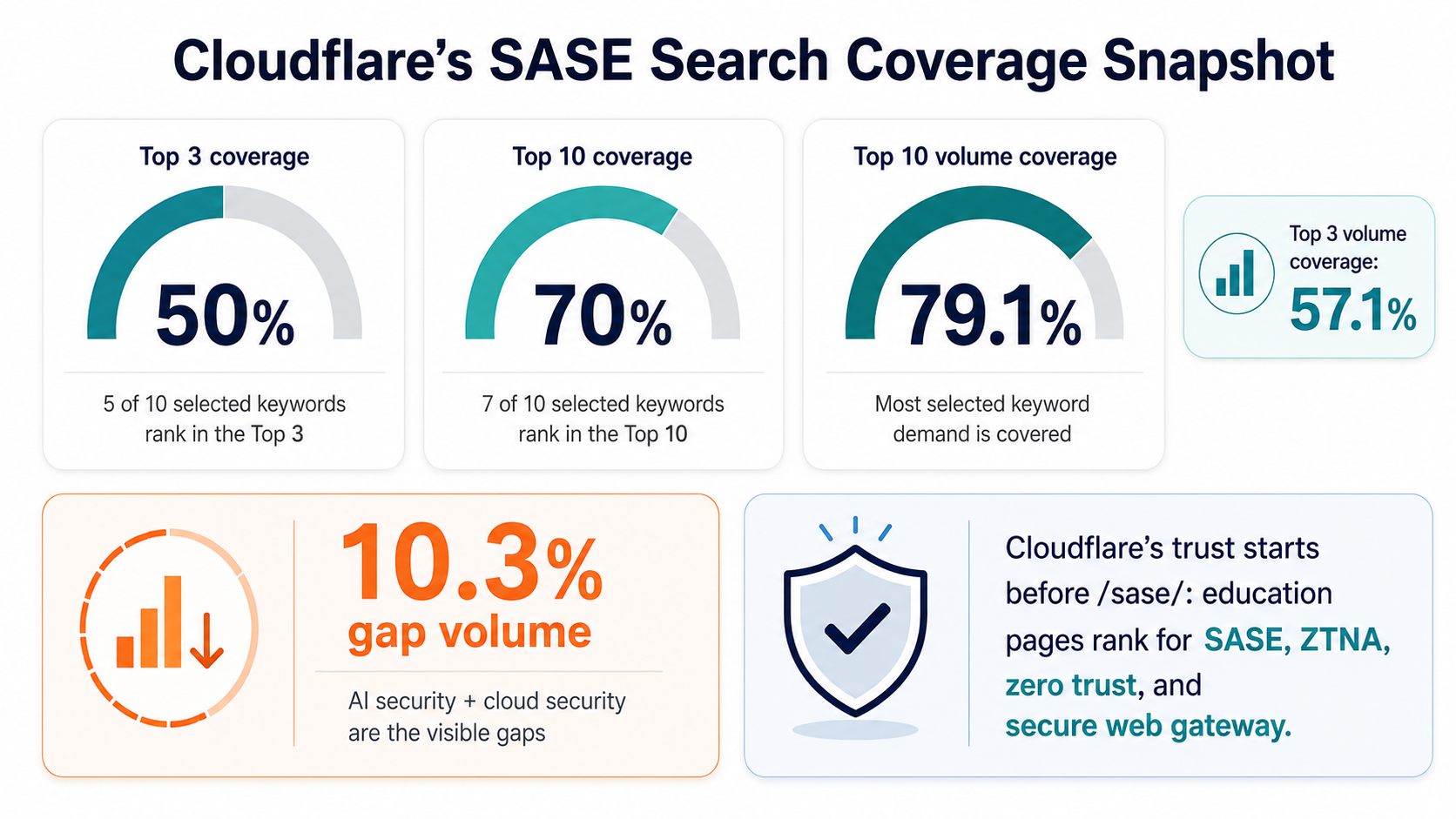
A cybersecurity page earns trust before conversion by showing up across the buyer’s research journey. Cloudflare’s strongest rankings sit in the learning layer, where buyers search for SASE, zero trust, ZTNA, and secure web gateway.
Cloudflare ranks in the Top 3 for 5 out of 10 selected security terms.
Cloudflare ranks in the Top 10 for 7 out of 10 selected security terms.
Most of the selected keyword demand is covered by visible Cloudflare rankings.
AI security and cloud security are the biggest visible gaps in the supplied dataset.
The supplied AI Overview proof also shows Cloudflare cited for “what is cybersecurity,” “cyber security information,” and “what is cybersquatting,” which supports its role as a cited cybersecurity education source in AI-style search results.
What the raw Semrush data does not say directly
/sase/ is a trust router, not the main traffic engine
Interactive insight
Trust Router Calculator: What the Raw Traffic Number Hides
The /sase/ page has only 482 traffic and 48 keywords, but that does not make it weak. Its role becomes clearer when compared with the wider SASE ecosystem.
Default data used
Calculated trust-router metrics
The /sase/ page contributes less than 10% of the SASE section’s traffic.
Most keyword coverage comes from supporting SASE pages, not the hub itself.
Each /sase/ keyword generates about 10 traffic units.
The wider section has more reach, but lower traffic efficiency per keyword.
The /sase/ page is almost 2x more efficient per keyword than the wider SASE section.
The wider SASE ecosystem generates 10.8x more traffic than the /sase/ page.
The Access product page drives 7.5x more traffic than the /sase/ hub.
Product pages carry most of the SASE organic weight
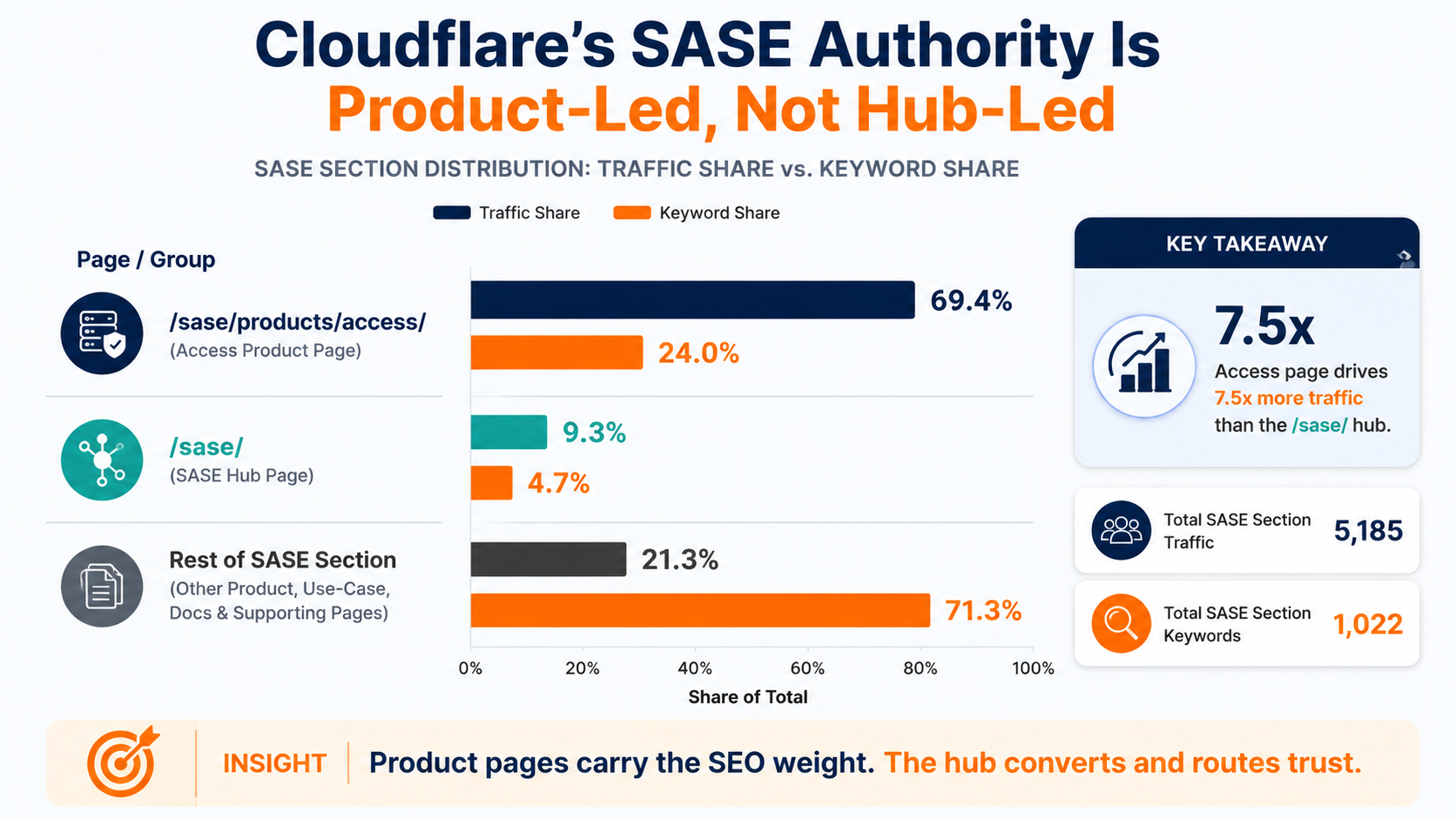
The Access page drives 69.4% of SASE section traffic. That tells me Cloudflare’s SASE authority is product-led, not hub-led.
Buyer-risk reduction: buyers trust the hub because there are deeper product paths behind it.
Product-led authority signal
| Page | Traffic | Keywords | Traffic share | Keyword share |
|---|---|---|---|---|
| /sase/products/access/ | 3,598 | 245 | 69.4% | 24.0% |
| /sase/ | 482 | 48 | 9.3% | 4.7% |
| Rest of SASE section | 1,105 | 729 | 21.3% | 71.3% |
Educational rankings create pre-click trust
The /sase/ landing page is supported by a learning library that ranks before the buyer is ready to convert. That is a powerful trust sequence.
Education-led authority pattern
| Term | Rank | Page type | Trust effect |
|---|---|---|---|
| secure web gateway | 1 | Learning | Owns category education |
| zero trust access | 1 | Learning | Owns concept explanation |
| SASE | 2 | Learning | Owns category discovery |
| zero trust | 2 | Learning | Owns framework-level education |
| ZTNA | 3 | Learning | Owns technical acronym search |
Weak-page failure: a weaker page tries to rank one sales page for everything. Cloudflare builds authority before the buyer reaches the sales page.
Interactive gap meter
AI Security Gap Meter: Messaging Strength vs. Organic Capture
Cloudflare’s SASE page is clearly written for AI-era security. The page mentions AI agents, GenAI usage, MCP servers, prompt analysis, and shadow AI. But the supplied ranking data shows the SEO footprint has not fully caught up.
Messaging Strength
Status: High
- Hero mentions AI agents
- Page discusses GenAI usage
- Page discusses MCP servers
- Page discusses prompt analysis
- 46 mentions of “AI” in supplied page copy
Organic Capture
Status: Low
- “AI security” has 2,400 searches
- Cloudflare is not in the Top 100
- Messaging outruns ranking capture
- AI hub opportunity exists
- Internal links should reinforce /sase/
Authority is massive, but anchor relevance is not fully visible
The issue is not link quantity. The issue is whether enough authority flows semantically toward SASE, ZTNA, SWG, CASB, DLP, and AI security.
Gap severity: Medium. The domain authority is strong, but product-topic anchor reinforcement is not proven by the supplied top-anchor data.
The /sase/ page has a navigational traffic dependency
/sase/ traffic by intent
| Intent traffic type | Traffic |
|---|---|
| Navigational traffic | 472 |
| Informational traffic | 8 |
| Commercial traffic | 2 |
| Transactional traffic | 2 |
| Total traffic | 482 |
Navigational traffic accounts for 97.9% of /sase/ traffic. That means the page currently relies heavily on brand or product-name demand.
Conversion implication: strong for existing awareness, weaker for new-market acquisition unless supporting pages continue feeding it.
The 8 trust pillars as a statistical model
Cloudflare’s SASE page works because the trust signals are layered. The page combines specificity, technical taxonomy, analyst proof, documentation access, topical authority, and conversion paths.
1. Security-specific positioning
Cloudflare’s hero says it helps “connect and protect your workforce, AI agents, and infrastructure.” That gives the page three protected surfaces immediately: people, non-human AI actors, and infrastructure.
Score: 9.5/10
2. AI-agent relevance
The page repeatedly connects SASE to GenAI, AI agents, shadow AI, prompt analysis, and MCP servers. The trust signal is strong, but the SEO capture is incomplete.
Score: 8.5/10
3. Analyst validation
The page includes Gartner and Forrester proof near the top. Cloudflare gives procurement and security leaders third-party validation early.
Score: 9/10
4. Technical product taxonomy
Cloudflare names ZTNA, SWG, CASB, NaaS, FWaaS, RBI, DLP, email security, and DEM. Technical buyers trust named controls more than vague “platform” language.
Score: 9/10
5. Use-case clarity
The page maps Cloudflare One into safe AI adoption, remote access, branch networking, phishing protection, and DNS filtering. The use cases reduce interpretation effort.
Score: 8.5/10
6. Documentation links
Cloudflare links from the marketing page to reference architecture and technical docs. That gives technical teams a validation route before speaking to sales.
Score: 8.5/10
7. Platform breadth and topical authority
The /sase/ page inherits trust from a 72-page SASE ecosystem with 5,185 traffic and 1,022 keywords.
Score: 9/10
8. Enterprise-grade CTAs
Cloudflare uses “Talk to an expert” and “Try Cloudflare One.” The first fits enterprise evaluation; the second fits technical or self-serve validation.
Score: 8.5/10
Backlink trust layer
Cybersecurity backlink quality matters because links are not only ranking signals. In this niche, link provenance also affects perceived trust.
Backlink metrics
| Metric | Value |
|---|---|
| Referring domains | 571K |
| Backlinks | 87.8M |
| Monthly visits | 91.2M |
| Organic traffic | 10.5M |
| Outbound domains | 33.4K |
| Authority Score | 83 |
| Toxicity score | n/a |
Notable link sources shown in supplied data
| Referring domain | Category | Authority Score |
|---|---|---|
| dell.com | Information Technology | 84 |
| techtarget.com | Information Technology | 84 |
| cisco.com | Information Technology | 76 |
| itmedia.co.jp | Information Technology | 75 |
| fortinet.com | Information Technology | 73 |
| trendmicro.com | Information Technology | 66 |
| cisa.gov | Information Technology | 65 |
| ietf.org | Information Technology | 59 |
| sophos.com | Information Technology | 58 |
| thehackernews.com | Information Technology | 58 |
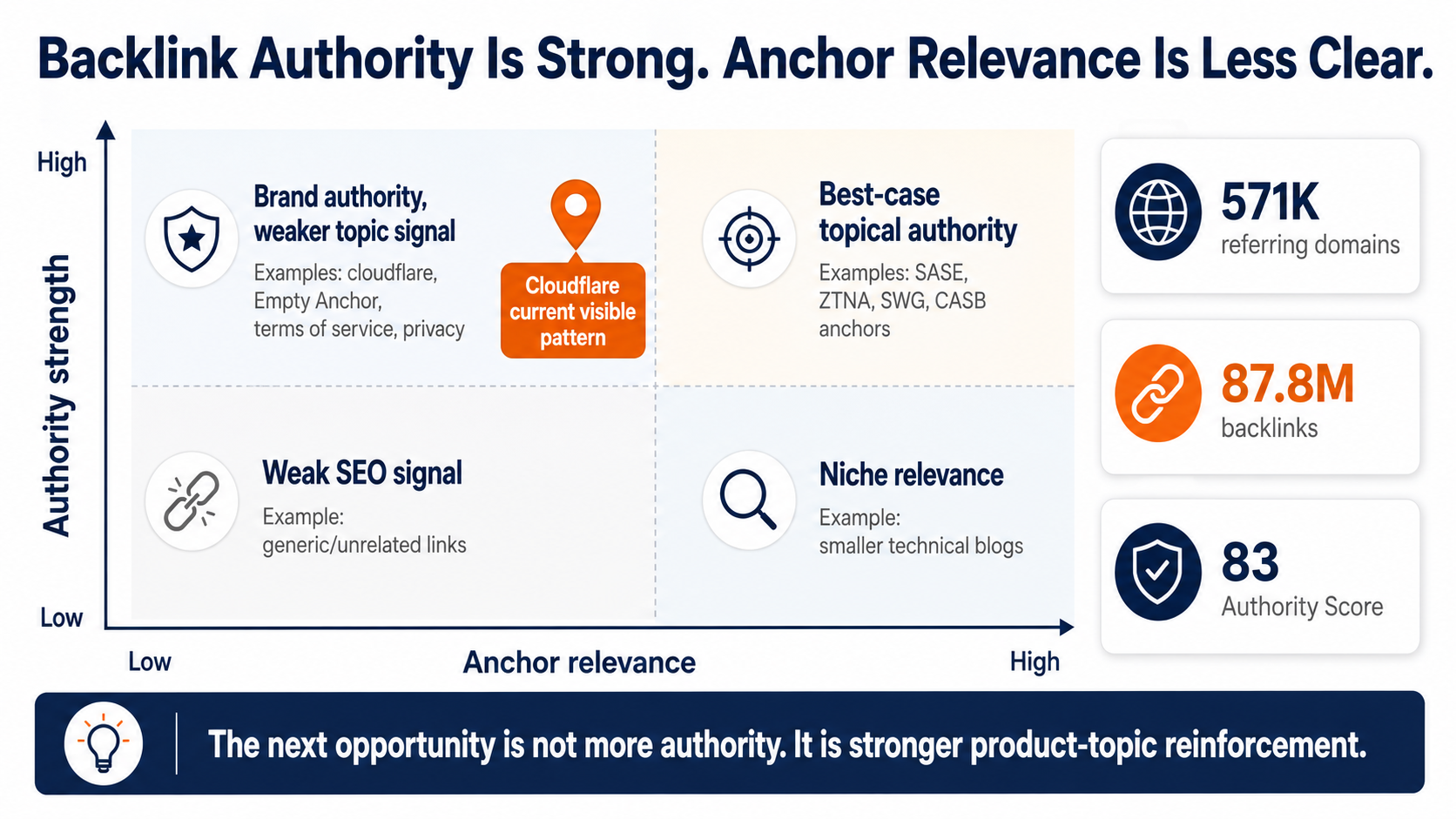
Backlink conclusion:
Cloudflare does not need more authority in general. The question is whether enough authority is pointed with product-relevant anchors to SASE, ZTNA, SWG, CASB, DLP, and AI security.
Honest critique
Cloudflare’s page is strong, but not perfect. The critique is important because a teardown with no criticism reads like sponsored content.
Improvement opportunities
| Issue | Evidence | Severity | Why it matters | Recommendation |
|---|---|---|---|---|
| /sase/ depends heavily on navigational traffic | 472 of 482 traffic is navigational | High | New-market discovery may rely on other pages | Build more non-brand internal links into /sase/ |
| AI messaging is ahead of ranking capture | “AI security” not top 100 | High | Page leads with AI agents but does not yet own the AI security keyword | Build AI security hub and supporting pages |
| CASB ranking is weak | CASB ranks 25 | Medium | CASB is core SASE terminology | Strengthen CASB page, internal anchors, and comparison content |
| FAQ schema not confirmed | FAQ exists, schema not supplied | Medium | FAQ content may not be fully machine-readable | Add FAQPage schema if not already implemented |
| Top-anchor relevance is unclear | Top anchors are branded, legal, and generic | Medium | Link authority may not reinforce SASE relevance | Improve internal anchor text toward SASE modules |
The biggest strategic gap is AI security. Cloudflare’s page is already talking about AI agents, MCP servers, and prompt analysis. The SEO footprint should now catch up.
Master Trust Scorecard
Statistical trust scorecard
| Trust pillar | Score | Key evidence | Metric | What a weak page loses |
|---|---|---|---|---|
| Security-specific positioning | 9.5 | Workforce, AI agents, infrastructure | 3 protected surfaces | Buyer relevance |
| AI-agent relevance | 8.5 | GenAI, MCP, prompt analysis | AI security not top 100 | Future-risk credibility |
| Analyst validation | 9 | Gartner + Forrester | 3 proof points | Third-party confidence |
| Technical taxonomy | 9 | ZTNA, SWG, CASB, DLP, DEM | 8+ modules | Technical believability |
| Use-case clarity | 8.5 | AI, remote access, phishing, browsing, networking | 5 use cases | Buyer interpretation speed |
| Documentation links | 8.5 | Docs + reference architecture | 2 technical paths | Engineering validation |
| Topical authority | 9 | 72 SASE pages, 1,022 keywords | 5,185 traffic | Ecosystem trust |
| CTA intent match | 8.5 | Talk + try + docs | 2 primary CTA intents | Conversion path fit |
| Total | 70.5 / 80 | Strong distributed trust model | 88.1% | Weak pages rely on claims |
Interactive self-audit
Can Your Cybersecurity Page Convert a Skeptical Buyer?
Use this quick checklist to see whether your cybersecurity landing page has enough proof to convert enterprise and technical buyers.
Select the proof signals your cybersecurity page already has. Your trust score will update automatically.
Final summary
So, what trust signals should a cybersecurity SEO or technical B2B page include before a buyer feels safe enough to convert?
It needs measurable authority, specific security positioning, analyst validation, named technical modules, use-case clarity, documentation links, quantified proof, and conversion paths for both enterprise buyers and technical evaluators.
Cloudflare’s /sase/ page works because trust is not isolated on one landing page. The page captures only 9.3% of SASE section traffic, but it sits inside a 72-page, 1,022-keyword SASE ecosystem supported by domain authority, educational rankings, product pages, docs, analyst validation, and measurable outcome proof.
The next trust frontier is AI-agent security. Pages that only say “AI-powered” will look thin. Pages that explain how AI agents, prompts, permissions, and data flows are secured will earn the next layer of buyer trust.
Sources referenced
FAQ
What trust signals matter most on a cybersecurity landing page?
The strongest trust signals are authority, third-party validation, technical product taxonomy, documentation links, customer outcomes, clear use cases, and proof that the vendor understands current risks such as AI agents, shadow AI, phishing, data loss, and remote access.
Why does Cloudflare’s SASE page work as a trust page?
Cloudflare’s SASE page works because it combines page-level proof with ecosystem-level authority. The /sase/ page has 482 traffic and 48 keywords, but the broader SASE section has 72 pages, 5,185 traffic, and 1,022 keywords.
What is the biggest SEO gap in Cloudflare’s SASE trust model?
The biggest gap is AI security. The page strongly positions AI agents and GenAI security, but the supplied keyword data shows Cloudflare is not in the top 100 for “AI security.”
How does analyst validation affect B2B cybersecurity conversion?
Analyst validation reduces perceived buyer risk. Gartner and Forrester proof helps security leaders, procurement teams, and technical evaluators justify vendor consideration internally.
What is a trust teardown in SEO?
A trust teardown evaluates whether a page gives buyers enough evidence to convert. It reviews authority, rankings, backlinks, page copy, proof points, CTAs, technical depth, and the content ecosystem supporting the page.
Why are documentation links important on cybersecurity pages?
Documentation links let technical buyers validate implementation before speaking to sales. For cybersecurity products, this reduces architecture risk, integration doubt, and engineering friction.
- Log in to post comments


 INDIA
INDIA