


The High-Intent Page Portfolio Model: A B2B SEO Framework for Pipeline, Not Traffic
As part of Supramind Digital’s B2B SEO methodology library, the High-Intent Page Portfolio Model shows how a B2B SEO company can turn commercial search demand into a structured mix of service, industry, use-case, comparison, and FAQ pages. It is built for B2B founders, in-house marketing teams, demand-generation leaders, and SEO strategists who want to grow qualified pipeline instead of relying on blog volume alone.
High-Intent Page Portfolio Model snapshot
This framework explains how commercial search demand and buyer decisions work together across five connected page types: Service, Industry, Use Case, Comparison, and FAQ, supported by CRO and internal linking.
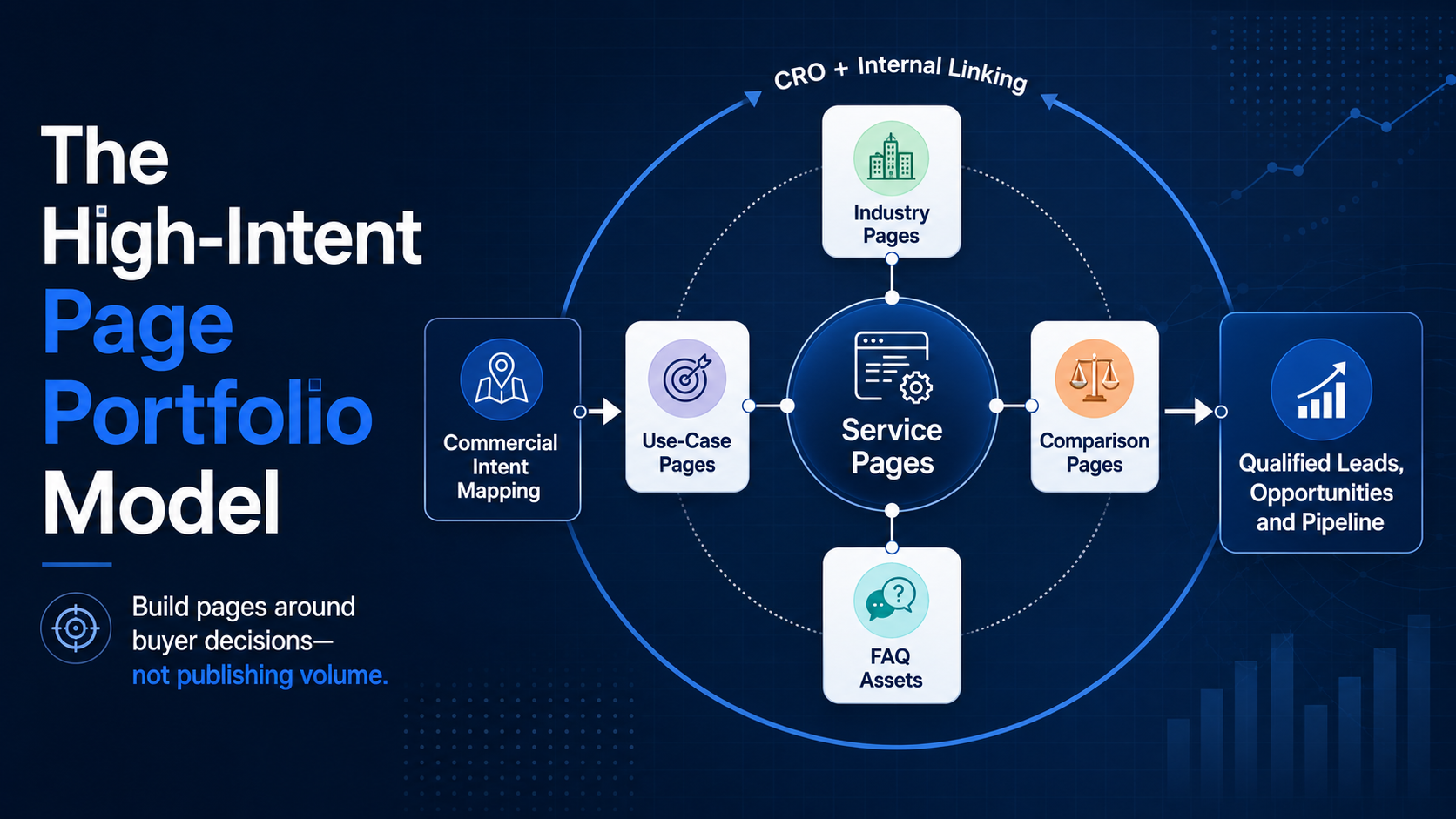
The High-Intent Page Portfolio Model is a B2B SEO framework that maps commercial search demand to interconnected service, industry, use-case, comparison and FAQ pages designed to influence pipeline—not simply generate traffic.
It is built for founders, marketing leaders and demand-generation teams replacing a blog-first calendar with a buyer-intent portfolio.
Why “More Blogs” Is Failing B2B SEO
Publishing more informational articles is no longer a dependable growth strategy on its own. In the first four months of 2026, 68.01% of US Google searches ended without a click, up from 60.45% in 2024 (SparkToro, 2026). Ahrefs also found that an AI Overview correlates with a 58% lower average click-through rate for the top-ranking result (Ahrefs, 2026).
Buyer behaviour creates a second pressure. First seller contact often happens roughly two-thirds of the way through a B2B purchase process (6sense, 2025). Gartner reports that 67% of buyers prefer a rep-free experience and 45% used AI during a recent purchase (Gartner, 2026). Informational content still matters, but it must route buyers toward pages that help them confirm fit, evaluate solutions and take action.
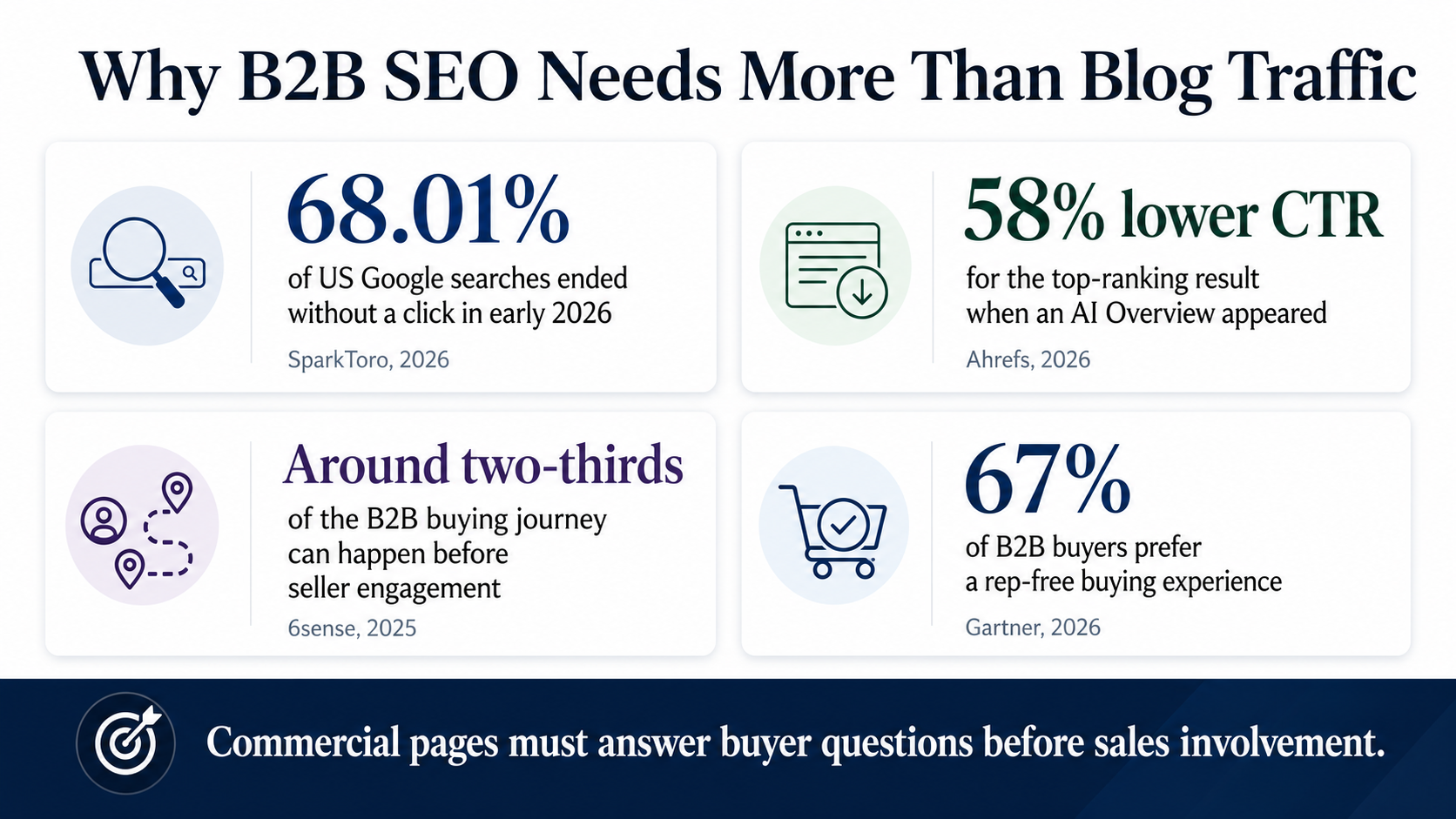
Commercial pages must answer buyer questions before sales involvement.
Published page-type benchmarks reinforce the distinction: application or use-case pages average 3.1%, service pages 2.7%, problem-solution and FAQ pages 2.7%, blog posts 2.0%, industry pages 1.8%, and broad hub pages 0.5% (First Page Sage, 2025). These are directional benchmarks rather than universal guarantees, but they show why traffic should not be treated as economically equal.
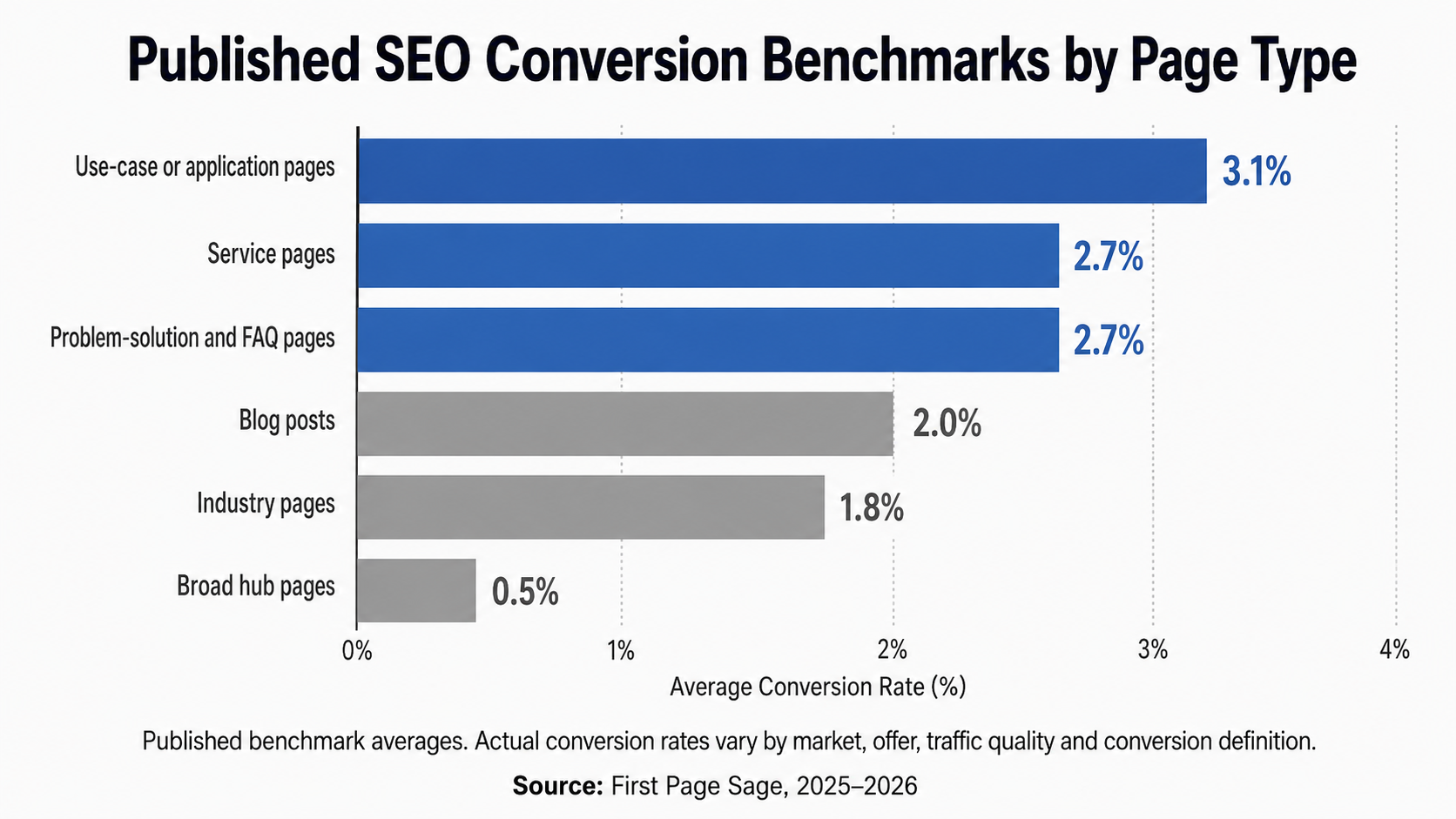
Published averages vary by market, offer, traffic quality and conversion definition.
The Portfolio at a Glance
| Page Type | Buyer Question | Suggested Share | Primary KPI |
|---|---|---|---|
| Service | Can this provider deliver the solution? | 25% | Qualified leads |
| Industry | Does the provider understand our sector? | 15% | Industry-qualified opportunities |
| Use case | Can the solution handle this specific job? | 25% | Assisted pipeline |
| Comparison | How does this option compare? | 20% | Demo or trial starts |
| FAQ | What must we clarify before proceeding? | 15% | Assisted conversions |
In our model, service and use-case pages receive the largest allocation because they connect identifiable demand with a solution. Comparison pages deserve meaningful investment too: “versus” keywords average 373.4 monthly searches, KD 23 and CPC $8.28, while “alternatives” queries average 128.8 searches, KD 17.1 and CPC $14.70 (Minuttia, 2024–2025).
Plan the starting portfolio: enter your services, industries, use cases, competitors and recurring buyer questions to estimate the page mix.
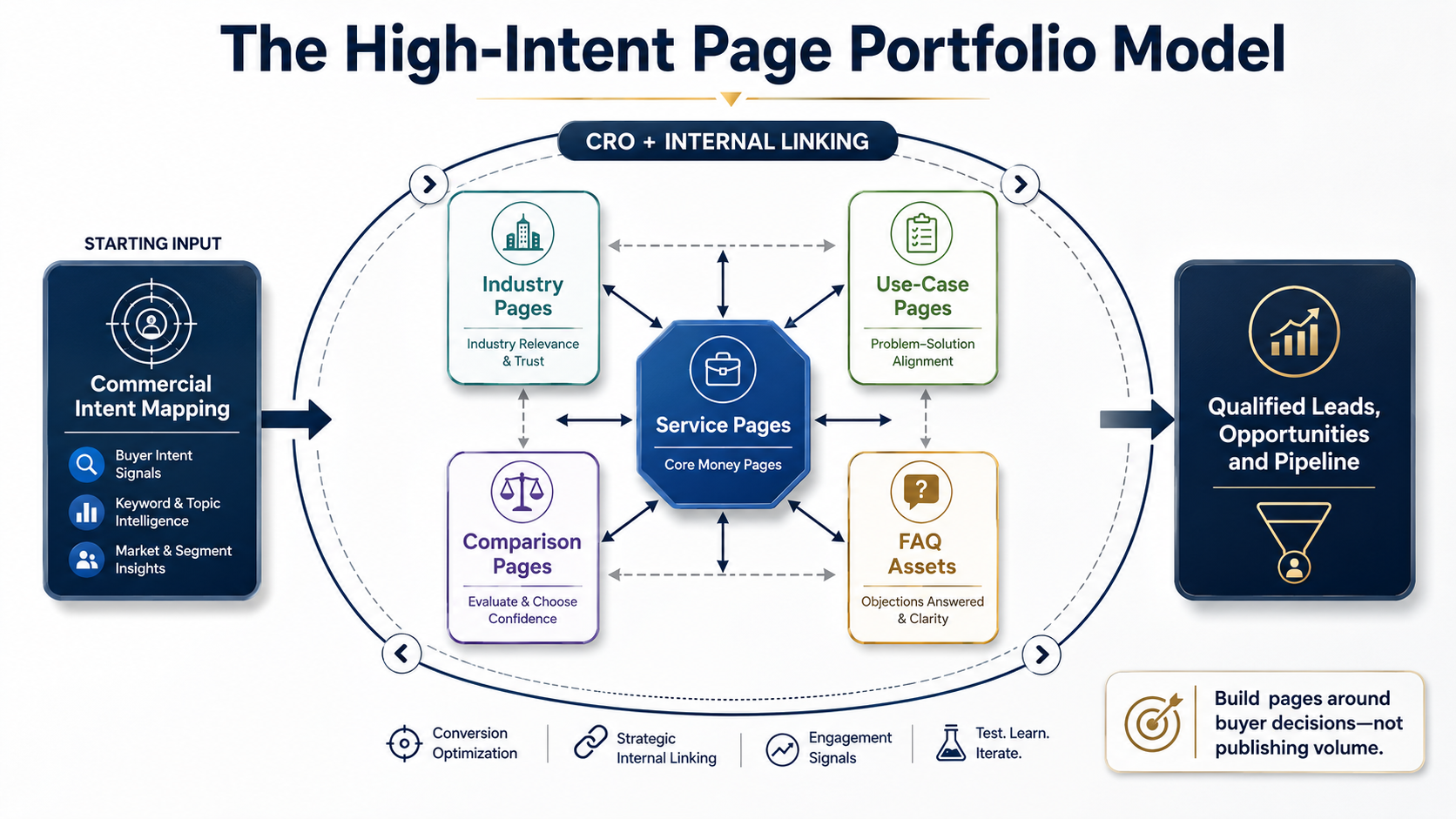
Service pages form the commercial centre; CRO and internal linking connect the portfolio.
High-Intent Page Portfolio Planner
Estimate a minimum viable mix of commercial-intent pages for your B2B website.
Method: one starting page per distinct service, priority industry, important use case and major comparison; FAQ assets group approximately five to eight related questions. No data is transmitted.
Recommended starting portfolio
What to build first
Planning methodology—not a universal quota. Validate every page against search demand, sales evidence, existing URL quality and cannibalisation risk.
Step 1 — Commercial Intent Mapping
Start with the language buyers already use. Mine Google Search Console, paid-search conversion terms, CRM opportunity notes, sales-call transcripts, competitor commercial pages, review platforms, “best,” “versus” and “alternatives” searches, and prompts used in AI-assisted research.
| Score | Intent | Recommended Page |
|---|---|---|
| 1 | General learning | Informational resource |
| 2 | Problem awareness | FAQ or guide |
| 3 | Solution exploration | Use-case page |
| 4 | Provider or industry evaluation | Service or industry page |
| 5 | Vendor selection | Comparison or conversion page |
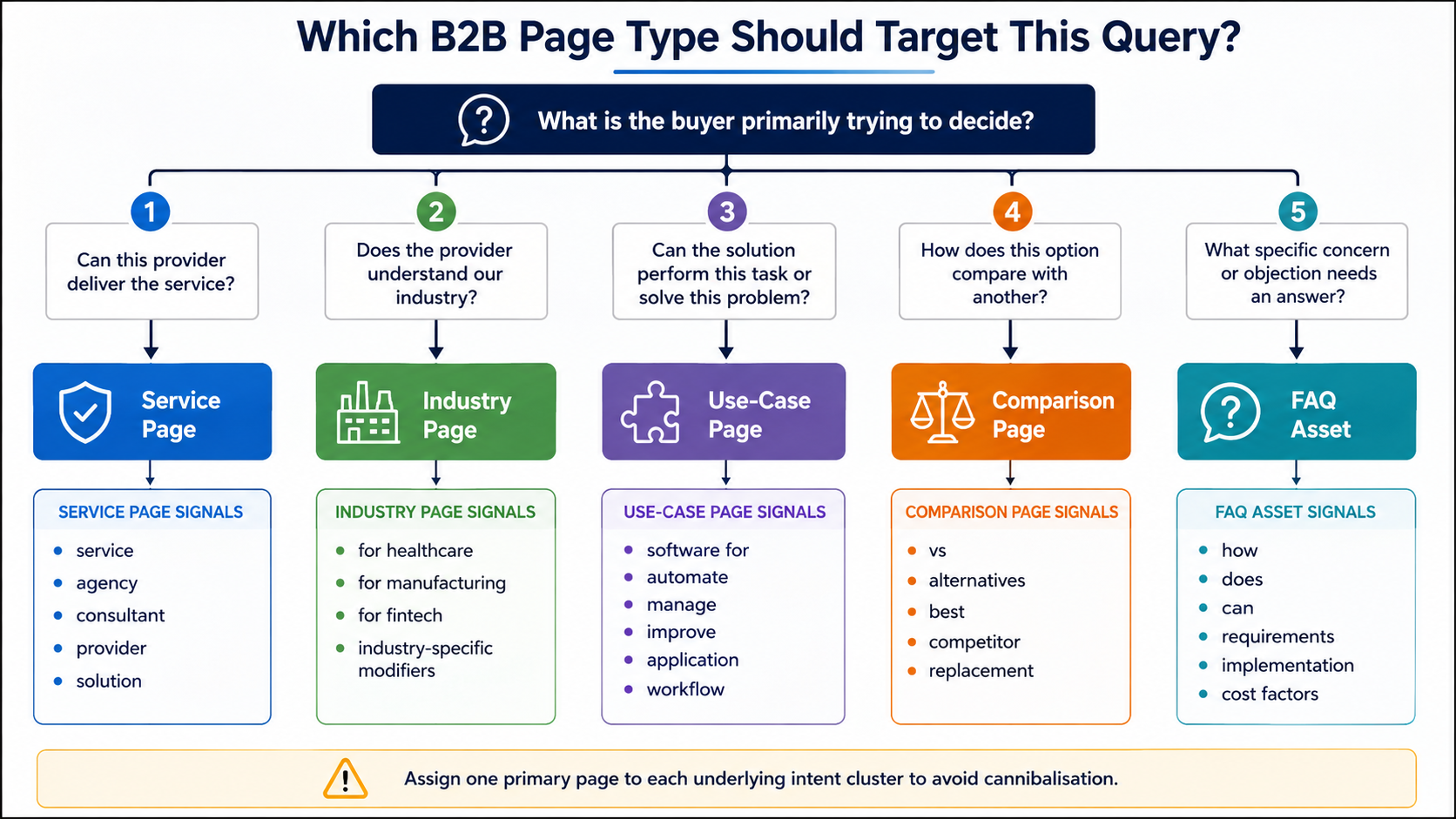
Assign one primary page to each underlying intent cluster to reduce cannibalisation.
The Five High-Intent Page Types
Each page family has a different job. A service page proves delivery capability; an industry page proves contextual fit; a use-case page connects a job to the solution; a comparison page supports vendor evaluation; and an FAQ asset resolves a narrow objection. Treating them as interchangeable usually produces generic copy and unclear conversion paths.
The Five High-Intent Page Types
Compare each page family’s purpose, anatomy, risk and measurement role.
Service Pages
Explain what the company delivers, for whom, and why it is credible.
H1, buyer fit, problems solved, scope, process, proof, FAQs and focused CTA.
Combining every capability into one generic Services page.
Qualified consultations, demos or proposals.
Approximately 2.7% published SEO conversion benchmark.
Industry Pages
Demonstrate understanding of a specific sector’s risks, workflows and buying criteria.
Industry challenge, relevant services, requirements, proof, use cases and CTA.
Changing only the industry name while reusing identical copy.
Industry-qualified opportunities.
Approximately 1.8% published SEO conversion benchmark.
Use-Case Pages
Connect a specific task or business problem to the solution.
Problem, workflow, solution approach, outcomes, implementation, proof and CTA.
Turning the page into another feature overview.
Assisted pipeline and movement to service or product pages.
Approximately 3.1% published SEO conversion benchmark.
Comparison Pages
Help shortlisted buyers evaluate products, providers or approaches.
Answer-first summary, comparison table, strengths, limitations, fit, migration and CTA.
Publishing an obviously biased comparison.
Demo starts, competitor displacement and influenced opportunities.
Versus keywords average 373.4 monthly searches, KD 23 and CPC $8.28. Alternatives keywords average 128.8 searches, KD 17.1 and CPC $14.70.
FAQ Assets
Resolve narrow questions and objections that delay conversion.
Natural question headings, concise answers, lists, tables and contextual links.
Creating generic accordion content only for schema.
Assisted conversions and clicks into commercial pages.
Schema alone does not guarantee AI citations.
The Internal Linking and CRO Layer
Service pages should sit at the commercial centre. Industry pages link to relevant services. Use-case pages link to the solution that enables the outcome. Comparison pages connect to services, migration guidance, proof and FAQs. FAQ assets route objections toward the correct next-stage page.
Google states that links help it discover pages and understand relevance (Google Search Central). In enterprise case studies, seoClarity reports a 23% increase in traffic to top sales pages, 24% organic growth and a 100% increase in discovered keywords after internal-link improvements (seoClarity, 2024). These are case-study outcomes, not guarantees, but they show why money pages should not remain isolated.
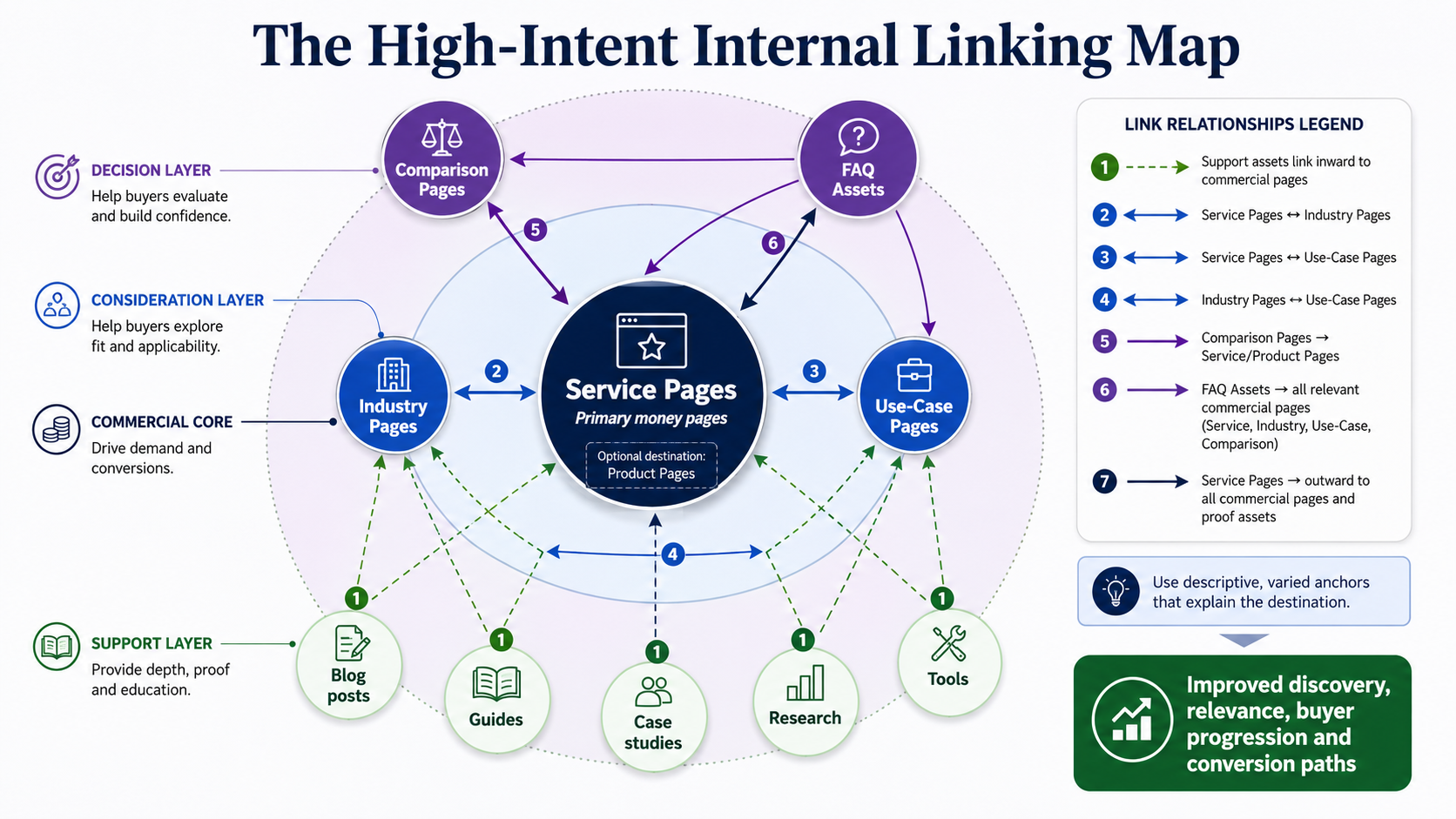
Use descriptive, varied anchor text that explains the destination.
Match the CTA to page intent
| Page Type | Primary CTA | Supporting Action |
|---|---|---|
| Service | Request a consultation | View process or proof |
| Industry | Discuss industry requirements | View relevant use cases |
| Use case | See the solution in action | Review implementation guidance |
| Comparison | Compare options or start a trial | View migration or fit criteria |
| FAQ | Continue to the relevant solution | Contact an expert |
90-Day Implementation Sequence
Weeks 1–2: mine commercial queries, score intent and audit gaps or cannibalisation. Weeks 3–4: improve priority service pages with proof, qualification content and measurable CTAs. Weeks 5–8: build industry and use-case pages, then connect relevant proof and internal links. Weeks 9–12: publish comparison pages, add FAQ assets and complete CRO and performance tracking.
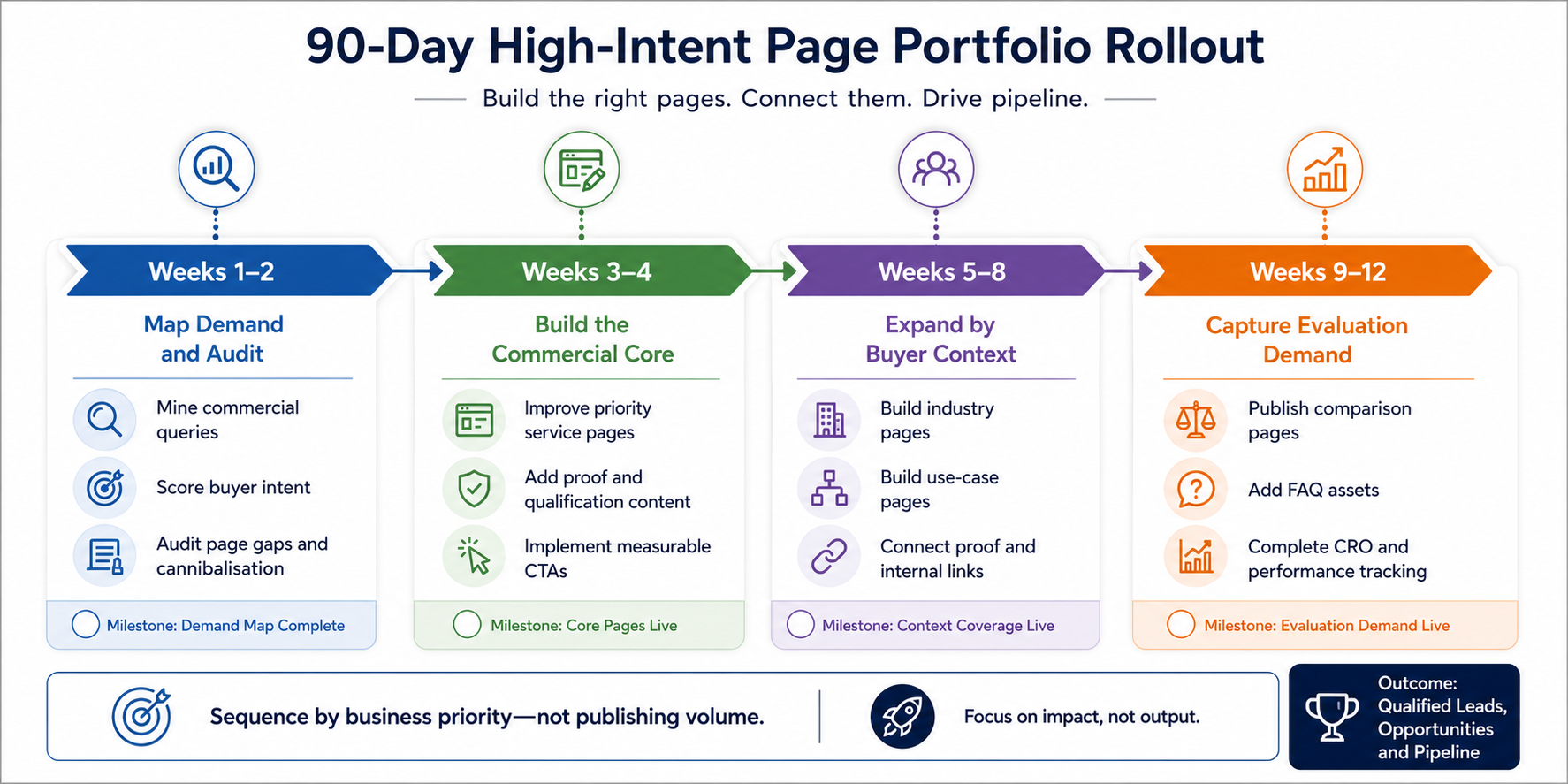
Sequence by business priority—not publishing volume.
Frequently Asked Questions
How many service pages does a B2B website need?
Create one page for each commercially distinct service with its own audience, scope, search demand and conversion path. Avoid separate pages for minor variations that answer the same buyer question.
Should B2B companies stop publishing blogs?
No. Blogs remain useful for education, authority and link acquisition. Their role should be to support commercial pages rather than operate as an isolated traffic programme.
What is the difference between an industry page and a use-case page?
An industry page is organised around a market, such as healthcare or manufacturing. A use-case page is organised around a task or outcome, such as automating compliance reviews.
Do comparison pages work for B2B SEO?
Yes. Comparison and alternatives searches often have modest volume but strong commercial intent, high CPC and relatively attainable keyword difficulty.
Do FAQ pages improve AI visibility?
They can when answers are concise, visible, well structured and supported by credible information. Schema markup alone does not guarantee citations.
How should this portfolio be measured?
Track qualified leads, opportunities, pipeline influence, assisted conversions and movement between page types—not only traffic and rankings.
Audit Your Existing Page Portfolio
The portfolio count is only the starting point. Use the coverage heatmap to evaluate whether each commercial topic has the right page family, intent alignment, proof, conversion path and internal links.
Page Portfolio Coverage Heatmap
Assess whether your commercial page portfolio covers the buyer decisions that matter.
Scoring: page status contributes 35%; intent alignment 20%; proof, conversion path and internal links 15% each. Priority weights the overall result. Progress is saved only in local browser storage.
| No. | Topic or Cluster | Page Family | Existing URL | Page Status | Intent Alignment | Proof Included | Conversion Path | Internal Links | Priority | Action |
|---|
Changes are saved automatically in this browser. No data is transmitted.
Gaps by page family
Colour-coded coverage matrix
| Topic | Family | Status | Intent | Proof | Conversion | Links | Priority | Score |
|---|
Top five recommended actions
Final Summary
The High-Intent Page Portfolio Model turns a general B2B SEO strategy into a commercial page system. It gives SEO for B2B companies a clearer investment logic: map demand, build the right page type, connect it to proof and next-stage content, and measure qualified pipeline rather than raw publishing output.
For teams comparing a B2B SEO consultant with a full-service agency—or trying to improve AI search visibility for B2B—the central question is the same: does the website answer the decisions buyers make before they contact sales?
Sources
- SparkToro, “In 2026, Less than One Third of Google Searches Still Send a Click,” June 8, 2026.
- Ahrefs, “Update: AI Overviews Reduce Clicks by 58%,” February 4, 2026.
- 6sense, “B2B Buyers Are Even Less of a Blank Slate Than We Thought,” 2025.
- Gartner, “67% of B2B Buyers Prefer a Rep-Free Experience,” March 9, 2026.
- First Page Sage, “Average SEO Conversion Rate by Page Type,” August 15, 2025.
- Minuttia, “The Truth About Comparison Keywords,” 2024–2026 update. See also the alternatives keyword study.
- Google Search Central, “SEO Link Best Practices for Google.”
- seoClarity, “5 Internal Linking Case Studies of Increased Visibility and Opportunity,” 2024.
Build a B2B SEO portfolio around pipeline—not page count
Supramind Digital helps B2B brands map commercial intent, strengthen money pages, connect proof and measure qualified demand across global markets.
Explore B2B SEO Services- Log in to post comments


 INDIA
INDIA