


Google Plus Answer-Surface Architecture Framework
As part of Supramind Digital's B2B SEO services methodology library, this framework explains how classic search eligibility and answer-surface fitness work together. It is built for a B2B SEO agency, in-house search team, content strategist, or technical SEO lead that needs a defensible way to improve visibility without relying on unsupported “AI SEO” shortcuts.
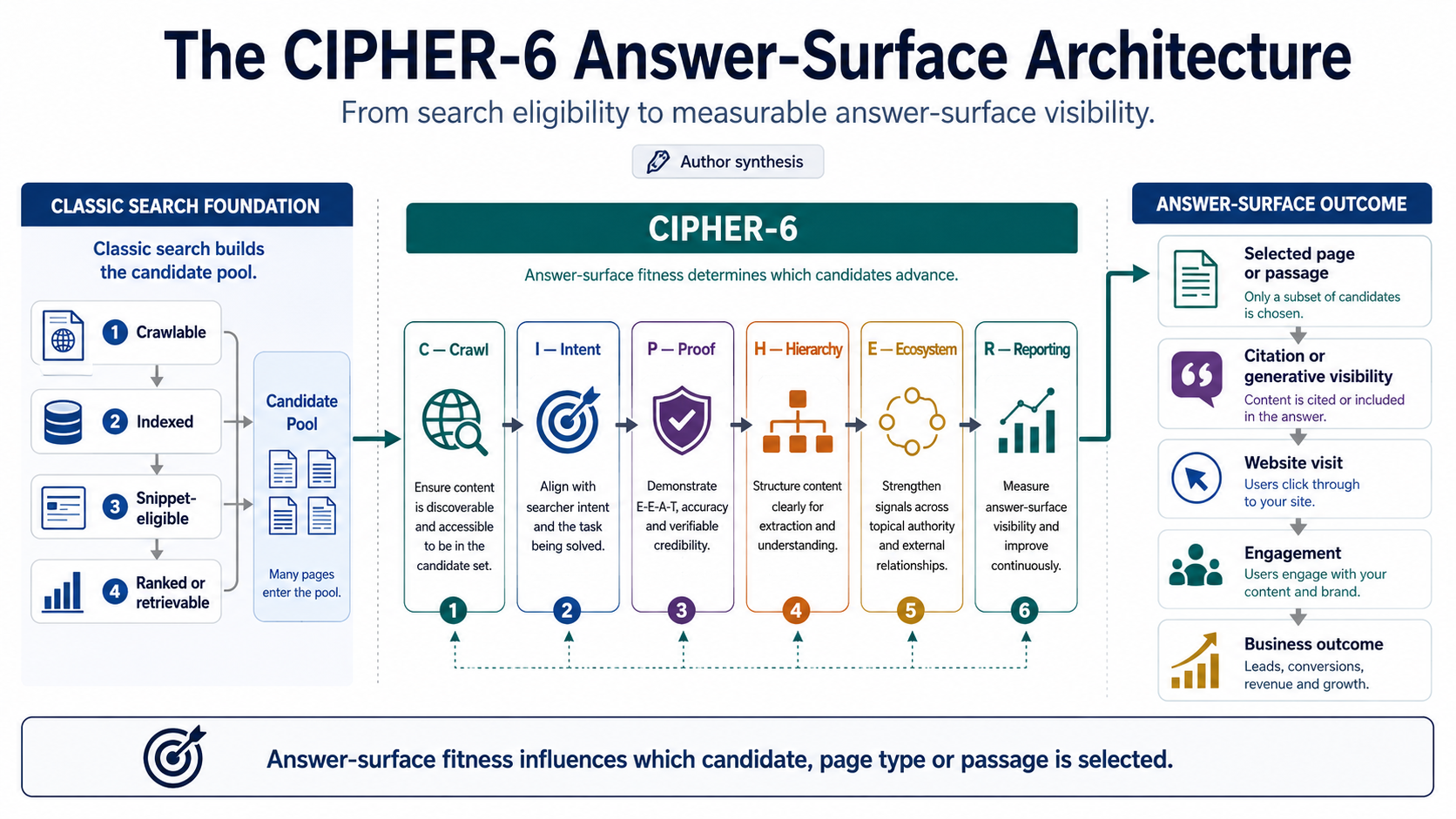
Google Plus answer-surface architecture snapshot
This framework explains how classic search eligibility and answer-surface fitness work together across six connected layers: Crawl, Intent, Proof, Hierarchy, Ecosystem, and Reporting.
Terminology note: “Google Plus” in this article means Google Search plus answer surfaces such as AI Overviews and AI Mode. It does not refer to the former Google+ social network.
Answer-Surface Architecture in One Box
What is answer-surface architecture?
Answer-surface architecture is the system that makes a page eligible for search, matched to the right task, worth citing, easy to extract, internally reinforced, and measurable. The six-layer CIPHER-6 model covers Crawl eligibility, Intent specialization, Proof, Hierarchical clarity, Ecosystem reinforcement, and Reporting.
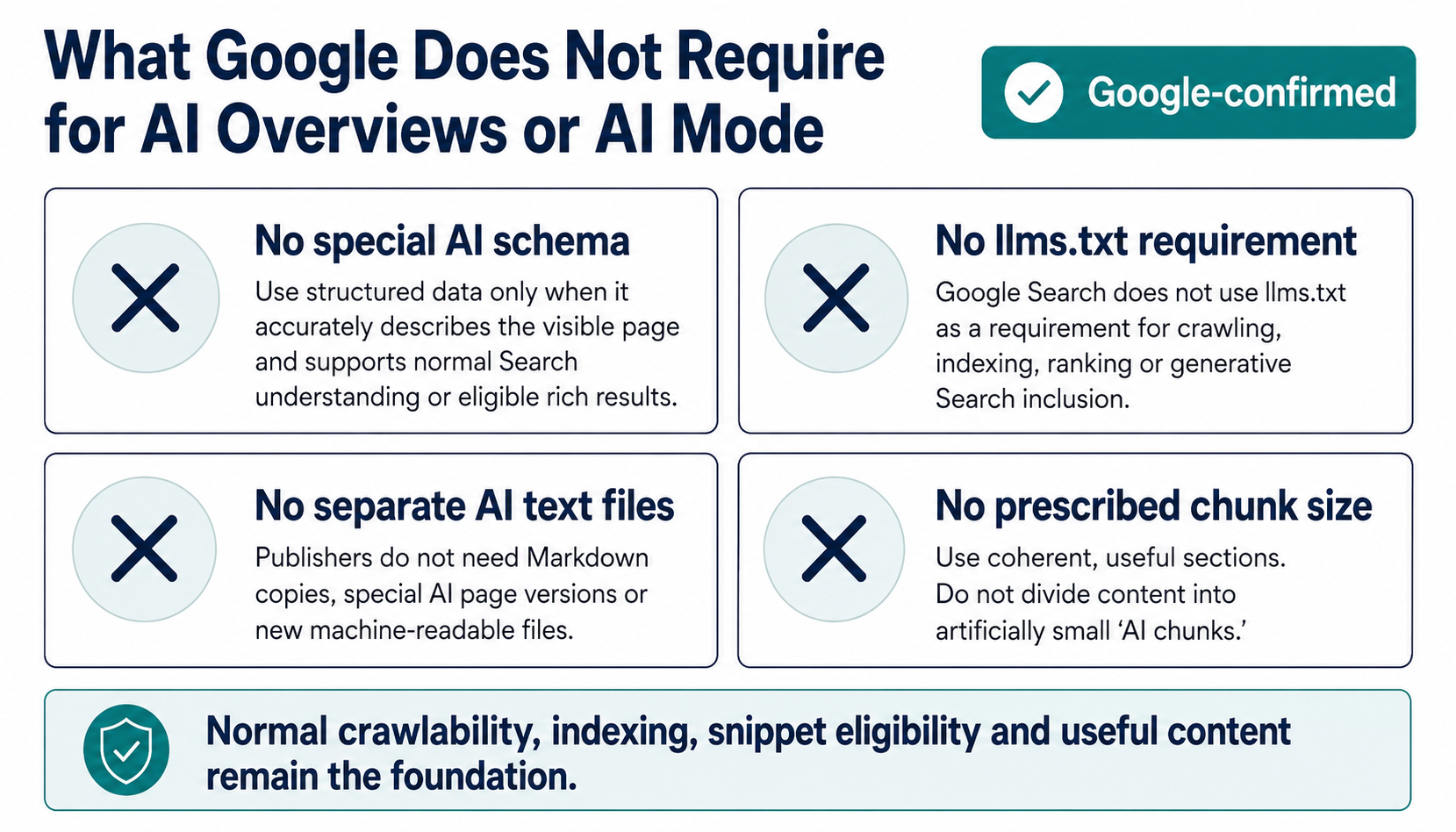
Google confirms that AI Overviews and AI Mode use Search infrastructure. Supporting pages must be indexed and snippet-eligible, but they do not need special AI schema, llms.txt, separate AI text files, or prescribed “AI chunks.” Classic SEO therefore creates the candidate pool; answer-surface fitness influences which page or passage is selected.[1][2]
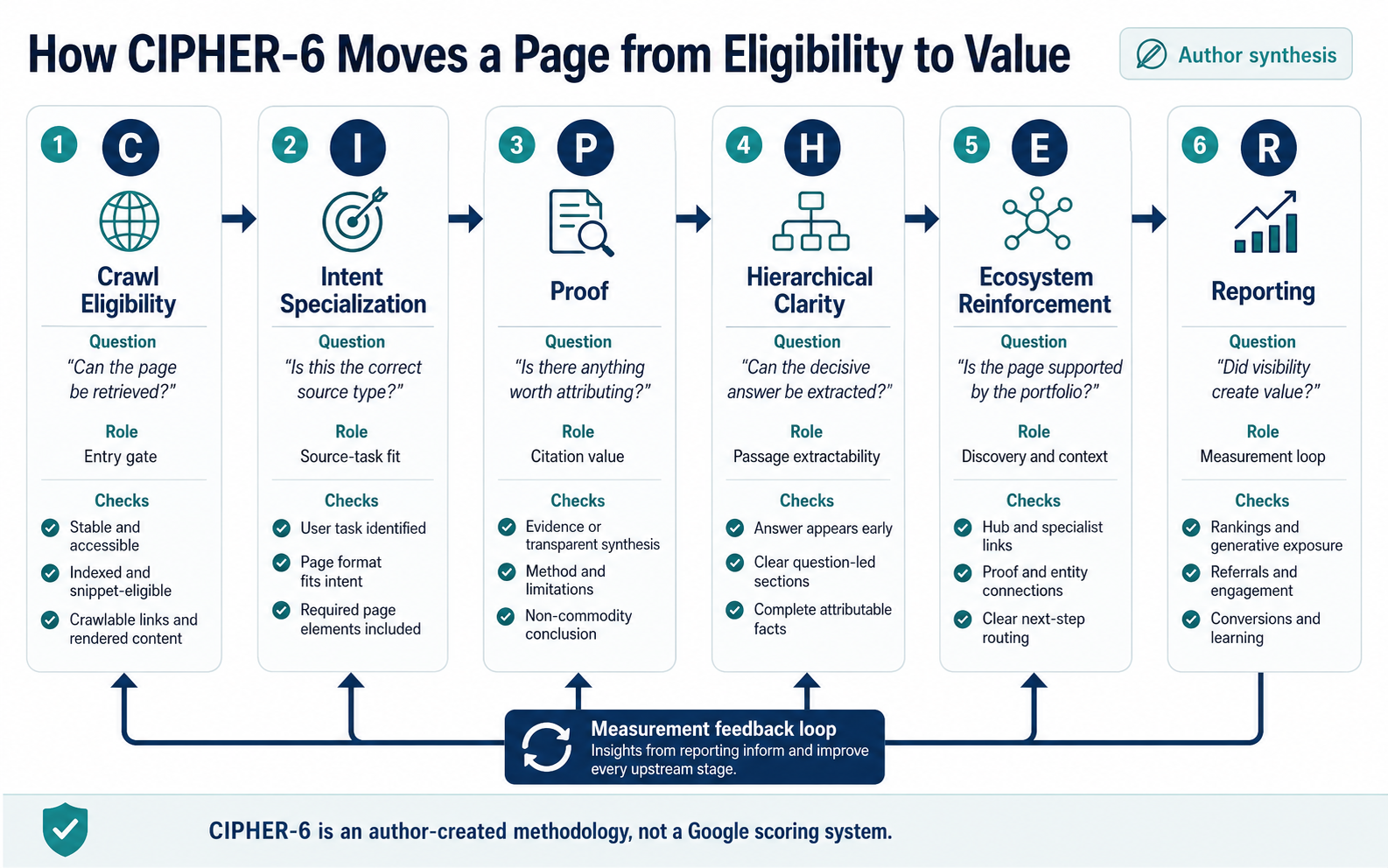
The CIPHER-6 Synthesis Matrix
The matrix combines official platform requirements, the strongest relevant statistics in the research set, classic-search payoff, answer-surface payoff, and editorial effort. The figures describe different datasets and should not be treated as additive causal weights.
| Layer | Core job | Strongest evidence in the report | Classic-search payoff | Answer-surface payoff | Effort to impact |
|---|---|---|---|---|---|
| C — Crawl | Make the page retrievable. | Google-confirmed eligibility gate; Semrush reviewed five million cited URLs.[1][16] | Discovery, rendering and canonical clarity. | Required for Google citation eligibility. | Medium to high |
| I — Intent | Match page type to task. | Across 1,056,727 citations, intent predicted the cited page type.[7] | Stronger intent fit and less cannibalization. | Better source fit for seed and fan-out tasks. | High to high |
| P — Proof | Add evidence worth attributing. | Cited pages averaged 31% fact coverage versus 24% for non-cited pages.[10] | Differentiation, trust and link-worthiness. | Distinct facts, methods and claims to ground. | High to high |
| H — Hierarchy | Expose the decisive passage. | Clarity was 32.83% more prevalent; 38% of analysed citations came from the first 100 words.[8][11] | Passage relevance, usability and clearer snippets. | Easier extraction and attribution. | Medium to high |
| E — Ecosystem | Connect hubs, proof and decisions. | Smaller high-AI-visibility sites showed approximately two times stronger internal linking.[9] | Crawl paths, hierarchy and contextual authority. | A broader retrievable portfolio. | Medium to medium |
| R — Reporting | Separate exposure from outcomes. | Generative reports launched June 3, 2026; linked data has an approximate 48-hour delay and 16-month retention.[3][4] | Query-to-conversion diagnosis. | Exposure, referral and value measurement. | Low-medium to high |
Editorial qualification: Effort and impact are prioritization judgments. They are not measured lift percentages.
The Six CIPHER-6 Layers: What Should Be Fixed?
Crawl
Eligibility gate
Intent
Source-task fit
Proof
Attributable value
Hierarchy
Passage clarity
Ecosystem
Portfolio reinforcement
Reporting
Outcome learning
How Do You Make a Page Eligible to Be Retrieved?
Fix technical eligibility before rewriting. For Google's AI features, indexation and normal snippet eligibility are prerequisites.[1][2]
- Confirm a stable 200 response, a preferred canonical, and no accidental
noindex,nosnippet,max-snippet:0, X-Robots-Tag, authentication, geo restriction, or WAF block. - Expose important navigation and pagination through crawlable
<a href>links rather than button-only or user-triggered JavaScript.[5] - Inspect rendered HTML so the answer, evidence, tables, author details, and internal links are present after rendering.
For AI answer surfaces versus classic search, this changes technical SEO from an efficiency issue into an eligibility gate.
Which Page Type Should Answer the User's Task?
Assign one dominant job to each page. The format should match whether the user wants to learn, compare, buy, verify, or act.[7]
- Map informational tasks to explainers or how-to guides, commercial tasks to comparisons, transactional tasks to product or service pages, and entity verification to profile or About pages.
- Include the visible elements the task needs: comparison criteria, limitations, specifications, price, availability, scope, process, proof, or qualification rules.
- Use structured data only when it accurately describes visible content. Schema can reduce ambiguity and support eligible rich results; it is not an AI-citation shortcut.[1][14][15]
For AI answer surfaces versus classic search, this changes the unit of optimization from one universal page into an intent-matched portfolio.
What Makes a Page Worth Citing?
Add a claim, method, calculation, or decision aid that a generic summary cannot replace. Google's guidance emphasizes original analysis, unique viewpoints, and non-commodity content.[2][6]
- When first-party evidence exists, publish the method, sample, dates, definitions, limitations, and negative or inconclusive findings.
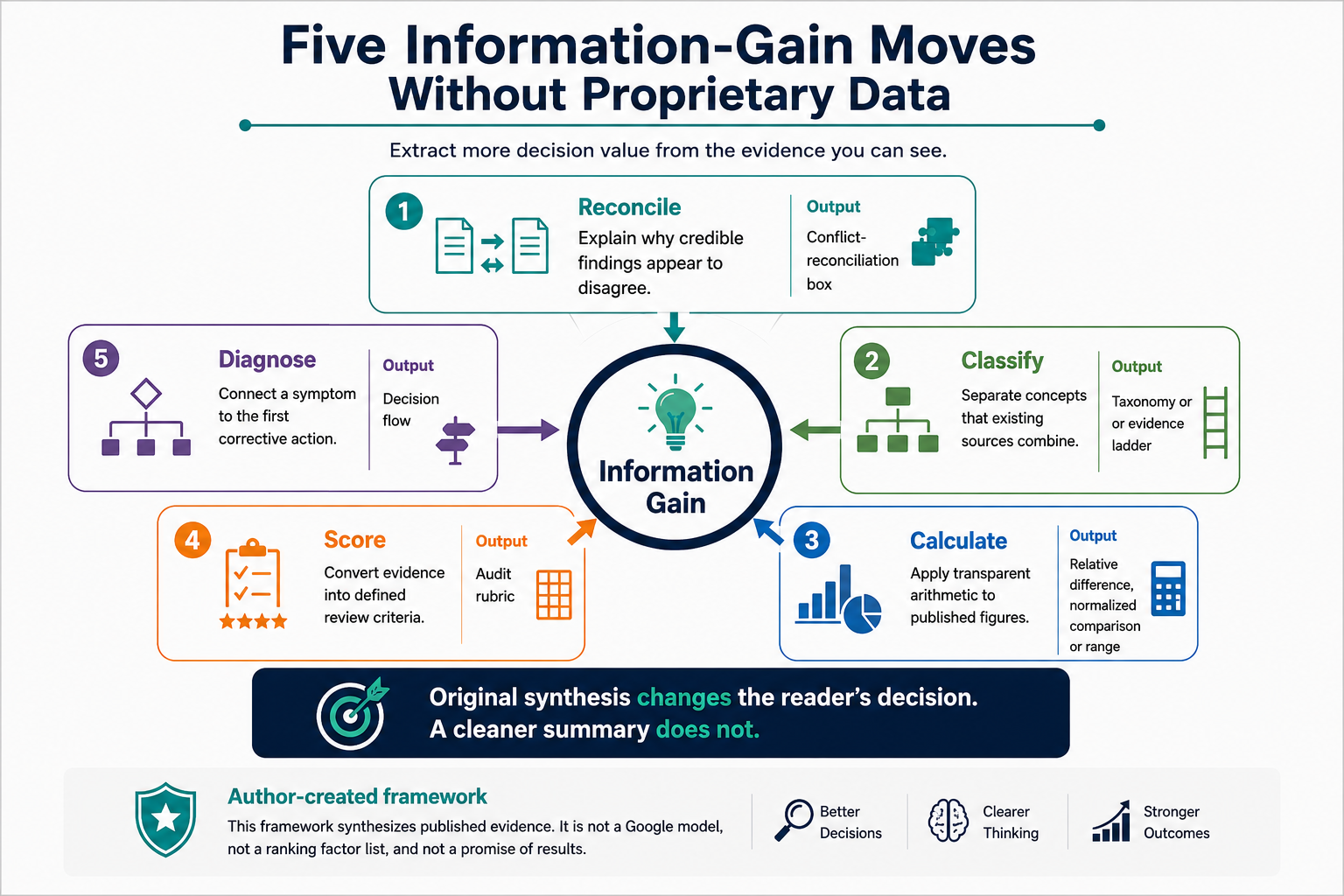
- Without proprietary data, create information gain by reconciling conflicting studies, normalizing metrics, making transparent calculations, or defining a useful taxonomy.
- Convert synthesis into a practical asset: a score, matrix, evidence ladder, decision tree, or boundary condition. Label interpretation as interpretation.
For AI answer surfaces versus classic search, this changes “comprehensive content” into attributable distinctiveness.
How Should the Answer Be Structured for Extraction?
State the answer early, then organize proof into coherent sections. Google does not require artificial “AI chunks.”[2]
- Open with the conclusion or definition and state conditions when the answer is not universal.
- Use question-led headings and answer each one immediately before adding context, exceptions, or examples.
- Use complete factual sentences, explicit comparison criteria, concise tables, named entities, dates, visible authorship, and accurate markup.
For AI answer surfaces versus classic search, this changes structure from scanability alone into passage-level extractability.
How Should Internal Links Reinforce the Portfolio?
Use links to reveal relationships, not to manufacture a citation signal. Google confirms that crawlable links support discovery and context.[5]
- Remove orphan pages and build bidirectional hub-to-spoke paths.
- Link commercial claims to relevant research, methodology, standards, profiles, policies, case studies, or product evidence.
- Use descriptive anchors and cross-link related specialist pages only when the relationship helps the reader.
For AI answer surfaces versus classic search, this changes internal linking from navigation alone into portfolio reinforcement.
How Should Visibility and Business Outcomes Be Measured?
Treat ranking, generative exposure, citation, click, engagement, and conversion as separate stages. One metric cannot stand in for the complete funnel.[3][4][13]
- Link Search Console and GA4, then compare pre-click query and landing-page data with engagement and conversions.
- Where available, monitor Google generative impressions, pages, countries, devices, and trends. Do not call an impression a confirmed citation or click.
- Track external answer-engine referrals and repeated prompt samples separately. A single prompt run can create false precision.
For AI answer surfaces versus classic search, this changes reporting from rank tracking into stage-by-stage diagnosis.
The Five Information-Gain Moves
For an author without first-party data, defensible originality comes from analysis design rather than invented evidence. The following moves are author-owned synthesis based on the research hierarchy.[2][6]
Reconcile
Explain why credible studies disagree. Publish the metric, denominator, date, method, and practical takeaway.
Classify
Separate concepts that existing sources combine. Publish a taxonomy, evidence ladder, or page-type map.
Calculate
Apply transparent arithmetic to published figures. Show a relative difference, range, or normalized comparison.
Score
Turn evidence into explicit review criteria. Publish a documented audit rubric rather than an unexplained number.
Diagnose
Map observable symptoms to the first layer to fix. Publish an ordered decision flow.
The CIPHER-12 Ship Score
Score each layer from 0 to 2. The suggested editorial ship threshold is 9 out of 12, with Crawl at 2 and no unsupported evidence claims. This is a governance rule, not a validated Google threshold.
| Criterion | 0 — Missing | 1 — Partial | 2 — Ship-ready |
|---|---|---|---|
| C — Crawl | Blocked or conflicting signals. | Indexable, but rendering or canonical issues remain. | Stable 200, canonical, snippet-eligible, and rendered output verified. |
| I — Intent | Page type mismatches the task. | Task partly served; key elements are missing. | Role, format, and visible elements fit the task. |
| P — Proof | Commodity summary or unsupported claims. | Sourced analysis with limited synthesis. | Primary proof or transparent secondary originality. |
| H — Hierarchy | Answer is buried; claims are hard to isolate. | Readable, but the answer or provenance is delayed. | Direct opening, question-led sections, and attributable facts. |
| E — Ecosystem | Orphaned or disconnected. | Links exist, but roles and anchors are weak. | Hub, specialists, proof, entities, and next steps connect. |
| R — Reporting | No baseline or outcome tracking. | Rankings or traffic only. | Eligibility, classic, generative, referral, engagement, and conversion tracked separately. |
Fix eligibility and page-role problems before adding more content.
The page may be useful, but major source-selection or measurement gaps remain.
Publish with documented weaknesses and a planned improvement cycle.
Maintain and monitor. A strong score still does not guarantee citation or traffic.
Diagnostic Decision Flow: Which Layer Should Be Fixed First?
- Not indexed or snippet-eligible: fix Crawl first. Do not rewrite until status codes, directives, canonicals, rendering, crawlable links, and bot access are clean.
- Indexed but not ranking: fix Intent, then Hierarchy. Confirm the user task and page type before expanding the copy.
- Ranking but not cited: fix Proof, then Hierarchy. Add a distinct claim, method, or calculation and expose the decisive passage early.
- Shown or cited but earning little traffic: fix Reporting. Verify whether the signal is an impression, citation, click, referral, or tracked session.
- Traffic without conversions: fix Intent and Reporting. Route informational visitors to the correct decision page and measure the handoff.
- Competing or orphaned pages: fix Ecosystem, then Intent. Clarify hub and specialist roles, consolidate overlap, and improve descriptive anchors.
The decision order is an original operational synthesis. Teams should test it against real site workflows and document where the sequence changes.
Stat Reconciliation: Does Ranking Predict Citation?
How can 37.1% of citations come from the top 10 while another study reports 80% from the top three?
The figures are not directly interchangeable because the studies used different measurement lenses. A conventional comparison chart would imply equivalence that the methodologies do not support.
| Study | Reported figure | What was measured | Qualification |
|---|---|---|---|
| Ahrefs, March 2026[12] | 37.1% top-10 | The same cited URL in an AI Overview and the direct-query top-10 blue links; four million AIO URLs across 863,000 SERPs. | Exact URL, direct query, blue-link ranking universe. |
| Surfer, July 2026[13] | 80% top-three | AIO citations within a broader 650,000-plus AI-answer rubric dataset. | The AIO-specific denominator and exact SERP definition were not fully disclosed in the report. |
Do not average the two percentages. They may differ by exact URL versus domain, direct query versus fan-out query, top citation versus every citation, blue links versus all SERP blocks, candidate filtering, parser, and model date. The defensible conclusion is narrower: organic strength helps a page enter the candidate pool, but seed-query rank alone does not reliably predict which URL or passage will be cited.
Final Summary: Build the Candidate Pool, Then Improve Selection Fitness
The Google Plus Answer-Surface Architecture is not a collection of GEO tricks. It is a sequential operating model: qualify the page, specialize it for the task, add attributable proof, expose the answer clearly, reinforce the supporting portfolio, and measure each outcome stage independently.
For B2B SEO, this distinction matters because ranking, retrieval, citation, referral, and conversion are related but separate events. A technically sound page may still be the wrong source type. A ranking page may still lack a distinct fact or method. A cited page may still fail to generate qualified action. CIPHER-6 gives a B2B SEO agency or in-house team a practical way to diagnose the first broken layer instead of responding to every visibility problem by publishing more copy.
The CIPHER-6 Answer-Surface Architecture treats AI visibility as a layer above normal search eligibility, not as a separate technical stack. First, technical SEO eligibility ensures a page is crawlable, indexed, rendered, and snippet-eligible. Next, page-type specialization matches the asset to the user's task. Original proof and information gain give the source a distinct fact, method, or synthesis worth attributing. Answer-first content structure exposes the decisive passage early without artificial “AI chunking.” Internal linking architecture connects hubs, specialists, proof, and conversion pages. Finally, Search Console and GA4 measurement separate ranking, generative exposure, citation, referral, engagement, and conversion. The core distinction is simple: classic SEO expands the candidate pool; answer-surface fitness influences which candidate or passage is selected.[1][2]
Frequently Asked Questions
Do I need special schema, an llms.txt, or AI text files for AI Overviews or AI Mode?
Does a top-10 ranking guarantee an AI citation?
Is an FAQ section a strong AI-citation tactic?
Does structured data improve AI citations?
Can secondary research create information gain?
Sources
- Google Search Central — AI features and your website
- Google Search Central — Optimizing your website for generative AI features
- Google Search Central Blog — Search Generative AI performance reports in Search Console
- Google Analytics Help — Connect Search Console to Google Analytics
- Google Search Central — Link best practices for Google
- Google Search Central — Creating helpful, reliable, people-first content
- Wix Studio AI Search Lab — Content types most cited by LLMs
- Semrush — Content Optimization for AI Search Study
- Wix Studio AI Search Lab — On-page factors for AI visibility
- Surfer — Key-fact coverage and AI Overview citations
- Surfer — AI citations from the first 100 words
- Ahrefs — Update: 38% of AI Overview citations pull from the top 10
- Surfer — AI Overviews Research: What Actually Gets You Cited?
- Google Search Central — General structured data guidelines
- Google Search Central — QAPage structured data
- Semrush — Technical SEO Factors and AI Search
- Log in to post comments


 INDIA
INDIA