


How to Turn AI Search Prompts Into SEO Content Pages Using the Prompt-to-Page Mapping Framework
As part of our AI SEO Services hub, this Prompt-to-Page Mapping Framework helps brands convert real AI search prompts into structured content assets. Use it to map buyer questions from ChatGPT, Perplexity, Gemini, Bing Copilot, Google AI Overviews and AI Mode into service pages, blog spokes, comparison pages, framework pages, industry pages, FAQ assets, lead magnets and conversion-focused landing pages.
The Prompt-to-Page Mapping Framework helps SEO and content teams convert raw AI search questions into a functional content architecture. Instead of relying solely on keyword lists, this framework indexes the complex questions buyers ask inside generative search tools and maps them to the ideal page type, evidence layer, internal link flow, and conversion pipeline.
This framework serves brands building authority in Generative Engine Optimization (GEO), Answer Engine Optimization (AEO), and AI visibility strategy. It systematizes decisions on when a prompt requires a comprehensive hub, support spokes, service landing pages, or high-intent lead assets.
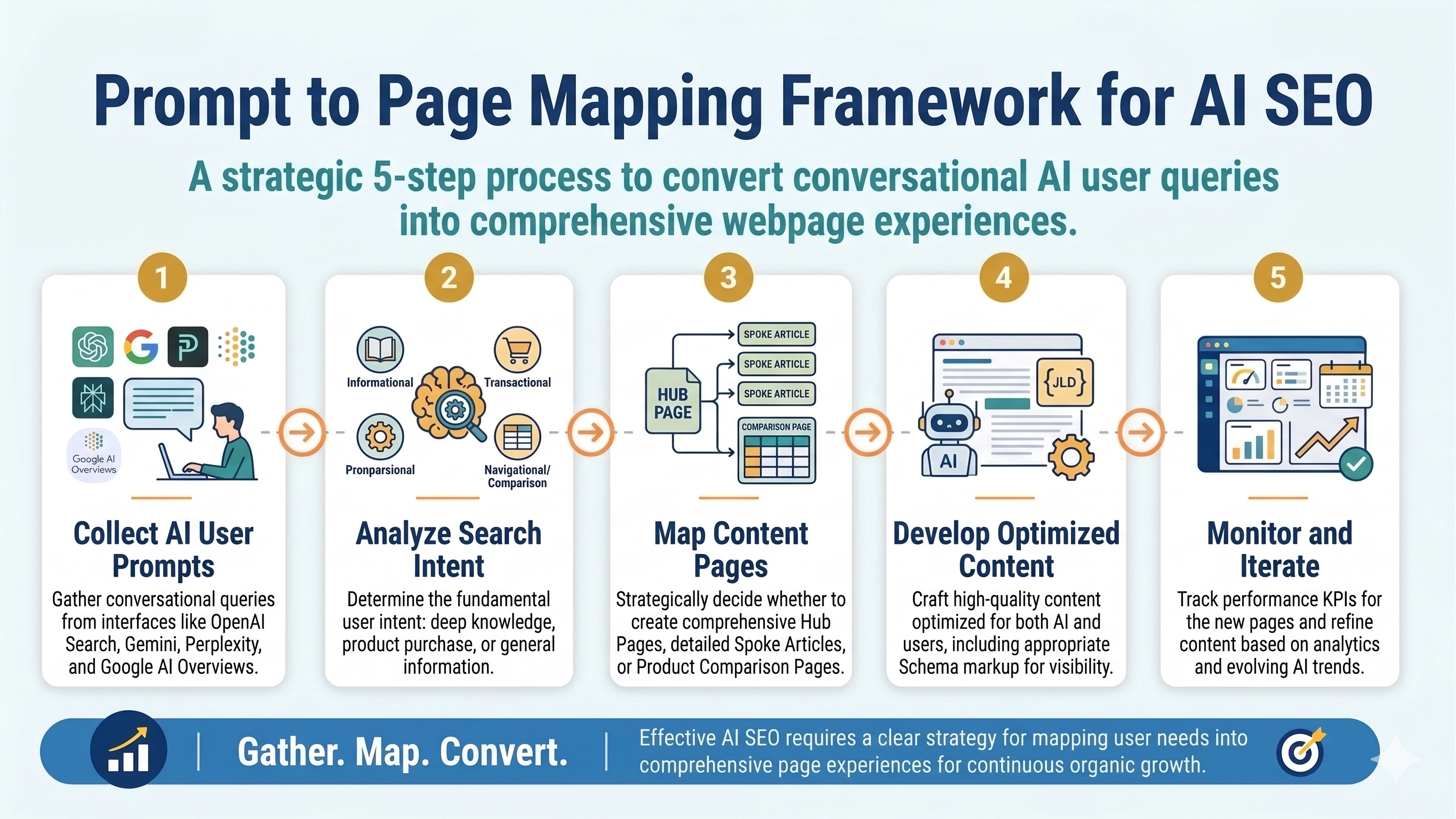
TL;DR: Prompt-to-Page Mapping in One Box
Prompt-to-Page Mapping is the exact science of restructuring web architecture around generative engine prompts. By aligning content layouts with actual conversational inputs, teams stop guessing keyword volume and start addressing exactly how AI search engines construct answers.
Traditional keyword mapping aligns query strings with product pages. Prompt-to-Page Mapping structures page content so search engine LLMs can parse context, retrieve clear citations, and link back to your domain organically.
Prompt Collection
Harvest conversational questions buyers put into ChatGPT, Gemini, Perplexity, communities, and real-time sales team queries.
Intent Mapping
Categorize queries into structural intents—separating conceptual lookups, product audits, platform queries, and vendor evaluation.
Pipeline Integration
Establish structured citation blocks and clear contextual pathways linking support pages directly back to revenue hubs.
Why Prompt Mapping Matters for AI SEO
AI search journeys are conversational, multi-tiered, and task-driven. Traditional keyword tools completely overlook the syntax of generative queries. To earn visibility, your content clusters must answer complete question vectors directly.
For Supramind Digital, this creates an enormous domain authority play. Using your core AI SEO Services page as a parent hub, you can construct a highly linked matrix of conversational spoke pages addressing GA4 tracking, platform citation optimization, and structural markup. To see how established brands already win (and lose) this game, study our Notion AI SEO teardown and Shopify AI SEO teardown, where we reverse-engineer the exact page structures generative engines cite.
| Traditional Keyword | AI Search Prompt | Intent Category | Recommended Page Asset |
|---|---|---|---|
| AI SEO services | "What SEO agency understands ChatGPT search optimizations and Perplexity citation models?" | Commercial / Vendor Hunt | Commercial AI SEO Services Hub |
| What is GEO | "What is Generative Engine Optimization and how do optimization techniques differ from SEO?" | Educational / High-Volume | "What is GEO" Comparative Article |
| ChatGPT SEO | "How can I get my company's B2B software cited when users query ChatGPT for recommendations?" | Platform Execution | Deep-Dive ChatGPT SEO Blueprint |
| AI SEO tools | "What tools actually track visibility across Gemini, Copilot, and Google AI Overviews?" | Tool Comparison | Comprehensive AI SEO Tools Guide |
| GA4 AI traffic | "How can I isolate referral traffic coming from Perplexity and ChatGPT inside Google Analytics 4?" | Technical / Analytics | GA4 AI Traffic Dashboard Guide |
The P.R.O.M.P.T. Framework
This framework offers SEO and growth teams a systematic process to translate user behaviors into actionable site elements. By assessing inputs sequentially, you verify that every written page has an explicit business and technological purpose.
Prompt Collection
Systematically pull inquiries from Sales logs, online communities, search console, and AI interface test-runs.
Reader Intent
Isolate the exact requirement of the searcher, identifying lookup, diagnostic, comparative, or commercial goals.
Opportunity Grouping
Cluster overlapping inquiries into clean thematic groups to prevent keyword self-cannibalization.
Map to Page Type
Establish the target page design—ranging from hubs, specialized spokes, comparison templates, or technical FAQ matrices.
Proof Layer
Furnish unique tables, original system screenshots, and citation markers to convince retrieval engines.
Traffic Path
Determine structured internal anchor tags pointing upstream to your transactional pages, capturing traffic immediately.
Step 1: Prompt Collection
Earning real estate in generative search engines means understanding real conversational questions. Rather than planning layouts around short-tail keywords, gather the precise multi-layered questions users type directly into search interfaces.
Not sure which prompts your competitors already own? Run your domain through our free AI Visibility Score Checker to benchmark where you currently appear across generative engines before you start harvesting prompts.
| Inquiry Source | Data Harvesting Strategy | AI SEO Application Example |
|---|---|---|
| AI Search Platforms | Input core company problems into Gemini, Perplexity, and Claude to analyze returned sources. | "How do search engines determine citation sources for Perplexity Answers?" |
| Sales Engineering Logs | Extract exact technical questions and purchase blockages from sales transcripts. | "Can our technical teams track and attribute organic conversions from ChatGPT?" |
| SERP Search Intent | Map Google's 'People Also Ask' prompts alongside AI Overview source pages. | "What is the literal technological difference between classic SEO and GEO?" |
| Industry Forums | Audit Reddit, Quora, and Discord channels for industry-specific problem vectors. | "Is Generative Engine Optimization actually working, or is it a passing trend?" |
Step 2: Reader Intent Classification
Classifying incoming questions prevents strategic misalignment. Providing a sales page to a searcher seeking a raw calculation will result in quick departures. By classifying intent at the prompt level, we structure content layouts for optimal engagement.
| Intent Structure | Prompt Formulation Patterns | Best-Fit Page Layout | Conversion Goal |
|---|---|---|---|
| Definitions | "What does [Term] mean", "Explain [Topic] simply" | Glossary page or educational spoke | Read deep-dive services |
| How-To Systems | "How can I set up", "Steps to configure", "Guide for" | Technical step-by-step blueprint | Download implementation template |
| Comparisons | "Software A vs B", "pros and cons of", "alternatives to" | Unbiased comparison dashboard | Book structural strategy call |
| Vertical Industry | "AI SEO for e-commerce, software, healthcare, SaaS" | Dedicated vertical landing page | Request customized industry audit |
| Vendor Assessment | "Top agency for", "best optimization services", "consultants" | Commercial parent service page | Schedule executive consultation |
Step 3: Opportunity Grouping
Rather than constructing separate, shallow articles for every conversational variation, cluster related prompts into comprehensive topic frameworks. This signals topical depth to LLM crawlers while simplifying the page hierarchy for human readers.
1. Platform Clustering
Cluster questions centered on individual engines: optimizing for ChatGPT Search, optimizing Perplexity references, or securing AI Overviews placements.
2. Strategy Clustering
Consolidate optimization tasks such as JSON-LD schema implementation, brand citation audits, and organic source reporting templates.
3. Sector Clustering
Group sector-specific prompts together, addressing unique challenges in e-commerce directories, medical guidelines, or B2B software listings.
Step 4: Map Prompts to Page Types
Determining layout styles ensures your pages answer user questions perfectly. Choosing correct page layouts guarantees a highly intuitive user experience while maintaining an clean crawling path for search engines.
| Prompt Theme Cluster | Selected Web Page Layout | Production Article Title Example | Anchor Text to Core Hub |
|---|---|---|---|
| Defining the Core Tech | Educational Spoke | "What is Generative Engine Optimization? The Technical Blueprint" | AI SEO services |
| Reporting Setup Guides | Interactive Blueprint | "How to Attribute and Track AI Referrals Inside GA4" | AI search optimization services |
| Competitive Appraisals | Detailed Tool Matrix | "Top 10 AI SEO Platforms to Audit AI Overviews" | AI SEO software guide |
| B2B Core Evaluations | SaaS Vertical landing page | "AI SEO and Citation Optimization Services for Enterprise SaaS" | SaaS AI SEO expert |
Step 5: Add the Proof and Evidence Layer
AI search models evaluate your content's informational richness before extracting citations. Earning these mentions requires concrete data layers that show deep experience, authoritative knowledge, and factual accuracy. For a full breakdown of which evidence signals retrieval engines actually reward, follow our Citation-Worthy Content Framework alongside this step.
| Evidence Requirement | Strategic Implementation | Practical Implementation Example |
|---|---|---|
| Verified Sources | Reference official research, technical standards, or patents. | Cite Google Search Patent filings, schema guidelines, or OpenAI documentation. |
| Execution Media | Provide original screenshots, dashboard panels, and workflow visualizations. | Provide screenshots of GA4 filters, JSON-LD test markup, and Perplexity panels. |
| Structured Frameworks | Map complex instructions into visual workflows and checklists. | The Supramind AI Visibility Score Framework or our custom GEO Readiness audit sheet. |
| Original Metrics | Consolidate raw datasets into scannable comparison tables. | Performance comparison tables detailing visibility changes across key search engines. |
Step 6: Build the Traffic and Conversion Path
A perfectly optimized informational spoke must actively build your revenue pipeline. By embedding clear, context-specific internal links and high-value next-step offers, you turn casual readers into qualified leads.
Attribution closes the loop: without clean referral data you can't prove which spokes drive pipeline. Use our free GA4 AI Traffic Tracking Generator to build the exact filters and channel groups that isolate ChatGPT, Perplexity, and Gemini referrals inside Google Analytics 4.
| Page Type | Primary Internal Link Target | Recommended Offer (CTA) | Key Performance Indicator |
|---|---|---|---|
| Educational Spoke | Core AI SEO Services Hub | "Explore our full suite of AI SEO Services" | Scroll depth, downstream click-throughs |
| Technical Framework | AI Visibility Audit landing page | "Get our comprehensive GA4 Attribute Template" | Form submissions, template downloads |
| Vertical Sector landing page | Main Service Booking page | "Schedule a custom e-commerce GEO Strategy session" | Sales-qualified leads, consultation bookings |
Prompt-to-Page Readiness Score
Evaluate your target topics to determine if they justify a standalone page. Score each operational attribute from 0 to 5 (0 indicating weak relevance, 5 indicating perfect alignment). This scorecard pairs naturally with our AI Visibility Score Framework, which measures how each published page ultimately performs across generative engines.
Prompt Evaluation Scorecard
Calculate candidate topics against core brand requirements before launching new pages.
Example AI SEO Prompt-to-Page Map
This strategy blueprint shows how Supramind Digital can map common industry prompts to construct a high-authority GEO topic cluster around your primary services page.
| Target Search Prompt | Intent Group | Recommended Page Asset | Primary Hub Anchor Text | High-Intent Lead Magnet Offer |
|---|---|---|---|---|
| "What is AI SEO?" | Educational | "What is AI SEO?" Spoke Resource | AI SEO services | Explore AI SEO Services |
| "What is GEO?" | Educational | "What is Generative Engine Optimization?" Spoke | GEO optimization services | Download GEO Checklist |
| "How do I get cited by ChatGPT Search?" | Platform optimization | ChatGPT SEO Implementation Guide | ChatGPT SEO agency | Get ChatGPT Visibility Audit |
| "How do I track AI traffic in GA4?" | Technical | GA4 Referral Tracking Framework | AI visibility attribution metrics | Download GA4 Attribution Filters |
| "Best AI SEO agency for SaaS brands" | Commercial | B2B SaaS AI SEO Services Vertical Page | AI SEO consulting services | Request Custom SaaS Audit |
| "SEO vs GEO vs AEO vs LLMO differences" | Comparative | SEO vs GEO vs AEO Comparison Chart | Generative Engine Optimization | Request AI Search Roadmap |
Prompt-to-Page Mapping Checklist
| Content Strategy Checklist Task | Complete? | Technical Action Note |
|---|---|---|
| Gather 50+ real buyer prompts from search engines and sales CRM files. | In Progress | Avoid standard keyword lists; focus on full-sentence, question-based user queries. |
| Categorize all target prompts into clean intent groups. | In Progress | Identify looks, comparisons, diagnostic issues, and vendor audits. |
| Group prompts into logical topic clusters to prevent keyword overlap. | In Progress | Group variations under primary questions to focus content depth on fewer URLs. |
| Map candidate clusters to specific, functional page layouts. | In Progress | Decide between deep educational spoke articles, tools dashboards, or vertical pages. |
| Inject unique data frameworks, expert insights, and verification layers. | In Progress | Ensure information depth meets LLM source retrieval criteria to secure citations. |
| Establish internal anchor links pointing directly to your parent service hub. | In Progress | Create clear pathways for crawlers to pass authority directly to primary sales hubs. |
Ready to construct an AI-search optimized content roadmap?
Supramind Digital helps enterprise brands map customer search prompts into high-performing content engines—turning raw conversational inputs into hubs, guides, specialized landing pages, and qualified leads.
Frequently Asked Questions
What is Prompt-to-Page Mapping?
Prompt-to-Page Mapping is the strategic process of designing web architecture around natural search prompts. It aligns content with the structural models of LLMs, deciding whether a prompt needs a cornerstone hub, a technical guide, or a comparison page.
How does prompt mapping differ from keyword mapping?
Keyword mapping focuses on isolated keyword strings and standard search volume. Prompt mapping centers on complete user sentences and conversational intent, tailoring page content so AI engines can parse, reference, and cite the domain easily.
Should every AI query have its own standalone page?
No. Creating isolated pages for every variation leads to thin content and crawling blockages. Low-volume prompts should be grouped together inside thorough frameworks, checklist pages, or unified FAQ matrices.
How often should we audit our prompt-to-page clusters?
We suggest evaluating your active prompt map monthly during rapid campaign launches, and quarterly for mature authority hubs. AI retrieval indices change quickly, requiring regular updates to content structure.
- Log in to post comments


 INDIA
INDIA