


Citation-Worthy Content Framework: How to Create AI SEO Content That Search and Answer Engines Can Reference
As part of our AI SEO Optimization hub, this Supramind Citation-Worthy Content Framework helps brands create content that search engines, AI answer engines, journalists, analysts, and buyers can confidently reference. Use it to audit and improve your content for ChatGPT, Perplexity, Gemini, Bing Copilot, Google AI Overviews, and AI Mode by strengthening answer clarity, original insights, source-backed evidence, entity signals, expert validation, structured formatting, and conversion-focused next steps.
The Citation-Worthy Content Framework helps brands create content that is easier for search engines, AI answer engines, journalists, analysts and buyers to reference. It is built for AI SEO, Generative Engine Optimization, Answer Engine Optimization and modern SEO content strategies where simply publishing keyword-rich content is no longer enough.
Traditional SEO content often answers a topic broadly. Citation-worthy content goes further. It gives direct answers, adds information gain, includes verifiable evidence, clarifies entities, uses expert validation, structures information cleanly and guides users toward the next useful action.
TL;DR: Citation-Worthy Content in One Box
Citation-worthy content is content that gives a clear answer, adds something new, supports claims with credible evidence, uses structured formatting, clarifies entities, proves expertise and sends qualified users to the right next step.
The goal is not to write for AI. The goal is to publish content that is genuinely useful, verifiable, well-structured and trustworthy enough for people and AI systems to rely on when answering commercial and informational questions.
Clear extraction
Each important section should include a direct answer that can stand alone without forcing readers to decode long paragraphs.
Evidence-backed claims
Statistics, examples, expert quotes, client data, screenshots and source links make the page easier to trust and reference.
Clear context
Brands, tools, people, industries, locations and concepts should be named consistently and connected clearly.
Conversion path
If a cited page gets visibility but has no proof, offer or next step, AI visibility may not turn into leads.
Why Citation-Worthy Content Matters for AI SEO
AI search platforms often summarize, compare and synthesize information from multiple sources. In that environment, thin, repetitive or unsupported content is less useful than content with definitions, data, comparisons, examples, structured answers and verifiable expertise.
For Supramind Digital, citation-worthy content is a practical bridge between traditional SEO and AI SEO. It supports Google AI Overviews, AI Mode, ChatGPT Search, Perplexity, Gemini, Bing Copilot, answer engines, journalist research, sales enablement and bottom-funnel service positioning. Before improving individual pages, benchmark where you stand: run your domain through our free AI Visibility Score Checker to see how often your brand currently appears across generative engines.
| Old SEO Content Habit | Problem in AI Search | Citation-Worthy Upgrade |
|---|---|---|
| Broad keyword coverage with generic definitions. | The page adds little beyond what already exists. | Add a specific definition, original angle, practical framework and example. |
| Claims without data. | Hard for users, journalists or AI systems to verify. | Add source-backed statistics, screenshots, expert quotes and case evidence. |
| Long paragraphs with no extractable answer. | The content is harder to summarize or reference. | Use answer blocks, tables, bullets, checklists and descriptive headings. |
| Brand mentions without entity clarity. | AI systems may not clearly connect the brand to its service category. | Add consistent brand descriptions, sameAs links, schema, author information and relevant third-party proof. |
| Informational article with no conversion path. | Visibility does not become pipeline. | Add content audit CTA, framework download, hub page link and relevant service offer. |
Evidence Behind the Framework
The Citation-Worthy Content Framework is based on three practical realities: Google guidance still emphasizes helpful, reliable, people-first content; AI search products increasingly provide answers with supporting web links; and GEO research shows that source-backed, statistic-rich and quotation-supported content can improve visibility in generative responses.
| Evidence | Source | What It Means for Content Teams | Practical Application |
|---|---|---|---|
| Google says the same foundational SEO best practices apply to AI features and highlights helpful, reliable, people-first content. | Google Search Central | AI SEO content should not abandon SEO fundamentals. | Keep pages crawlable, internally linked, textual, useful and structured. |
| Google says AI Overviews and AI Mode surface relevant links and may use query fan-out across subtopics and data sources. | Google Search Central | One broad article is not enough for complex buyer journeys. | Build content clusters with hub, spokes, comparison pages, FAQs and proof assets. |
| OpenAI describes ChatGPT Search as a way to get timely answers with links to relevant web sources. | OpenAI | Pages must be useful both as answers and as link-worthy sources. | Create clear definitions, practical checklists, charts, examples and source citations. |
| Microsoft describes AI-powered Bing as delivering complete answers with linked sources. | Microsoft | Answer engines need referenceable passages, not just keyword coverage. | Use answer blocks, comparison tables and concise evidence sections. |
| The GEO research paper found that methods such as statistics addition, quotation addition, and cite-sources style improvements can increase visibility in generative responses. | Aggarwal et al., GEO: Generative Engine Optimization | Evidence-rich content can be more useful in generative answer contexts. | Add data, expert quotes, references and high-specificity paragraphs instead of keyword stuffing. |
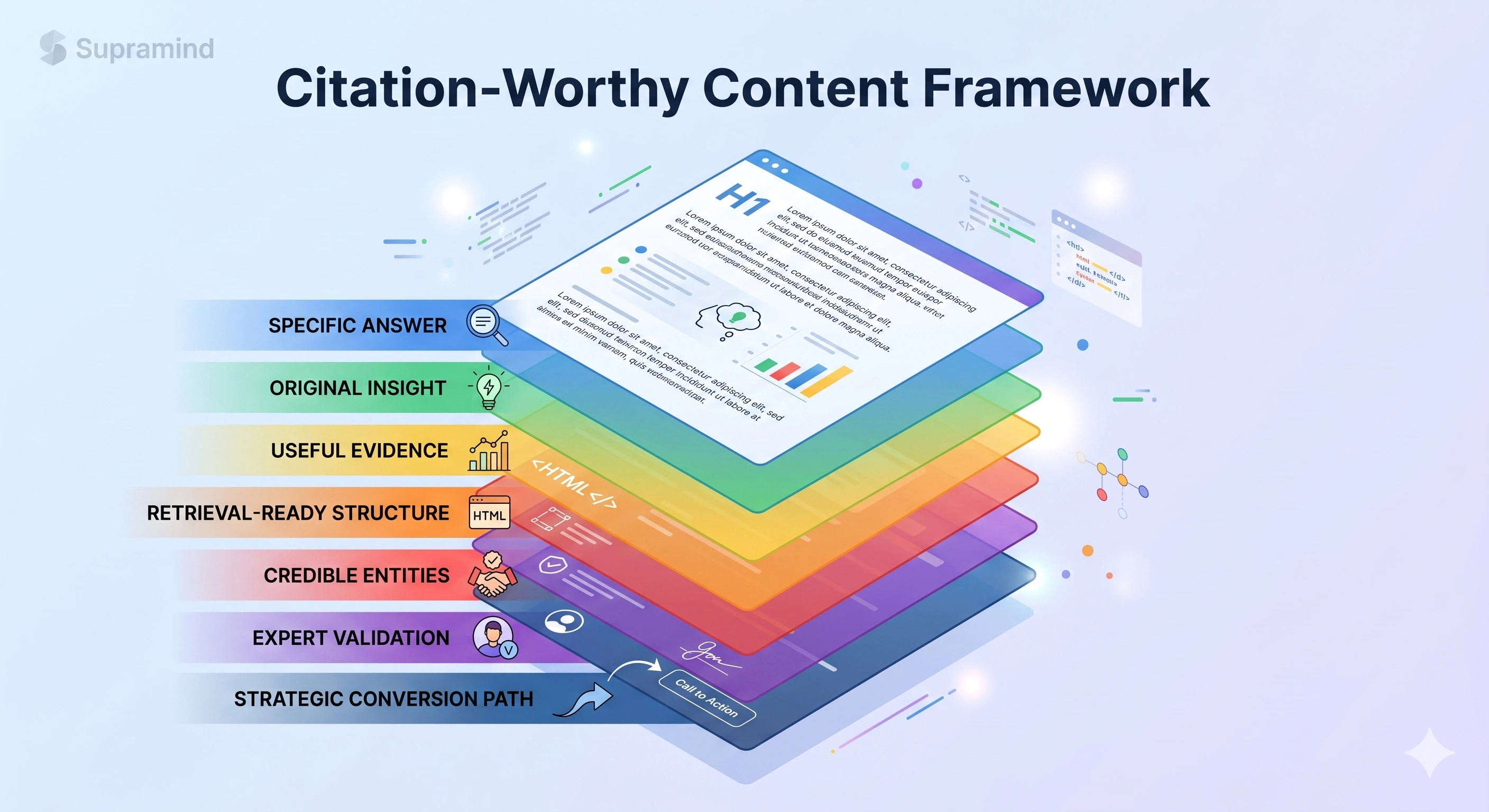
The S.O.U.R.C.E.S. Citation-Worthy Content Framework
The S.O.U.R.C.E.S. framework is a seven-layer content improvement model. It can be used to audit existing pages, brief new content, train writers, refresh underperforming assets and build AI SEO spokes around the Supramind AI SEO Services hub. To decide which conversational queries deserve their own hub, spoke or comparison page in the first place, pair it with our Prompt-to-Page Mapping Framework.
Specific Answer
Give a direct, concise, standalone answer under each important heading.
Original Insight
Add information gain: frameworks, examples, data, mini-studies or unique POV.
Useful Evidence
Support claims with credible sources, screenshots, quotes and case evidence.
Retrieval-Ready
Use headings, tables, lists, schema, summaries and clean content architecture.
Credible Entities
Clarify brands, people, tools, industries, services and relationships.
Expert Validation
Show real expertise through authors, reviewers, credentials and client context.
Strategic Path
Connect the cited asset to relevant next steps, CTAs, audits and service pages.
S: Specific Answer Blocks
Every major H2 or H3 should include a direct answer before deeper explanation. This helps users, featured snippets, AI summaries and internal reviewers understand the point quickly.
Use a 40 to 80 word answer block under important headings, followed by context, examples, tables and source-backed evidence.
| Weak Version | Citation-Worthy Version | Why It Works |
|---|---|---|
| AI SEO is important for modern businesses. | AI SEO is the practice of improving how a brand appears in AI-generated answers, citations, summaries and recommendations across platforms such as Google AI Overviews, ChatGPT Search, Perplexity, Gemini and Bing Copilot. | It defines the concept, names platforms and clarifies what visibility means. |
| Citation-worthy content helps you rank better. | Citation-worthy content helps search and answer engines understand what a page says, why it is trustworthy and when it should be used as supporting evidence for a user's question. | It explains the mechanism instead of making a vague outcome promise. |
| Use schema for AI SEO. | Structured data helps clarify visible page content for eligible search features, but Google says there is no special schema required to appear in AI Overviews or AI Mode. Schema should match visible content and support clarity, not act as a shortcut. | It includes nuance and avoids overclaiming. |
O: Original Insight and Information Gain
Citation-worthy content should add something beyond what the top-ranking pages already say. This can be a proprietary framework, industry benchmark, teardown, dataset, before/after example, prompt test, expert interpretation, calculator or practical template. Teardowns are one of the most effective formats: our Notion AI SEO teardown and Shopify AI SEO teardown show how analyzing a real brand's AI search footprint produces the kind of original, referenceable insight generic articles cannot match.
| Information Gain Type | Example for Supramind | Best Page Type | AI SEO Benefit |
|---|---|---|---|
| Original framework | The S.O.U.R.C.E.S. Citation-Worthy Framework | Strategy guides, hub pages | Gives AI platforms a unique, named concept to reference that can't be found elsewhere. |
| Proprietary Data | "We analyzed 100 AI Overviews for SaaS queries..." | Blog posts, Whitepapers | Models favor statistically backed claims and hard numbers as anchor facts. |
| Expert POV | A unique quote from our SEO Lead debunking a myth. | Opinion pieces, FAQs | Differentiates generic advice with authoritative perspective. |
U: Useful Evidence and Source Support
Generative Engine Optimization research has shown that AI models prefer to cite content that is robustly backed by sources. Claims made without evidence are easily dismissed by AI synthesizers.
External Citations
Link out to highly credible, high-authority sources (e.g., Google Search Central documentation, academic papers) to validate your assertions.
Visual Proof
Embed screenshots, annotated charts, and before-and-after results. Text surrounding these elements often gets prioritized contextually.
First-Party Evidence
Use your own case studies, client quotes, and real-world implementation examples to show that your methodology is proven.
R: Retrieval-Ready Structure
Content needs to be formatted in a way that makes it incredibly easy for both traditional crawlers and LLM retrieval systems to parse. Disorganized walls of text are the enemy of AI search.
- Descriptive H2s and H3s: Use headings that explicitly state the topic or ask the question (e.g., "How Does AI Read Content?").
- Comparison Tables: AI models love parsing standard HTML <table> structures for comparing features or pros/cons.
- Bulleted Checklists: Step-by-step guides should use ordered <ol> or unordered <ul> lists for direct extraction.
- Semantic HTML: Use correct tags instead of styled divs.
C: Credible Entity Signals
An "Entity" is a distinct, well-defined thing or concept (a brand, a person, a service, a location). AI search engines rely heavily on the Knowledge Graph to understand how entities connect. When writing citation-worthy content, you must establish clear entity relationships.
Always refer to your brand consistently. Link authors to their bio pages and LinkedIn profiles. Use sameAs schema to connect your brand to your social profiles and Wikipedia/Crunchbase pages if applicable. Define industry jargon explicitly to associate your page with the broader industry entity.
E: Expert Validation
E-E-A-T (Experience, Expertise, Authoritativeness, and Trustworthiness) is critical in AI SEO. Models are trained to prefer high-quality, expert-led sources, especially for YMYL (Your Money or Your Life) topics or B2B decision-making.
Ensure your content features Author By-lines with detailed bios, verified reviewer credentials, and quotes from identifiable Subject Matter Experts (SMEs). Do not publish anonymous or generic "Admin" posts.
S: Strategic Conversion Path
Getting cited in an AI Overview or a ChatGPT response is useless if the traffic doesn't convert. Citation-worthy content is inherently strategic; it anticipates the user's next logical step. Closing the loop also requires clean attribution: use our free GA4 AI Traffic Tracking Generator to build the filters that isolate ChatGPT, Perplexity and Gemini referrals, so you can prove which cited pages actually drive pipeline.
Citation-Worthy Readiness Score
Use this quick interactive calculator to evaluate a piece of content before you publish it. Rate your content on each of the S.O.U.R.C.E.S. criteria. Once a page goes live, track its ongoing performance across generative engines with our AI Visibility Score Framework, a repeatable model for measuring AI search visibility over time.
Page Anatomy and Checklist
A perfectly optimized citation-worthy page typically includes:
- Optimized Title & Meta: Targeted for both humans and AI intent.
- TL;DR / Executive Summary: A bulleted list at the very top.
- Direct Answer Block: 40-80 words answering the primary intent immediately.
- Data Visualization: A chart, graph, or proprietary infographic.
- Comparison Table: Structured data contrasting concepts or solutions.
- Expert Quote Callout: Highlighted insight from an identified SME.
- Contextual CTA: Flowing naturally into the next stage of the funnel.
FAQ and Sources
Common questions about Answer Engine Optimization and the S.O.U.R.C.E.S. framework.
What is citation-worthy content?
Citation-worthy content is content that provides clear, specific, trustworthy, source-backed, and well-structured information that search engines, AI answer engines, journalists, buyers, and researchers can confidently reference.
Can citation-worthy content guarantee AI citations?
No. No agency can guarantee citations in ChatGPT, Perplexity, Gemini, Bing Copilot, Google AI Overviews, or AI Mode. Citation-worthy content improves the quality, clarity, evidence, structure, and authority signals that make content easier to discover, understand, and reference.
How is it different from normal SEO content?
Normal SEO content often focuses on keywords, headings, internal links, and topical coverage. Citation-worthy content adds stronger evidence, original insight, expert validation, entity clarity, structured answers, comparison tables, source references, and conversion-ready proof blocks.
What pages should be optimized first?
Start with commercial hub pages, high-traffic informational pages, comparison pages, industry pages, case studies, tool pages, and content that already ranks but is not being cited or referenced in AI search results.
Turn AI Visibility Into Pipeline
Don't leave your AI traffic hanging. Embed contextual offers, interactive audits, and clear pathways to your core service pages to capture intent generated by Answer Engines.
- Log in to post comments


 INDIA
INDIA