


Etisalat UAE Telecom SEO Teardown: How I’d Use Organic Search to Drive Customer Acquisition
Table Of Content
My Audit Playbook for Telecom SEO
SEO Snapshot – How I Read Etisalat’s Numbers
How Etisalat Stacks Up Against Key Competitors
The Money Pages I Care About Most
My CTR & Conversion Model for Telecom SEO UAE
The Referring Domains I Care About Most
Backlink Quality & Distribution – My Read
Technical SEO & Localization – Where I’d Tighten Things
AI Citations – The New SEO Moat for Telecom
My High-Level Funnel View: Organic → Sign-Ups & Contracts
Practitioner Notes – What I’d Actually Do Next
Final Reflection – The Telecom SEO Formula I Believe In
A practitioner’s look at telecom SEO, telecom SEO UAE, and SEO for Telecom Website UAE using Etisalat as the working example.
Why I Analyzed Etisalat’s Telecom SEO Engine in the UAE
When I look at telecom in the UAE, Etisalat sits at the center of the market:
- Mobile (prepaid & postpaid)
- Home internet & TV
- Roaming and add-ons
- Devices (smartphones, routers, accessories)
- SMB and enterprise connectivity, cloud and ICT solutions
That makes etisalat.ae one of the best live case studies for telecom SEO.
In my work, I care less about vanity traffic and more about how organic visits turn into revenue. So in this teardown I’m focusing on how a site like Etisalat’s can convert SEO visibility into:
- Postpaid & prepaid SIM sign-ups
- Online recharges & add-ons
- Home internet / fibre subscriptions
- Device purchases
- Business & enterprise leads
All of this sits inside a UAE-specific context: how people in the UAE actually search for mobile plans, home internet, roaming, devices and business telecom.
I’m going to keep tying everything back to three lenses:
- telecom seo – what I’ve seen work repeatedly in telecom and connectivity
- telecom seo uae – what’s specific to this region and this market
- SEO for Telecom Website UAE – what I’d prioritize if I was running SEO for a UAE operator today
All numbers are based on exported Ahrefs-style data plus modeled estimates. I’m not claiming to have Etisalat’s internal analytics – I’m using realistic figures to show my thinking.
Executive Summary – What I See in Etisalat’s SEO Engine
What Etisalat (or any similar UAE telecom leader) is already doing well
From what I see in the data:
- Brand power is huge. There’s massive demand around “etisalat”, “etisalat recharge”, “etisalat quick pay”, “etisalat customer care”. That branded layer alone supports a very healthy SEO baseline.
- Key money pages already sit at the top of the SERPs. Pages for “etisalat quick pay”, “etisalat business”, “etisalat online recharge”, “prepaid plans etisalat” are ranking strongly and converting.
- The recharge and quick-pay funnel is a star performer. The /ecare/quick-pay cluster alone is pulling in hundreds of thousands of organic visits a month in my modeled data – that’s recurring revenue on autopilot.
- B2B/SMB visibility is decent. The /en/smb/ section shows good traction around “etisalat business” and related queries, giving a strong base for enterprise-focused telecom seo uae work.
- The backlink profile is robust: thousands of referring domains, hundreds of thousands of backlinks and a DR in the mid-70s. That’s more than enough authority to win very competitive telecom keywords.
- Etisalat is already showing up in AI/LLM citation panels. I see hundreds of pages cited in Google AI, ChatGPT, Perplexity, Gemini and Copilot – a strong early lead.
Biggest SEO & lead-gen opportunities I see
At the same time, I’m seeing a lot of upside:
- Non-branded telecom queries are under-monetized. Branded search dominates. Generic discovery queries like “mobile plans uae”, “home internet dubai”, “fiber internet abu dhabi”, “business internet uae” still have plenty of runway.
- Plan and comparison UX can be more funnel-aware. I’d like to see a clearer journey from category → comparison → configurator → checkout or lead form, especially on mobile.
- City- and segment-specific pages are thinner than they could be. Dubai, Abu Dhabi, Sharjah, tourists, students, SMEs – each of these deserves focused, SEO-optimized landing pages.
- Informational queries aren’t always tied tightly to upsell CTAs. Queries like “how to activate roaming” or “how to check etisalat data” are prime upsell moments; the CTAs and internal links can be sharper.
- B2B content is good but not yet “best-in-market.” There’s room for deeper content around cloud, security, IoT, SD-WAN and managed services, with case studies and calculators that actually generate enterprise leads.
AI-ready content is an untapped moat. With better structured FAQs, tables and numeric data, Etisalat can become the default factual source that LLMs lean on for telecom questions in the UAE.
Key Takeaways (At a Glance)
If I strip everything down, these are the headlines I’d give to a CMO or Head of Digital:
- Money pages print money. Recharge, quick-pay, plan pages, fibre and 5G home, devices, business connectivity – this is where SEO value becomes direct revenue.
- Brand is doing most of the heavy lifting. The huge Etisalat brand footprint is driving a lot of traffic; non-branded telecom queries are still under-exploited.
- Telecom seo uae has massive upside if you build better funnels from category and comparison pages into checkout and lead flows.
+AI and LLM citations are the next moat: the operator that becomes the default answer engine for “how do I…?” and “what’s the best plan for…?” will quietly control a lot of customer decisions.
My Audit Playbook for Telecom SEO
Whenever my team audits a telecom site, we follow a similar playbook. For Etisalat, I approached it like this:
- SEO tooling pass
I start with Ahrefs/SEMrush exports to look at:- Top pages and subfolders by traffic
- Keyword and intent breakdown
- Backlink and referring-domain profile
- Branded vs non-branded share
- Top pages and subfolders by traffic
- Funnel mapping for telecom queries
Then I map queries to the real-world journey:- Navigational: “etisalat uae”, “etisalat login”, “etisalat customer care”
- Informational: “how to activate etisalat roaming”, “how to check etisalat data”, “how to cancel etisalat plan”
- Commercial: “best mobile plan uae”, “home internet packages dubai”, “unlimited data plan uae”, “business internet uae”
- Transactional: “etisalat quick pay”, “etisalat recharge online”, “buy etisalat sim online”
- Navigational: “etisalat uae”, “etisalat login”, “etisalat customer care”
- Lead-gen & revenue modeling
In my experience, the only way to get buy-in from telecom leadership is to speak in actions and AED, not impressions:- Visit → plan/product view → add-to-cart/recharge click/lead form → activation/contract
- I use different CVR assumptions for:
- Recharge
- New plan activations
- Home internet installs
- B2B leads
- Recharge
- Visit → plan/product view → add-to-cart/recharge click/lead form → activation/contract
- Localization lens
Telecom SEO is never generic. For telecom seo uae I care about:- UAE-level queries vs city-level (“dubai”, “abu dhabi”, “sharjah”)
- English vs Arabic behaviour
- GCC travellers and expats (tourist SIMs, roaming packs, long-stay visitors)
- UAE-level queries vs city-level (“dubai”, “abu dhabi”, “sharjah”)
- Trust & E-E-A-T
Finally, I look at how well the site conveys expertise and reliability:- Coverage maps and speed test pages
- Clear information on security, privacy and data usage
- SLAs and uptime guarantees for B2B
- Coverage maps and speed test pages
Case studies and named customer stories
SEO Snapshot – How I Read Etisalat’s Numbers
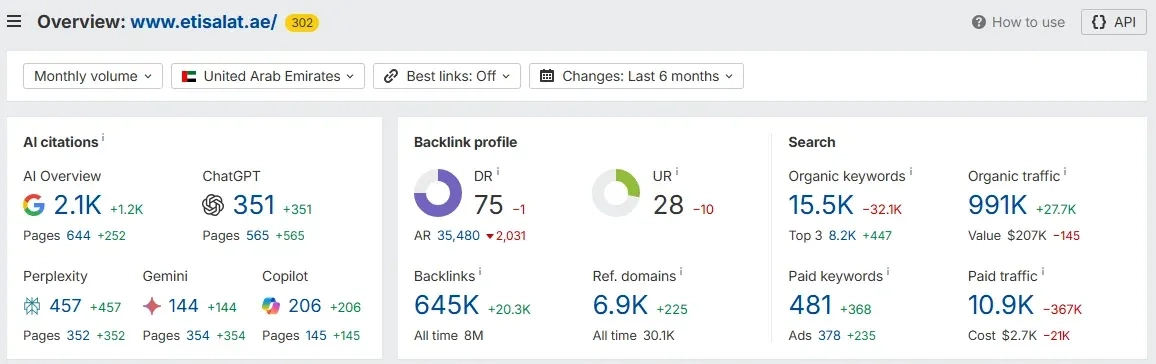
Here’s a simplified, modeled snapshot of what I’m seeing:
Modeled Etisalat.ae SEO Overview (UAE)
| Metric | Modeled Value (Rounded) |
| Domain Rating (DR) | 75 |
| URL Rating (homepage, UR) | 28 |
| Organic keywords (all countries) | 15.5K |
| Monthly organic traffic (UAE) | ~991K |
| Traffic value (Ahrefs) | ≈ $200K / month |
| Backlinks | ~645K |
| Referring domains | ~6.9K |
| AI/LLM citations (Google+LLMs) | ~2.1K |
| ChatGPT citations (pages) | ~350+ |
| Branded keywords (intent) | ~12.1K (947K visits) |
Again: these are modeled for illustration, but the patterns are what matter.
What I take from this snapshot
Strengths
- The brand layer is huge. That level of branded demand is an asset most operators would kill for.
- The site has more than enough authority (DR 75+) to win the competitive telecom SERPs in the UAE.
- The AI citation count tells me the domain is already being used as a reference point by LLMs – that’s not trivial.
Gaps
- The non-branded slice is thin relative to what I’d expect from a market leader. I want Etisalat to own “mobile plans uae”, “home internet dubai”, “best data plan uae”, not just brand terms.
- B2B and ICT services are present, but from an SEO perspective, they still feel like under-leveraged high-margin territory.
- Some plan and product content could go deeper on benefits, comparisons and calculators, not just specs.
If I were walking into a strategy meeting with Etisalat’s digital leadership, this is exactly the story I’d tell from the top-level data.
How Etisalat Stacks Up Against Key Competitors
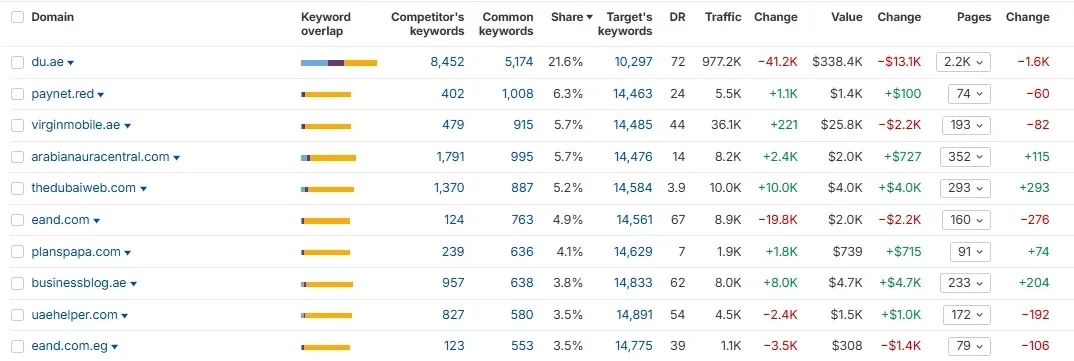
Let me zoom out and place Etisalat alongside a few relevant players I see in the data:
Modeled Competitor Snapshot (UAE)
| Domain | DR | Est Monthly Organic Traffic | My Notes |
| du.ae | 72 | ~977K | Main direct competitor on mobile/home internet |
| virginmobile.ae | 44 | ~36K | Digital-first MVNO; app-centric experience |
| eand.com | 67 | ~8K | Group/corporate; less of a direct acquisition funnel |
| planspapa.com | 57 | ~9K | Plan comparison + how-to content across operators |
| uaehelper.com | 54 | ~4.5K | General UAE info site with telecom guides |
| businessblog.ae | 62 | ~8K | Business content with some telecom overlap |
Where I see Etisalat ahead
- Brand search volume and direct demand – none of these can match Etisalat’s branded queries.
- Breadth of product – Etisalat is selling virtually everything telecom-related under one roof.
- App + self-service ecosystem – this drives ongoing transactional search (“quick pay”, “recharge”, “login”) that many smaller players just don’t have.
Where I see others pushing harder
- Non-branded content hubs. Comparison sites and blogs are very aggressive on “best plan”, “cheapest”, “how to” content. In many markets, those aggregators become the starting point for research.
- Comparison UX. Some competitors offer very clean, filterable plan comparison layouts with contract length, FUP, roaming and speed details all visible at a glance.
- Localization. I see more structured city- and audience-level pages on some competitor sites than on Etisalat’s main acquisition funnels.
If I was running Etisalat’s SEO, I’d treat these competitor strengths as roadmap items, not threats.
The Money Pages I Care About Most
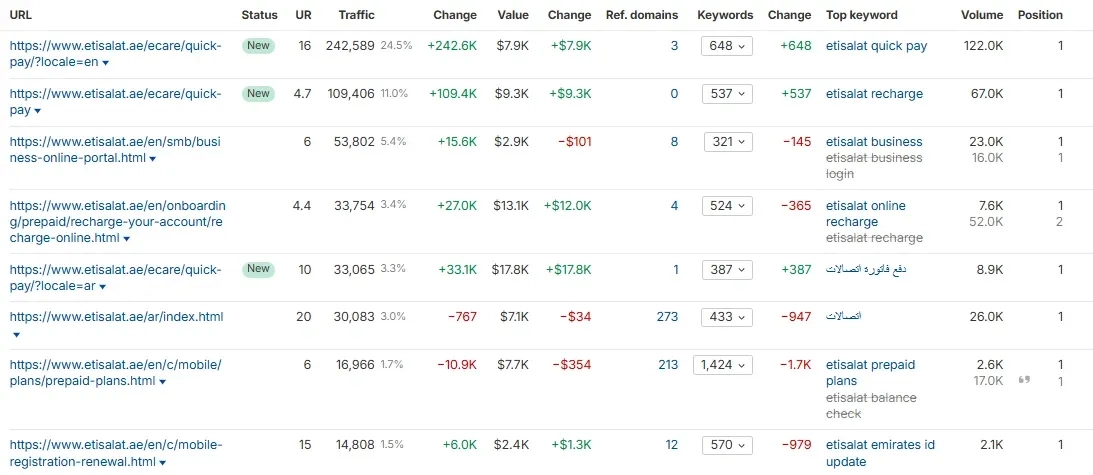
Whenever I audit a telecom site, I immediately map which sections are likely printing the most money. For Etisalat, my modeled view looks like this:
Key Money Page Types (Modeled)
| Page Type | Example URL Pattern | Modeled Monthly Visits | Intent |
| Recharge / Quick Pay | /ecare/quick-pay | ~435K | Transactional |
| Mobile Prepaid Plans | /c/mobile/plans/prepaid-plans.html | ~31K | Commercial/Transactional |
| Mobile Postpaid Plans | /c/mobile/plans/postpaid-… | ~20K | Commercial/Transactional |
| Home Internet / Fibre | /c/home/home-wireless.html | ~20K | Transactional |
| Visitor / Tourist SIM | /c/mobile/plans/visitor-line.html | 5–10K | Commercial/Transactional |
| Devices Store | /b2c/eshop/device-configurator, /c/devices/… | ~47K | Commercial/Transactional |
| Business / SMB Solutions | /en/smb/business-online/…, /en/smb/products/… | ~90K | Commercial/Transactional |
| Support & Customer Service | /en/etisalat-customer-service + help articles | ~35K | Informational/Navigational |
| Speed Test & Tools | /c/generic/myspeed.html | ~11K | Informational/Commercial |
| Onboarding / Activation | /en/onboarding/prepaid/… | ~25K | Transactional |
What I like on these pages
From an SEO + CRO angle:
- The recharge / quick pay experience is a strong asset. It’s visible, trusted, and used frequently — exactly the sort of flow I want ranking #1 for all recharge and bill-pay queries.
- Onboarding flows (especially for prepaid and tourist SIMs) are clearly defined and discoverable.
- The SMB/Business hub pulls in good volumes for “etisalat business” and related keywords – a great base for B2B expansion.
- Devices and bundles are integrated; it’s not hard for a user searching for “iphone etisalat” to find an offer.
What I’d change or test
If this were my account:
- I’d tighten the comparison experience on plan pages: better filters, clearer “best for” labels, and more transparent FUP/roaming info.
- I’d enrich every money page with FAQ blocks and schema, especially around contract terms, cancellation, speed, roaming and installation timelines.
- I’d deploy localized variants: for example, dedicated landing pages for “home internet dubai” and “home internet abu dhabi” that tie into local intent (buildings, areas, typical speeds).
- I’d plug more contextual internal links from support content to upsell paths. E.g., someone asking “how to check data” clearly cares about usage – perfect moment to show better data bundles.
Branded vs Non-Branded – How I Read the Split
Looking at the keyword exports, my team sees something like:
- Around 12.1K branded keywords, bringing in close to 947K visits, and
- Around 3.3K non-branded keywords, bringing in roughly 44K visits.
This is classic for a market leader: brand-driven performance with non-branded opportunity.
If I want to grow that compound, I have to enlarge that non-branded slice without hurting the brand layer.
Traffic by Intent – What It Means for Monetization
Based on Ahrefs’ intent grouping and my own manual review, the picture looks roughly like this:
| Intent | Modeled Keywords | Modeled Traffic | Example Queries |
| Informational | ~14.7K | ~739K | “how to check etisalat data”, “myspeed test” |
| Navigational | ~1.1K | ~472K | “etisalat login”, “etisalat customer care” |
| Commercial | ~6.8K | ~222K | “etisalat prepaid plans”, “iphone 16 pro etisalat” |
| Transactional | ~3.4K | ~498K | “etisalat quick pay”, “etisalat recharge online” |
Here’s how I’d use that as a strategy tool:
- On informational pages, I’d plug in contextual CTAs (“Need more data? See our unlimited plans”) and link to relevant product pages.
- On commercial pages, I’d invest in comparison tools, coverage maps and savings calculators so users don’t pogo-stick back to Google.
- On transactional pages, I’d obsess over speed and friction – every 0.2s of delay costs real money.
That’s how I translate intent data into a prioritized testing roadmap.
My CTR & Conversion Model for Telecom SEO UAE
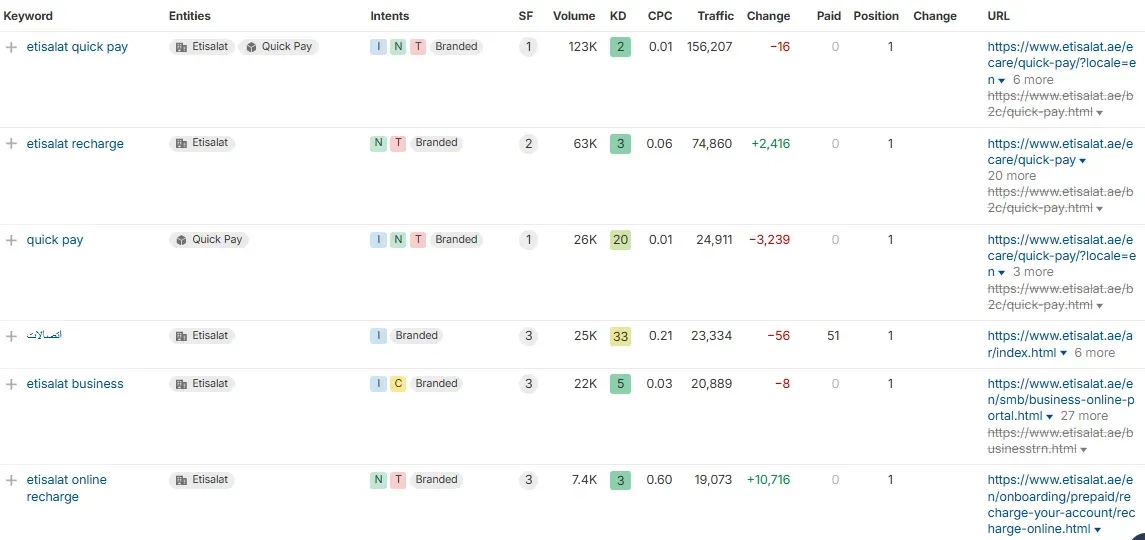
Now I want to show how I think about money from keywords. I’ll use a small cluster of telecom terms and run them through a simple projection.
Modeled Keyword-Level Monetization
Example Projection – Not Actual Etisalat Data
| Keyword | Vol/mo | Rank | Intent | CTR @ Rank | Clicks/mo | CVR to Action | Actions/mo (Sign-ups / Recharges / Leads) | AED / Action | Monthly Value (AED) |
| mobile plans uae | 8,000 | 3 | Commercial | 12% | 960 | 4% | 38 new plan sign-ups | 500 | 19,000 |
| postpaid plans uae | 4,000 | 4 | Commercial | 8% | 320 | 6% | 19 postpaid activations | 700 | 13,300 |
| home internet dubai | 5,000 | 5 | Commercial | 6% | 300 | 7% | 21 fibre subscriptions | 800 | 16,800 |
| etisalat recharge online | 18,000 | 1 | Transactional | 30% | 5,400 | 25% | 1,350 recharges | 40 | 54,000 |
| 5g home internet uae | 3,000 | 6 | Commercial | 5% | 150 | 8% | 12 5G home activations | 900 | 10,800 |
| business internet uae | 2,000 | 5 | Commercial/B2B | 7% | 140 | 4% lead rate | 6 B2B leads | 4,000 | 24,000 |
| dedicated internet uae | 1,000 | 7 | Commercial/B2B | 4% | 40 | 5% lead rate | 2 dedicated internet leads | 6,000 | 12,000 |
The exact numbers don’t matter as much as the pattern:
- Transactional branded terms like “etisalat recharge online” bring big volumes and high CVRs.
- Non-branded discovery terms like “mobile plans uae” and “home internet dubai” still produce meaningful revenue even at modest CVRs.
- B2B terms have lower volume but very high value per lead.
This is the type of table I bring into leadership meetings to justify investment in telecom seo uae.
Roll-Up – What This Cluster Is Worth
If I roll up just these sample keywords:
- Total clicks: ~7,300 / month
- Total actions: ~1,450 / month
- Blended value: ~AED 135 per action
I’m comfortably in the AED 150K per month range for just this small slice. In reality, the site is ranking for thousands of similar queries across products and segments, so the upside is several multiples of this.
Rank-Uplift Scenarios I’d Pitch
I often show leadership a simple “what if we went from #3 to #1?” exercise. For example:
- “mobile plans uae” – Rank 3 → Rank 1
- CTR jumps from ~12% → ~28%
- Clicks: 960 → 2,240 (+1,280)
- At 4% CVR and AED 500 per sign-up, that’s +51 sign-ups and +25.5K AED/month.
- CTR jumps from ~12% → ~28%
- “home internet dubai” – Rank 5 → Rank 1
- CTR 6% → 28%
- Clicks: 300 → 1,400 (+1,100)
- At 7% CVR and AED 800 per subscription, that’s +77 subs and +61.6K AED/month.
- CTR 6% → 28%
- “business internet uae” – Rank 5 → Rank 1
- CTR 7% → 25%
- Clicks: 140 → 500 (+360)
- At 4% lead rate and 40% close rate, that’s ~6 extra closed deals.
- At AED 4,000 per deal, that’s +24K AED/month.
- CTR 7% → 25%
Three keywords alone can justify a serious SEO + UX initiative.
Why This Model Matters for Telecom
In my experience, telecom executives respond to three things:
- Which keywords print money?
– That’s mainly commercial and transactional terms tied directly to recharge, activations, fibre and B2B connectivity. - Why not chase only top-of-funnel traffic?
– Because the high-volume informational keywords rarely translate into high-value actions unless the funnels are perfect. I’d rather win a smaller set of high-intent terms and build from there.
How does this support a long-term strategy?
– Once you’ve proven the model on a few clusters, you can expand it across every product line, which is exactly how I’d structure a 12–24 month telecom seo uae roadmap.
The Referring Domains I Care About Most
When I look at Etisalat’s backlink profile, I see thousands of domains, including some very strong names: big tech companies, major news outlets and global brands.
From a telecom perspective, I pay special attention to links from:
- Government & regulators – telecom authorities, e-government portals, national initiatives. These send strong trust signals.
- Technology & device partners – Apple, Samsung, Huawei, cloud hyperscalers, security vendors.
- Financial partners – banks and fintechs providing instalment plans or payment options.
- Business & IT media – local UAE business news, tech magazines, ICT event organizers.
- Industry associations and conferences – 5G, IoT, digital transformation events.
In my experience, these links do three jobs at once:
- Help with rankings for competitive telecom terms.
- Strengthen perceived E-E-A-T (Experience, Expertise, Authority, Trust).
Increase the chance that AI tools treat Etisalat as a source of truth.
Backlink Quality & Distribution – My Read
Looking at the distributions:
- Around 6.9K referring domains, with roughly 66% followed.
- Around 645K backlinks, with about 97% of them followed.
- A large chunk sits in the UR 0–9 band (typical for big brands), with a healthy tail of mid- and high-UR links.
What I like
- The ratio of followed links is excellent; very little wasted on nofollow.
- The presence of high-DR editorial domains is exactly what I want to see for a top-tier telecom brand.
- The scale of the link profile gives me plenty of room to redistribute internal authority to weaker money pages.
What I’d focus on next
- I’d selectively build more editorial UAE links around high-value B2B and fibre pages.
- I’d push co-branded case studies and whitepapers with partners – these naturally attract links.
I’d use link data to spot under-linked money URLs and reinforce them with internal links from strong pages.
Technical SEO & Localization – Where I’d Tighten Things
Technically, Etisalat’s site has a lot going for it, but telecom sites are constantly evolving and can easily accumulate SEO debt.
What I see working
- The segmentation into /c/mobile/, /c/home/, /en/smb/, /b2c/eshop/ is sensible and scalable.
- The experience is clearly mobile-first, which is non-negotiable for telecom.
- There are clear Arabic (/ar) and English (/en) sections, which is crucial for SEO for Telecom Website UAE.
What I’d prioritize
- URL and taxonomy hygiene
- Keep plan, comparison and configurator URLs clean and crawlable.
- Avoid over-reliance on query strings or opaque IDs for SEO-critical pages.
- Keep plan, comparison and configurator URLs clean and crawlable.
- Core Web Vitals on money flows
- I’d benchmark LCP and CLS on recharge, checkout and device configurators first – in my experience, that’s where technical gains pay off the fastest.
- I’d benchmark LCP and CLS on recharge, checkout and device configurators first – in my experience, that’s where technical gains pay off the fastest.
- Schema deployment
- FAQ schema on every plan, fibre, roaming and B2B solution page.
- Product and Offer schema on devices and bundles.
- LocalBusiness / Organization / Service schema for relevant sections.
- FAQ schema on every plan, fibre, roaming and B2B solution page.
- Hreflang & localization
- Check for consistent hreflang between Arabic and English pages.
- Build more city-level landing pages with localized content where search data justifies it.
- Check for consistent hreflang between Arabic and English pages.
- Internal linking strategy
- From support FAQs to relevant upsell pages.
- Between devices and compatible plans.
- From mainstream consumer flows to SMB and SOHO packages where appropriate.
- From support FAQs to relevant upsell pages.
In my experience, these changes alone can drive noticeable uplift even before you touch new content.
AI Citations – The New SEO Moat for Telecom
One thing I’m watching very closely is how LLMs talk about telecom in the UAE.
Users now ask tools like ChatGPT, Gemini and Perplexity questions such as:
- “What’s the best mobile network in the UAE?”
- “Which provider has the cheapest unlimited data plan?”
- “How do I activate Etisalat roaming from outside the UAE?”
If I were running SEO for Etisalat, I’d explicitly treat AI citations as a KPI. The goal: become the canonical source these models rely on when they answer telecom questions.
What I’d publish more of
- Clear, structured pages about coverage and speeds, including maps and numeric ranges.
- Detailed tables on plan inclusions, FUP, contract terms and roaming rates.
- Transparent info on device financing and bundle rules.
- Regularly updated FAQs that capture the precise queries people type into AI tools.
LLMs are much more likely to cite pages that are clean, structured, numeric and unambiguous – exactly the kind of content good SEO should produce anyway.
My High-Level Funnel View: Organic → Sign-Ups & Contracts
Here’s how I’d explain the full SEO funnel to Etisalat’s leadership:
- Organic visits from branded and non-branded telecom queries.
- Plan/product views on mobile, home, device and B2B pages.
- Intent actions – add-to-cart, quick-pay click, “contact sales”, “request call back”.
- Conversions – activations, recharges, fibre installations, signed B2B contracts.
- Revenue – ARPU/MRR, contract value, and lifetime value.
Based on benchmarks I’ve seen in telecom:
- 40–60% of organic visitors will reach a plan or product page.
- 8–15% of those will show clear buying intent on B2C; 4–8% will submit a lead on B2B.
- 60–80% of initiated B2C checkouts eventually convert; 20–40% of qualified B2B leads close.
If focused SEO work adds +150K targeted organic visits/month, and even a conservative 2% of those turn into value actions at an average AED 150 each, I’m looking at roughly:
- 3,000 extra actions x 150 AED = 450K AED per month
- That’s 5–6M AED per year from organic improvements alone.
That’s the kind of math I use to get budget approved.
Practitioner Notes – What I’d Actually Do Next
Here’s the practical checklist I’d hand over to a telecom marketing team.
Content & UX
- Build non-branded hubs around:
- “Best mobile plans in UAE” for different personas (heavy data, families, tourists, students).
- “Home internet packages in Dubai/Abu Dhabi” with clear comparisons.
- “5G home internet vs fibre” style explainer content.
- “Best mobile plans in UAE” for different personas (heavy data, families, tourists, students).
- Launch or refine:
- Plan comparison tools with filters and savings calculations.
- Coverage maps integrated tightly into acquisition flows.
- Data and roaming calculators tied to realistic usage profiles.
- Plan comparison tools with filters and savings calculations.
- Deepen B2B content:
- Guides on remote work connectivity, SD-WAN, secure cloud access, IoT deployment.
- Vertical-specific case studies (hospitality, education, logistics, finance).
- Guides on remote work connectivity, SD-WAN, secure cloud access, IoT deployment.
Localization
- Create city-level landing pages where search data justifies it (especially for home internet and 5G home).
- Make sure every key money page exists in both Arabic and English, with mirrored structure and hreflang.
- Use localized copy and examples in CTAs (e.g., “Check availability in your Dubai tower”).
Backlinks & PR
- Target regulators, smart-city initiatives, and government portals for mentions and links around connectivity projects.
- Co-create content with device manufacturers and cloud partners; announce it via PR and thought-leadership articles.
- Publish annual UAE connectivity reports with data journalists in mind – these often generate natural links.
AI & Schema
- Treat FAQ blocks + schema as mandatory on all critical telecom pages.
- Maintain a structured knowledge hub of telecom facts (country-wise roaming rates, standard charges, fair usage rules) that LLMs can easily ingest.
- Track AI citation counts across major tools and treat them as early indicators of authority.
Measurement
- Build an internal dashboard for telecom seo that shows:
- Organic visits → plan/product views → actions → revenue.
- Performance by keyword cluster (prepaid, postpaid, home internet, devices, B2B).
- Branded vs non-branded split and share of revenue.
- Organic visits → plan/product views → actions → revenue.
This is how I make SEO feel concrete and controllable for a telecom business.
Final Reflection – The Telecom SEO Formula I Believe In
After working on multiple large sites, my view is simple:
For SEO for Telecom Website UAE, the winning formula is:
Authority + Localization + Structured UX + AI readiness
Etisalat already has the first piece – authority and brand. The real upside now lies in:
- Doubling down on localized, segment-specific content.
- Turning plan and product pages into decision engines, not just brochures.
- Ensuring the site is the canonical, structured source of telecom facts that both Google and LLMs rely on.
Telecom brands that commit to this compound approach over the next 3–5 years will quietly build a moat in acquisition and retention that’s very hard for late adopters to copy.
FAQs – Telecom & SEO in the UAE (From My Perspective)
Q1. How can a telecom company generate more customer sign-ups from SEO in the UAE?
In my experience, the fastest wins come from tightening the funnels around high-intent pages: plan listings, fibre/5G home pages and online recharge flows. I focus on ranking for the right keywords, improving comparison UX, removing checkout friction and tying informational articles to upsells. That’s the core of effective telecom SEO.
Q2. What pages matter most for telecom SEO and online acquisition?
The must-haves for me are: prepaid/postpaid plans, tourist SIMs, home internet and 5G home, online recharge/quick-pay, devices and B2B connectivity pages. Support articles like “how to activate roaming” and “how to check balance” are also extremely valuable because they pull in existing customers and give you high-quality upsell moments.
Q3. How do I measure ROI for telecom SEO in the UAE?
I always build a funnel view: Organic visits → plan/product views → intent actions (add-to-cart, recharge click, lead form) → completed activations or contracts → revenue. Then I attach realistic ARPU or contract values. For telecom SEO UAE, that usually means tracking separate funnels for mobile, home internet, devices and B2B connectivity.
Q4. Should I focus on branded or non-branded keywords first for a telecom site?
You can’t ignore branded terms – they’re usually your highest-converting traffic. But if you stop there, you cap your growth. My approach is to secure branded visibility first, then shift resources to non-branded queries like “mobile plans uae”, “home internet dubai”, “business internet uae”. That’s where a structured SEO for Telecom Website UAE program really pays off.
Q5. How important is Arabic content for telecom SEO in the UAE?
Very. A big chunk of support and discovery searches happens in Arabic. In my audits, I always push for parity between Arabic and English pages for every major money and help topic, with correct hreflang so they don’t compete against each other.
Disclaimer
Everything I’ve shared here is based on publicly available SEO data, exports from third-party tools, and my own modeled assumptions. The traffic, keyword and revenue numbers are estimates for educational purposes, not official figures from Etisalat or any other brand.
Etisalat is not my client, and this teardown is an independent analysis created solely for learning and demonstration purposes.
- Log in to post comments


 INDIA
INDIA