


IKEA’s international SEO Strategy - A Data-driven teardown of a global retail SEO engine
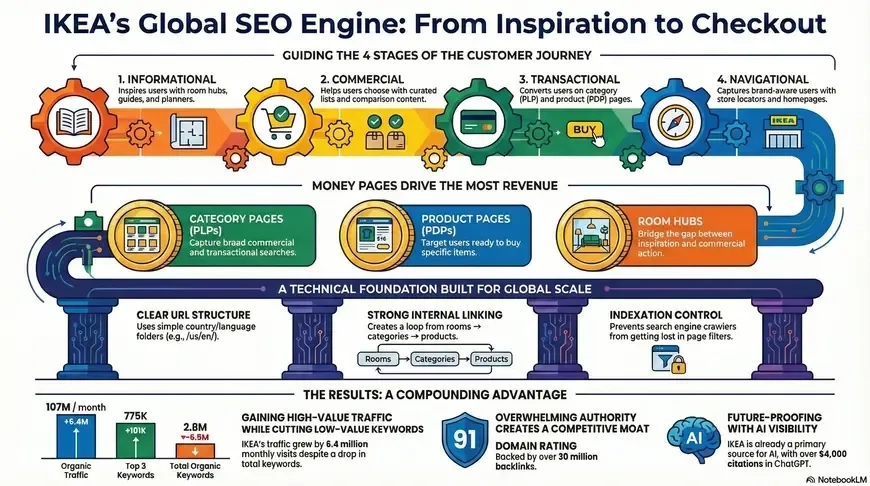
TOC (Table of Contents)
- Introduction — Why IKEA’s Global SEO Engine Works
- Executive Summary
- My Audit Playbook (for Global Retail eCommerce)
- SEO Snapshot (Global, Ahrefs-style View)
- Competitor Benchmark (Data = USA-only)
- The Money Pages That Drive Sales (Global Structure)
- CTR- & Intent-Aware Projection Model (USA-only)
- Trust Builders: Referring Domains That Move Rankings (Global)
- Backlink Quality & Distribution (Global)
- Technical SEO & Localization Wins (Global eCommerce-specific)
- AI Citations as a New Moat (beyond Google)
- Site-Wide Revenue Engine Projection (USA-only funnel)
- Practitioner Key Takeaways (Actionable Notes)
- FAQs (International eCommerce SEO)
- Disclaimer
IKEA is one of the rare retailers whose international seo strategy have to work simultaneously across dozens of languages, currencies, and shopping behaviors—while still guiding users from “room inspiration” to add-to-cart, delivery/pickup, and store visits. In this teardown, I’ll break down how IKEA scales organic visibility across markets, what its “money pages” look like, and how global demand can be translated into bottom-funnel actions—using USA-only modeling for conversion and revenue projections (per your rules).
Introduction — Why I Analyzed IKEA’s Global SEO Engine
IKEA isn’t just a furniture retailer—it’s a global discovery engine:
- Massive SKU depth + long-tail category breadth
- Inspiration-led browsing (rooms, styles, space constraints)
- Omnichannel expectations (delivery, pickup, click & collect, stores)
- Many markets with different search modifiers (“near me”, city names, delivery terms, local language, local unit conventions)
That combination forces IKEA to master three SEO realities at once:
- Scale: millions of queries across hundreds of categories
- Localization: country + language targeting that must stay consistent and crawlable
- Conversion: turning “ideas” traffic into product lists → PDPs → checkout
This teardown focuses on exactly that: how IKEA turns organic visibility into transactions, basket growth, and store/service actions—and how multi-market retail leaders can copy the framework.
Executive Summary
What IKEA does well (based on provided organic + link footprint snapshots and top-page patterns)
- Country/language architecture built for scale (clear country + language directories like /us/en/, /fr/fr/, /de/de/ across many markets)
- Category depth wins commercial intent (a large share of top pages are PLPs under /cat/…)
- Room hubs and planners capture “inspiration-to-purchase” demand
- Brand demand is enormous and acts as a compounding acquisition flywheel
- Backlink authority is massive (30M+ backlinks; 160K+ referring domains)
Biggest opportunities (where global retailers usually leave money on the table—even with strong brand)
- Non-branded capture: brand traffic is strong, but category intent is where incremental revenue scales
- Template depth + internal linking refinement: better “room → category → product” pathways, and better intent matching per market
- Indexation control for faceted navigation: avoid parameter/index bloat while keeping high-intent filtered pages accessible
- Schema & trust signals at PLP/PDP level: structured data, delivery promise, returns clarity, review distribution
- Market parity: ensure best-performing templates and content systems ship to more markets, not just a few
Key Takeaways (At a Glance)
- “Money pages” (PLPs/PDPs/room hubs/stores/offers/services) drive the highest intent and revenue.
- Non-branded queries (category + product intent) are where a scaled retailer can grow beyond brand demand.
- A scalable international seo strategy depends on indexation control + internal linking + localization systems.
- A compounding global seo strategy requires market parity, hreflang discipline, and templates built for intent (not just translation).
My Audit Playbook (for Global Retail eCommerce)
Here’s the framework I use for large international eCommerce sites like IKEA.
- Tooling + views that matter
- Ahrefs/Semrush-style patterns: top pages, keyword buckets, intent splits, referring domains/backlinks
- GSC patterns (if available): index coverage, query/page mapping, parameter crawl activity, country performance
- Funnel mapping: how each intent group moves into a money page
- Funnel intent mapping (global retail)
- Navigational (“get me to IKEA”)
- “IKEA”, “IKEA delivery”, “IKEA returns”, “IKEA [country/city]”, “IKEA near me”
- Usually lands on: country homepages, store locator, customer service
- Informational (“teach me / inspire me”)
- “how to plan a small bedroom”
- “wardrobe size guide”
- “sofa fabric types”
- Usually lands on: room hubs, guides, planners, FAQs → then pushes into PLPs
- Commercial (“help me choose”)
- “best sofa for small living room”
- “wardrobe price”
- “kitchen cabinet ideas”
- Usually lands on: curated lists, comparison hubs, room pages, category intros → then PLPs
- Transactional (“I want to buy”)
- “bed frame queen delivery”
- “sofa bed”
- “storage boxes near me”
- Usually lands on: PLPs, PDPs, offers/sale pages, store inventory pages
- Localization layers (the stuff that breaks at global scale)
- Country + language split (folders often outperform subdomains for consolidated authority)
- Currency + unit differences (cm/inches), local naming conventions
- “Near me” and city modifiers vary by SERP layout market-to-market
- Delivery terminology differs (delivery vs shipping, click & collect vs pickup, etc.)
- Trust signals that unlock conversion
- For global retail, the “SEO page” is also a conversion page. Top trust signals:
- Price clarity (including financing where applicable)
- Stock/availability and delivery timelines
- Returns, warranty, assembly options
- Reviews and FAQs (and structured data)
- Payment options and store pickup messaging
SEO Snapshot (Global, Ahrefs-style View)
Below is a consolidated snapshot based on the Ahrefs Overview (All locations, Monthly view) for www.ikea.com, reflecting organic performance, backlinks, and AI citation visibility
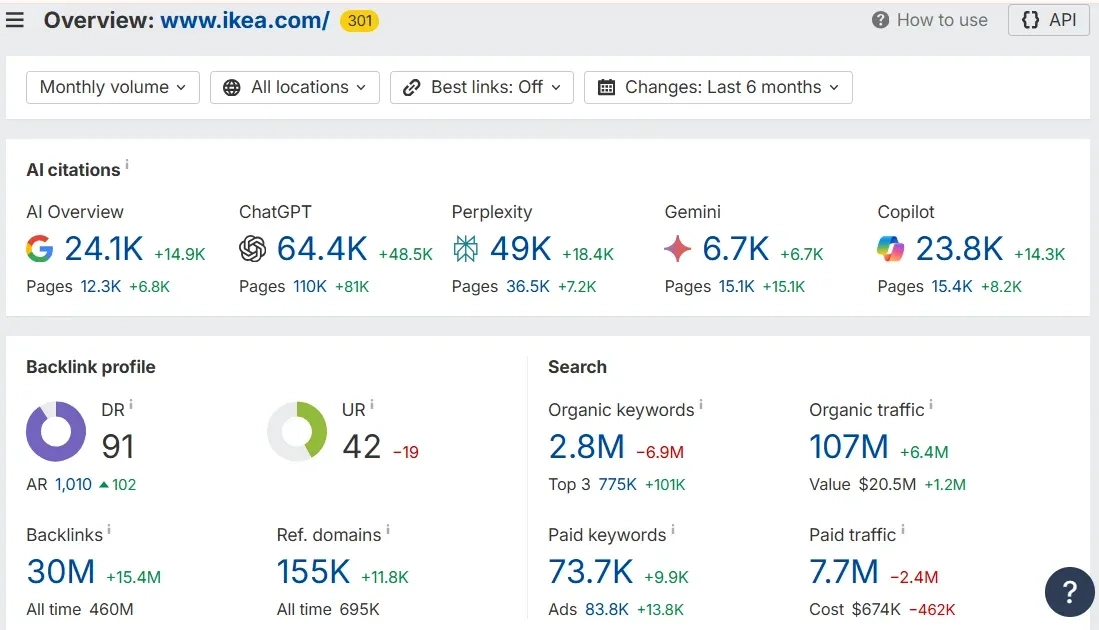
Global SEO Snapshot (Ahrefs Overview)
| Metric | Current Value | Change (Last 6 Months) | Insight |
| Domain Rating (DR) | 91 | — | Extremely strong authority moat |
| URL Rating (UR) | 42 | ▼ −19 | Individual URL equity fluctuates with template & internal linking changes |
| Backlinks | 30M | ▲ +15.4M | Massive link velocity reinforces category dominance |
| Referring Domains | 155K | ▲ +11.8K | Broad, diversified authority profile |
| All-time Backlinks | 460M | — | Long-term link accumulation engine |
| All-time Ref. Domains | 695K | — | Global brand footprint across markets |
Organic Search Performance (Global)
| Metric | Value | Change |
| Organic Keywords | 2.8M | ▼ −6.9M |
| Top 3 Keywords | 775K | ▲ +101K |
| Organic Traffic | 107M / month | ▲ +6.4M |
| Traffic Value | $20.5M / month | ▲ +$1.2M |
What this tells us
- Despite a decline in total ranking keywords, IKEA is gaining more Top-3 positions, which directly explains the net traffic growth.
- This is typical of index cleanup + stronger category consolidation, not a loss of visibility.
- IKEA is ranking better where it matters most (commercial & transactional queries).
What this tells us
- Despite a decline in total ranking keywords, IKEA is gaining more Top-3 positions, which directly explains the net traffic growth.
- This is typical of index cleanup + stronger category consolidation, not a loss of visibility.
- IKEA is ranking better where it matters most (commercial & transactional queries).
Paid Search Snapshot (Contextual, Not Core SEO)
| Metric | Value | Change |
| Paid Keywords | 73.7K | ▲ +9.9K |
| Paid Traffic | 7.7M | ▼ −2.4M |
| Ads Count | 83.8K | ▲ +13.8K |
| Paid Traffic Cost | $674K | ▼ −$462K |
Interpretation
- IKEA relies far more on organic scale than paid acquisition.
- Paid traffic is being optimized down while organic continues to scale—classic enterprise SEO maturity signal.
AI Citations Visibility (Emerging Discovery Layer)
| Platform | Estimated Mentions | Change | Pages Referenced |
| ChatGPT | 64.4K | ▲ +48.5K | 110K |
| Perplexity | 49K | ▲ +18.4K | 36.5K |
| Google AI Overviews | 24.1K | ▲ +14.9K | 12.3K |
| Copilot | 23.8K | ▲ +14.3K | 15.4K |
| Gemini | 6.7K | ▲ +6.7K | 15.1K |
Why this matters
- IKEA is already functioning as a primary source entity for AI-driven answers.
- Strong category structure, product data, and brand authority make IKEA highly citable for:
- “Best furniture for…”
- “Affordable storage solutions”
- “Where to buy furniture online”
Snapshot Summary (What This Data Proves)
- Traffic is growing despite keyword contraction → IKEA is consolidating toward higher-value rankings
- Authority is compounding → backlinks + referring domains growing aggressively
- Top-3 keyword growth is the real win → direct impact on revenue pages
- AI citation visibility is accelerating fast → future-proofing discovery beyond Google
Primary optimization lever going forward
- Strengthen PLP and room-hub internal linking
- Expand decision-support content (comparisons, “best for” use cases)
- Ensure AI-friendly formatting (tables, FAQs, clear specs)
Competitor Benchmark (Data = USA-only)
For benchmarking, we switch to USA-only competitor data (as required).
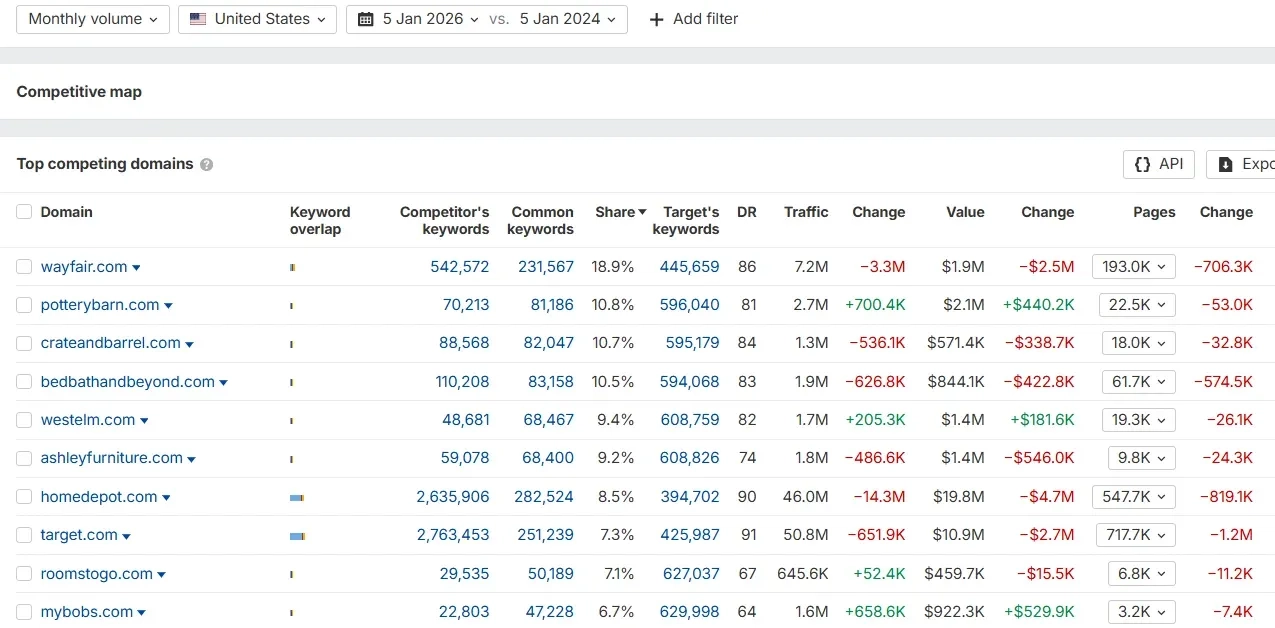
USA competitors (table)
Note: “Value” below is a modeled proxy (not provided in the competitor export). It estimates traffic value using a simple blended CPC-like multiplier to help compare opportunity, not to claim exact revenue.
| Domain | DR | Est. Organic Traffic (USA) | Modeled Value (USA/mo) | Notes |
| amazon.com | 96 | 372,180,165 | $279.1M | Marketplace gravity; dominates long-tail product SERPs |
| target.com | 91 | 50,777,796 | $38.1M | Strong retail SEO + category breadth |
| homedepot.com | 90 | 46,017,997 | $34.5M | Wins in home improvement intent + local |
| wayfair.com | 86 | 7,148,201 | $5.4M | Category SEO + filters + SERP features |
| potterybarn.com | 81 | 2,696,022 | $2.0M | Premium niche strength + style intent |
| westelm.com | 82 | 1,707,766 | $1.3M | Design-led content + category focus |
IKEA USA baseline (from the provided location snapshot): ~12.9M/month organic traffic in the US.
What IKEA does better
- Brand pull + trust at scale (click confidence)
- Omnichannel advantage (stores + services)
- Room ecosystem (inspiration-to-purchase loop)
- “Planning” pathways competitors often lack
Where competitors may be ahead
- Aggressive SERP feature capture (shopping grids, review snippets, “best” lists)
- Content hubs built specifically for comparisons and decision support
- Faster iteration in certain niches (e.g., “best X for small space” clusters)
The Money Pages That Drive Sales (Global Structure)
IKEA’s revenue-driving organic pages generally fall into these buckets:
- Country homepages (entry points for brand + navigation)
- Category pages (PLPs) under /cat/… (commercial + transactional)
- Product pages (PDPs) under /p/… (transactional)
- Room hubs under /rooms/… (inspiration → product lists)
- Planners/tools (high intent; often leads to large baskets)
- Offers/sale pages (deal intent)
- Store locator/store pages (local intent → offline uplift)
- Service/help pages (returns, delivery, credit, assembly; conversion unlockers)
Page type → intent mapping (examples from the top-pages export)
| Page Type | Example URL (from top-pages sample) | Est. Visits/mo | Intent |
| Country homepage | https://www.ikea.com/us/en/ | 3,168,647 | Navigational → Shopping |
| Category (PLP) | https://www.ikea.com/us/en/cat/beds-bm003/ | 149,670 | Commercial/Transactional |
| Room hub | https://www.ikea.com/us/en/rooms/kitchen/ | 98,511 | Inspiration → Commercial |
| Planner/tool | https://www.ikea.com/de/de/planners/kitchen-planner/ | 115,081 | High-intent planning |
| Product (PDP) | https://www.ikea.com/us/en/p/kallax-shelf-unit-white-80275887/ | 63,729 | Transactional |
| Store locator | https://www.ikea.com/us/en/stores/ | 74,952 | Local intent |
| Offers | https://www.ikea.com/us/en/offers/ | 43,708 | Transactional deal-seeking |
What IKEA does well
- PLPs dominate: in the global top-pages sample, category pages are a major slice of high-traffic URLs.
- Rooms act as a bridge: room pages rank strongly in multiple markets and can push users into categories.
- Planners capture high AOV intent: especially kitchens/wardrobes where baskets are big.
What to improve (template + conversion)
- Add stronger intent blocks on PLPs: “best for small spaces”, “delivery by date”, “top picks under $X”
- Improve internal linking density: rooms → categories → best-selling PDPs (and back up the chain)
- Strengthen schema on categories (where feasible) and PDPs (always)
- Control faceted indexation so filters don’t explode crawl budget
Traffic Source Breakdown (Global: Branded vs Non-Branded)
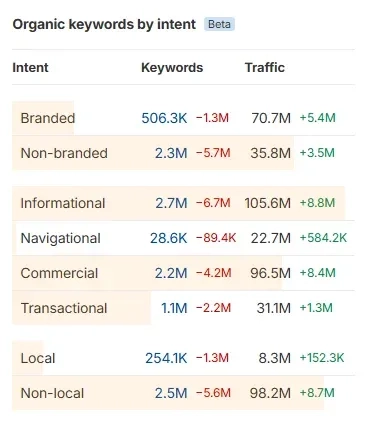
Based on the provided intent snapshot:
| Segment | Keywords | Traffic |
| Branded | 506.3K | 70.7M |
| Non-branded | 2.3M | 35.8M |
What that means strategically
- IKEA’s traffic is brand-heavy (~66%), which is a strength (stability) but also a signal:
- The largest incremental growth typically comes from non-branded category + product intent where competitors can outrank brands via content and SERP features.
Traffic by User Intent (Global)
These intent buckets often overlap (e.g., a branded keyword can also be transactional), but they show where the demand sits.
| Intent | Keywords | Traffic |
| Informational | 2.7M | 105.6M |
| Commercial | 2.2M | 96.5M |
| Transactional | 1.1M | 31.1M |
| Navigational | 28.6K | 22.7M |
| Local | 254.1K | 8.3M |
How each stage supports conversion
- Informational → room guides, planning content, size/how-to pages that link into PLPs
- Commercial → comparison and “best for” intent that should land on curated category experiences
- Transactional → PLPs and PDPs optimized for checkout confidence (delivery, returns, availability)
- Local → store pages + “shop this store” pathways + pickup messaging
CTR- & Intent-Aware Projection Model (USA-only)
Everything in this section is Modeled Example – USA only.
- Inputs used: USA keyword sample export (volume + current position)
- CTR: modeled by rank curve (not claimed as exact)
- CVR + AOV: modeled benchmarks by intent (not IKEA internal data)
Modeled table (USA only)
| Keyword | Search Volume (USA) | Rank | Intent | CTR (modeled) | Clicks (modeled) | CVR (modeled) | Orders/Leads | AOV (USD) | Monthly Value (USD) |
| ikea | 3,650,000 | 1 | Navigational | 0.35 | 1,277,500 | 1.20% | 15,330 | 220 | 3,372,600 |
| ikea desk | 85,000 | 1 | Transactional | 0.294 | 24,990 | 2.30% | 575 | 180 | 103,500 |
| ikea kitchen cabinets | 35,000 | 1 | Transactional | 0.294 | 10,290 | 2.30% | 237 | 1,200 | 284,400 |
| sofa bed | 104,000 | 2 | Transactional | 0.168 | 17,472 | 2.30% | 402 | 450 | 180,900 |
| bed frame | 171,000 | 2 | Transactional | 0.168 | 28,728 | 2.30% | 661 | 300 | 198,300 |
| floating shelves | 147,000 | 2 | Commercial | 0.16 | 23,520 | 1.40% | 329 | 70 | 23,030 |
| storage | 151,000 | 3 | Commercial | 0.11 | 16,610 | 1.40% | 233 | 85 | 19,805 |
| furniture store | 89,000 | 2 | Commercial | 0.16 | 14,240 | 1.40% | 199 | 220 | 43,780 |
| furniture stores near me | 367,000 | 4 | Navigational | 0.1 | 36,700 | 1.20% | 440 | 220 | 96,800 |
| shop laundry basket nearby | 232,000 | 1 | Transactional | 0.294 | 68,208 | 2.30% | 1,569 | 55 | 86,295 |
Roll-Up Summary (USA-only)
From this small modeled keyword set:
- Total clicks (modeled): ~1.52M/month
- Total orders/leads (modeled): ~19,975/month
- Total modeled value: ~$4.41M/month
- Blended AOV: ~$221
The point isn’t that these numbers are “true”—it’s that the mechanism is predictable:
rank + intent + CTR + conversion rate + AOV → revenue model.
Rank-Uplift Opportunity (#3 → #1) (USA-only)
Here’s what “move up the SERP” means in dollars (modeled):
| Keyword | Current Rank | Current Value | Rank 1 Value | Monthly Upside |
| furniture stores near me | 4 | $96.9K | $339.1K | +$242.2K |
| storage | 3 | $19.8K | $50.3K | +$30.5K |
| bed frame | 2 | $198.2K | $346.9K | +$148.7K |
Why this model matters for global retail leaders
- The clusters that “print money” are often not blog posts:
- beds, sofas, storage, desks, wardrobes, cabinets
- “small space” modifiers
- delivery + pickup modifiers
- PLP/PDP improvements beat pure blog traffic because they sit closer to checkout.
- USA learnings can guide global prioritization—but don’t assume the same CVR in every market:
- delivery infrastructure, payment options, competition, and brand maturity vary widely.
Trust Builders: Referring Domains That Move Rankings (Global)
For global retail, links that matter aren’t just “high DR”—they’re links that shift category competitiveness in multiple markets:
- Top-tier media and lifestyle publications (editorial context)
- Home/design blogs with real engagement
- Partnerships (manufacturers, suppliers, collaborations)
- Local store citations and regional directories (market-specific trust)
- Community/influencer coverage (high-quality editorial only)
✔ Why this matters for IKEA-like sites
Because category SERPs (beds/sofas/storage) are brutally competitive, and link equity is often the separator between:
- ranking #4 and ranking #1
- being visible on “best” lists and being ignored
Backlink Quality & Distribution (Global)
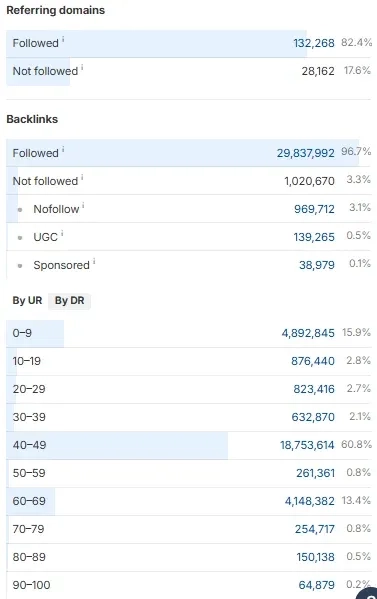
Observed Breakdown
| Metric | Share |
| Dofollow | 96.70% |
| DR 60+ Links | 13.40% |
| DR 40–49 | 60.80% |
Improvement Levers
- Digital PR with data assets
- Seasonal design campaigns
- Market-specific lifestyle partnerships
Backlinks by DR bucket (distribution)
A large share of backlinks in the snapshot sit in the DR 40–49 bucket.
| DR bucket | Backlinks | Share |
| 0–9 | 4,892,845 | 15.90% |
| 10–19 | 876,440 | 2.80% |
| 20–29 | 823,416 | 2.70% |
| 30–39 | 632,870 | 2.10% |
| 40–49 | 18,753,614 | 60.80% |
| 50–59 | 261,361 | 0.80% |
| 60–69 | 4,148,382 | 13.40% |
| 70–79 | 254,717 | 0.80% |
| 80–89 | 150,138 | 0.50% |
| 90–100 | 64,879 | 0.20% |
What looks strong
- Massive volume of followed links + broad referring domain base supports category dominance.
How to improve (even for giants)
- Build market-specific PR assets (seasonal trends, small-space data, sustainability reporting)
- Ship product-led link magnets (planning tools, calculators, interactive guides)
- Expand local partnerships that strengthen store-driven organic conversion
Technical SEO & Localization Wins (Global eCommerce-specific): why IKEA’s international seo strategy scales
This is where IKEA-like sites win or lose long-term.
What’s working
Clear country/language URL patterns
Example: /us/en/, /fr/fr/, /de/de/, /gb/en/—this is the foundation of scalable localization.
Category pages built as stable landing pages
PLPs under /cat/… with consistent IDs tend to be easier to canonicalize and manage.
Room hubs and planners as demand shapers
They capture browsing intent that later converts on PLPs/PDPs.
What to improve (typical high-scale issues)
Indexation control (facets, parameters, variants)
- Decide which filtered combinations deserve indexation (e.g., “sofa bed small space”)
- Canonicalize the rest
- Prevent crawl traps (sort orders, infinite filter combinations)
Core Web Vitals at PLP/PDP level
- PLPs often suffer from heavy scripts, filter UIs, and image loads
- PDPs often suffer from variant switching + review widgets + recommendations
Structured data coverage
- PDP: Product, Offer, Review, Breadcrumbs
- PLP: Breadcrumbs + ItemList where appropriate
- Organization + LocalBusiness/store markup where applicable
- FAQ schema selectively (avoid spam; use where it helps conversion)
Internal linking systemization
Build the “compounding loop”:
- Room hub → best subcategories
- Category → best sellers + top use cases
- PDP → related categories + “complete the room” bundles
AI Citations as a New Moat: extending IKEA’s global seo strategy beyond Google
Shopping discovery is shifting. Users now ask:
- “best sofa for small living room”
- “where to buy affordable storage solutions”
- “best desk for home office setup”
To increase citations in ChatGPT/Gemini/Perplexity-style experiences, IKEA-like brands should ship:
- Structured comparison tables (dimensions, materials, price bands, delivery compatibility)
- Buying guides with clear specs and “best picks” blocks
- FAQ blocks that answer decision questions (delivery, assembly, returns, durability)
- Collections by use-case (“small apartment”, “renter-friendly”, “kids room”, “pet-friendly fabrics”)
The win: citations don’t just drive awareness—they drive high-intent clicks into PLPs and curated “best picks” pages.
Site-Wide Revenue Engine Projection (USA-only funnel, global learnings)
Everything below is USA-only modeled using the provided USA organic traffic baseline (~12.9M/mo).
A practical funnel model (Modeled Example – USA only)
| Funnel stage | Modeled rate | Modeled volume (monthly) |
| Organic visits (USA) | — | 12,900,000 |
| PLP views | 55–65% | 7.1M – 8.4M |
| PDP views | 30–45% | 3.9M – 5.8M |
| Add-to-cart | 5–9% of PDP views | 195K – 522K |
| Checkout starts | 45–60% of ATC | 88K – 313K |
| Purchases | 65–80% of checkout | 57K – 250K |
Modeled revenue impact (USA-only)
If we assume a conservative blended:
- Purchases: ~120K/month (mid-range)
- Blended AOV: $160–$220 (varies by category mix)
That implies a modeled monthly revenue band of roughly:
- $19M – $26M/month (USA-only, modeled)
✔ Why this is useful
Because global leaders can run the same model market-by-market to decide where to prioritize:
- category template upgrades
- planner/tool expansion
- internal linking systems
- store SEO improvements
Practitioner Key Takeaways (Actionable Notes)
If you’re running SEO for a multi-market retail brand, here’s the playbook to steal.
Prioritize page types (where revenue concentrates)
- Top categories (beds, sofas, storage, desks, wardrobes, cabinets)
- Room hubs feeding those categories
- PDPs for hero SKUs + high-link products
- Offers pages for deal intent
- Store locator/store pages for local conversion
PLP template upgrades (high ROI)
Add:
- “Best for” blocks (small space, budget, durability)
- Shipping/pickup clarity above the fold
- Category FAQs (returns, delivery, sizing)
- Strong internal links to: room hubs, buying guides, best-selling PDPs
- Breadcrumb + structured data consistency
PDP upgrades (conversion unlockers
Add/strengthen:
- Reviews distribution + FAQs
- Delivery promise clarity and alternatives (pickup/click & collect)
- “Complete the room” bundles (basket expansion)
- Comparative modules (alternatives, sizes, materials)
Indexation & crawl strategy (global scale survival)
Rules to enforce:
- Canonicals for variant/parameter chaos
- Block crawl traps (infinite combinations)
- Keep only high-intent filtered pages indexable
- Monitor per-market parity (don’t let one market drift into index bloat)
Internal linking playbook (the IKEA-style loop)
- Room hubs → best categories
- Categories → hero subcategories + best sellers
- PDPs → complementary categories + “complete the set”
- Guides → money pages (PLPs/PDPs), not just other guides
Link campaigns that make sense for retail
- Seasonal trend reports (small-space living, back-to-school, renter living)
- Data assets (most searched room styles by city/country)
- Design collaborations + PR
- Local market partnerships around store openings/events
Final Reflection
IKEA’s advantage isn’t one trick—it’s the combination:
Authority + technical control + scalable templates + localization discipline + AI readiness = compounding advantage.
That’s what a real global retail SEO engine looks like
FAQs (International eCommerce SEO)
How should a retailer choose country folders vs subdomains?
For most global retailers, folders make it easier to consolidate authority and manage internal linking at scale—critical for an international SEO strategy that needs compounding effects across markets.
How do you manage hreflang and market parity?
Treat hreflang as the plumbing and parity as the product. If the best PLP template ships in only three markets, your global SEO strategy won’t compound because users and crawlers experience inconsistent value across locales.
How do you control faceted navigation without index bloat?
Decide upfront which filtered combinations deserve indexation based on high intent and real demand. Canonicalize or block the rest to prevent crawl waste while still capturing valuable long-tail clusters.
How do you measure SEO ROI across markets if conversions differ?
Build a market-by-market funnel model: sessions → PLP → PDP → add to cart → checkout → purchase. Apply local CVR and AOV benchmarks where possible, and model ranges where data is limited.
How can global retailers increase AI citations that drive purchases?
Publish decision-support content that’s easy to cite, such as comparison tables, specs, FAQs, best-pick lists, and room-to-product pathways. This strengthens both discovery and conversion loops.
Disclaimer
- This teardown uses provided estimated organic/link footprint visuals and exports.
- Any conversion/revenue figures are modeled examples for illustration.
- All conversion projections are USA-only (per the rule). Global sections are structural/strategic and should not be interpreted as applying identical conversion rates in every market.
- IKEA is not our client.
- Log in to post comments


 INDIA
INDIA