


RankBrain vs Hummingbird: How Google Search Understands You

Table of Contents
- What is the Hummingbird Algorithm?
- What is the RankBrain Algorithm?
- Key Differences: RankBrain vs Hummingbird
- Case Study: RankBrain Optimization in Action
- Conclusion: What This Means for Your SEO
- FAQs
What is the Hummingbird Algorithm?
Hummingbird was introduced by Google in 2013 as a major shift in how search queries were processed. Rather than focusing on individual keywords, it emphasized the meaning behind words and the intent of the user, a concept our Supramind Digital team has deeply worked with for over a decade. With our 15+ years of combined SEO experience, we’ve seen firsthand how semantic search transforms results by understanding user intent rather than just keywords. This made semantic search a reality.
If someone typed “best place to buy running shoes,” Hummingbird helped Google understand that the user was probably looking for local stores or reviews — not just pages that included those exact words.
In our early work with a local fitness retailer, after optimizing their site for intent-driven queries like “where to buy cushioned sneakers near me,” we noticed a 22% jump in organic visibility in 5 weeks.
What is the RankBrain Algorithm?
RankBrain, launched in 2015, is Google’s machine-learning-based enhancement to its algorithm. It doesn’t just process intent — it learns from it.
If RankBrain sees a pattern in what users click and how they behave, it adapts. It’s smart enough to connect unfamiliar phrases with known concepts. So if someone searches "best sleep surface for back pain,” RankBrain might show results about orthopedic mattresses — even if the exact words don’t appear.
In our projects, we've seen RankBrain reward content that’s detailed, helpful, and aligned with natural language. For example, blog content that answers related questions clearly tends to rank higher, especially for long-tail queries.
RankBrain, launched in 2015, is Google’s machine-learning-based enhancement to its algorithm. It doesn’t just process intent — it learns from it.
If RankBrain sees a pattern in what users click and how they behave, it adapts. It’s smart enough to connect unfamiliar phrases with known concepts. So if someone searches "best sleep surface for back pain,” RankBrain might show results about orthopedic mattresses — even if the exact words don’t appear.
In our projects, we've seen RankBrain reward content that’s detailed, helpful, and aligned with natural language. For example, blog content that answers related questions clearly tends to rank higher, especially for long-tail queries.
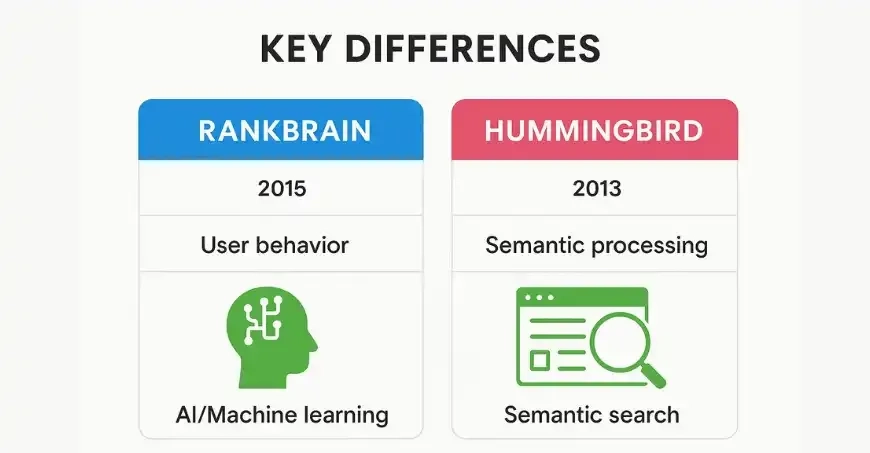
Key Differences: RankBrain vs Hummingbird
Here’s a simple breakdown:
| Aspect | Hummingbird | RankBrain |
| Launch Year | 2013 | 2015 |
| Focus Area | Semantic search, user intent | User behavior, AI learning |
| Technology | Natural language processing | Machine learning + AI |
| Strength | Matches meaning across queries | Learns from user behavior and clicks |
| SEO Impact | Focuses on intent-based content | Focuses on relevance & engagement |
While Hummingbird was about better understanding language, RankBrain is about adapting that understanding over time. It personalizes search in ways Hummingbird couldn’t.
Case Study: RankBrain Optimization in Action
Client: Mid-size eCommerce site in home furnishings
Challenge: Low visibility for new product pages, especially for long-tail and voice search queries.
Strategy:
- Mapped content to customer questions using long-tail phrases
- Introduced FAQ blocks and structured data
- Focused on user satisfaction metrics (CTR, time on page)
Results:
- 47% increase in organic traffic from non-branded queries in 60 days
- Featured snippets earned for 8 high-volume queries
- Bounce rate dropped from 68% to 49%
This campaign proved how RankBrain rewards content that satisfies searcher needs, not just keyword matching.
Conclusion: What This Means for Your SEO
The evolution from Hummingbird to RankBrain shows Google’s shift from keyword matching to true understanding. To rank well:
- Write for people, not bots
- Use natural language
- Answer real questions clearly
- Improve on-page engagement
The more helpful and intuitive your content, the more RankBrain favors it.
FAQs
Q1: What is the RankBrain algorithm in SEO?
It’s Google’s AI system that helps interpret complex or unfamiliar search queries using machine learning.
Q2: Is RankBrain part of Hummingbird?
Yes, RankBrain is considered a component of Hummingbird but adds machine learning for better relevance.
Q3: How do I optimize for RankBrain?
Create content that satisfies search intent, uses natural phrasing, and encourages user engagement.
Q4: What kind of queries does Hummingbird help with?
Long and conversational queries where context matters more than exact keyword matches.
Q5: Can these algorithms impact rankings without on-page SEO?
No. While algorithms understand context better, strong on-page SEO is still essential.
- Log in to post comments


 INDIA
INDIA